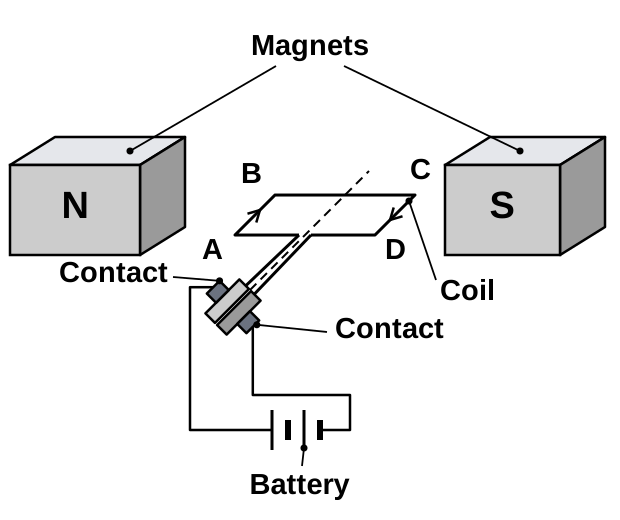
Figure 7 draws the switch open. Once it is closed, current flows along a copper rod resting on two parallel rails, which sit between a north pole above and a south pole below. Figure 7 marks four directions, A to D. Figure 8 shows a basic motor: a coil between two magnets, wired to a battery through two contacts.
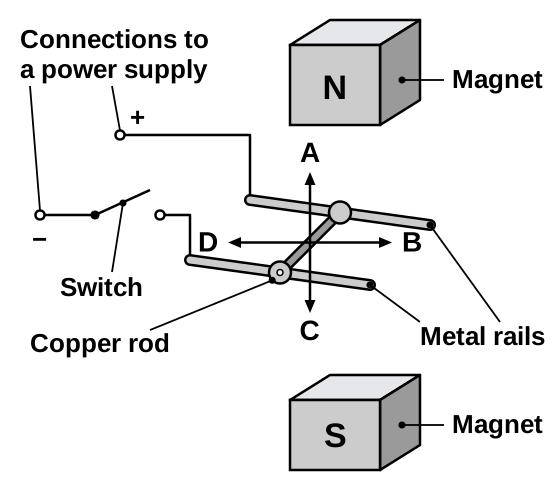
Using the magnet poles and the current direction in Figure 7, pick the arrow, A to D, that shows how the rod accelerates.
Our own questions on this topic, marked straight away, so you see what to revise. Free now.
Show model answer for 07.1Hide model answer for 07.1
B. The field points from the north pole down to the south pole. The current runs from the positive terminal along the rear rail, then across the rod towards the front rail. Fleming's left-hand rule gives a force to the right, along the rails.
Rod mass 5.0 g, length in the field 0.070 m, flux density 0.30 T, current 2.0 A. Calculate its initial acceleration.
See how you would score on The Motor EffectShow model answer for 07.2Hide model answer for 07.2
Use this equation:. F = B × I × l. Put in current 2.0 A, flux density 0.30 T and length 0.070 m:. F = 2.0 × 0.30 × 0.070. = 0.042 N
Change the mass to kilograms:. 5.0 g = 0.0050 kg. Use this equation:. F = m × a. Put in the values:. 0.042 = 0.0050 × a. Rearrange for a:. a = 0.042 over 0.0050. = 8.4 m/s2
How the marks are earned
- One mark: substitute the flux density, current and length into F = B × I × l.
- One mark: the force, 0.042 N.
- One mark: change grams to kilograms and put into F = m × a, so 0.042 = 0.0050 × a.
- One mark: rearrange to a = 0.042 ÷ 0.0050.
- One mark: the final acceleration, 8.4 m/s2. Later marks still follow if the mass was not converted.
Why it scores
Two marks: the substitution into the motor effect equation and its value.
Three marks: the mass conversion with its substitution, the rearrangement and the final value. The unit is not needed for the mark here, but always write it.
Revise The Motor EffectExplain how the magnets' field and the coil's own field keep the coil of Figure 8 turning the same way.
See how you would score on The Motor EffectShow model answer for 07.3Hide model answer for 07.3
The magnetic field of the coil's current interacts with the field of the magnets, giving a force on side AB and a force on side CD. The current in AB is opposite to that in CD, so one force pushes up and the other pushes down, and the coil rotates.
At each half turn the split-ring commutator hands each coil end over to the other contact, so the current direction around the coil flips. The force on each side then points the other way, which keeps the turning effect in one direction and the coil spinning.
How the marks are earned
- One mark: the two magnetic fields interact and give forces on the sides AB and CD of the coil. An answer about a generator earns nothing.
- One mark: the current in AB is opposite to that in CD, so the forces on them point in opposite directions and turn the coil.
- One mark: every half turn, each end of the coil moves to the opposite contact. Saying the split-ring commutator makes this swap each half turn earns the mark; naming it alone does not.
- One mark: the current through each side flips, so each force flips too, and the turning carries on the same way.
Why it scores
Two marks: forces from the interacting fields, and the opposite forces on opposite sides that give a turning effect.
Without the swap, the forces would pull the coil back and it would stop. Two marks: the commutator swap, and the reversed current and forces.
Revise The Motor EffectThe coil in Figure 8 lies flat. Explain why no turning effect acts on it when it stands upright.
See how you would score on The Motor EffectShow model answer for 07.4Hide model answer for 07.4
Upright, the gaps in the split ring meet the contacts, so no current flows in the coil. With no current there is no magnetic force on the coil, so there is no moment.
How the marks are earned
- One mark: no current flows in the coil.
- One mark: so no magnetic force acts, and so there is no moment. This mark depends on the first.
Why it scores
The first mark is the loss of current and the second is the consequence. The second mark depends on the first.
Revise The Motor Effect