A transformer has an iron core with a primary (input) coil and a secondary (output) coil, shown in Figure 11.
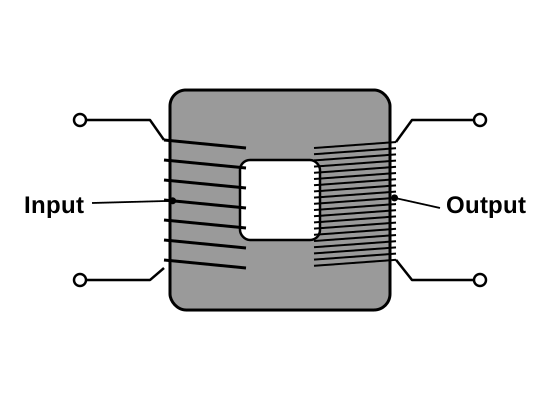
Give the reason an iron core is used in the transformer.
Our own questions on this topic, marked straight away, so you see what to revise. Free now.
Show model answer for 09.1Hide model answer for 09.1
Iron is magnetically soft: it is magnetised easily and loses its magnetism easily. So it carries the alternating magnetic field from the primary coil to the secondary coil.
How the marks are earned
- Iron is magnetically soft, so it gains and loses magnetism readily. Saying just magnetic, or a good conductor, earns no mark.
Primary coil: 345 turns. Secondary coil: 6000 turns and 400 kV across it. Find the primary potential difference in volts.
See how you would score on National Grid & TransformersShow model answer for 09.2Hide model answer for 09.2
400 kV = 400 000 V.
The potential differences are in the same ratio as the turns:. Vp over 400 000 = 345 over 6000. Rearrange for Vp:. Vp = 345 over 6000 × 400 000. = 23 000 V
How the marks are earned
- One mark: change kilovolts to volts, 400 kV = 400 000 V.
- One mark: put the values into Vp ÷ Vs = Np ÷ Ns, so Vp ÷ 400 000 = 345 ÷ 6000.
- One mark: rearrange to Vp = 400 000 × 345 ÷ 6000.
- One mark: the final potential difference, 23 000 V. Later marks still follow if the secondary potential difference was not converted.
Why it scores
The answer is asked for in volts, so convert first. Missing this loses only this mark.
The substitution, the rearranged form and the evaluated answer each earn a mark. The primary has fewer turns, so its potential difference is smaller. That matches the answer.
Revise National Grid & TransformersAlternating current runs through the primary. Explain how this gives the secondary coil an alternating potential difference.
See how you would score on National Grid & TransformersShow model answer for 09.3Hide model answer for 09.3
Current that keeps reversing in the primary builds a field that keeps changing, and the iron core guides that field through the secondary coil.
The secondary coil is in this changing field, so its turns cut through the field lines. That induces a potential difference across its ends. The field keeps reversing, so the induced potential difference also alternates.
How the marks are earned
- One mark: the core carries a magnetic field that keeps changing, created by the a.c. in the primary.
- One mark: the secondary coil lies in this changing field, so its wire cuts through the field lines.
- One mark: this induces a potential difference between the two terminals of the secondary.
Why it scores
A changing field in the core is the first mark. A steady current would make a steady field and no induction.
Cutting the field earns the second mark and the induced potential difference earns the third. The reversing field is why the output alternates.
Revise National Grid & Transformers