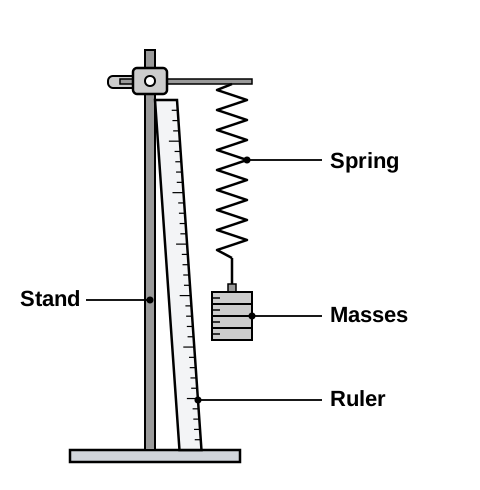
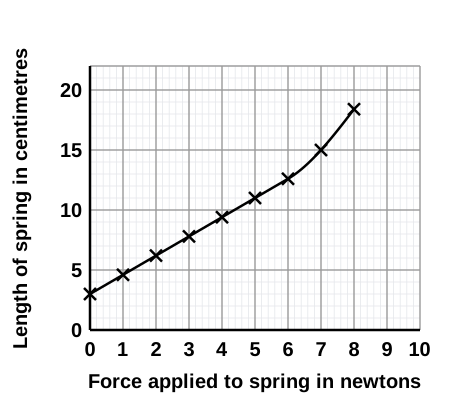
A student hangs masses from a spring on a stand and measures the spring's length with a ruler. Figure 1 shows the rig, with the ruler held by hand beside the spring (the hand is not drawn). Figure 2 plots the spring's length against the force from the masses.
Name the independent variable the student changes in this practical.
Our own questions on this topic, marked straight away, so you see what to revise. Free now.
Show model answer for 02.1Hide model answer for 02.1
The pull on the spring, supplied by the masses' weight, is what the student chooses to vary.
How the marks are earned
- The force on the spring, which is the weight of the hanging masses. Saying the mass hung on the spring is also accepted.
Describe one way someone could be hurt in this set-up, and one precaution that makes it less likely.
See how you would score on Forces & Their EffectsShow model answer for 02.2Hide model answer for 02.2
A heavy stack of masses could tip the stand over and hit the student. Clamping the base of the stand to the bench stops it tipping.
How the marks are earned
- One mark: a named harm from the set-up, such as the stand tipping over onto the student, masses dropping on a foot, or the spring snapping.
- One mark: a precaution that matches that harm, such as clamping the stand's base to the bench, keeping the masses small in number, standing up so the student can move away quickly, or wearing eye protection against a snapping spring.
Why it scores
The precaution must answer the risk named. A snapping spring would be matched by goggles instead.
Revise Forces & Their EffectsGive two changes to how the spring's length is read that would make the readings more accurate.
See how you would score on Forces & Their EffectsShow model answer for 02.3Hide model answer for 02.3
Clamp the ruler upright right beside the spring, and fix a pointer to the bottom of the spring so the reading is taken at one clear point.
How the marks are earned
- Any two, one mark each: hold the ruler upright; fix the ruler in a clamp next to the spring; fix a pointer to the bottom of the spring to read against the scale; use a ruler with finer divisions.
Why it scores
A tilted, hand-held ruler away from the spring gives readings that wander. Fixing it upright and close, and marking the spring's end, removes that error. A finer ruler would also help.
Revise Forces & Their EffectsThe line in Figure 2 meets the length axis at 3.0 cm, not at zero. Give the reason it misses the origin.
See how you would score on Forces & Their EffectsShow model answer for 02.4Hide model answer for 02.4
With no force on it the spring is already about 3.0 cm long. The graph shows length, not extension, so the line cannot start at zero.
How the marks are earned
- The spring already has a length with no force on it, so its length is not zero. Equivalent: length, not extension, was plotted.
After 6.0 N each extra newton stretches this spring more than before. Explain the cause.
See how you would score on Forces & Their EffectsShow model answer for 02.5Hide model answer for 02.5
Past 6.0 N the spring is overstretched and does not return to its original length (inelastic). Extension stops being in proportion to force, so each extra newton adds more length than the last.
How the marks are earned
- One mark: the spring has been stretched past what it can recover from, so it is permanently deformed (inelastic).
- One mark: so extension is no longer in proportion to force. Saying it has passed its limit of proportionality, or no longer follows Hooke's law, also earns this.
Why it scores
The first idea is the physical change in the spring. The second is its effect on the graph, which is the loss of proportionality.
Revise Forces & Their EffectsWhich relation links force F, spring constant k and extension e? Tick one box.
See how you would score on Forces & Their EffectsShow model answer for 02.6Hide model answer for 02.6
F = k × e. Force is spring constant multiplied by extension.
How the marks are earned
- Tick the relation where force is spring constant multiplied by extension.
A 4.0 N pull extends the spring by 0.064 m. Work out k, the spring constant, in N/m.
See how you would score on Forces & Their EffectsShow model answer for 02.7Hide model answer for 02.7
Start from this equation:. F = k × e. Put in the values:. 4.0 = k × 0.064
Rearrange for k:. k = 4.0 over 0.064. = 62.5 N/m
How the marks are earned
- One mark: put the force and the extension into F = k × e.
- One mark: rearrange to k = F ÷ e.
- One mark: the final value, 62.5, with 63 also accepted. The unit, newtons per metre, is not needed for the mark here, but always write it.
Why it scores
Both real values in the equation earn the first mark. The extension is already in metres, so no conversion is needed.
The rearranged form earns the second mark and the division gives the last. Check against Figure 2: at 4.0 N the length is 9.4 cm, so the extension is 9.4 − 3.0 = 6.4 cm = 0.064 m.
Revise Forces & Their Effects