A record-attempt skydiver starts a fall from 40 km up. Figure 6 begins a free-body diagram for a moment soon after the jump.
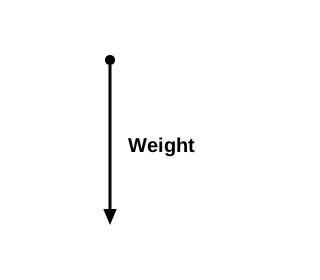
Figure 6 shows only the weight of a skydiver still speeding up. Add the second force: arrow and label.
Our own questions on this topic, marked straight away, so you see what to revise. Free now.
Show model answer for 05.1Hide model answer for 05.1
Draw one arrow upwards from the dot, shorter than the weight arrow, and label it air resistance (drag).
How the marks are earned
- One mark: one arrow from the dot, pointing straight up, drawn shorter than the weight arrow.
- One mark: the arrow labelled air resistance. Drag is also accepted.
Why it scores
The skydiver is still accelerating downwards, so the resultant force is downwards. That means the upward force must be smaller than the weight.
Revise Forces & Their EffectsThe skydiver starts from rest with a mean acceleration of 0.64 m/s2 for 2.5 minutes. Calculate the velocity reached.
See how you would score on Newton's Laws of MotionShow model answer for 05.2Hide model answer for 05.2
2.5 minutes = 2.5 × 60. = 150 s
Use this equation:. acceleration = fraction: change in velocity over time, end of fraction. Put in the values:. 0.64 = fraction: v − 0 over 150, end of fraction. Rearrange for v:. v = 0.64 × 150. = 96 m/s
How the marks are earned
- One mark: change minutes to seconds, 2.5 minutes = 150 s.
- One mark: put the values into acceleration = change in velocity ÷ time.
- One mark: rearrange to find the velocity, v = 0.64 × 150.
- One mark: the final velocity, 96. Later marks still follow if the time was not converted.
Why it scores
Acceleration in m/s2 needs the time in seconds. Missing this loses only this mark.
The initial velocity is zero, so the change in velocity is just v. The substitution, rearrangement and answer each earn a mark.
Revise Newton's Laws of MotionExplain why the speed of a falling skydiver stops increasing and becomes constant.
See how you would score on Terminal VelocityShow model answer for 05.3Hide model answer for 05.3
At the start only weight acts. As the skydiver speeds up, the air resistance grows. This goes on until the air resistance is equal to the weight, pointing the opposite way.
The two forces then cancel, so the resultant force is zero. With no resultant force there is no acceleration, so the skydiver keeps a constant velocity: terminal velocity.
How the marks are earned
- One mark: as the skydiver's speed rises, air resistance rises.
- One mark: this continues until the air resistance equals the weight, acting in the opposite direction.
- One mark: so the resultant force is zero.
- One mark: so the acceleration is zero, and the velocity stays constant.
Why it scores
Two marks: air resistance rising with speed, then reaching the same size as the weight.
Two further marks: zero resultant force, then zero acceleration and constant velocity. Each step must follow from the one before.
Revise Terminal VelocityExplain why the air pressure on the skydiver grows as the fall continues.
See how you would score on PressureShow model answer for 05.4Hide model answer for 05.4
The lower the skydiver falls, the more air there is above, and that air has more weight pressing down. Pressure is force divided by area, so the pressure on the skydiver increases.
How the marks are earned
- One mark: as the skydiver falls, more air lies above, so the weight of the air above rises. Saying the mass or number of air particles above rises also earns this.
- One mark: pressure is force divided by area, so the pressure is greater.
- Alternative route, 2 marks: the air around the skydiver gets denser as the fall goes on (1), so air particles strike the skydiver more often and the pressure rises (1).
Why it scores
The first mark is for the growing weight of air above. The second links that force to pressure through p = F ÷ A.
Revise PressureForces on the skydiver: 240 N up, 200 N left. Draw a scaled vector diagram and find the resultant's size and angle to vertical.
See how you would score on Forces & Their EffectsShow model answer for 05.5Hide model answer for 05.5
Choose a scale, such as 1 cm for 40 N. Draw a line 6.0 cm long upwards for 240 N. From its tip draw a line 5.0 cm long to the left for 200 N. The arrow from the start to the end is the resultant.
The resultant measures about 7.8 cm, so it is about 312 N. Its angle to the vertical is about 40 degrees, towards the left.
How the marks are earned
- One mark: a scale drawing of a triangle or parallelogram, with the 240 N side clearly longer than the 200 N side.
- One mark: the resultant drawn in the right direction, up and to the left.
- One mark: the size of the resultant, anywhere from 300 N to 320 N.
- One mark: the angle to the vertical, anywhere from 38 degrees to 42 degrees.
Why it scores
A scale that makes the diagram large keeps the measurement accurate. The two forces must join tip to tail, with the vertical one longer.
A calculation checks the measurement: the square root of (2402 + 2002) is 312 N, and the angle whose tangent is 200 ÷ 240 is 39.8 degrees.
Revise Forces & Their Effects