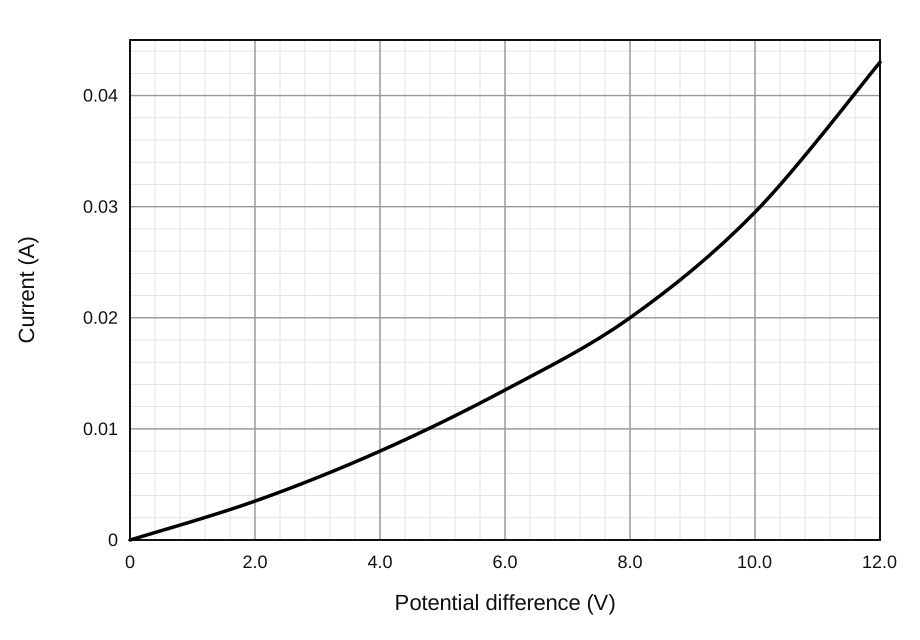
A student studies how the current in a thermistor depends on the potential difference across it. Figure 7 shows the circuit built so far, with no meters in it. Figure 8 shows the student's readings plotted as a graph.
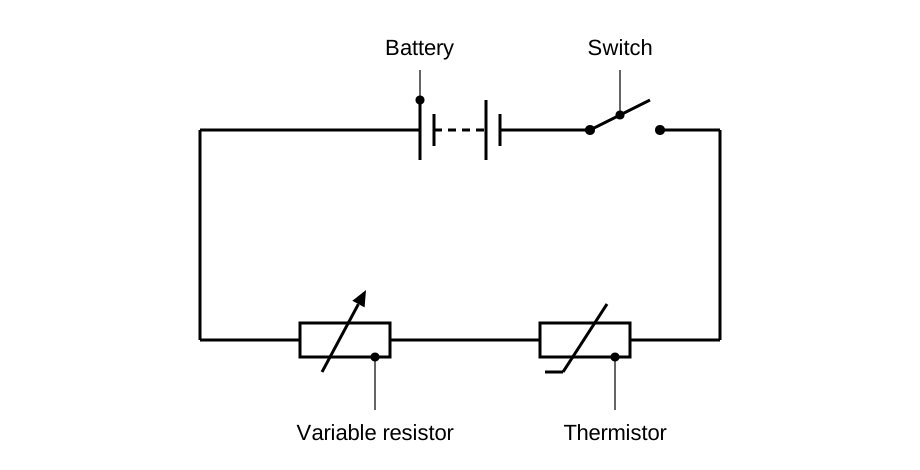
(a)(i) Sketch the two meters needed on Figure 7: one to measure the thermistor's current, one for its p.d.
Our own questions on this topic, marked straight away, so you see what to revise. Free now.
Show model answer for 16.1Hide model answer for 16.1
The drawing must show a circle marked A set into the main loop, for example in the wire between the variable resistor and the thermistor, with the loop passing through it. It must also show a circle marked V joined by two extra wires, one to each end of the thermistor, so the voltmeter sits on a side branch around the thermistor.
How the marks are earned
- One mark: each meter has its proper symbol, a circle holding A for the ammeter and a circle holding V for the voltmeter. Their position does not matter for this mark.
- One mark: the ammeter sits in the single loop, inserted into any wire, so the thermistor's current runs through it as well (series).
- One mark: the voltmeter is connected in parallel, with one wire from each side of the thermistor. It may also span the ammeter as well as the thermistor, but it must not be across the battery, the variable resistor or the switch.
Why it scores
An ammeter measures the current that flows through it, so it goes in series. A voltmeter measures the potential difference between two points, so it goes in parallel with the component being tested. The thermistor is the part under investigation, so the voltmeter goes across only that.
Revise Series & Parallel Circuits(a)(ii) Choose the reason the student includes a variable resistor in this circuit. Tick one box.
See how you would score on Resistance & Ohm's LawShow model answer for 16.2Hide model answer for 16.2
The first box. Changing the variable resistor changes the total resistance of the circuit, so the current changes, and the thermistor then takes a different potential difference. The battery's own potential difference stays the same.
How the marks are earned
- Tick the box about current: the resistor's job is to vary how much current flows round the loop.
(a)(iii) Give the reason for opening the switch between each pair of readings.
See how you would score on I-V CharacteristicsShow model answer for 16.3Hide model answer for 16.3
A current heats the components. The resistance of a thermistor changes with temperature, so a warming thermistor would spoil the results. Switching off between readings lets everything stay at room temperature, so each reading is accurate.
How the marks are earned
- The components, especially the thermistor, would otherwise warm up, so switching off keeps them at room temperature. Saying it gives more accurate readings is also accepted. Saying it saves energy earns nothing.
(b)(i) Describe how the current changes as the potential difference rises along the curve in Figure 8.
See how you would score on I-V CharacteristicsShow model answer for 16.4Hide model answer for 16.4
Raising the p.d. across the thermistor drives more current through it. The curve steepens along its length, so each extra volt adds more current than the one before. It bends upward instead of being straight.
How the marks are earned
- One mark: the current goes up as the potential difference goes up (or comes down as it comes down). The symbols V and p.d., or the word voltage, are fine in place of the full name; so is the symbol A or I for the current. Using the coulomb's symbol for current is not accepted.
- One mark: it rises at a faster rate, so the line gets steeper as the potential difference increases. Saying the graph is non-linear or curved also earns this mark. Saying only proportional, directly proportional or inversely proportional earns nothing.
- Other way round, worth both marks: raising the current makes the potential difference grow more slowly.
Why it scores
One mark is for the direction of the trend. The second is for describing the shape: a steepening curve means the current rises faster than the potential difference does, which is why the line is not straight.
Revise I-V Characteristics(b)(ii) Does the thermistor's resistance go up or down when the p.d. across it is raised? Use Figure 8.
See how you would score on I-V CharacteristicsShow model answer for 16.5Hide model answer for 16.5
It decreases. Resistance is potential difference divided by current. On Figure 8 the current grows faster than the potential difference, so the ratio falls. A larger current also warms the thermistor, and a warm thermistor has lower resistance.
How the marks are earned
- The resistance decreases, which is why the current rises faster than the potential difference.
(b)(iii) Use Figure 8 to find how much current flows through the thermistor at 8.0 V.
See how you would score on I-V CharacteristicsShow model answer for 16.6Hide model answer for 16.6
Go up from 8.0 V on the horizontal axis to the curve, then across to the current axis. The current is 0.02 A.
(b)(iv) Find the thermistor's resistance when the p.d. across it is 8.0 V, using your current reading from Figure 8.
See how you would score on Resistance & Ohm's LawShow model answer for 16.7Hide model answer for 16.7
Potential difference = current × resistance. resistance = fraction: potential difference over current, end of fraction
Put in the numbers:. resistance = fraction: 8.0 V over 0.02 A, end of fraction
Resistance = 400 Ω.
How the marks are earned
- One mark: use potential difference = current × resistance, in the form resistance = potential difference ÷ current.
- One mark: substitute the values: 8.0 ÷ 0.02. Putting them into the unrearranged equation, 8.0 = 0.02 × resistance, also earns this mark. The rearranging and substituting can come in either order.
- One mark: the answer 400. The unit, ohms, is printed on the answer line and is not needed for this mark. A wrong current from the earlier part, carried forward correctly, still earns this mark.
- The correct answer, 400 Ω, on the answer line earns full marks.
Why it scores
This earns the equation mark, for resistance = potential difference ÷ current. You can also put the numbers into potential difference = current × resistance first and rearrange after, because the order does not matter.
Substituting the value you read from Figure 8 earns the second mark. If your reading was slightly different, your own value is used.
The last mark is for the answer, 400. The unit is printed on the answer line and is not needed for the mark. The right answer alone, with no working, earns all 3 marks.
Revise Resistance & Ohm's Law