The topic here is levers. Figure 6 shows a loaded wheelbarrow. The wheel's axle is the pivot, and the load's weight acts between the handles and the wheel.
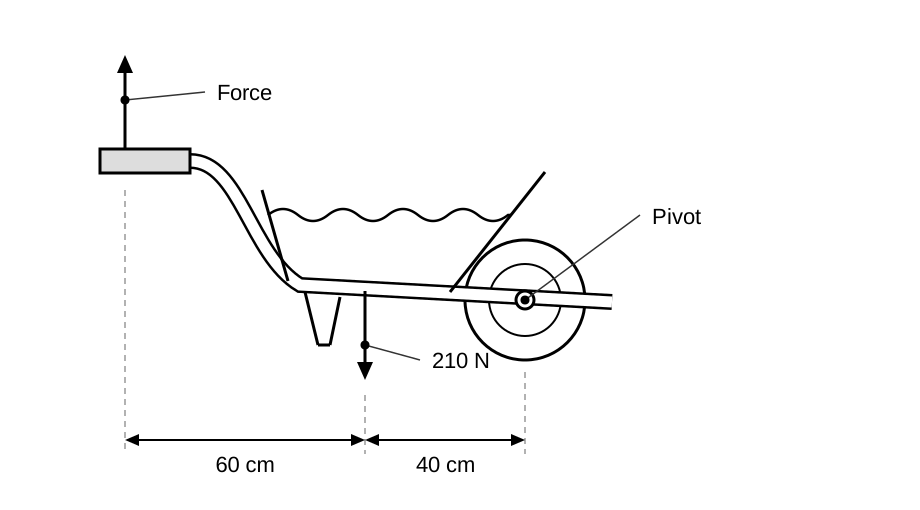
Using Figure 6, find the smallest upward force needed at the handles to lift the 210 N load, in N.
Our own questions on this topic, marked straight away, so you see what to revise. Free now.
Show model answerHide model answer
At the point of lifting, the turning effects about the pivot balance: force × distance on one side equals force × distance on the other. The load is 40 cm from the pivot. The handle force is this far from the pivot:. 60 + 40 = 100 cm. force × 100 = 210 × 40. Rearrange for the force:. force = fraction: 210 × 40 over 100, end of fraction. = 8400 over 100. = 84 N. That is the first option. 126 N uses 60 cm as the load's distance. 140 N divides by 60 cm instead of 100 cm. 210 N assumes the gardener holds the whole load, but the wheel takes much of the weight, so a much smaller force is enough.
How the marks are earned
- Choose 84 N: take moments about the pivot, with the load 0.40 m from it and the handle force 1.00 m from it, so force × 1.00 = 210 × 0.40.
- The right option alone earns the mark with no working needed. One answer only: two answers earn nothing, and a circled or underlined right option counts if the box is blank.