The topic here is the LDR. Figure 4 shows a battery with a fixed p.d. across two parallel branches, one holding a lamp and one holding an LDR. Point P is on the lamp branch and point Q is on the LDR branch.
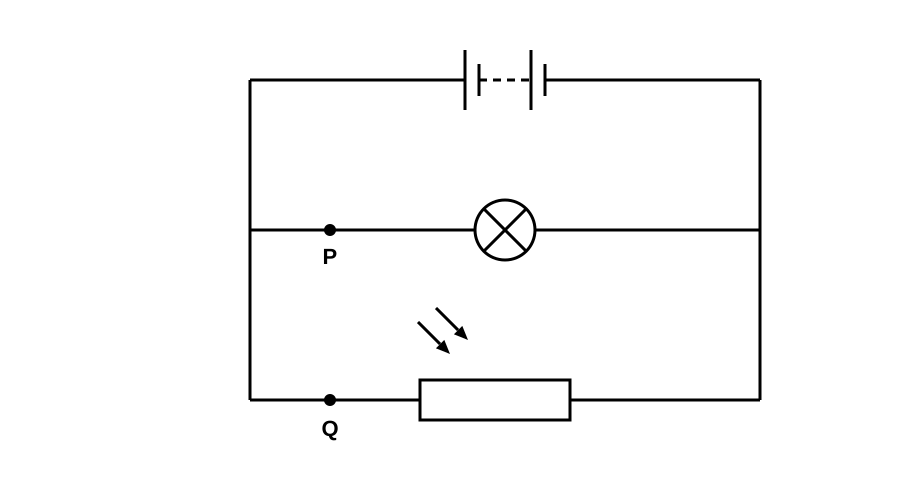
More light now falls on the LDR. Choose the row showing how the currents at P and at Q respond.
Our own questions on this topic, marked straight away, so you see what to revise. Free now.
Show model answerHide model answer
Each parallel branch gets the full p.d. of the battery, which is fixed. The lamp's resistance does not change, so the current at P stays the same, and a change in the other branch cannot alter it. In brighter light the LDR's resistance falls, and with the same p.d. across it, this equation gives more current at Q:. current = p.d. over resistance. That is the third option. The first option wrongly links the two branches. The second has the LDR's behaviour backwards. The fourth forgets that the LDR's resistance changes with light.
How the marks are earned
- Choose P stays the same and Q increases: the LDR's resistance falls in brighter light, and with the same p.d. across it, more current flows in its branch.
- One answer only: two answers earn nothing, and a circled or underlined right option counts if the box is blank.