Figure 16 gives the mass and age of four stars. Stars shine because of nuclear fusion, and the Big Bang theory describes how the Universe began.
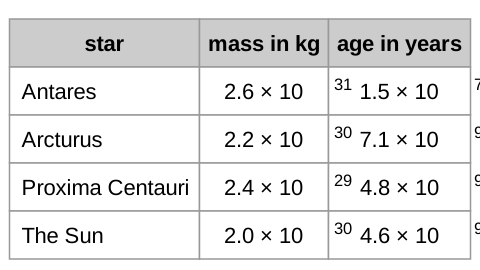
(a)(i) From Figure 16, name the star most likely to end its life as a black hole.
Our own questions on this topic, marked straight away, so you see what to revise. Free now.
Show model answer for 10.1Hide model answer for 10.1
Antares. It is by far the most massive star in the table.
(a)(ii) Give a reason from Figure 16 for your choice of star.
See how you would score on Life Cycle of StarsShow model answer for 10.2Hide model answer for 10.2
Antares has the largest mass in the table, 2.6 × 1031 kg, which is more than ten times the Sun's mass. Only a very massive star ends as a black hole.
How the marks are earned
- It has the greatest mass in the table, far more than the Sun. Saying it is much heavier than the Sun is accepted. Biggest on its own, or its age, earns nothing.
(b)(i) Describe what nuclear fusion is.
See how you would score on Nuclear Fission & FusionShow model answer for 10.3Hide model answer for 10.3
Fusion is when two small nuclei join together to form one larger nucleus, as when hydrogen nuclei fuse into helium nuclei in the Sun.
How the marks are earned
- One mark: small nuclei join together (fuse or combine). Atoms or particles in place of nuclei earn nothing.
- One mark: to make a larger nucleus. Hydrogen nuclei joining to form helium nuclei is accepted as an example.
Why it scores
One mark is for the nuclei joining and the other is for the larger nucleus that results. Some mass turns into energy in the process.
Revise Nuclear Fission & Fusion(b)(ii) The Sun radiates 3.9 × 1026 J each second. With c = 3.0 × 10⁸ m/s, find the mass this equals, with unit.
See how you would score on Nuclear Fission & FusionShow model answer for 10.4Hide model answer for 10.4
Start with the equation:. E = m × c2. Rearrange for the mass:. m = E over c2. = fraction: 3.9 × 1026 over (3.0 × 10⁸)2, end of fraction. = fraction: 3.9 × 1026 over 9.0 × 10¹⁶, end of fraction
m = 4.3 × 10⁹ kg.
How the marks are earned
- One mark: rearrange E = m × c2 to m = E ÷ c2, giving m = 3.9 × 1026 ÷ (3.0 × 10⁸)2.
- One mark: the mass lost with its unit, 4.3 × 10⁹ kg, or anything rounding to it, for instance 4.333 × 10⁹ kg. Leaving off the unit, or giving an incorrect one, gives just one mark in all.
- The right final answer, with its unit, on its own earns full marks.
Why it scores
The rearranged form with the values in earns the first mark. The speed of light is squared before dividing.
The second mark needs the unit as well as the value. The Sun loses roughly four million tonnes of mass every second.
Revise Nuclear Fission & Fusion(c) Choose two observations that back the Big Bang model of the Universe, and say how each one backs it.
See how you would score on Red Shift & Big BangShow model answer for 10.5Hide model answer for 10.5
Red-shift is one piece of evidence. Light from distant galaxies arrives with a longer wavelength, shifted towards the red end of the spectrum. This means the galaxies are moving away from us. The further away a galaxy is, the bigger its red-shift, so the faster it is receding.
Red-shift shows the whole Universe is expanding, so everything was once much closer together. That fits the Big Bang theory, in which space started out tiny, hot and dense and has been expanding ever since.
The second piece is the cosmic microwave background radiation: microwaves arriving from all over the sky. They are a relic of the early, very hot Universe, stretched and cooled as space grew. This backs the idea of a definite beginning.
How the marks are earned
- This is level marked. Read it from the weakest answer up. For 1 to 2 marks, a student only names two items from this list: a claim of the theory, red-shift, the cosmic microwave background radiation. For 3 to 4 marks, one piece of evidence is named and either described, meaning what is observed, or tied to the claim it backs, and the other piece is named. For 5 to 6 marks, one piece of evidence is named, described and tied to the claim it backs, and the other piece is named too.
- Red-shift described: light from distant galaxies has a longer wavelength, or a lower frequency, than it started with.
- Red-shift as support: the shift means the galaxies are moving away from us and from each other; a bigger shift means faster motion; more distant galaxies show a bigger shift; so the Universe is expanding.
- Cosmic microwave background radiation described: microwave radiation detected coming from every direction in space.
- Cosmic microwave background radiation as support: it is a relic of the Universe's earliest time, it points to cooling since then, and it shows there was a definite beginning.
Why it scores
This identifies the evidence, describes it, and links it to the theory in a chain. The pattern of distance and speed is what points to expansion.
Linking the evidence to the theory's central claim turns a description into an explanation. It is the step that reaches the top level.
Identifying a second, separate piece of evidence is needed for the top level, and adding what it shows earns further credit.
Revise Red Shift & Big Bang