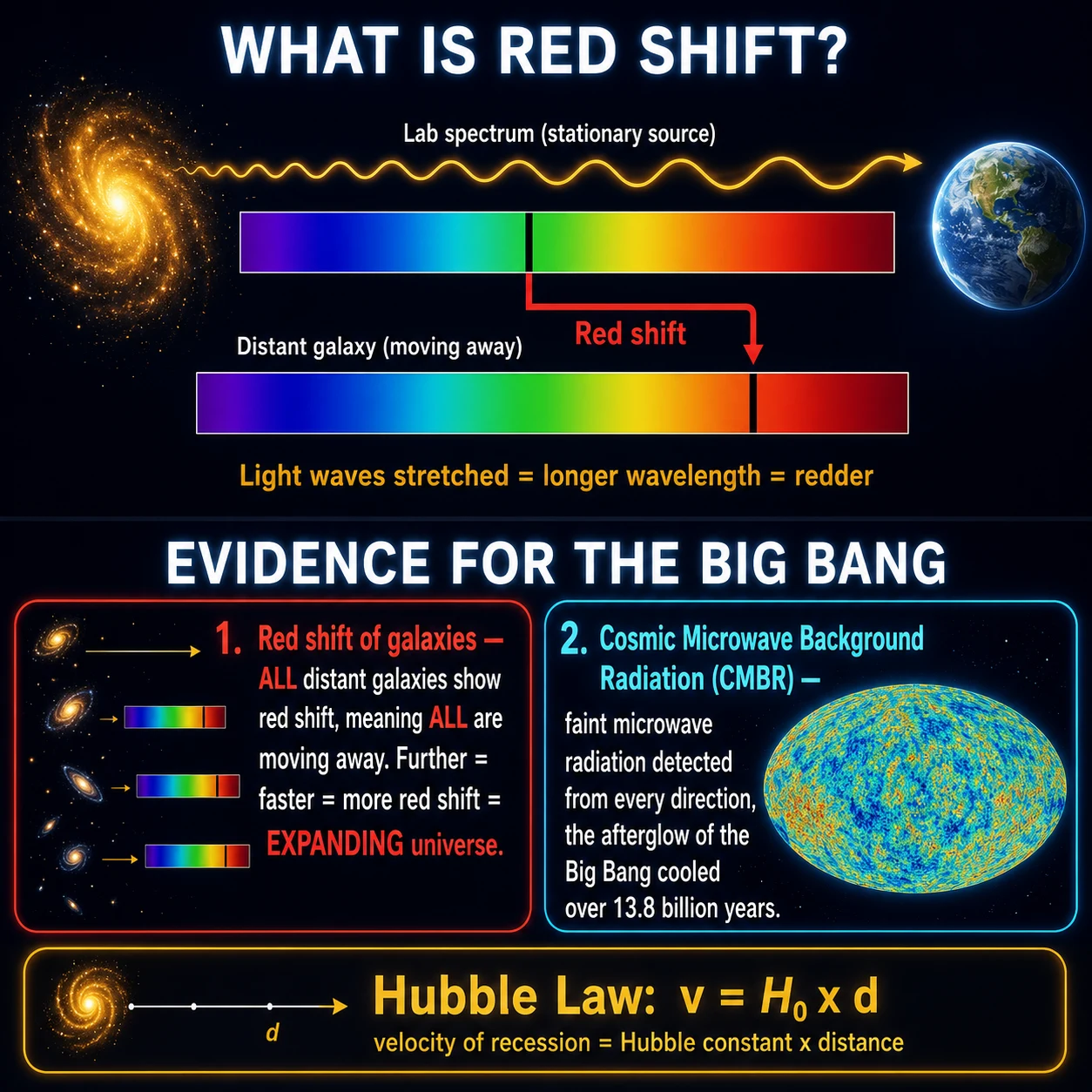
Figure 1: The Doppler effect for light — a source moving away produces red shift (longer wavelengths), a source moving towards you produces blue shift (shorter wavelengths)
Red shift is the light equivalent of the Doppler effect — the change in observed frequency or wavelength of a wave when the source and observer are moving relative to each other.
How Red Shift Works
When a galaxy moves away from us, the light waves it emits are stretched as they travel through space — their wavelength increases. Longer wavelengths in the visible spectrum appear red, so this stretching is called red shift.
When a galaxy moves towards us, light waves are compressed — their wavelength decreases. Shorter wavelengths appear blue, so this is called blue shift (only observed in galaxies very close to us, like the Andromeda Galaxy, which is heading towards the Milky Way).
How We Detect Red Shift
Scientists detect red shift by analysing the absorption spectrum of starlight. Every element absorbs specific wavelengths of light, creating dark lines at known positions in the spectrum. When a galaxy is red-shifted, all these lines are shifted towards the red (longer wavelength) end of the spectrum by the same proportion. By measuring how far the lines have shifted, scientists can calculate the galaxy's velocity.
This deep dive covers Red Shift — Light from a Moving Source within Red Shift & Big Bang for GCSE Physics. Revise Red Shift & Big Bang in Space Physics for GCSE Physics with 13 exam-style questions and 12 flashcards. This topic appears regularly enough that it should still be part of a steady revision cycle. It is section 2 of 14 in this topic. Use this deep dive to connect the idea to the wider topic before moving on to questions and flashcards.
Practice questions for Red Shift & Big Bang
What is the orbital period of a geostationary satellite?
Explain why a geostationary satellite stays above the same point on Earth's surface.