Glass slows light and bends its path as it enters. For an experiment on this, a student can use a ray box, which gives one thin beam, and a rectangular block of glass. Figure 9 lists wavelength and frequency for red, yellow and blue light, measured in air and again in glass.
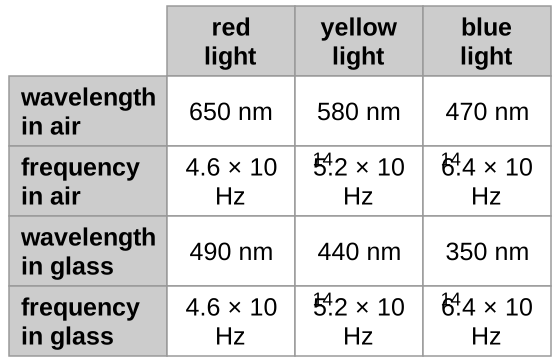
(a) Describe a method with a ray box and glass block to trace a ray bending in the glass. A labelled sketch may help.
Our own questions on this topic, marked straight away, so you see what to revise. Free now.
Show model answer for 05.1Hide model answer for 05.1
Lay the glass block on a sheet of paper and draw round its outline. Switch on the ray box and aim its narrow ray at one face of the block.
Mark a cross where the ray enters the block and another where it leaves. Remove the block and join the two crosses with a ruler. That line is the refracted ray inside the glass.
How the marks are earned
- Any four, one mark each: set the block on a sheet of paper and trace its outline; point the ray box so its beam strikes the block (a labelled sketch of block and ray box also earns this); put a cross at the spot where the beam goes in, or along the incoming beam; put a cross at the spot where it comes out, or along the outgoing beam; draw a straight line between the two crosses.
- If neither the entry nor the exit is marked, simply drawing the light rays earns one mark.
Why it scores
Drawing round the block fixes where the glass sits, and aiming the ray at it starts the refraction. These earn two marks.
The entry mark, the exit mark and the joining line each earn a mark, and only four are available in all.
Revise Reflection & Refraction(b)(i) Use Figure 9 to say how wavelength changes when light passes from glass into air.
See how you would score on Reflection & RefractionShow model answer for 05.2Hide model answer for 05.2
The wavelength increases. Each colour has a longer wavelength in air than in glass, for example blue light goes from 350 nm to 470 nm.
How the marks are earned
- It gets longer, for example blue light goes from 350 nm to 470 nm. Quoting the values is accepted, and so is saying it gets shorter going from air into glass.
(b)(ii) Use Figure 9 to say how frequency changes when light passes from glass into air.
See how you would score on Reflection & RefractionShow model answer for 05.3Hide model answer for 05.3
The frequency stays the same. Each colour has an identical frequency in air and in glass, for example blue light is 6.4 × 10¹⁴ Hz in both.
How the marks are earned
- It does not change. It stays the same, and quoting the matching values is accepted.
(b)(iii) Blue light moves at 3.0 × 10⁸ m/s in air. Using Figure 9, find the change in its speed in glass.
See how you would score on Wave PropertiesShow model answer for 05.4Hide model answer for 05.4
Change nanometres to metres:. 350 nm = 350 × 10-9 m. Use the wave speed equation for blue light in glass:. v = f × λ. v = 6.4 × 1014 × 350 × 10-9. = 2.24 × 10⁸ m/s
change in speed = 3.0 × 10⁸ − 2.24 × 10⁸. = 7.6 × 10⁷ m/s. So the light slows by about 7.6 × 10⁷ m/s.
How the marks are earned
- One mark: speed in glass = frequency × wavelength = 6.4 × 1014 × 350 × 10-9.
- One mark: the speed in glass, 2.2 × 10⁸ m/s. Any value that rounds to this, such as 2.24 × 10⁸, is accepted.
- One mark: subtract from the air speed, 3.0 × 10⁸ − 2.24 × 108 = 7.6 × 10⁷ m/s. This mark does not depend on the earlier ones.
- Alternative route, 3 marks: the wavelength falls by 470 − 350 = 120 nm (1); change in speed = 6.4 × 1014 × 120 × 10-9 (1); 7.7 × 10⁷ m/s (1). The value 7.6 × 10⁷ also scores all 3. The last mark follows through from your own change in wavelength.
- The right final answer on its own earns full marks.
Why it scores
The substitution earns one mark and the speed in glass earns the next. The frequency is the same in air and glass, so 6.4 × 10¹⁴ Hz is right for both.
The subtraction from the air speed earns the last mark. Working with the 120 nm change in wavelength gives 7.7 × 10⁷, which is also accepted.
Revise Wave Properties