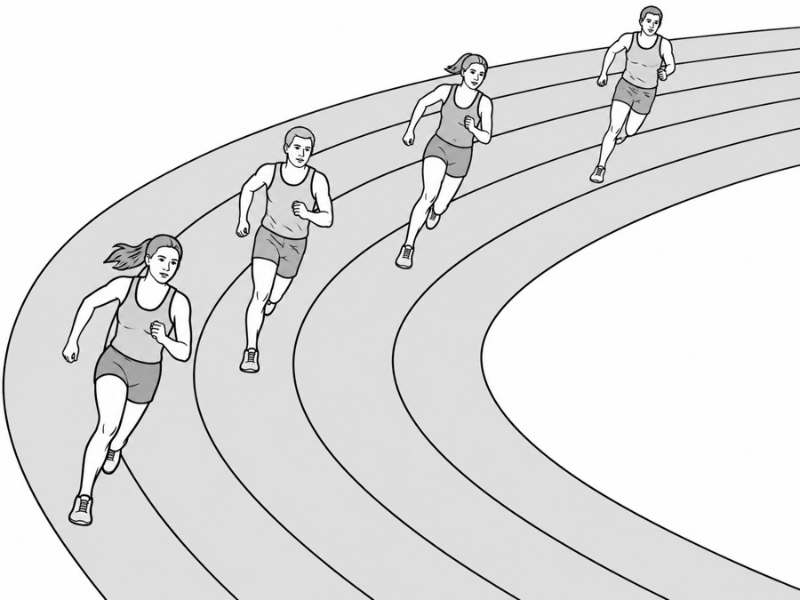
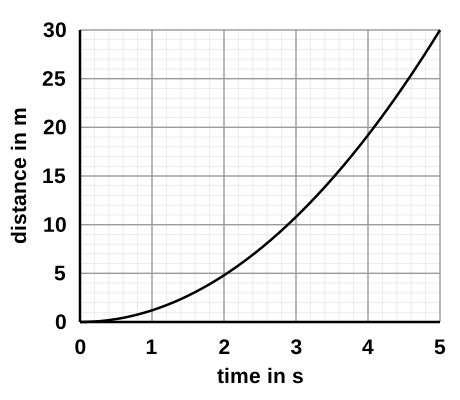
In Figure 10 a skier slides down a straight slope that drops through a height h. In Figure 11 runners keep a steady speed round a bend. Figure 12 plots distance against time for one runner starting a race on a straight.
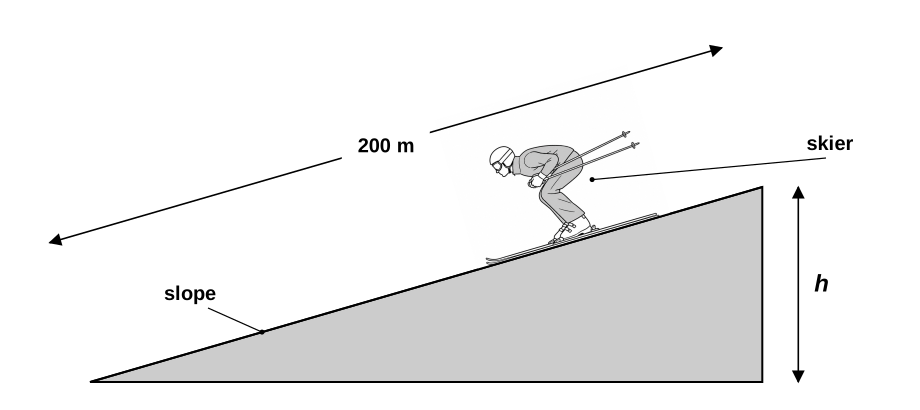
(a)(i) A 70 kg skier loses 39 000 J of gravitational potential energy. Taking g as 10 N/kg, find the height h in m.
Our own questions on this topic, marked straight away, so you see what to revise. Free now.
Show model answer for 06.1Hide model answer for 06.1
Start with the equation:. change in GPE = m × g × h. Rearrange for the height:. h = fraction: change in GPE over m × g, end of fraction. = fraction: 39 000 over 70 × 10, end of fraction
h = 39 000 over 700. = 55.7. So the height is about 56 m.
How the marks are earned
- One mark: rearrange change in GPE = m × g × h to h = change in GPE ÷ (m × g), giving 39 000 ÷ (70 × 10).
- One mark: the height, 56 m. Any value that rounds to 56, such as 55.71, is accepted, and 57 m (56.85) is accepted if g = 9.8 N/kg is used.
- The right final answer on its own earns full marks.
Why it scores
The rearrangement earns the first mark.
The second mark is for the evaluation. The energy is divided by both the mass and g, so multiply those two first.
Revise Gravitational Potential Energy(a)(ii) From rest, the skier reaches 27 m/s at the bottom. Using Figure 10, find the acceleration along the slope.
See how you would score on Newton's Laws of MotionShow model answer for 06.2Hide model answer for 06.2
The skier starts from rest, so:. u = 0. Use this equation:. v2 − u2 = 2 × a × x. The values are:. v = 27 m/s. x = 200 m. Here x is the length of the slope.
Rearrange for the acceleration:. a = fraction: 272 over 2 × 200, end of fraction. = 729 over 400. = 1.8 m/s2
How the marks are earned
- One mark: choose v2 − u2 = 2 × a × x, which links speeds, acceleration and distance.
- One mark: rearrange to a = (v2 − u2) ÷ (2 × x), with 272 and 200 in place. The part (a)(i) height in place of 200 m is also given this mark, but not the final mark.
- One mark: the acceleration, 1.8 m/s2. Any value that rounds to 1.8, such as 1.8225, is accepted.
- Alternative route, 3 marks: the average speed is 13.5 m/s, so the time is 200 ÷ 13.5 = 14.8 s (1); a = 27 ÷ 14.8 (1); a = 1.8 m/s2 (1).
- The right final answer on its own earns full marks.
Why it scores
This equation uses distance instead of time, which suits the data. The slope length is the distance the skier travels, not the height h.
The rearranged form and the evaluated acceleration earn two marks.
Revise Newton's Laws of Motion(a)(iii) Explain how to work out how much energy the skier dissipates from top to bottom.
See how you would score on Energy Stores & SystemsShow model answer for 06.3Hide model answer for 06.3
Find the skier's gravitational potential energy at the start and the kinetic energy at the finish. Subtract the second from the first: the result is the amount that has been dissipated as thermal energy.
Here the kinetic energy at the bottom is:. kinetic energy = ½ × 70 × 272. = 25 515 J. So the energy dissipated is:. energy dissipated = 39 000 − 25 515. = 13 485 J
How the marks are earned
- One mark: find the gravitational potential energy at the top and the kinetic energy at the bottom.
- One mark: subtract the one from the other. Subtracting any two energies is accepted, and a difference is accepted for subtracting. For example 39 000 − 25 515 = 13 485 J earns both marks.
Why it scores
Naming both energies earns one mark and the subtraction earns the other.
This shows the method with the real numbers. The missing energy has gone to the surroundings as thermal energy.
Revise Energy Stores & Systems(b)(i) State why an athlete's velocity changes when the speed is constant round a bend.
See how you would score on Forces & Their EffectsShow model answer for 06.4Hide model answer for 06.4
Velocity is a vector, with direction as well as size. Round the bend the runner's direction keeps changing, so the velocity changes even though the speed does not.
How the marks are earned
- The direction of travel keeps changing. Saying velocity has direction as well as size, so it is a vector, is also accepted. A changing speed is not the reason.
(b)(ii) Find the gradient of the curve in Figure 12 at 2.5 s, in m/s.
See how you would score on Newton's Laws of MotionShow model answer for 06.5Hide model answer for 06.5
At 2.5 s the curve is at about 7.5 m. Lay a ruler so it just touches the curve there without crossing it, and draw the tangent.
Take a large triangle on the tangent, for example from (1.5 s, 1.5 m) to (3.5 s, 13.5 m).. gradient = 12 over 2.0. = 6.0 m/s
How the marks are earned
- One mark: at the 2.5 s point, add a straight line that just touches the curve without cutting it. The long side of a triangle drawn on the tangent also counts.
- One mark: work out the gradient of that tangent, 6.0 m/s. Any value from 5.0 to 7.0 m/s is accepted. This mark needs the tangent.
Why it scores
A tangent shows the slope of the curve at that single instant. It earns the first mark.
The gradient of a distance against time graph is speed, so the runner is moving at about 6 m/s at 2.5 s. The evaluation earns the second mark.
Revise Newton's Laws of Motion