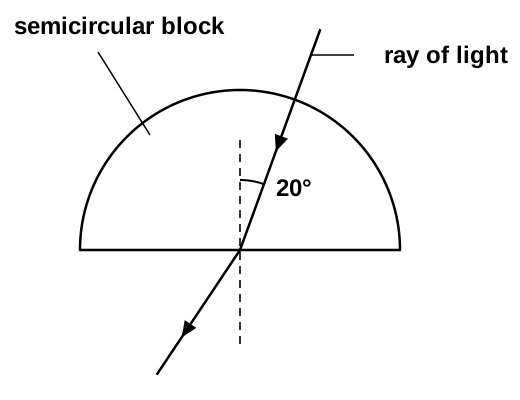
Figure 13 shows a ray of light aimed at the centre of the flat edge of a half-round plastic block, meeting the dashed normal at 20 degrees. The critical angle of this plastic is 38 degrees. Ceres is a small world in the asteroid belt, circling the Sun on a path beyond Mars and inside Jupiter's orbit.
(a) How does a lens's power relate to its focal length, and how does the shape of a stronger lens differ?
Our own questions on this topic, marked straight away, so you see what to revise. Free now.
Show model answer for 07.1Hide model answer for 07.1
The more powerful the lens, the shorter its focal length. A more powerful lens is also more strongly curved, so it looks thicker or fatter.
How the marks are earned
- One mark: the shorter the focal length, the greater the lens's power.
- One mark: a stronger lens has surfaces that curve more sharply (a smaller radius of curvature), so it is thicker or fatter. Describing a converging lens as more convex, or a diverging one as more concave, is also accepted.
Why it scores
One mark is for the link to focal length and one for the link to shape. A stronger lens bends light more sharply, so it brings rays to a focus closer to the lens.
Revise Lenses & Images(b)(i) Name a situation in which a lens makes a virtual image.
See how you would score on Lenses & ImagesShow model answer for 07.2Hide model answer for 07.2
The magnified image seen through a magnifying glass, a converging lens held with the object closer than its focal length, is virtual. The image in a diverging lens is virtual too.
How the marks are earned
- One from: what you see through a magnifying glass, which is a converging lens with the object inside its focal length; or anything seen through a diverging lens. A telescope, microscope or pair of glasses on its own earns nothing.
(b)(ii) Name a situation in which a lens makes a real image.
See how you would score on Lenses & ImagesShow model answer for 07.3Hide model answer for 07.3
The image on the retina of the eye is real. So is the image a camera lens forms, or a projector's image on a screen, because the object is farther than the focal length.
How the marks are earned
- One from: the image of a distant object made by a converging lens; the photograph or image in a camera; the image from a projector; the image on the retina of the eye. A phone on its own earns nothing.
(c) The angle at the flat edge rises from 20 to 50 degrees, the critical angle being 38 degrees. Describe what happens to the ray.
See how you would score on Reflection & RefractionShow model answer for 07.4Hide model answer for 07.4
From 20 degrees up to 38 degrees the ray still leaves the flat edge, bending away from the normal, and the angle outside gets bigger as the angle inside does. At exactly 38 degrees the angle outside is 90 degrees and the ray runs along the flat edge.
Above 38 degrees, up to 50 degrees, no light leaves. The ray is totally internally reflected back into the block, and the angle of reflection equals the angle of incidence.
How the marks are earned
- Any three, one mark each: as the angle inside the block grows, the angle outside grows too, with the ray outside bending further from the normal and towards the block's surface; at 38 degrees the angle outside is 90 degrees, so the ray runs along the flat edge; above 38 degrees the ray is reflected back into the block (total internal reflection); above 38 degrees the angle of reflection equals the angle of incidence.
- Marks can come from a labelled diagram. Weak partial reflections are not credited.
Why it scores
A growing angle outside earns one mark. The ray running along the edge at the critical angle earns another.
Reflection back into the block earns one mark, and the equal angles can earn another. Any three ideas give full marks.
Revise Reflection & Refraction(d) Ceres receives radiation from the Sun, yet its average temperature stays constant. Explain why.
See how you would score on Black Body RadiationShow model answer for 07.5Hide model answer for 07.5
Ceres absorbs radiation from the Sun, which transfers energy to it. Ceres also emits radiation of its own, and the hotter it gets, the faster it emits.
The temperature stops changing when the rate at which Ceres emits radiation equals the rate at which it absorbs it. Then it gains and loses energy at the same speed.
How the marks are earned
- Four marks from these five ideas: Ceres takes in radiation or thermal energy from the Sun, and heat, energy transferred to Ceres, Ceres gaining energy and the Sun heating it all count (1); Ceres also gives out radiation or thermal energy (1); the hotter it is, the faster it radiates (1); the temperature holds steady once radiation is emitted as fast as it is absorbed (1); and rate or power is mentioned in the third or fourth idea (1).
- One statement alone, that the temperature stays steady when radiation is emitted as fast as it is absorbed, scores all 4 marks. Saying only that Ceres receives radiation earns nothing, because the question already says so.
- Giving out, losing, releasing and dissipating all count as emitting, and power counts for rate. If absorption is greater than emission so the temperature rises, the first two marks are earned.
Why it scores
Absorbing and emitting are the first two marks. Emission rising with temperature is the third.
Equal rates is the key mark, and it must mention rate or power. If absorption beat emission the temperature would rise.
Revise Black Body Radiation