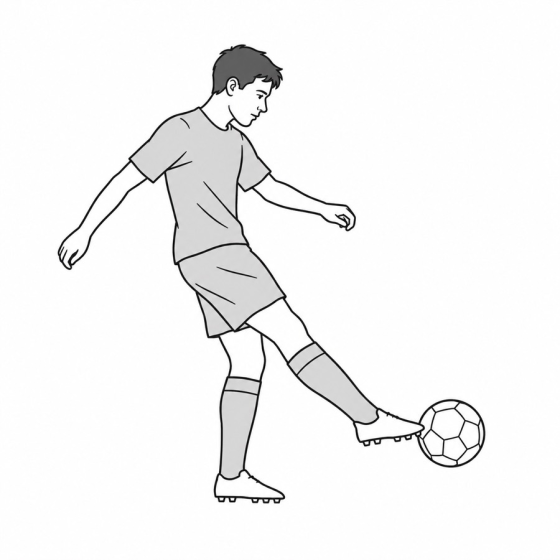
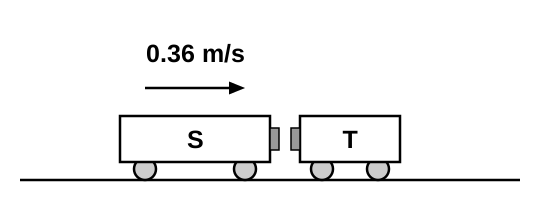
In Figure 14 a footballer kicks a stationary ball of mass 0.43 kg. The kick pushes on the ball with 2700 N and the ball leaves at 36 m/s. In Figure 15 trolley S moves at 0.36 m/s towards a stationary trolley T on a level track. The two stick together and move off as one.
(a)(i) The 0.43 kg ball leaves the kick at 36 m/s. Find its momentum and state the unit.
Our own questions on this topic, marked straight away, so you see what to revise. Free now.
Show model answer for 08.1Hide model answer for 08.1
Use the equation:. p = m × v. momentum = 0.43 × 36. = 15.48. This is about 15.
The unit is kg m/s.
How the marks are earned
- One mark: use momentum = mass × velocity.
- One mark: the value, 15, from 0.43 × 36. Any value that rounds to 15, such as 15.48 or 15.5, is accepted. The correct value alone earns two marks.
- One mark: the unit, kg m/s (also written kg m s-1).
Why it scores
Choosing the equation earns one mark and the value earns another.
The unit is a separate mark. It comes from mass in kg times velocity in m/s.
Revise Momentum(a)(ii) The kick force is 2700 N. Find how long the foot touches the ball, in seconds.
See how you would score on Force & CollisionsShow model answer for 08.2Hide model answer for 08.2
The ball starts at rest, so its change in momentum is the 15 kg m/s found in part (a)(i).. Use this equation:. force = fraction: change in momentum over time, end of fraction. Rearrange for the time:. time = fraction: change in momentum over force, end of fraction. = 15 over 2700
time = 0.0056 s. So the foot touches the ball for just over half a hundredth of a second.
How the marks are earned
- One mark: use force = change in momentum ÷ time, so time = 15 ÷ 2700. The route through F = m × a and a = (v − u) ÷ t also earns this mark.
- One mark: the time, 0.0056 s. Any value that rounds to 0.0056, such as 0.005555, is accepted. Using 15.48 gives 0.0057 s, also accepted, and the answer follows through from your part (a)(i) value.
- The right final answer on its own earns full marks.
Why it scores
The equation and the change in momentum earn the first mark. Starting from rest means the change equals the final momentum.
The second mark is for the evaluation. The contact is very brief because the force is large.
Revise Force & Collisions(a)(iii) Describe the pair of forces between foot and ball, using Newton's third law.
See how you would score on Newton's Laws of MotionShow model answer for 08.3Hide model answer for 08.3
The foot pushes on the ball with 2700 N, and at the same moment the ball pushes back on the foot with a force of the same size in the opposite direction.
The two forces act on different objects, so they never cancel each other. The ball accelerates because of the force on it.
How the marks are earned
- One mark: the two forces are equal and opposite (action and reaction being equal and opposite is accepted).
- One mark: one force is the push of the foot on the ball.
- One mark: the other force is the push of the ball on the foot.
- Saying the force on the ball equals the force on the foot earns 2 marks, and adding that they point in opposite directions earns 3.
Why it scores
Naming both forces as acting on different objects earns two marks, and saying they are equal and opposite earns the third.
This guards against a common slip. A pair of equal and opposite forces on two bodies does not mean nothing moves.
Revise Newton's Laws of Motion(b) Using momentum, explain why S and T move off slower together than S moved alone before.
See how you would score on MomentumShow model answer for 08.4Hide model answer for 08.4
The total momentum of the system stays the same through the collision. The total after equals the momentum S had before.
momentum = mass × velocity. After they stick, the moving mass is that of S and T together, which is bigger. The same momentum shared over a bigger mass means a smaller velocity.
How the marks are earned
- One mark: momentum is conserved, so the total before the collision equals the total after.
- One mark: momentum = mass × velocity.
- One mark: once they have joined, the moving mass is larger.
Why it scores
Momentum being conserved earns the first mark.
The equation earns one mark and the bigger moving mass earns the other. The lower velocity follows from them.
Revise Momentum