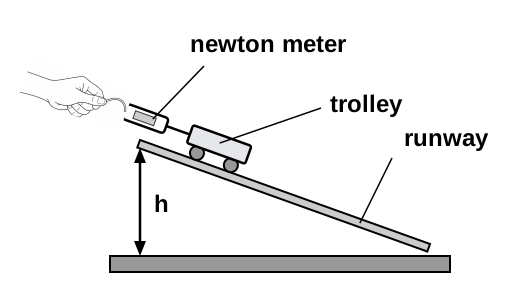
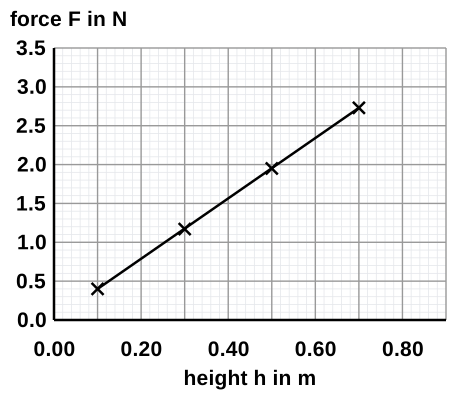
Figure 2 shows a beach ball falling through air, with a downward weight of 2.5 N and an upward air resistance. In Figure 3 students use a newton meter to hold a trolley still on a runway whose raised end is at height h. Figure 4 plots the force needed against h.
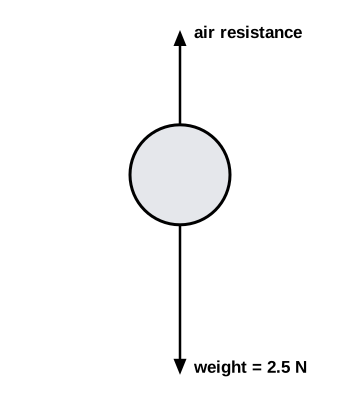
(a)(i) The ball, mass 0.25 kg, has a downward resultant force of 0.92 N. Calculate its acceleration in m/s2.
Our own questions on this topic, marked straight away, so you see what to revise. Free now.
Show model answer for 02.1Hide model answer for 02.1
Only the resultant force makes the ball accelerate, so F in the equation is 0.92 N, not the 2.5 N weight.
Start with the equation:. F = m × a. Rearrange for the acceleration:. a = F over m. = 0.92 over 0.25
a = 3.68. So the acceleration is 3.7 m/s2.
How the marks are earned
- One mark: use the resultant force, 0.92 N, as F in F = m × a, not the weight. If nothing else scores, writing a = F ÷ m on its own earns one mark.
- One mark: rearrange and substitute, a = 0.92 ÷ 0.25. The substitution still counts if the two values are multiplied, or divided the other way round. This mark still follows if a wrong force, for example the weight or the air resistance, is used correctly in force ÷ 0.25.
- One mark: the acceleration, 3.7 m/s2. Any value that rounds to 3.7, such as 3.68, is fine. Using 250 g unconverted gives 0.0037, which scores two marks. A wrong force that gives 10, 14 (13.7), 6.3 or 1.8 also scores 2 marks, and negative values are ignored.
- The right final answer on its own earns full marks.
Why it scores
The resultant is what is left after air resistance has been taken from the weight. Choosing it earns the first mark.
The rearranged form with the values in earns the second mark.
The final mark is for the value. Leaving the mass as 250 g would give 0.0037 and lose only this mark.
Revise Newton's Laws of Motion(a)(ii) With a 2.5 N weight and a 0.92 N resultant downwards, how strong is the upward drag on the ball, in N?
See how you would score on Forces & Their EffectsShow model answer for 02.2Hide model answer for 02.2
The ball falls, so the resultant is the weight minus the air resistance.. air resistance = 2.5 − 0.92. = 1.58 N. This is about 1.6 N.
How the marks are earned
- Air resistance = 2.5 − 0.92 = 1.58 N. Either 1.58 N or 1.6 N is accepted.
(b)(i) At h = 0.60 m the four force readings in newtons were 2.1, 2.7, 2.5 and 2.2. Find their mean.
See how you would score on Forces & Their EffectsShow model answer for 02.3Hide model answer for 02.3
Add the four readings:. total = 2.1 + 2.7 + 2.5 + 2.2. = 9.5. Divide by 4:. mean = 9.5 over 4. = 2.375. So the mean force is about 2.4 N.
How the marks are earned
- Mean = total ÷ 4 = 9.5 ÷ 4 = 2.4 N. The values 2.375 and 2.38 are also accepted.
(b)(ii) From Figure 4, estimate the force at a height of 0.80 m.
See how you would score on Forces & Their EffectsShow model answer for 02.4Hide model answer for 02.4
Use a ruler to continue the straight line to the gridline at 0.80 m on the h axis, then read across to the force axis. F is about 3.1 N.
How the marks are earned
- One mark: carry the straight line on until it reaches h = 0.80 m.
- One mark: read the force there, 3.1 N. Any value from 3.05 to 3.20 N is accepted.
- The right final answer on its own earns full marks.
Why it scores
One mark for continuing the line and one for the reading. The crosses lie on a straight line, so extending it is fair. As a check, the gradient 3.9 N/m × 0.80 m gives 3.1 N.
Revise Forces & Their Effects(b)(iii) How steep is the straight line plotted for force against height? Give the slope in N/m.
See how you would score on Forces & Their EffectsShow model answer for 02.5Hide model answer for 02.5
Take two points far apart on the line, such as (0.10 m, 0.40 N) and (0.70 m, about 2.75 N), or draw a big triangle under the line.
gradient = fraction: change in F over change in h, end of fraction. = fraction: 2.75 − 0.40 over 0.70 − 0.10, end of fraction. = 2.35 over 0.60. = 3.9 N/m
How the marks are earned
- One mark: pick any two points on the line, or draw any triangle on the graph. Points far apart are better advice, but they are not required.
- One mark: gradient = change in F ÷ change in h, giving 3.9 N/m. Anything from 3.80 to 4.00 is accepted.
- The right final answer on its own earns full marks.
Why it scores
Points far apart keep the error from reading the graph small. This earns the first mark.
The evaluation earns the second mark. The gradient says how many newtons of force each extra metre of height needs.
Revise Forces & Their Effects