The topic here is infrasound and ultrasound. In Figure 1 a technician holds a device that sends out a short ultrasound pulse and detects the echo from a wall.
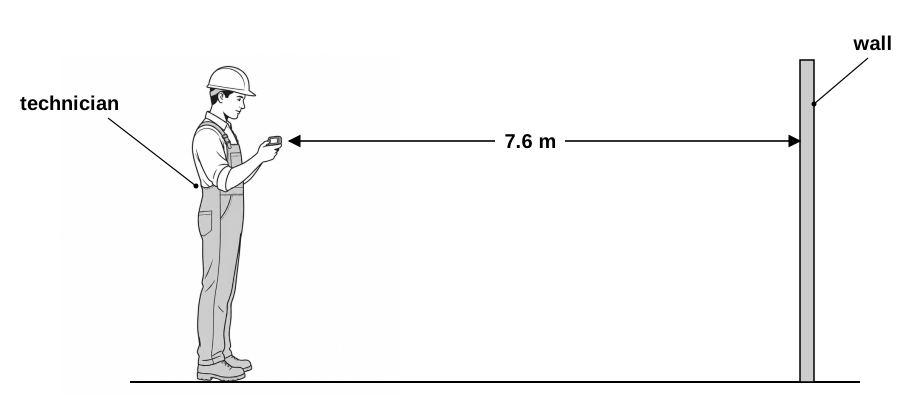
(a) Pick the frequency that is infrasound. Tick one box.
Our own questions on this topic, marked straight away, so you see what to revise. Free now.
Show model answer for 01.1Hide model answer for 01.1
2.2 Hz. Infrasound lies below about 20 Hz, so only 2.2 Hz fits. 22 Hz is already audible, and the kilohertz values are thousands of hertz, far higher still.
How the marks are earned
- Tick 2.2 Hz, the only value below 20 Hz, the lowest frequency people can hear.
(b) The wall stands 7.6 m away, and ultrasound travels at 330 m/s in air. Find the time before the echo returns.
See how you would score on Sound WavesShow model answer for 01.2Hide model answer for 01.2
The echo comes from a pulse that goes to the wall and returns, so the total distance travelled is:. total distance = 2 × 7.6. = 15.2 m
Start with the speed equation:. speed = distance over time. Rearrange for the time:. time = distance over speed. = 15.2 over 330
The time is 0.046 s.
How the marks are earned
- One mark: start from speed = distance ÷ time, in the form time = distance ÷ speed.
- One mark: put in the values. The pulse travels to the wall and back, so the distance is 2 × 7.6, giving (2 × 7.6) ÷ 330. Using 7.6 ÷ 330 on its own also earns this mark.
- One mark: the final time, 0.046 s. Any value that rounds to 0.046, such as 0.04606, is fine. Using the one-way distance gives 0.023 s, which scores only the first two marks.
- The right final answer on its own earns full marks.
Why it scores
Counting the journey both ways is the step most students miss. Skipping it halves the answer.
Choosing the equation and substituting the values earn the first two marks.
The last mark is for the evaluation. The one-way distance would give 0.023 s and lose it.
Revise Sound Waves(c) Give a scientific reason why a person cannot hear infrasound.
See how you would score on Sound WavesShow model answer for 01.3Hide model answer for 01.3
Infrasound has a frequency below 20 Hz. That is lower than the lowest frequency the human ear can detect, so the ear does not respond to it.
How the marks are earned
- Frequency route, one mark: the frequency of infrasound is what matters.
- Frequency route, one mark: that frequency is too low, below the 20 Hz bottom of human hearing. Saying it is below 20 Hz earns both marks.
- Ear route, 2 marks instead: name a part of the ear, such as the cochlea, eardrum, ossicles, hairs or membrane (1), and say it cannot vibrate in response, for example it is too stiff or too thin to respond (1).
Why it scores
One mark names the frequency as the cause and the other says it is too low, below the hearing range. Saying the frequency is below 20 Hz covers both.
Revise Sound Waves