Figure 8 shows a water feature for a garden. Its electric motor drives a pump, which raises water 70 cm from the lowest container to the highest. The water then runs back down.
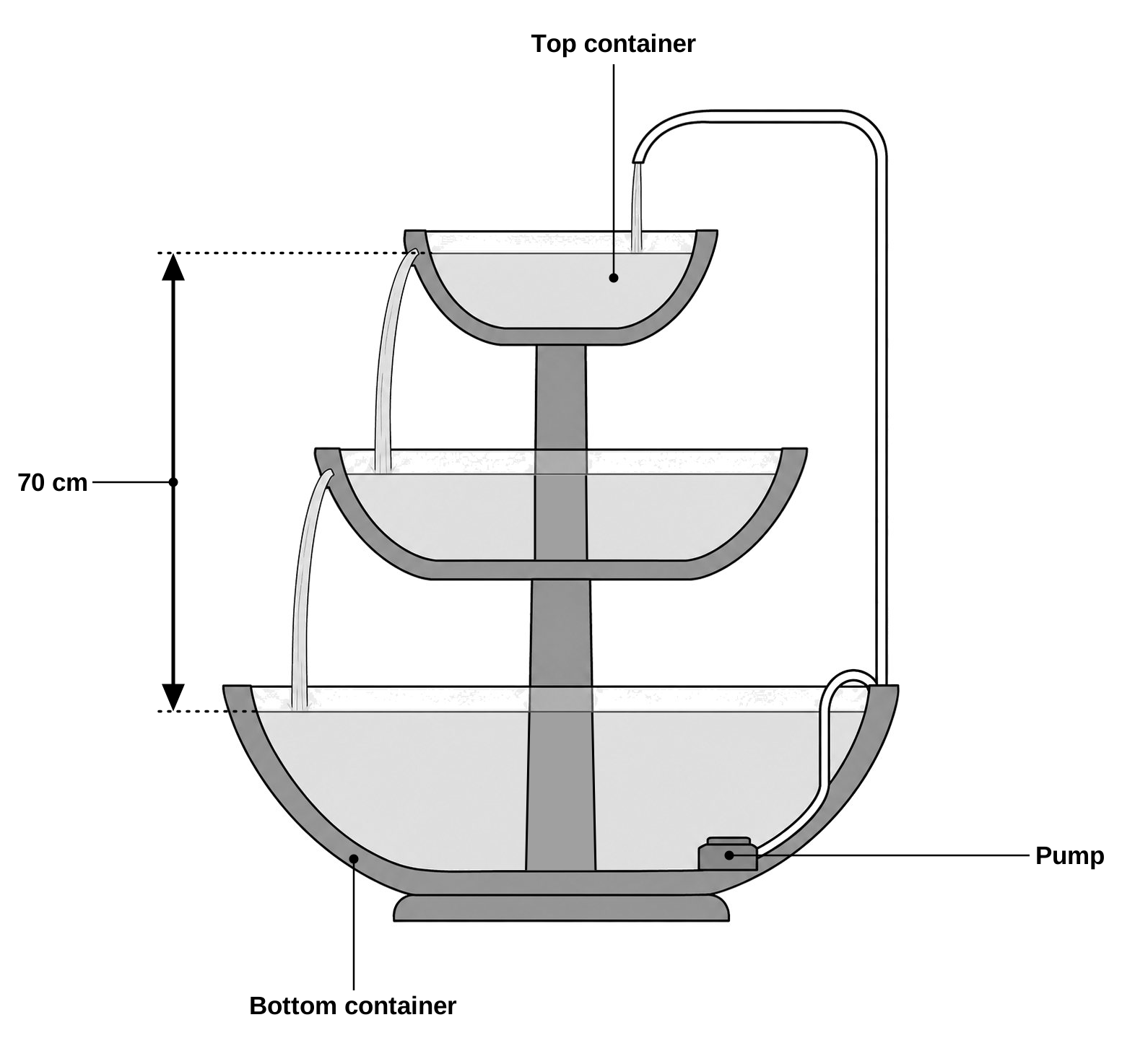
Each second the water gains 0.343 J as gravitational potential energy. Using g = 9.8 N/kg, calculate the mass pumped per second.
Our own questions on this topic, marked straight away, so you see what to revise. Free now.
Show model answer for 09.1Hide model answer for 09.1
The height in Figure 8 is 70 cm, which is 0.70 m.
Gravitational potential energy = mass × gravitational field strength × height. Substituting:. 0.343 J = m × 9.8 N/kg × 0.70 m. Rearranging:. m = fraction: 0.343 J over 9.8 N/kg × 0.70 m, end of fraction. = 0.343 over 6.86. = 0.050 kg
How the marks are earned
- One mark: take the height from Figure 8 and convert it to metres.
- One mark: substitute into the gravitational potential energy equation.
- One mark: rearrange to find the mass.
- One mark: the correct mass. The unit, kilograms, is not needed for the mark here, but always write it.
Why it scores
The first mark is for finding the right quantity in the figure and converting it. Later marks still follow if the conversion is wrong.
The marks are for the height (found in the first step), the substitution, the rearrangement and the answer. Stating the equation first keeps the order clear. The unit is not needed for the mark here, but always write it.
Revise Gravitational Potential EnergyThe motor has a power of 4.86 W and a resistance of 6.0 Ω. Find the charge that passes through it in 30 minutes.
See how you would score on Electrical Power & EnergyShow model answer for 09.2Hide model answer for 09.2
P = I2 × R. Put in the values:. 4.86 = I2 × 6.0. Rearrange for I2:. I2 = 4.86 over 6.0. = 0.81. Taking the square root:. I = √0.81. = 0.90 A
The time is 30 minutes, so change it to seconds:. 30 × 60 = 1800 s
Q = I × t. = 0.90 × 1800. = 1620 C
How the marks are earned
- One mark: substitute into power = current squared × resistance.
- One mark: rearrange to get current squared.
- One mark: find the current.
- One mark: change minutes to seconds.
- One mark: substitute into charge flow = current × time.
- One mark: the final charge. The unit, coulombs, is not needed for the mark here, but always write it.
- Later marks follow through from your own current, and from your own time if the conversion is wrong.
Why it scores
This is three marks: substituting, rearranging and finding the square root. Forgetting the square root is a common mistake.
Time must be in seconds for the charge equation.
Substituting the current and time and multiplying gives the last two marks. 1600 C is also accepted. The unit is not needed for the mark here, but always write it.
Revise Electrical Power & EnergyThe motor is replaced by one with the same input power but a greater efficiency. Explain the effect on the water flow.
See how you would score on EfficiencyShow model answer for 09.3Hide model answer for 09.3
A more efficient motor wastes a smaller proportion of its input energy, so more of the same input power is useful. This lifts a greater mass of water each second, so the flow of water increases.
How the marks are earned
- One mark: more water is lifted each second, or the flow increases. Saying only that the water moves faster does not earn this.
- One mark: because less energy or power is wasted, a smaller proportion of the input energy is wasted, or the useful power output is greater.
Why it scores
The cause is less wasted energy and the effect is greater useful power, which lifts more water each second.
Revise Efficiency