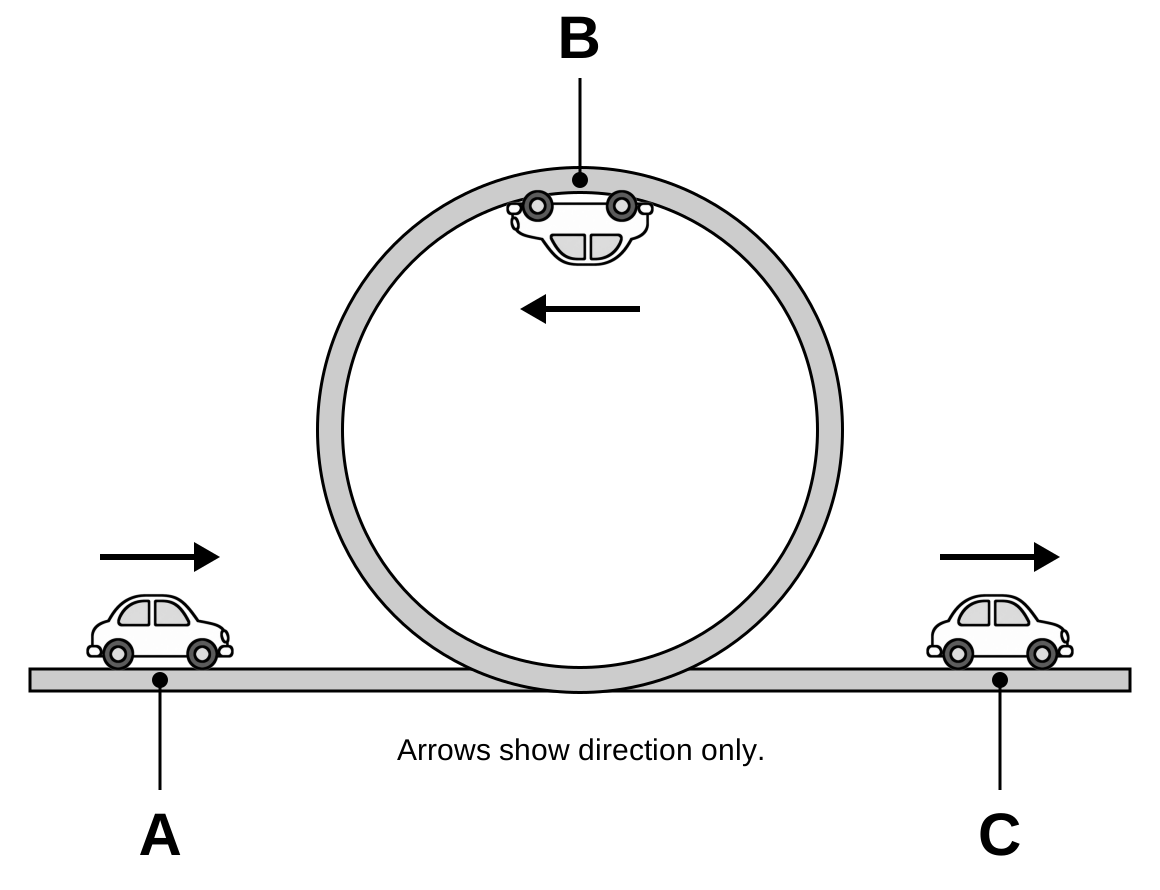
A spring launcher starts a toy car on a race track. Pulling its handle squashes the spring, and letting go passes the spring's stored energy to the car. Figure 9 shows a loop further along the track, with three marked positions.
The spring compresses by 0.075 m. Spring constant 64 N/m, car mass 0.052 kg. Calculate the car's greatest possible speed to 2 significant figures.
Our own questions on this topic, marked straight away, so you see what to revise. Free now.
Show model answer for 10.1Hide model answer for 10.1
Elastic energy = ½ × k × e2. Here e is the compression. So:. energy = 0.5 × 64 × 0.0752. = 0.18 J
Take all of the spring's stored energy as becoming kinetic energy of the car.. Kinetic energy = ½ × m × v2. The energy is 0.18 J and m is 0.052 kg. So:. v2 = fraction: 0.18 over ½ × 0.052, end of fraction. = 0.18 over 0.026. = 6.92
Taking the square root gives about 2.63 m/s, so the speed written to two significant figures is 2.6 m/s.
How the marks are earned
- One mark: substitute into elastic energy = ½ × spring constant × extension squared.
- One mark: the elastic energy value.
- One mark: substitute this energy into the kinetic energy equation.
- One mark: rearrange for speed squared.
- One mark: find the speed.
- One mark: round correctly to 2 significant figures. A wrong speed earns this only if your working used every value given: the compression, the spring constant and the mass.
- The force and acceleration route also earns marks, one at each stage: greatest force 4.8 N; greatest acceleration 92.3 m/s2; average acceleration 46.2 m/s2; speed squared from 2 × 46.2 × 0.075, about 6.923; speed about 2.631 m/s; then 2.6 m/s.
Why it scores
This uses the correct equation, with the compression as e, and gives the energy stored. On the energy route, this equation must be used for the later calculation marks to count, and those marks then follow from your own energy value.
Equating the two energies is the key idea. The maximum speed assumes no energy is wasted.
The square root gives the speed and the final mark is for rounding to the stated number of significant figures.
Revise Energy Stores & SystemsIn Figure 9 the car runs A to B to C. Assuming no friction or air resistance, describe how its energy stores change.
See how you would score on Energy Stores & SystemsShow model answer for 10.2Hide model answer for 10.2
From A to B the car rises, so its kinetic energy decreases and its gravitational potential energy increases. Energy is transferred from the kinetic store to the gravitational potential store.
From B to C the car falls, so its gravitational potential energy decreases and its kinetic energy increases, with no energy wasted. At C the car is back at the height of A, so each store is the same size as it was at A.
How the marks are earned
- One mark: on the way from A to B, the kinetic store falls.
- One mark: over that same stretch, the gravitational potential store grows.
- One mark: past B on the way to C, the gravitational potential store drains back into the kinetic store.
Why it scores
This covers both changes on the way up. Both stores need to be named with the direction of change.
This is the reverse transfer on the way down and earns the final mark.
Revise Energy Stores & SystemsAs the car finishes, a light gate works out its speed. Which two measurements does it need? Tick two boxes.
See how you would score on Forces & Their EffectsShow model answer for 10.3Hide model answer for 10.3
How long the car is, and the time it takes to go through the gate.. Speed = distance over time. Use the car's length as the distance.
How the marks are earned
- One mark for how long the car is, front to back, which is the distance it covers while it blocks the light.
- One mark for the time it takes to cross the gate.
- Ticking extra boxes cancels a correct tick.
Why it scores
Speed needs a distance and a time. The gate gives the time, and the length of the car that cuts the beam is the distance moved in that time.
Revise Forces & Their Effects