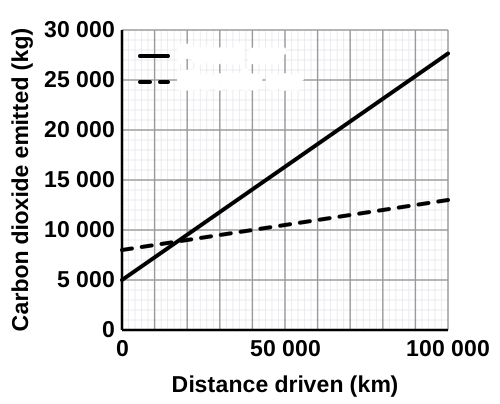
Building a car releases carbon dioxide, before it has driven any distance. Figure 6 tracks the total carbon dioxide from two cars, one petrol and one electric, as the distance each has driven grows.
Explain one way that carbon dioxide emissions harm the environment.
Our own questions on this topic, marked straight away, so you see what to revise. Free now.
Show model answer for 04.1Hide model answer for 04.1
As a greenhouse gas, carbon dioxide absorbs infrared radiation that would otherwise escape to space. More energy stays in the atmosphere, so average temperatures rise worldwide. This global warming brings changes such as higher sea levels.
How the marks are earned
- One mark: it is a greenhouse gas. Absorbing infrared radiation, or causing the greenhouse effect, also earns this.
- One mark: this leads to global warming or climate change. Examples such as rising sea levels or more extreme weather are accepted.
Why it scores
A full explanation names the gas property first and then the environmental result. Just saying 'pollution' earns nothing.
Revise Energy ResourcesRead from Figure 6 how much carbon dioxide building the electric car released.
See how you would score on Energy ResourcesShow model answer for 04.2Hide model answer for 04.2
8000 kg. The electric car's line meets the vertical axis there, at zero distance, before the car has been driven.
How the marks are earned
- Read the value where the electric car's line starts, at zero distance. The unit is not needed for the mark here, but always write it.
At one distance the two cars have released equal totals of carbon dioxide. Use Figure 6 to find this distance.
See how you would score on Energy ResourcesShow model answer for 04.3Hide model answer for 04.3
17 000 km, where the two lines cross.
How the marks are earned
- Read the distance at the point where the two lines meet. Anything from 16 000 km to 18 000 km is accepted.
The electric car runs from a battery and emits nothing as it moves. Explain why its total still rises with distance.
See how you would score on Energy ResourcesShow model answer for 04.4Hide model answer for 04.4
The further the car goes, the more often its battery must be recharged. Some of the electricity for charging is generated in power stations that burn coal, oil or gas, and these release carbon dioxide.
How the marks are earned
- One mark: the car or its battery has to be recharged.
- One mark: that electricity comes from burning coal, oil or gas, or fossil fuels. Saying only some of it does is extra detail.
Why it scores
The first idea is the charging, and the second links that charging to fossil fuels.
Revise Energy ResourcesWhich two energy resources release no carbon dioxide while generating electricity? Tick two boxes.
See how you would score on Energy ResourcesShow model answer for 04.5Hide model answer for 04.5
Nuclear and solar. Neither burns a fuel containing carbon when it generates electricity.
How the marks are earned
- One mark for ticking nuclear and one mark for ticking solar.
- Ticking extra boxes cancels a correct tick.
Why it scores
Wood, oil and biofuel all release carbon dioxide when they are burned to generate electricity, because each contains carbon. Only the two that burn no such fuel earn the marks.
Revise Energy Resources