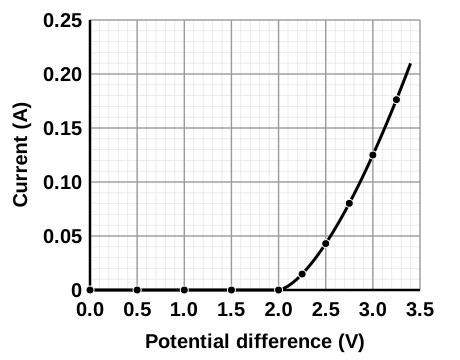
A student measures the current through an LED at different values of potential difference. Figure 4 is the circuit, with its supply connected the first way. Figure 5 is the graph of the readings.
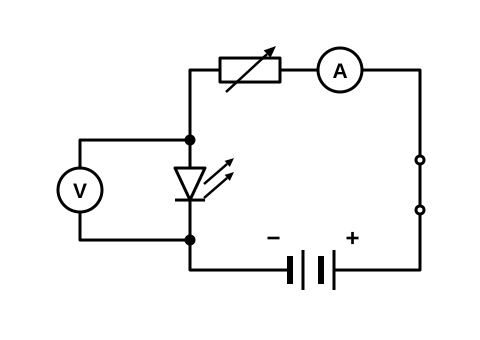
Using the circuit in Figure 4, name one way to change the LED's potential difference.
Our own questions on this topic, marked straight away, so you see what to revise. Free now.
Show model answer for 03.1Hide model answer for 03.1
Adjust the variable resistor in the circuit.
How the marks are earned
- Give one practical change that alters the LED's potential difference: use or adjust the variable resistor, add or remove cells, add a second battery, pick a battery with a different potential difference, or put extra parts in the loop.
Which word equation is right? Tick one box.
See how you would score on Resistance & Ohm's LawShow model answer for 03.2Hide model answer for 03.2
potential difference = current × resistance. In symbols:. V = I × R
How the marks are earned
- One mark: tick the equation where potential difference equals current multiplied by resistance.
Find the LED's resistance at 3.0 V, reading from Figure 5.
See how you would score on I-V CharacteristicsShow model answer for 03.3Hide model answer for 03.3
Go up from 3.0 V on the horizontal axis to the curve, then across to the vertical axis. The current is 0.125 A.
Start from this equation:. V = I × R. Put in the values:. 0.125 × R = 3.0. Rearrange for the resistance:. R = 3.0 over 0.125. = 24 Ω
How the marks are earned
- One mark: read the current from the graph at the stated potential difference.
- One mark: substitute into V = I × R.
- One mark: rearrange to R = V ÷ I.
- One mark: the correct resistance, 24. The unit, ohms, is not needed for this mark, but always write it. For the first mark, read between 0.12 A and 0.13 A. Later marks follow your own reading between 0.10 A and 0.15 A.
Why it scores
A careful graph reading is the first mark. A small reading error is allowed, and later marks follow your own value.
The substitution, the rearrangement and the answer each earn a mark, so show all three lines.
Revise I-V CharacteristicsThe student swaps the supply connections in Figure 4. The ammeter now reads 0.0 A at every potential difference. Explain this reading.
See how you would score on I-V CharacteristicsShow model answer for 03.4Hide model answer for 03.4
An LED has a very high resistance in the reverse direction. So the current is too small for the ammeter to show, and it reads 0.0 A.
How the marks are earned
- One mark: the LED has a very high resistance.
- One mark: this very high resistance applies in the reverse direction. This mark depends on the first.
- If neither is scored, one mark is given for saying an LED only lets current through one way.
Why it scores
The first mark is the very high resistance, and the second links it to the reverse direction. The second mark depends on the first.
Revise I-V Characteristics