A student wants a value for water's specific heat capacity. Figure 3 shows the kit: a power supply, a joulemeter that records the energy transferred, a heater and a thermometer in a beaker of water, and a separate balance.
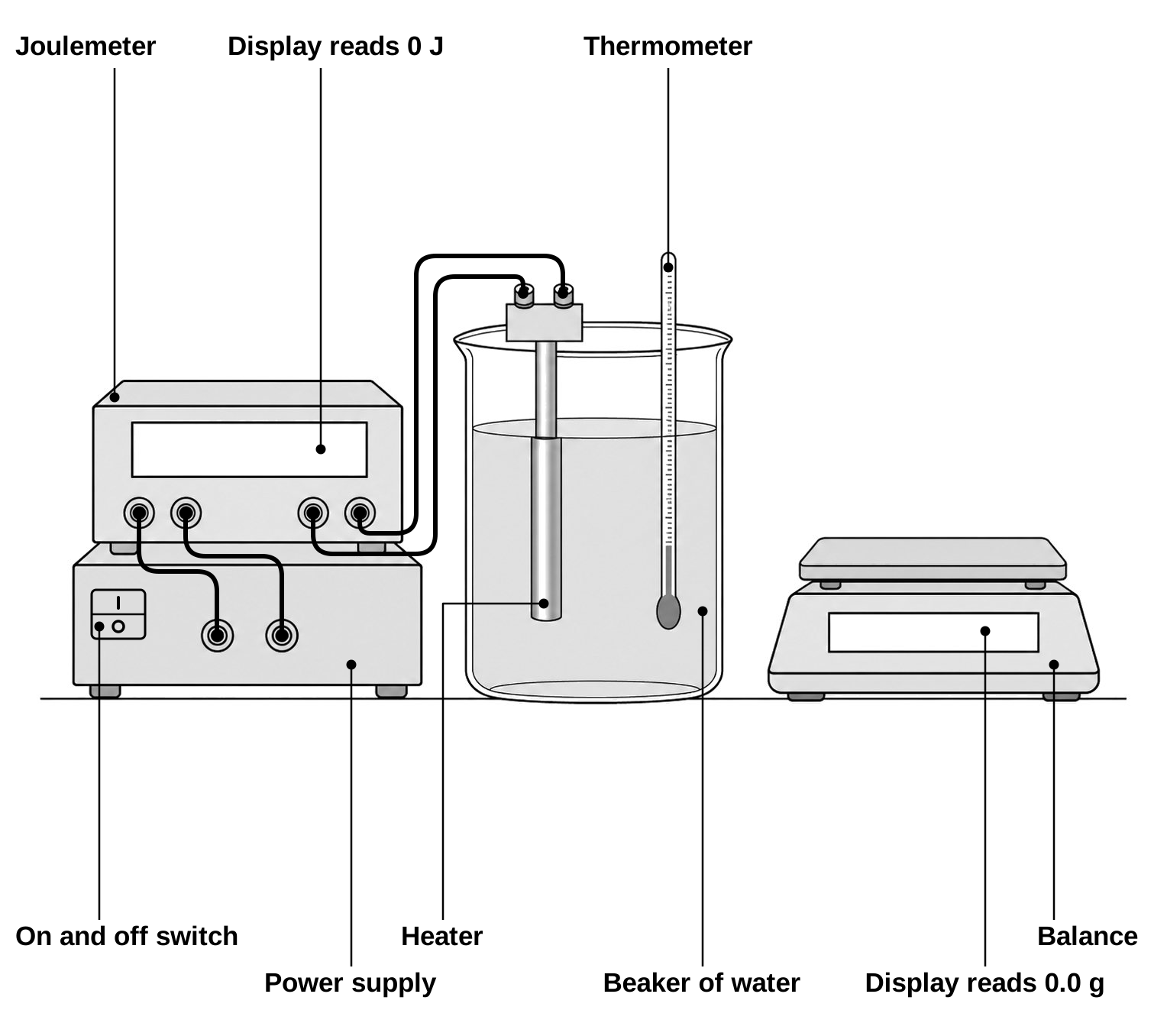
Name one hazard that the set-up in Figure 3 presents.
Our own questions on this topic, marked straight away, so you see what to revise. Free now.
Show model answer for 02.1Hide model answer for 02.1
The hot water, which could scald skin if it spilt.
How the marks are earned
- Name the hazard itself: hot water, a hot beaker, the hot heater, spilt water or broken glass.
- Describing the harm alone, without naming the item, does not earn the mark.
Set out a method, using Figure 3, that gives a value for water's specific heat capacity.
See how you would score on Specific Heat CapacityShow model answer for 02.2Hide model answer for 02.2
Put the empty beaker on a balance and record its mass. Add water, record the new mass, and subtract the first reading from the second to find the mass of water.
Put the heater and thermometer in the water, with the heater fully covered, and record the starting temperature. Zero the joulemeter and switch on the power supply. After some minutes, switch off, then record the energy shown on the joulemeter and the highest temperature reached.
Change the mass from grams to kilograms. Find the temperature change by subtracting the start from the finish.. Then use this equation:. energy = mass × specific heat capacity × temperature change. Rearrange it to:. c = fraction: E over m × Δθ, end of fraction. Use it to calculate the specific heat capacity.
How the marks are earned
- This is level marked. For 5 or 6 marks the method must work and its steps must follow a sensible order. For 3 or 4 marks most steps appear, but the method may fail or the order may slip. For 1 or 2 marks only some steps appear, with no clear links.
- The top level also needs a clear way of finding the mass of water: use a balance for the empty beaker and again for the beaker with water, then subtract.
- Say what is read and where from: energy from the joulemeter, temperature before and after from the thermometer.
- Finish by using the specific heat capacity equation to calculate the answer.
- Extra detail, not required for a mark: changing the mass from grams to kilograms before the calculation.
Why it scores
Showing how the mass is found is essential for the top level. The mass cannot simply be assumed.
These are the key measurements, taken in a logical order. The energy and the temperature rise must come from the same period of heating, and the water carries on warming for a moment after the heater goes off.
A method is only complete when the measured values are combined with the correct equation to reach the result.
Revise Specific Heat CapacitySome energy escapes from the water into the room. How could the apparatus be altered to cut this loss?
See how you would score on Specific Heat CapacityShow model answer for 02.3Hide model answer for 02.3
Wrap the beaker in an insulating material, such as cotton wool.
How the marks are earned
- Add insulation around the beaker, or put a lid on it. A named insulating material is fine, and so is swapping the beaker for an insulating cup, such as a plastic one.
The student's result is 4410 J/kg °C. The accepted value is 4200 J/kg °C. Find the percentage difference between them.
See how you would score on Specific Heat CapacityShow model answer for 02.4Hide model answer for 02.4
Difference = 4410 − 4200. = 210 J/kg °C. Percentage difference = 210 over 4200 × 100. = 5%
How the marks are earned
- One mark: find the difference between the two values, or set out the percentage calculation correctly.
- One mark: the correct percentage. Divide by the accepted value, not the student's value.
Why it scores
The first step finds the size of the error and the second compares it with the accepted value. Dividing by the student's value instead gives 4.76%, which is marked wrong.
Revise Specific Heat Capacity