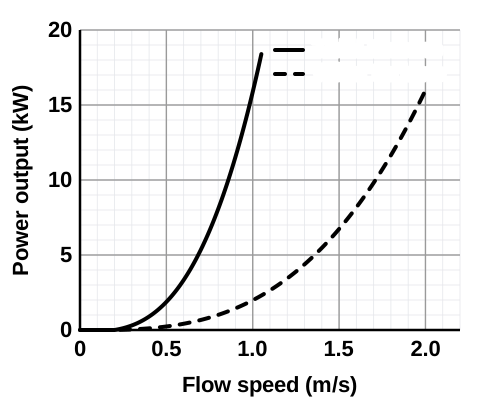
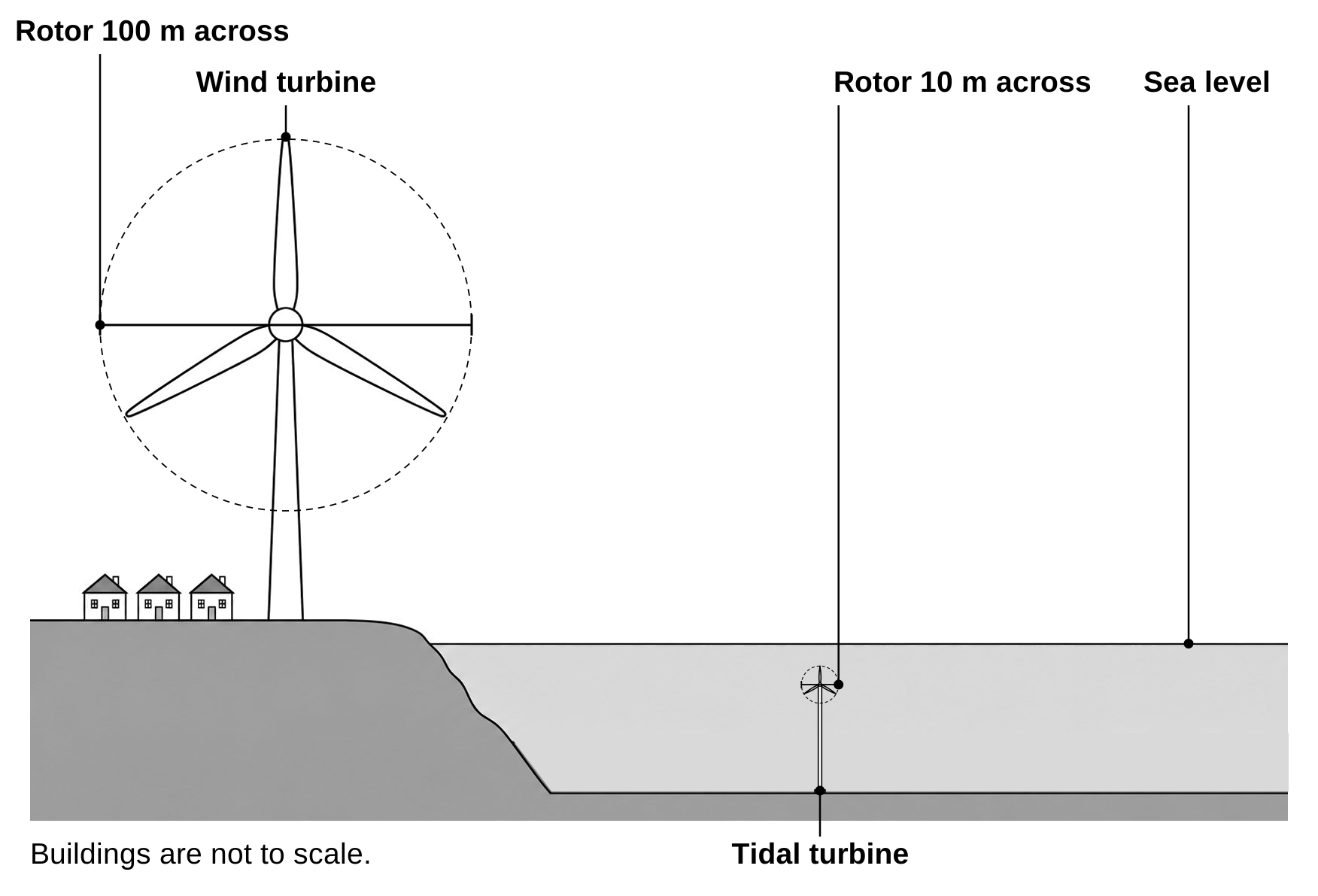
Tides and wind both turn turbines that generate electricity. 'Flow speed' means how fast the tide or the wind moves past a turbine. Figure 1 plots power output against flow speed for one tidal turbine and one wind turbine. Figure 2 shows those same two turbines where they stand. The wind turbine's rotor is 100 m across and the tidal turbine's rotor is 10 m across.
How does a renewable energy resource differ from a non-renewable one?
Our own questions on this topic, marked straight away, so you see what to revise. Free now.
Show model answer for 01.1Hide model answer for 01.1
A renewable energy resource is replaced as it is used, so it can keep being used. A non-renewable energy resource exists in a limited amount, so it is used up and cannot be replaced in a useful time.
How the marks are earned
- One mark: a renewable resource is replenished or replaced. Saying 'as it is used' is extra detail, not required.
- One mark: a non-renewable resource exists in a limited quantity, so its stock is finite.
- Saying only that one 'never runs out', 'will run out', 'will not last forever', has an 'infinite supply' or is 'sustainable' does not earn a mark.
Why it scores
Each half of the answer gets its own mark. The key idea is replacement against a finite stock, not a vague word like sustainable.
Revise Energy ResourcesWrite the equation that links density, mass and volume.
See how you would score on DensityShow model answer for 01.2Hide model answer for 01.2
density = mass over volume. In symbols:. ρ = m over V
How the marks are earned
- Density equals mass divided by volume. Standard symbols are accepted.
The tidal turbine takes in 824 000 kg of seawater per second. Seawater has density 1030 kg/m3. Calculate the volume of that seawater.
See how you would score on DensityShow model answer for 01.3Hide model answer for 01.3
Start from the density equation:. density = mass over volume. Put in the values:. 1030 = 824 000 over V
Rearrange to get the volume on its own:. V = 824 000 over 1030
So the volume is 800 m3.
How the marks are earned
- One mark: put the mass and the density into the density equation.
- One mark: rearrange so volume is mass divided by density.
- One mark: the final value, 800. The unit, cubic metres, is not needed for the mark here, but always write it.
Why it scores
Both real values in the equation earn the first mark, and they show the examiner you chose the right equation.
The volume on one side and the two values on the other earns the second mark.
The division gives the final mark. The unit is not needed for the mark here, but always write it.
Revise DensityFigure 1 also shows that power output rises with flow speed. State two other conclusions you can draw from it.
See how you would score on Energy ResourcesShow model answer for 01.4Hide model answer for 01.4
From about 0.2 m/s up to where the tidal curve ends, at about 1.05 m/s, the tidal turbine gives a greater power output than the wind turbine at the same flow speed. Over that range, the same increase in flow speed raises the tidal power by more than it raises the wind power.
How the marks are earned
- Any two, one mark each: no output at the very lowest flow speeds; the tidal curve sits above the wind curve from about 0.2 m/s up to where the tidal curve ends, at about 1.05 m/s (saying the wind turbine needs quicker flow for equal output is the same point, so it earns this mark once only); a rise in speed lifts tidal output more than wind output; output does not grow in step with speed.
- Remarks about dependability or efficiency earn nothing, since the graph does not show them. Saying the tide flows more slowly than the wind is wrong, and it cancels one correct conclusion even if you state that conclusion as well: the graph compares outputs at the same speed. Calling the rise exponential earns nothing.
Why it scores
Two separate conclusions, each read directly from the graph and comparing the two generators. The claim is limited to the range from about 0.2 m/s to the end of the tidal curve, because the graph says nothing beyond it. Each conclusion earns a mark.
Revise Energy ResourcesUsing Figure 2, compare the effects on the environment of the two turbines.
See how you would score on Energy ResourcesShow model answer for 01.5Hide model answer for 01.5
The wind turbine stands in the open with a rotor 100 m across, so it spoils the view far more than the tidal turbine, whose 10 m rotor is hidden under the water. People nearby are also more likely to hear the wind turbine, because the sound of the tidal turbine stays under the water.
The wind turbine can kill flying birds, whereas fish and other sea life are more at risk from the tidal turbine. The wind turbine is much bigger, so it takes more raw materials to build each one. Figure 1 shows it gives less power at the same flow speed, so more of them are needed for the same output, which uses still more materials.
How the marks are earned
- This is level marked. For 1 or 2 marks, simple separate statements are enough. For 3 or 4 marks, the points need detail and clear reasons that are joined up, not a list.
- Useful comparisons: size and how visible each is, noise, the materials needed to build them, how many are needed for the same power, and the effect on wildlife.
- The question asks for a comparison, so link points to both turbines where you can. The scheme does not require every point to name both.
Why it scores
Each sentence links a feature (position, size) to its impact (view, noise). That logical linking is what the top level rewards.
Figure 2 shows no wildlife, so the harm to birds and to sea life comes from your own knowledge; each generator gets its own impact. The size of the wind turbines and the number needed at the same flow speed give the reason for the greater use of materials, which is the logical linking needed for the top level.
Revise Energy Resources