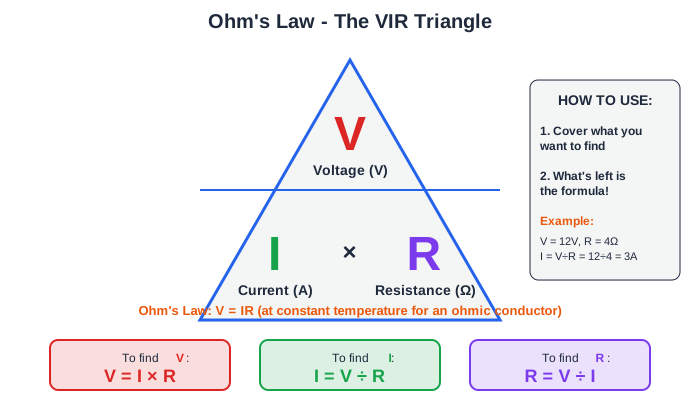
ElectricityDiagram

The V-I-R Triangle

Part of Resistance & Ohm's LawGCSE Physics

This diagram covers The V-I-R Triangle within Resistance & Ohm's Law for GCSE Physics. Revise Resistance & Ohm's Law in Electricity for GCSE Physics with 14 exam-style questions and 30 flashcards. This is a high-frequency topic, so it is worth revising until the explanation feels precise and repeatable. It is section 3 of 16 in this topic. Focus on the labels, the relationships between parts, and the explanation that turns the diagram into an exam-ready answer.

Topic position

Section 3 of 16

Practice

14 questions

Recall

30 flashcards

📊 The V-I-R Triangle

VIR triangle showing V=IR, I=V/R, and R=V/I — cover what you want to find and the formula is revealed

Figure 1: The VIR triangle — cover the quantity you want to find and read off the calculation.

Keep building this topic

Read this section alongside the surrounding pages in Resistance & Ohm's Law. That gives you the full topic sequence instead of a single isolated revision point.

Practice Questions for Resistance & Ohm's Law

Which of the following best describes electrical resistance?

  • A. The amount of charge flowing past a point per second
  • B. The opposition to the flow of current in a circuit
  • C. The energy transferred per unit charge by the source
  • D. The rate at which electrical energy is transferred
1 markfoundation

Explain what is meant by an ohmic conductor.

2 marksstandard

Quick Recall Flashcards

Ohm's Law equation?
V = IR where V = voltage (V), I = current (A), R = resistance (Ω)
Unit of resistance?
Ohm (Ω)

Want to test your knowledge?

PrepWise has 14 exam-style questions and 30 flashcards for Resistance & Ohm's Law — with adaptive difficulty and instant feedback.

Join Alpha