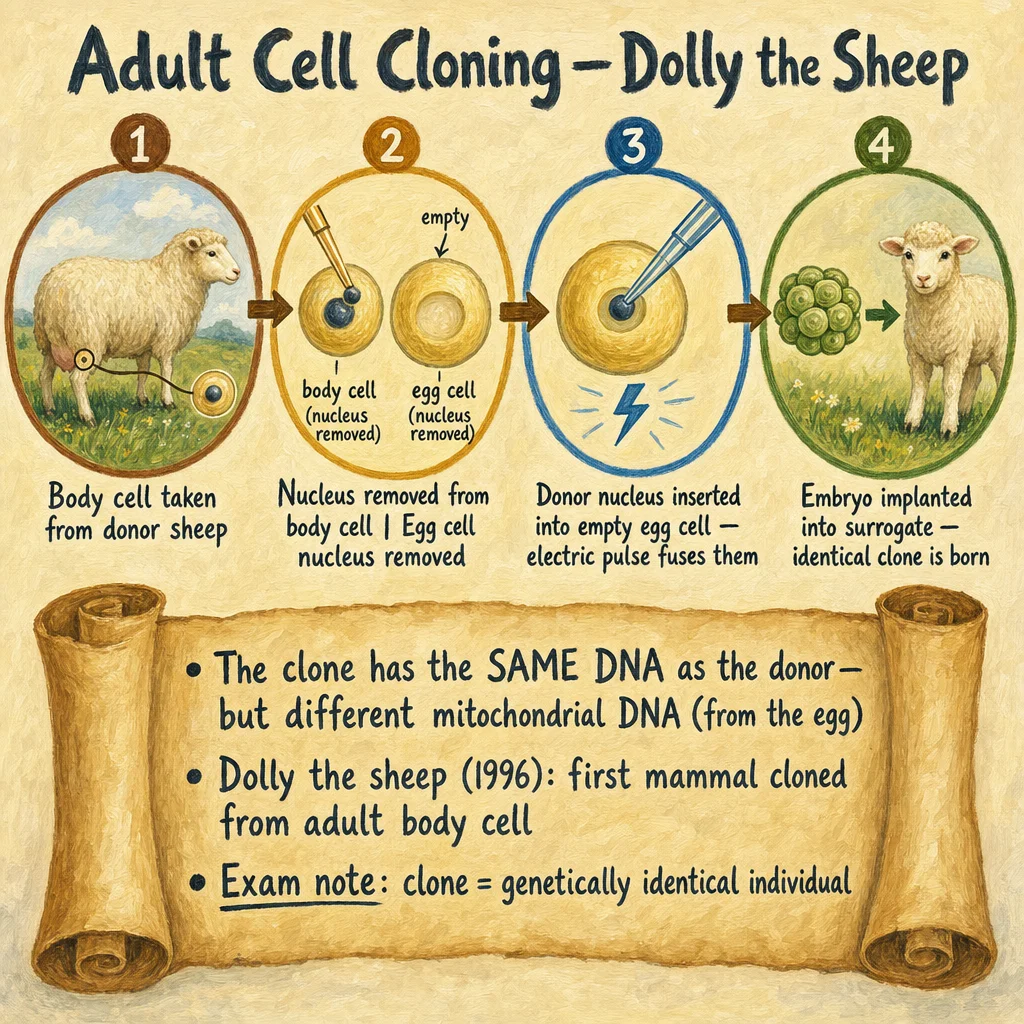
Remember: Clone = genetically identical | Plants: tissue culture, cuttings | Animals: adult cell cloning (nucleus transfer into egg cell)
This diagram covers Visual: Cloning within Cloning for GCSE Biology. Cloning techniques, applications, and ethical considerations It is section 4 of 12 in this topic. Focus on the labels, the relationships between parts, and the explanation that turns the diagram into an exam-ready answer.
Practice questions for Cloning
What is the name of the first mammal to be cloned from an adult cell?
What is the process called when a plant is grown from a cutting?
Quick recall flashcards
What was significant about Dolly the sheep?
Dolly (born 1996) was the first mammal cloned from an adult (somatic) cell. This proved that a specialised adult cell could be reprogrammed to create a whole organism — previously scientists thought adult cells had permanently 'switched off' the genes not needed for their function.
What is a clone?
A genetically identical copy of an organism. Clones have exactly the same DNA as their parent. Cloning occurs naturally (e.g. identical twins, bacterial reproduction) and can be done artificially in plants and animals.