The MIR Triangle: Write I on top, M and R side by side on the bottom.
Cover the value you want to find: I = M x R | M = I / R | R = I / M
(M = Magnification, I = Image size, R = Real size)
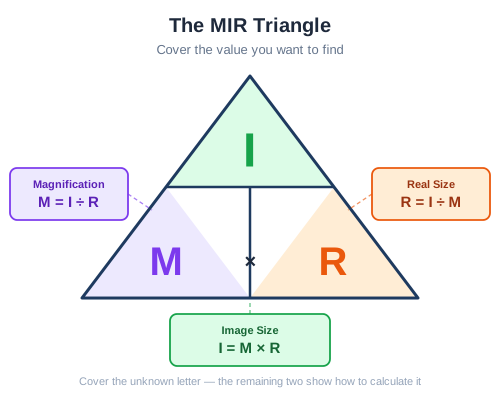
The magnification formula triangle — cover what you want to find
Example 1: Finding Real Size
A cell measures 30 mm on a photograph taken at x400 magnification. What is the actual size of the cell?
- Write the formula: Real size = Image size ÷ Magnification
- Substitute values: Real size = 30 mm ÷ 400
- Calculate: Real size = 0.075 mm
- Convert to micrometres: 0.075 mm × 1000 = 75 micrometres (75 µm)
Why convert? Most cells are measured in micrometres (µm). 1 mm = 1000 µm.
Example 2: Finding Magnification
A red blood cell has an actual diameter of 8 µm. In a diagram it measures 24 mm. What is the magnification?
- Make units match: Convert 24 mm to µm: 24 mm × 1000 = 24,000 µm
- Write the formula: Magnification = Image size ÷ Real size
- Substitute values: Magnification = 24,000 µm ÷ 8 µm
- Calculate: Magnification = x3000
Key rule: Both values MUST be in the same units before dividing.
Quick Check: A cell image measures 45 mm under a microscope at x300 magnification. What is the actual size in micrometres?
Real size = Image size ÷ Magnification = 45 mm ÷ 300 = 0.15 mm. Convert to µm: 0.15 × 1000 = 150 µm. The actual size of the cell is 150 micrometres.
This deep dive covers Magnification Calculations: Worked Examples within Cell Biology Practical Investigations for GCSE Biology. Comprehensive practical skills, experimental design, data analysis, microscopy techniques, and scientific methodology in cell biology It is section 3 of 18 in this topic. Use this deep dive to connect the idea to the wider topic before moving on to questions and flashcards.
Practice questions for Cell Biology Practical Investigations
When using a light microscope to observe cells, which objective lens should be used first?
Describe how to focus a light microscope on a specimen.