Rates of ReactionDiagram

Collision Theory — Temperature Effect

Part of Rates & Collision TheoryGCSE Chemistry

This diagram covers Collision Theory — Temperature Effect within Rates & Collision Theory for GCSE Chemistry. Revise Rates & Collision Theory in Rates of Reaction for GCSE Chemistry with 20 exam-style questions and 16 flashcards. This is a high-frequency topic, so it is worth revising until the explanation feels precise and repeatable. It is section 2 of 13 in this topic. Focus on the labels, the relationships between parts, and the explanation that turns the diagram into an exam-ready answer.

Topic position

Section 2 of 13

Practice

20 questions

Recall

16 flashcards

📐 Collision Theory — Temperature Effect
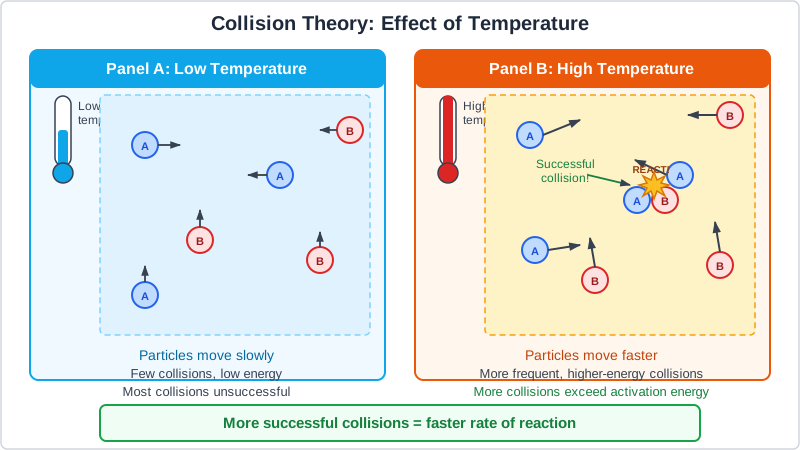
Two panels comparing low temperature (slow particles, few collisions) with high temperature (fast particles, many successful collisions)

Figure 1: At higher temperatures, particles move faster and more collisions exceed the activation energy threshold.

Keep building this topic

Read this section alongside the surrounding pages in Rates & Collision Theory. That gives you the full topic sequence instead of a single isolated revision point.

Practice Questions for Rates & Collision Theory

According to collision theory, which of the following must happen for a chemical reaction to take place?

  • A. Particles must dissolve in water
  • B. Particles must collide with sufficient energy
  • C. Particles must be heated to 100 degrees C
  • D. Particles must be in the liquid state
1 markfoundation

Explain, using collision theory, why increasing the concentration of a reactant solution increases the rate of reaction.

2 marksstandard

Quick Recall Flashcards

What are the units for rate?
g/s, cm³/s, or mol/s
What is rate of reaction?
How quickly reactants are used up or products are formed

Want to test your knowledge?

PrepWise has 20 exam-style questions and 16 flashcards for Rates & Collision Theory — with adaptive difficulty and instant feedback.

Join Alpha