Quantitative ChemistryDiagram

Cross-Topic Chemistry Web

Part of Moles & CalculationsGCSE Chemistry

This diagram covers Cross-Topic Chemistry Web within Moles & Calculations for GCSE Chemistry. Revise Moles & Calculations in Quantitative Chemistry for GCSE Chemistry with 22 exam-style questions and 20 flashcards. This is a high-frequency topic, so it is worth revising until the explanation feels precise and repeatable. It is section 12 of 15 in this topic. Focus on the labels, the relationships between parts, and the explanation that turns the diagram into an exam-ready answer.

Topic position

Section 12 of 15

Practice

22 questions

Recall

20 flashcards

🔗 Cross-Topic Chemistry Web

Moles links directly to reactivity, electrolysis, rates, energy changes and gas-volume calculations. Use this map when planning synoptic exam answers.
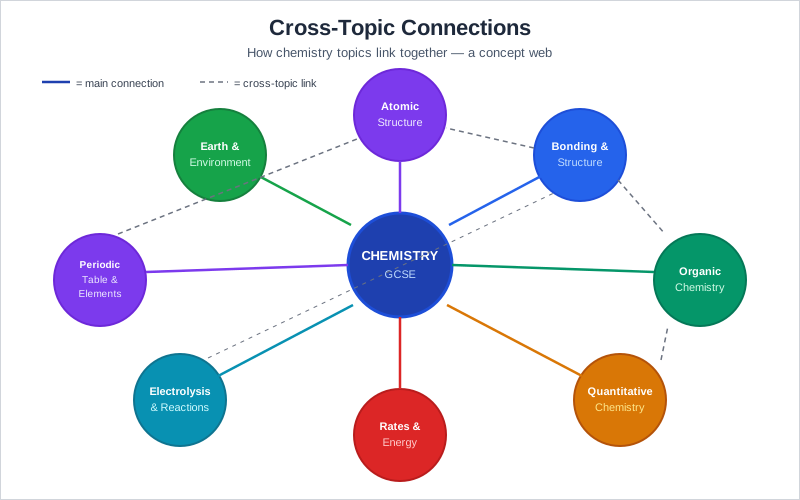
Cross-topic chemistry concept map showing links between moles, reactivity, electrolysis, rates, energy changes, gas volumes and resources

Figure 3: Cross-topic chemistry concept map

Keep building this topic

Read this section alongside the surrounding pages in Moles & Calculations. That gives you the full topic sequence instead of a single isolated revision point.

Practice Questions for Moles & Calculations

One mole of any substance contains how many particles?

  • A. 6.02 × 10²³
  • B. 6.02 × 10²⁰
  • C. 3.01 × 10²³
  • D. 6.02 × 10¹⁸
1 markfoundation

Explain why the percentage yield of a reaction is never 100% in practice.

2 marksstandard

Quick Recall Flashcards

What is Avogadro's constant?
6.02 × 10²³ particles per mole This is the number of particles in one mole of any substance.
Define 'one mole'
The amount of substance containing 6.02 × 10²³ particles One mole of any element weighs exactly its Ar in grams

Want to test your knowledge?

PrepWise has 22 exam-style questions and 20 flashcards for Moles & Calculations — with adaptive difficulty and instant feedback.

Join Alpha