ForcesDiagram

Free Body Diagrams

Part of Forces & Their EffectsGCSE Physics

This diagram covers Free Body Diagrams within Forces & Their Effects for GCSE Physics. Revise Forces & Their Effects in Forces for GCSE Physics with 25 exam-style questions and 11 flashcards. This is a high-frequency topic, so it is worth revising until the explanation feels precise and repeatable. It is section 4 of 13 in this topic. Focus on the labels, the relationships between parts, and the explanation that turns the diagram into an exam-ready answer.

Topic position

Section 4 of 13

Practice

25 questions

Recall

11 flashcards

📊 Free Body Diagrams

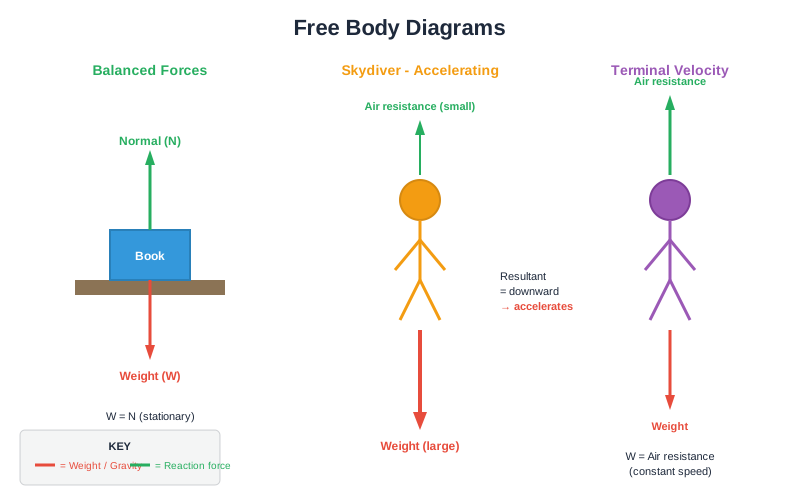
Free body diagrams showing balanced forces on a book (weight equals normal force), unbalanced forces on an accelerating skydiver (weight greater than air resistance), and terminal velocity (weight equals air resistance)

Figure 1: Free body diagrams for common force scenarios

KEY POINTS: Free body diagrams show ALL forces acting on ONE object. Balanced forces (equal and opposite) = no acceleration. Unbalanced forces = acceleration in direction of larger force.

Keep building this topic

Read this section alongside the surrounding pages in Forces & Their Effects. That gives you the full topic sequence instead of a single isolated revision point.

Practice Questions for Forces & Their Effects

What is a force?

  • A. A push or pull that can change the motion or shape of an object
  • B. The speed at which an object moves
  • C. The mass of an object in kilograms
  • D. The distance an object travels in one second
1 markfoundation

Explain what is meant by the resultant force on an object.

2 marksstandard

Quick Recall Flashcards

Resultant Force
Opposite directions: SUBTRACT (bigger − smaller)
Resultant Force
Same direction: ADD them

Want to test your knowledge?

PrepWise has 25 exam-style questions and 11 flashcards for Forces & Their Effects — with adaptive difficulty and instant feedback.

Join Alpha