ElectricityDiagram

Three-Pin Plug Wiring

Part of Mains Electricity & SafetyGCSE Physics

This diagram covers Three-Pin Plug Wiring within Mains Electricity & Safety for GCSE Physics. Revise Mains Electricity & Safety in Electricity for GCSE Physics with 13 exam-style questions and 30 flashcards. This is a high-frequency topic, so it is worth revising until the explanation feels precise and repeatable. It is section 3 of 17 in this topic. Focus on the labels, the relationships between parts, and the explanation that turns the diagram into an exam-ready answer.

Topic position

Section 3 of 17

Practice

13 questions

Recall

30 flashcards

📊 Three-Pin Plug Wiring
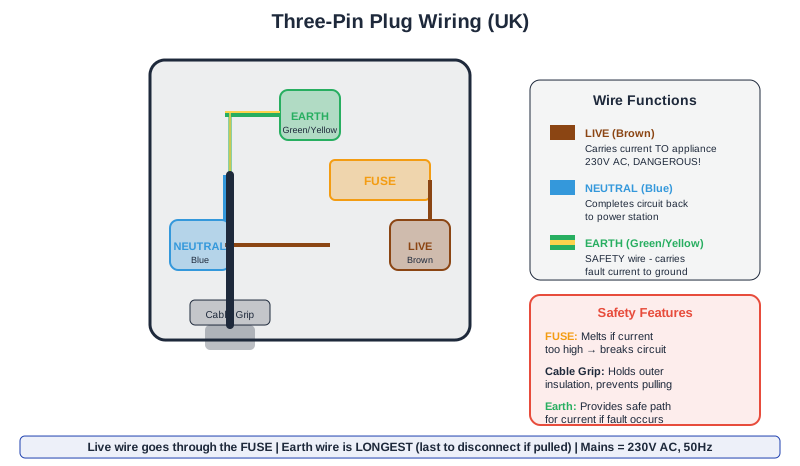
UK three-pin plug showing live (brown), neutral (blue), and earth (green/yellow) wire positions with fuse and cable grip

Figure 1: UK three-pin plug — live (brown, top right), neutral (blue, top left), earth (green/yellow, top centre). Fuse in live wire. Cable grip at base.

Keep building this topic

Read this section alongside the surrounding pages in Mains Electricity & Safety. That gives you the full topic sequence instead of a single isolated revision point.

Practice Questions for Mains Electricity & Safety

What does AC stand for, and how does it differ from DC?

  • A. Alternating current; it flows at a higher voltage than DC
  • B. Alternating current; it repeatedly changes direction, whereas DC flows in one direction only
  • C. Adapted current; it is produced only by batteries
  • D. Alternating current; it flows at a constant rate, whereas DC changes direction
1 markfoundation

Explain how a fuse protects an electrical circuit from damage.

2 marksstandard

Quick Recall Flashcards

What is AC?
Alternating Current — current direction reverses constantly (50 times/second in UK)
What is DC?
Direct Current — current flows in one direction only (batteries provide DC)

Want to test your knowledge?

PrepWise has 13 exam-style questions and 30 flashcards for Mains Electricity & Safety — with adaptive difficulty and instant feedback.

Join Alpha