
Red shift — Hubble's law
This study notes covers Red shift — Hubble's law within Red Shift & Big Bang for GCSE Physics. Revise Red Shift & Big Bang in Space Physics for GCSE Physics with 13 exam-style questions and 12 flashcards. This topic appears regularly enough that it should still be part of a steady revision cycle. It is section 2 of 15 in this topic. Use this study notes to connect the idea to the wider topic before moving on to questions and flashcards.
Topic position
Section 2 of 15
Practice
13 questions
Recall
12 flashcards
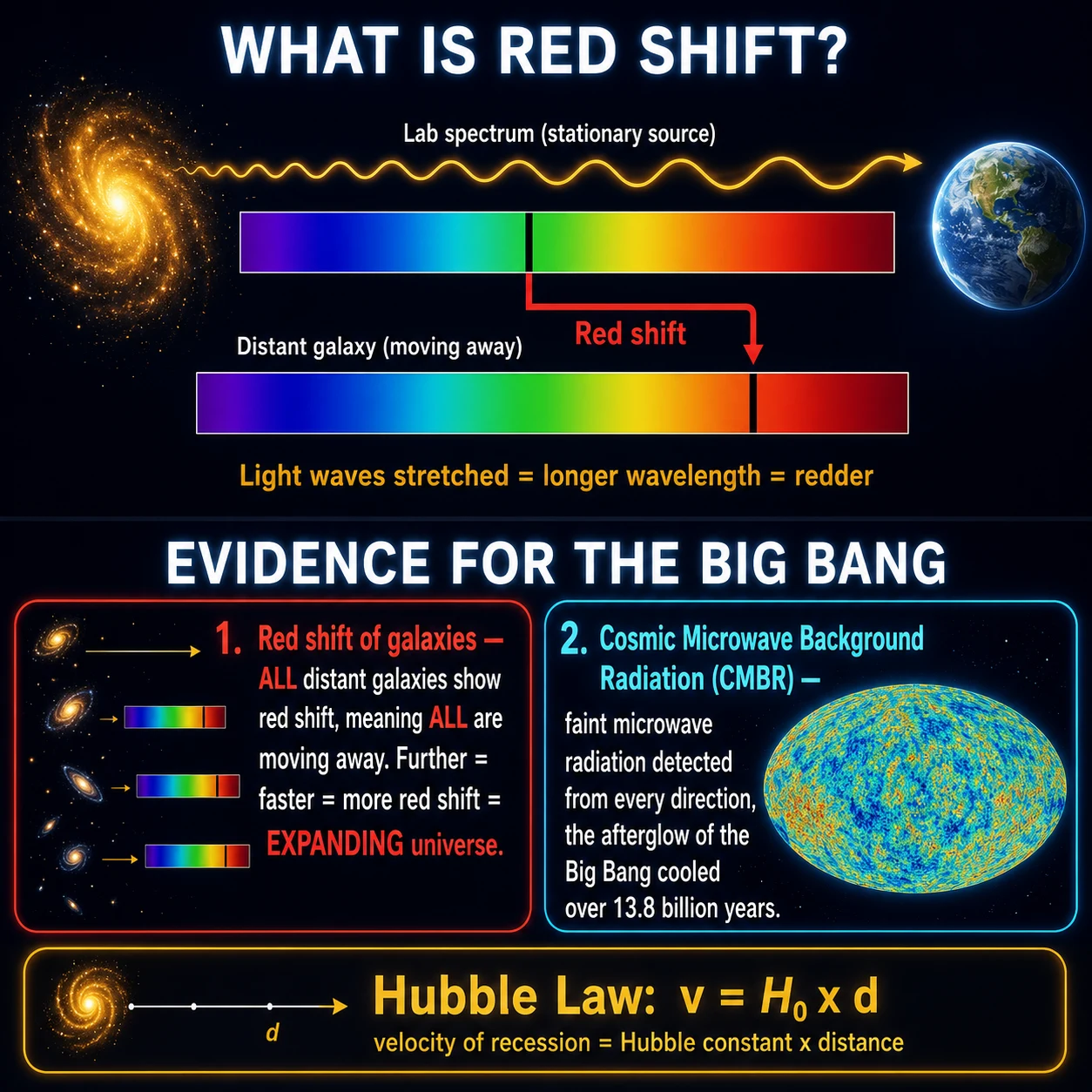
Figure: Red shift — Hubble's law
Keep building this topic
Read this section alongside the surrounding pages in Red Shift & Big Bang. That gives you the full topic sequence instead of a single isolated revision point.
Practice Questions for Red Shift & Big Bang
What is the orbital period of a geostationary satellite?
Explain why a geostationary satellite stays above the same point on Earth's surface.
Quick Recall Flashcards
13 questions on Red Shift & Big Bang — practise free
Instant marking, adaptive difficulty, and 12 spaced repetition flashcards. Free until your GCSEs.
Try PrepWise Free