OrganisationDiagram

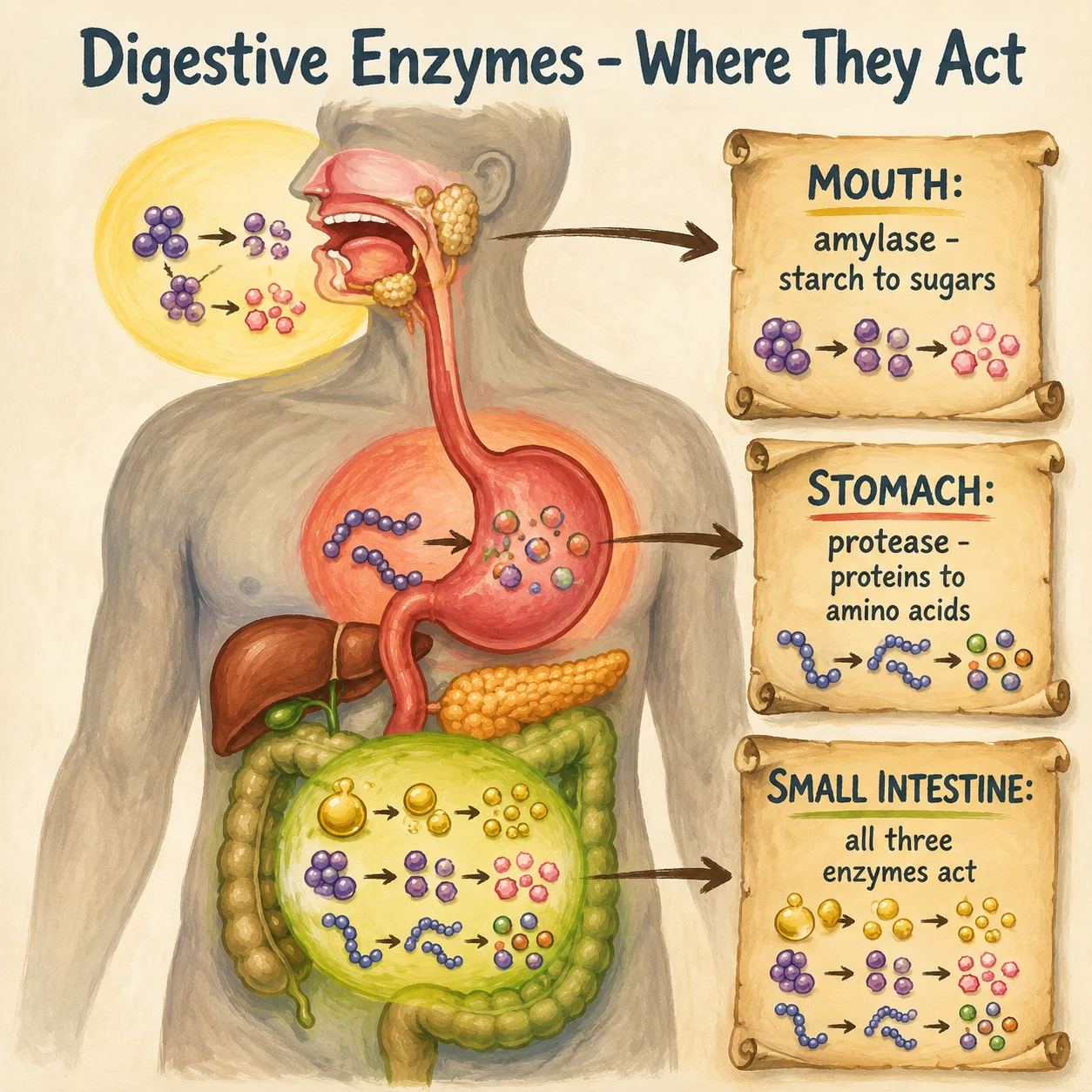
Where Digestive Enzymes Work

Part of Enzymes in DigestionGCSE Biology

This diagram covers Where Digestive Enzymes Work within Enzymes in Digestion for GCSE Biology. Enzyme structure and function, digestive enzymes, factors affecting enzyme activity, lock and key model, and practical investigations It is section 6 of 19 in this topic. Focus on the labels, the relationships between parts, and the explanation that turns the diagram into an exam-ready answer.

Topic position

Section 6 of 19

Practice

20 questions

Recall

25 flashcards

Where Digestive Enzymes Work

Mouth Amylase Starch → Maltose Stomach Pepsin Proteins → Amino acids pH 1.5-2.0 Liver Produces Bile Pancreas Amylase, Trypsin, Lipase Small Intestine Bile acts here Emulsifies fats pH 8.5 Trypsin works Lipase works Pancreatic amylase works pH Conditions for Digestive Enzymes: 1.5 Pepsin 7 Amylase 8.5 Trypsin 8 Lipase Each enzyme has an optimal pH range Digestive Enzymes Throughout the Digestive System

Keep building this topic

Read this section alongside the surrounding pages in Enzymes in Digestion. That gives you the full topic sequence instead of a single isolated revision point.

Practice Questions for Enzymes in Digestion

What are enzymes?

  • A. Carbohydrates that provide energy for cells
  • B. Biological catalysts that speed up chemical reactions
  • C. Proteins that are used up during digestion
  • D. Molecules that store genetic information
1 markfoundation

Explain the effect of increasing temperature on enzyme activity.

3 marksstandard

Quick Recall Flashcards

What does lipase do?
Breaks down lipids (fats) into fatty acids and glycerol. Produced by pancreas, works in small intestine.
What is an enzyme?
A biological catalyst that speeds up chemical reactions by lowering activation energy. Enzymes are proteins with specific 3D shapes.

Want to test your knowledge?

PrepWise has 20 exam-style questions and 25 flashcards for Enzymes in Digestion — with adaptive difficulty and instant feedback.

Join Alpha