The Chemical Breakdown Champions
The Chemical Breakdown Champions
Every day, your digestive system performs an incredible feat of chemistry. The large molecules in your food - proteins, carbohydrates, and fats - are far too big to be absorbed into your bloodstream. Enter digestive enzymes: biological catalysts that break down these complex molecules into smaller, absorbable units. Without these molecular scissors working at precisely the right conditions, we couldn't extract nutrients from our food.
Tap any label to zoom into the mechanism step-by-step.
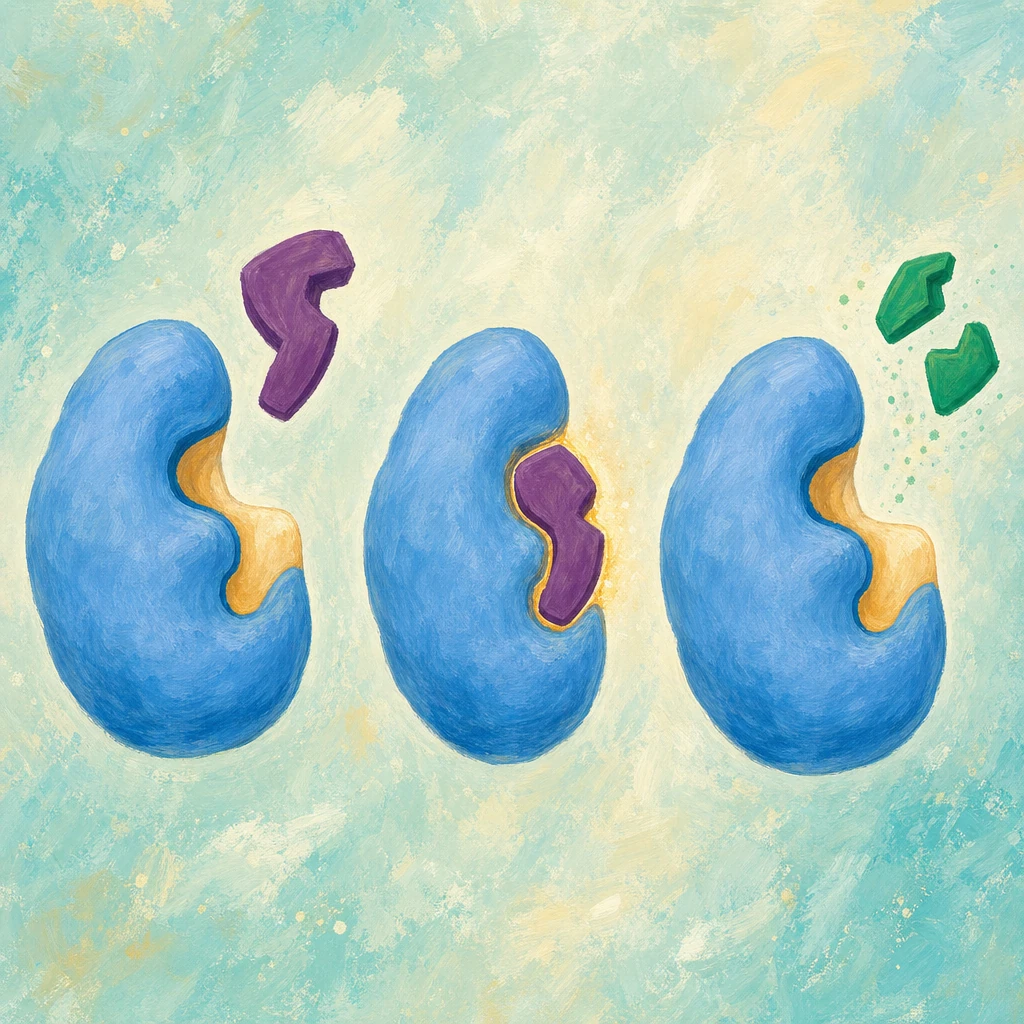
- 1Active site — The specific pocket where the reaction happens
- 2Enzyme-substrate complex — The brief moment when substrate fits perfectly into the active site
- 3Enzyme specificity — One enzyme, one substrate — the lock-and-key rule
- 4Products released — Reaction complete — enzyme exits unchanged, ready to go again
- 5Denaturation — When the active site loses its shape — permanently
Tap any label to zoom into the mechanism step-by-step.
Biology glossary
- What is an enzyme?
- A biological catalyst that speeds up chemical reactions by lowering activation energy. Enzymes are proteins with specific 3D shapes.
- What does lipase do?
- Breaks down lipids (fats) into fatty acids and glycerol. Produced by pancreas, works in small intestine.
Earn the mark scheme marks
Memory Aids
Lock and Key: Picture a padlock (enzyme) with a keyhole (active site). Only one specific key shape (substrate) will fit. If you bend the lock with heat, no key will ever work again — that is denaturation.
Remembering which enzyme digests what — PLP, LLL, ALA:
- Protease Loves Proteins
- Lipase Loves Lipids
- Amylase Loves Amylose (starch)
Enzyme locations — "Stomach Pepsin, Pancreas Produces All Three, Intestine Trypsin Lives":
- Mouth + Pancreas: Amylase
- Stomach only: Pepsin
- Pancreas + Small intestine: Trypsin, Lipase
Bile is not an enzyme: Bile Breaks fat Into Little Emulsions — but it does not break chemical bonds. It is produced by the liver, stored in the gall bladder, and works in the small intestine (duodenum).
Quick Check: A student heats an amylase solution to 80°C for five minutes, then cools it back to 37°C and adds starch. Explain why starch is not broken down.
Heating to 80°C has denatured the amylase. The high temperature broke the bonds maintaining the enzyme's three-dimensional shape, permanently altering the active site. When cooled, the active site does not return to its original complementary shape. The starch (substrate) can no longer fit into the active site, so no enzyme-substrate complexes form and digestion cannot occur. Cooling reverses the slowing of reaction rate caused by low temperature, but it does not reverse denaturation, which is permanent.
Quick Check: A student adds extra lipase to a fat emulsion and finds the rate of reaction increases at first but then reaches a plateau. Using your knowledge of enzyme kinetics, explain why the rate stops increasing.
At low enzyme concentrations, adding more lipase increases the number of active sites available, so more substrate molecules can be converted at any one time — the rate increases. However, once the enzyme concentration is high enough that all substrate molecules are continuously occupied with enzyme active sites, adding more enzyme makes no difference. The substrate concentration has become the limiting factor. All substrate molecules are already bound to an enzyme, so the reaction is at its maximum rate (all active sites are saturated). To increase the rate further, more substrate would need to be added.
Quick Check: Pepsin works in the stomach (pH 1.5). When food moves into the small intestine, bile raises the pH to around 8.5. Explain why this is important for the digestion of proteins in the small intestine.
Pepsin would be denatured or highly inactive at pH 8.5 — it is adapted to acidic conditions. The small intestine uses a different protease enzyme, trypsin, which has an active site shaped for its substrate at the optimum pH of 8.5. Bile neutralising the stomach acid raises the pH to the optimum for trypsin, allowing it to work efficiently. This also prevents trypsin from being denatured by low pH. The switch from pepsin to trypsin at different pH values means protein digestion can continue in two different organs using enzymes adapted to each location.
Now try it yourself
Quiz · Question 1 of 25
What are enzymes?
Tap an answer to check it
This topic in real past papers
Every real exam question we've found on enzymes in digestion, with a full worked answer.