The Heart: Your Body's Tireless Pump
🫀 The Heart: Your Body's Tireless Pump
Every minute of your life, your heart beats about 70 times, pumping 5 litres of blood around your body. In just one day, your heart will beat over 100,000 times and pump enough blood to fill a small swimming pool. This incredible muscle never rests, working 24/7 to deliver oxygen and nutrients to every cell in your body.
The story of circulation began when early scientists noticed that blood seemed to "flow" rather than just sit still in vessels. William Harvey's revolutionary experiments in the 1600s proved that blood circulates in a closed loop, powered by the heart as a muscular pump. Today, we know the heart and circulation system is one of the most sophisticated delivery networks on Earth.
The human heart in frontal cross-section. Tap any label to explore that structure in detail.
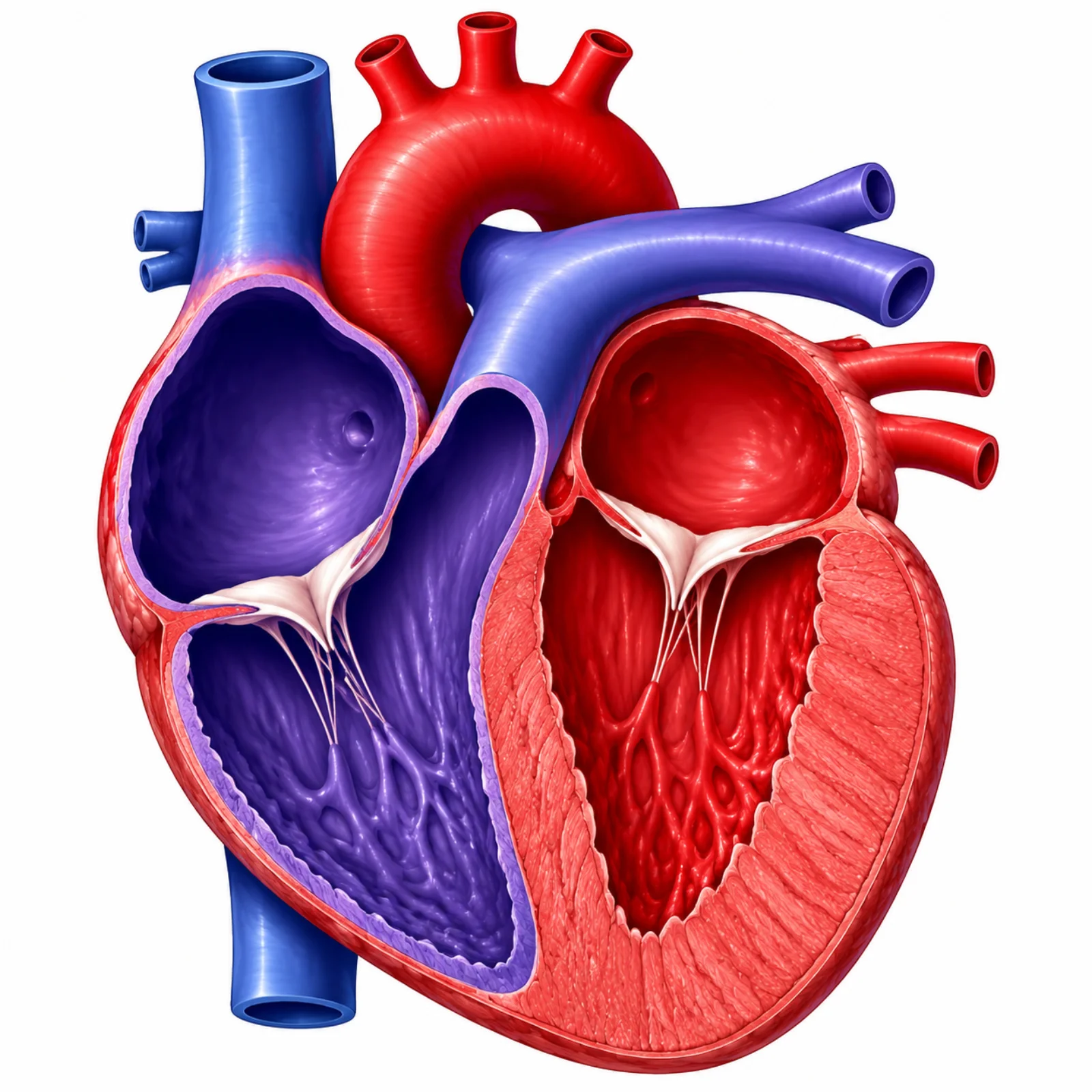
- 1Aorta — Carries oxygenated blood from the left ventricle to the whole body.
- 2Pulmonary artery — Carries deoxygenated blood from the right ventricle to the lungs.
- 3Right atrium — Receives deoxygenated blood from the body via the vena cava.
- 4Right ventricle — Pumps deoxygenated blood to the lungs. Thinner wall than the left ventricle.
- 5Left atrium — Receives oxygenated blood from the lungs via the pulmonary veins.
- 6Left ventricle — The most powerful pump. Thick muscular wall pushes blood to the whole body.
- 7Bicuspid valve — Prevents blood flowing back from the left ventricle into the left atrium.
Figure 1: The human heart in frontal cross-section. Tap any label to explore that structure in detail.
Cardiac Output = Heart Rate × Stroke Volume
Earn the mark scheme marks
Memory Aids
Complete blood flow path — use this mnemonic:
"Very Rich Royals Prefer Luxury Palaces, Lovely Architecture"
- Vena cava
- Right atrium
- Right ventricle
- Pulmonary artery (to lungs)
- Lungs (oxygenation)
- Pulmonary vein (from lungs)
- Left atrium
- Aorta (from left ventricle to body)
Artery vs Vein: Arteries carry blood Away from the heart. Veins carry blood TO (into) the heart — and veins have valves because the pressure is low and blood needs help flowing back up against gravity.
Valve names: Tricuspid has 3 flaps and is on the Right (T and R — both later in the alphabet, like Right). Bicuspid has 2 flaps and is on the Left.
Cardiac output calculation: CO = HR x SV — "Heart Rate times Stroke Volume gives the output."
Quick Check: A person has a blockage in their coronary arteries, but their heart chambers are constantly filled with blood. Explain why this blockage could still cause the heart to stop working.
The blood inside the heart chambers cannot diffuse into the thick cardiac muscle walls quickly enough to supply the muscle cells with oxygen and glucose. The heart muscle has its own separate blood supply via the coronary arteries, which branch off the aorta and run along the outer surface of the heart. If a coronary artery becomes blocked — for example by a fatty deposit (atherosclerosis) — the heart muscle cells beyond the blockage are deprived of oxygen and glucose. Without oxygen, aerobic respiration cannot occur, so the muscle cells cannot produce the ATP needed for contraction. The affected section of heart muscle dies, causing a heart attack (myocardial infarction).
Quick Check: During exercise, a person's heart rate increases from 70 to 140 beats per minute and their stroke volume increases from 70 ml to 100 ml. Calculate the cardiac output at rest and during exercise and explain why this increase is important.
Resting cardiac output = 70 × 70 = 4,900 ml/min (approximately 5 litres/min). Exercise cardiac output = 140 × 100 = 14,000 ml/min (14 litres/min). The cardiac output nearly triples during exercise. This is important because exercising muscles have a greatly increased demand for oxygen (for aerobic respiration to produce ATP) and glucose. They also produce more carbon dioxide and lactic acid that must be removed. A higher cardiac output delivers oxygen and glucose faster and removes waste products more quickly, allowing the muscles to sustain exercise and preventing the build-up of lactic acid that causes fatigue.
Quick Check: Explain why the double circulatory system gives mammals an advantage over fish, which have a single circulatory system.
In a single circulatory system (as in fish), blood passes through the heart once per circuit. After passing through the gill capillaries to be oxygenated, blood pressure drops significantly. The blood then continues at lower pressure to the body tissues. In a double circulatory system, blood returns to the heart after oxygenation in the lungs, where the left ventricle pumps it out again at high pressure to the body organs. This means body organs receive blood at high pressure, allowing more efficient and rapid delivery of oxygen and nutrients. This supports the higher metabolic rate of warm-blooded mammals, which need to supply energy continuously to maintain body temperature.
Now try it yourself
Quiz · Question 1 of 30
How many chambers does the human heart have?
Tap an answer to check it
This topic in real past papers
Every real exam question we've found on the heart and circulation, with a full worked answer.