Test yourself on Variation with exam style questions, marked instantly.
Flashcards that come back just before you would forget them.
A revision plan that remembers what you know and shows what to do next.
See which topics you have nailed and which need another look.
Quiz yourself on VariationGet your flashcardsBuild my revision planTrack my progressTypes of Variation
Caused by differences in genes inherited from parents
Examples: Blood type, eye colour, inherited diseases
Caused by conditions in which organism develops
Examples: Scars, language spoken, tanned skin
Most characteristics are influenced by BOTH:
- Height: Genes set potential, but nutrition affects actual height
- Weight: Metabolism is genetic, but diet/exercise affect it
- Intelligence: Genetic component, but education matters too
Sources of Genetic Variation
- Mutations: Random changes in DNA sequence
- Sexual reproduction: Mixing of alleles from two parents
- Meiosis: Random assortment of chromosomes; crossing over
Visual: Variation
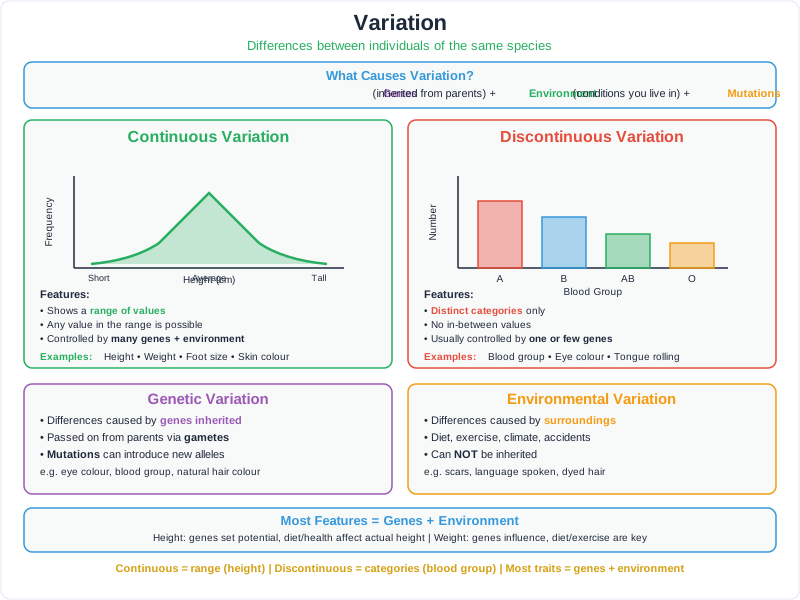
Remember: Continuous = range (height, weight) | Discontinuous = distinct groups (blood type) | Most traits affected by BOTH genes AND environment
How It Works: How Variation Arises
Variation between individuals arises from three main sources: genetics, environment, and mutations. Sexual reproduction is the primary mechanism for generating genetic variation. During meiosis, chromosomes are shuffled — homologous chromosomes pair up and exchange segments in a process called crossing over, and then separate randomly into gametes. This means each gamete contains a unique combination of alleles. When two gametes from different parents fuse at fertilisation, the resulting offspring has a novel combination of alleles from four grandparents, ensuring no two individuals (except identical twins) are genetically identical.
Mutations are spontaneous, random changes in DNA base sequence. Most mutations have no effect on the organism (they occur in non-coding DNA or are repaired by cellular machinery). Some mutations are harmful — they produce non-functional proteins. Rarely, a mutation is beneficial and may be selected for by natural selection. Mutations are the ultimate source of all new genetic variation in a population; without them, only existing allele combinations would be possible.
Environmental variation arises because development and phenotype are influenced by the conditions in which an organism lives. Identical twins share the same genome, but differences in diet, exercise, disease exposure, and lifestyle mean they can have measurably different heights, weights, and even facial features as adults.
Key Definitions
Common Misconceptions
Misconception: "All variation is inherited from parents."
Reality: Many characteristics are influenced or determined by environmental factors. Scars, tattoos, and tanned skin are entirely environmental. Characteristics such as height and body mass are influenced by both genetics (inherited potential) and environment (nutrition, exercise, health). Blood group is purely genetic, but most traits involve both.
Misconception: "Mutations are always harmful."
Reality: The vast majority of mutations are neutral — they have no effect because they occur in non-coding regions of DNA or produce a protein that still functions normally. Some mutations are beneficial and may improve an organism's survival or reproduction. Harmful mutations do occur, but they are not the majority. Mutations are the source of all new genetic variation and are essential for evolution.
Misconception: "Continuous variation is genetic and discontinuous variation is environmental."
Reality: Both continuous and discontinuous variation can be genetic, environmental, or a combination. Blood group (discontinuous) is entirely genetic. Body mass (continuous) is influenced by both genetics and environment. The distinction between continuous and discontinuous is about the pattern of variation (range vs. categories), not its cause.
Misconception: "Identical twins have exactly the same characteristics."
Reality: Identical twins share the same genome (formed from one fertilised egg that splits), but they can have different phenotypes due to environmental variation. Differences in diet, exercise, stress, or illness during development can lead to measurable differences in height, weight, health, and even appearance.
Memory Aids
GEM causes variation: Genes, Environment, Mutations — the three sources of variation. "GEM" is the gem of a mnemonic for this topic.
Continuous vs Discontinuous — "C for Curve, D for Distinct": Continuous variation produces a smooth normal distribution curve on a graph (e.g., a bell curve of heights). Discontinuous variation produces distinct, separate bars on a bar chart (e.g., blood group A, B, AB, O — no in-between).
Examples to remember for each type: Continuous: height, mass, foot size, IQ test score. Discontinuous: blood group (ABO), eye colour (categorical), tongue rolling (yes/no), sex (male/female). When in doubt, ask: "Could there be a value in between?" If yes, it is continuous.
Mutations are rare, random, and mostly neutral: The 3 Rs of mutations. They are not directed towards a particular outcome — a mutation cannot "decide" to be helpful.
Quick Check: A student measures the heights of 100 students in Year 11. Explain why a graph of height would show a normal distribution, and identify one genetic and one environmental factor that contributes to height variation.
Height is an example of continuous variation — it is influenced by many genes (polygenic inheritance) and environmental factors, so individuals show a range of values from shortest to tallest, with most people clustered around the mean. This produces a bell-shaped normal distribution curve. Genetic factor: the genes inherited from parents set the potential height range (tall parents tend to have taller children). Environmental factor: nutrition during childhood — adequate calcium and protein intake supports bone and muscle growth, so better-nourished individuals tend to reach more of their genetic potential height.
Quick Check: Explain how sexual reproduction and meiosis together increase genetic variation in a population compared to asexual reproduction.
During meiosis, homologous chromosomes pair up and crossing over occurs — segments of chromosomes are exchanged, creating new combinations of alleles on each chromosome. Chromosomes then separate randomly into gametes, so each gamete has a unique combination. At fertilisation, gametes from two different parents combine, mixing alleles from four grandparents. This means every offspring (except identical twins) has a genotype different from any other individual. Asexual reproduction produces genetically identical offspring (clones) by mitosis, so no new combinations arise. Sexual reproduction therefore generates much greater genetic diversity within a population.
Quick Check: A new mutation arises in a gene coding for a digestive enzyme. Evaluate the likely impact of this mutation on the organism.
The impact depends on the type of mutation. Most mutations are neutral: if the mutation occurs in a non-coding region, or produces a codon that codes for the same amino acid (silent mutation), the enzyme structure and function are unchanged. A harmful mutation that changes the amino acid sequence could alter the active site shape, reducing or eliminating enzyme function and impairing digestion — this could be fatal if the enzyme is essential. A beneficial mutation is very rare but possible — the enzyme could have an improved active site or greater stability. Overall, neutral or harmful outcomes are far more likely than beneficial ones, but mutations are not always damaging.
Exam Focus
Regularly ExaminedVariation is tested regularly in AQA Paper 2 and Edexcel 1BI0/1 (Paper 1), often as shorter questions and as context for longer evolution questions. Common question formats:
- Classify variation type: Given an example (e.g., blood group, height), state whether it is continuous or discontinuous and whether it is genetic, environmental, or both.
- Graph interpretation: Describe the pattern shown in a histogram (normal distribution = continuous variation; separate bars = discontinuous variation).
- Explain sources of variation: Name and explain three causes — mutations, sexual reproduction (meiosis and random fertilisation), and environmental factors.
- Link to evolution: Variation questions often connect to natural selection — "explain why variation is important for natural selection" (variation provides the raw material for selection to act on).
Edexcel 1BI0 style: Edexcel Paper 1 (1BI0/1) often uses a data table or bar chart as stimulus — for example, measurement data for height, hand span, or reaction time from a class investigation. You may be asked to identify whether the data shows continuous or discontinuous variation, and to "Suggest" reasons for the distribution pattern. Extended questions link variation to natural selection and evolution — Edexcel expects you to make this connection explicitly rather than treating variation as a standalone topic.
Command word alert: "Describe the pattern" when given a graph = state whether it is a normal distribution (continuous) or separate categories (discontinuous). "Explain why" = give the biological reason for the pattern.
Exam Tips: Variation
Classify carefully: When asked to classify a characteristic, consider whether the graph would be a smooth curve (continuous) or distinct separate bars (discontinuous). Height → bell curve → continuous. Blood group → A, B, AB, O bars → discontinuous.
Mutations are neutral, not always harmful: If asked to evaluate the effect of a mutation, always consider neutral outcomes as well as harmful. The mark scheme often includes "most mutations have no effect" as a mark point.
Three sources of variation: Always be able to name all three — (1) mutations, (2) sexual reproduction / meiosis, (3) environmental factors. Listing only one or two will lose marks on "explain the causes of variation" questions.
Link variation to evolution: Variation is the foundation of natural selection. If variation questions appear near evolution questions, the link is deliberate. Be prepared to explain: variation → some individuals better adapted → better survival and reproduction → alleles passed on.
Identical twins as evidence: Identical twins with different phenotypes are frequently used as exam contexts to test whether you understand the difference between genetic and environmental variation. Both share the same genotype, so any differences between them are environmental.
Edexcel data analysis on variation: Edexcel 1BI0/1 uses variation as a context for data-handling skills. If given a table of measurements, you may be asked to calculate the range, identify anomalous results, or compare distributions between two groups. These are AO3 "analyse" marks — state what the data shows, then explain the biological reason. Do not just describe the numbers.
Make this stick
Signing in gives access to all PrepWise features.