Paper 2 Higher

PrepWiseGuide to a real paper

Edexcel GCSE Biology

Paper 2 Higher

June 2025
100 marks · 1 hour 45 minutes · 10 questions

A real paper, in its real order. Each description and answer is ours, so you can see how each mark is earned. Not made or approved by Edexcel.

PrepWise guide: Edexcel GCSE Biology Paper 2 HigherQuestion 1

Bananas go from green to yellow as they ripen, and they get sweeter. Figure 1 shows an unripe bunch beside a ripe one. Unripe fruit stores more of its carbohydrate as starch.
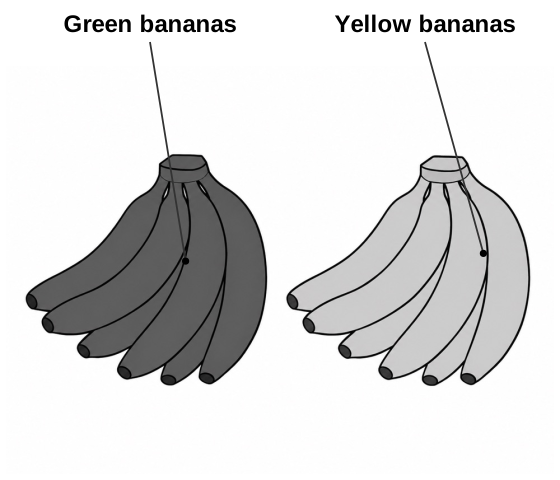
Figure 1
Line drawing of two bunches of bananas side by side, the left bunch shaded darker and labelled green bananas, the right bunch shaded lighter and labelled yellow bananas.
01.1[2 marks]

Unripe bananas hold more starch. Describe a chemical test that shows starch is present.

See how you would score on The Human Digestive System
Show model answer for 01.1Hide model answer for 01.1

Put a few drops of iodine solution on a slice of the banana.

If the iodine changes from orange-brown to blue-black, starch is present.

2 marks

How the marks are earned

  1. One mark: add iodine. Iodine solution is the usual form, and the word iodine alone earns the mark.
  2. One mark: a blue-black colour means starch is there. Saying that the banana is what turns is not needed.

Why it scores

Naming iodine as the reagent earns the first mark.

The second mark is for the result, the blue-black colour that shows starch.

Revise The Human Digestive System
01.2[3 marks]

Ripening turns the starch into glucose. Describe how to test a banana for glucose.

See how you would score on The Human Digestive System
Show model answer for 01.2Hide model answer for 01.2

Mash some banana with a little water and add Benedict's reagent.

Heat the tube in a hot water bath for about five minutes.

If the blue mixture turns brick red, glucose is present.

3 marks

How the marks are earned

  1. One mark: Benedict's reagent (Benedict's solution counts).
  2. One mark: heat the sample, for example in a hot water bath. The heating step must be stated: the word heat, or heated, is needed. Saying it is heated with the reagent is not needed.
  3. One mark: a red colour shows glucose. The word brick is not needed. Yellow, green or orange is also credited in place of brick red.

Why it scores

The first mark is for naming Benedict's reagent.

The second mark is for heating. Benedict's reagent gives no change in the cold.

The third mark is for the positive colour. Green, yellow or orange also shows some glucose.

Revise The Human Digestive System
01.3[2 marks]

A green banana gave starch but no glucose; a yellow one gave both. Why did the yellow banana contain glucose?

See how you would score on Enzymes in Digestion
Show model answer for 01.3Hide model answer for 01.3

As the banana ripened, some of its starch was broken down into glucose.

Enzymes in the fruit, such as amylase, carry out this breakdown.

2 marks

How the marks are earned

  1. One mark: starch in the banana has been changed into glucose. Mentioning ripening is not needed.
  2. One mark: enzymes carry out this change.

Why it scores

The first mark is for the starch being converted to glucose. Starch is still there, so only part of it was changed.

The second mark is for naming enzymes as the cause.

Revise Enzymes in Digestion
Edexcel owns the copyright in its exam questions, so we cannot copy their wording. These descriptions and answers are ours. Not made or approved by Edexcel.[7 marks]
PrepWise guide: Edexcel GCSE Biology Paper 2 HigherQuestion 2

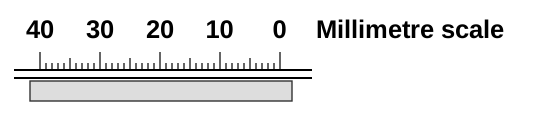
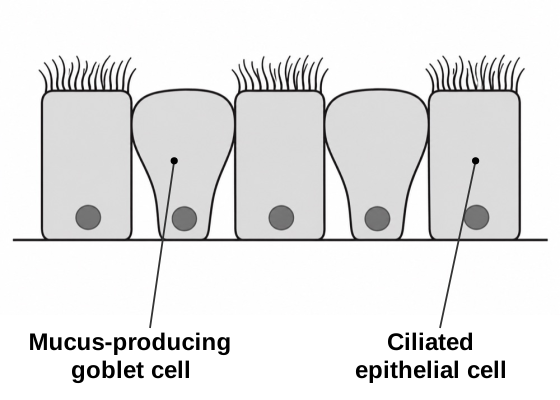
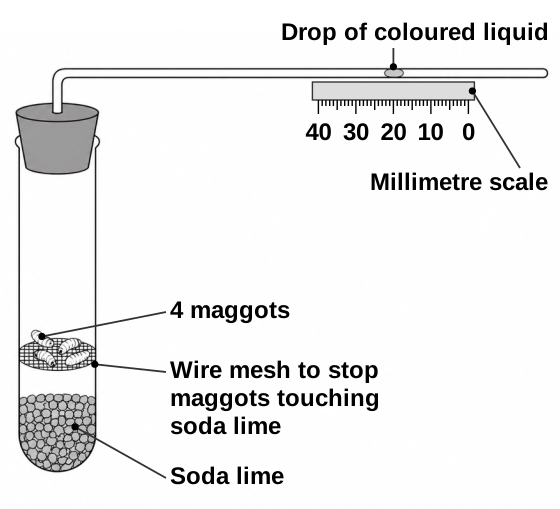
The lining of the lung airways has two kinds of cell side by side, goblet cells and ciliated cells (Figure 2). Later, a respirometer measures how fast maggots respire (Figure 4): they sit on a wire mesh over soda lime in a sealed tube, and a coloured drop in a narrow side tube moves along a millimetre scale. Figure 5 is that scale with no drop drawn.

Figure 2
Diagram of a row of five cells lining an airway: three with fine hairs on top and two flask-shaped cells between them. One leader line is labelled mucus-producing goblet cell and another ciliated epithelial cell.
Figure 4
Apparatus diagram: an upright test tube holding soda lime at the bottom, a wire mesh above it and maggots on the mesh. A bent glass tube leaves the stopper and runs to the right along a millimetre scale numbered 40 at the left to 0 at the right, with a drop of coloured liquid inside the tube.
Figure 5
The glass tube and millimetre scale from Figure 4 on their own, numbered 40 at the left to 0 at the right, with no drop in the tube.
02.1[2 marks]

Figure 2 shows goblet cells and ciliated cells lining an airway. Describe how these cells clear pathogens out of the airways.

See how you would score on Human Defense Systems - Non-specific
Show model answer for 02.1Hide model answer for 02.1

Goblet cells make sticky mucus, and pathogens in the air we breathe get trapped in it.

The cilia on the ciliated cells beat and waft the mucus up the trachea to the throat, where it is swallowed.

2 marks

How the marks are earned

  1. Any two of: pathogens stuck in mucus (naming pathogens is not needed); hairs or cilia moving or wafting the mucus or the pathogens (naming cilia or hairs is needed); mucus moved up the trachea, up a bronchiole, on to the throat, or swallowed.
  2. Micro-organisms is credited in place of pathogens.
  3. Hairs is credited in place of cilia.
  4. Away from the lungs is credited for the third point.

Why it scores

The first mark is for the pathogens being caught in the mucus.

The second mark is for the cilia moving the mucus, and the third idea, where it goes, also earns a mark. Any two of the three points earn both marks.

Revise Human Defense Systems - Non-specific
02.2[2 marks]

In a race, a runner's muscles respire with and without oxygen. Explain how the aerobic process supplies energy to run.

See how you would score on Respiration
Show model answer for 02.2Hide model answer for 02.2

In the mitochondria of the muscle cells, glucose reacts with oxygen to make carbon dioxide and water.

The reaction is exothermic, so it releases energy that the muscles use to contract while running.

2 marks

How the marks are earned

  1. Any two linked points: glucose reacts with oxygen; carbon dioxide and water are made; the reaction is exothermic; it takes place in the mitochondria.
  2. C6H12O6 and O2 are credited for glucose and oxygen.
  3. CO2 and H2O are credited for carbon dioxide and water.
  4. A correct equation for aerobic respiration earns both marks.

Why it scores

This gives the reactants, the products and where it happens. Any two of these points already earn both marks.

Exothermic is the link to energy, and it is a further mark point.

Revise Respiration
02.3[1 mark]

In the apparatus of Figure 4, why is soda lime put in the test tube?

See how you would score on Respiration
Show model answer for 02.3Hide model answer for 02.3

To absorb the carbon dioxide the maggots give out, so the drop moves only because oxygen is used up.

1 mark

How the marks are earned

  1. It absorbs the carbon dioxide. CO2 is credited.
Revise Respiration
02.4[1 mark]

The drop starts at 20 mm and moves 2 mm each minute. Mark on Figure 5 where it will be after 5 minutes.

See how you would score on Respiration
Show model answer for 02.4Hide model answer for 02.4

distance moved: 2 × 5 = 10 mm new position: 20 + 10 = 30 mm Draw the drop at 30 mm, towards the test tube.

1 mark

How the marks are earned

  1. The drop drawn at 30 mm on the scale: it moves 2 × 5, or 10 mm, towards the test tube, from 20 mm.
Revise Respiration
02.5[2 marks]

The test is run again with 2 maggots instead of 4. Explain what difference this makes to the way the drop moves.

See how you would score on Respiration
Show model answer for 02.5Hide model answer for 02.5

With fewer maggots the drop creeps along at a lower speed and covers less of the scale in the same time.

Two maggots carry out less respiration than four, so they use up less oxygen and the pressure in the tube falls less.

2 marks

How the marks are earned

  1. Any two linked points: the drop moves more slowly, or a shorter distance; because less oxygen is used; because less respiration takes place.
  2. Less carbon dioxide made or absorbed is credited in place of less oxygen used.

Why it scores

The first mark is for the effect on the drop.

The second mark is for the reason. Less respiration and less oxygen used are both mark points.

Revise Respiration
02.6[1 mark]

Give one change that would make the results of this investigation more reliable.

See how you would score on Cell Biology Practical Investigations
Show model answer for 02.6Hide model answer for 02.6

Repeat the whole investigation three times and calculate a mean distance moved.

1 mark

How the marks are earned

  1. Repeat the investigation, or work out a mean.
Revise Cell Biology Practical Investigations
Edexcel owns the copyright in its exam questions, so we cannot copy their wording. These descriptions and answers are ours. Not made or approved by Edexcel.[9 marks]
PrepWise guide: Edexcel GCSE Biology Paper 2 HigherQuestion 3

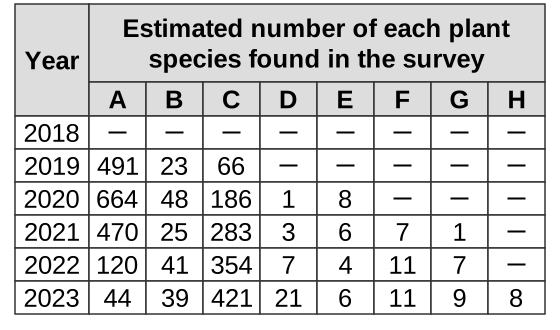
In 2018 every plant was cleared from 1000 m2 of soil, and a wall was put round the plot so people could not get in. By 2019 three plant species were growing there, two of them indigenous. The plot was surveyed each year after that, and Figure 6 gives the estimated number of plants of species A to H.

Figure 6
Table with one row for each year from 2018 to 2023 and one column for each plant species, lettered A to H, holding the estimated number of plants. A dash means none were found.
03.1[1 mark]

Two of the three species growing there in 2019 were indigenous. What does indigenous mean?

See how you would score on Biodiversity and Human Impacts
Show model answer for 03.1Hide model answer for 03.1

Native: the species lives naturally in this country, where it first came from.

1 mark

How the marks are earned

  1. Native, or coming from that country originally. The word species is not needed.
Revise Biodiversity and Human Impacts
03.2[1 mark]

Give one item of equipment a student could use to sample how many indigenous plants grow in the plot.

See how you would score on Ecosystems Communities
Show model answer for 03.2Hide model answer for 03.2

A quadrat, for example a 1 m by 1 m square frame.

1 mark

How the marks are earned

  1. A quadrat, or a square area of a stated size, for example 1 m by 1 m.
  2. A belt transect, a line transect or a grid is also credited.
Revise Ecosystems Communities
03.3[1 mark]

Use Figure 6 to state the trend in the number of species C plants between 2019 and 2023.

See how you would score on Ecosystems Communities
Show model answer for 03.3Hide model answer for 03.3

The number of species C plants increases every year.

1 mark

How the marks are earned

  1. It increases. Goes up or rises is credited too.
Revise Ecosystems Communities
03.4[1 mark]

Species B fell in number in 2021, perhaps through competition. Using Figure 6, which species most likely outcompeted it? Tick one box.

See how you would score on Competition Adaptations
Species A
Species C
Species D
Species H
Show model answer for 03.4Hide model answer for 03.4

Species C. It kept growing in number while B fell. Species A was falling itself, species D stayed tiny, and species H had not yet arrived.

1 mark

How the marks are earned

  1. Tick species C.
Revise Competition Adaptations
03.5[2 marks]

Suggest and explain one way in which the species you chose might have beaten species B in competition.

See how you would score on Competition Adaptations
Show model answer for 03.5Hide model answer for 03.5

Species C could have grown taller than species B, with bigger leaves.

Its leaves would shade species B, so C absorbed more light for photosynthesis and B got less.

2 marks

How the marks are earned

  1. One mark: the species was bigger in some way, such as taller, with larger leaves or with larger roots.
  2. Growing more, reproducing more, taking up more space or having a higher population is also credited for this mark.
  3. One mark, linked to it: so it got more of a resource, such as light, water, minerals or nutrients, or it photosynthesised more.
  4. A named mineral is credited in place of minerals.
  5. The reverse argument about species B is credited, for example B was shorter so it got less light.
  6. Species B being hit by disease, or eaten by animals, is credited for one mark.

Why it scores

The first mark is for a feature that gave species C the advantage.

The second mark links the feature to the resource that was won.

Revise Competition Adaptations
03.6[1 mark]

Species H later got into the walled plot. Suggest one way it could have arrived.

See how you would score on Ecosystems Communities
Show model answer for 03.6Hide model answer for 03.6

Its seeds were blown over the wall by the wind.

1 mark

How the marks are earned

  1. Any one of: carried in by the wind; brought in by animals; roots or shoots growing under the wall (the word growing is needed). For the wind and the animals, the word seeds is not needed.
Revise Ecosystems Communities
03.7[2 marks]

Plants need water as well. Explain how water from the soil gets into a plant.

See how you would score on Plant Transport Systems
Show model answer for 03.7Hide model answer for 03.7

Water enters the root hair cells from the soil by osmosis.

It crosses the partially permeable cell membrane, moving from the soil, where the water concentration is higher, into the cell, where it is lower.

2 marks

How the marks are earned

  1. Any two of: through the root hair cells (the word cells is not needed, and roots counts); by osmosis (the word osmosis is needed); across a partially permeable membrane (semi-permeable is credited); from a high to a low water concentration.
  2. Down a concentration gradient is credited for the last point.

Why it scores

Root hair cells and osmosis are each a mark point, so this line already earns both marks.

The membrane and the direction of movement are further mark points that make the explanation complete.

Revise Plant Transport Systems
Edexcel owns the copyright in its exam questions, so we cannot copy their wording. These descriptions and answers are ours. Not made or approved by Edexcel.[9 marks]
PrepWise guide: Edexcel GCSE Biology Paper 2 HigherQuestion 4

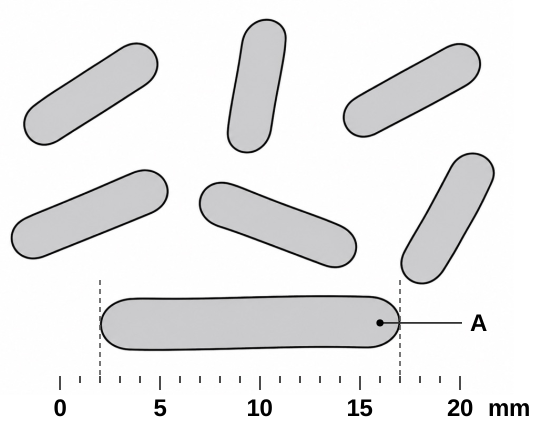
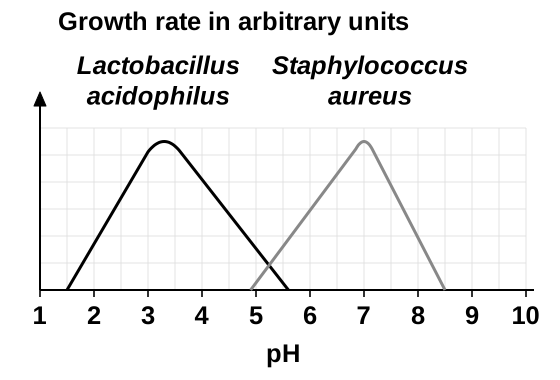
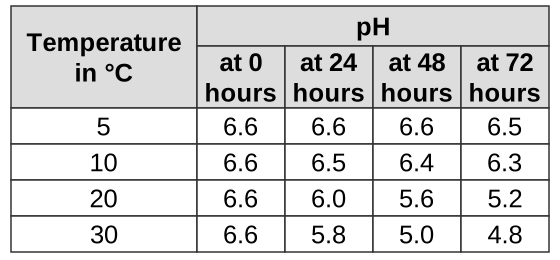
Lactobacillus acidophilus is a bacterium that lives in cow's milk. Figure 7 is a drawing of it magnified 18 000 times, with a millimetre scale beside the cell labelled A. Figure 8 plots how fast two kinds of bacteria grow across a range of pH. In a decay study, a student kept beakers of milk in water baths at four temperatures for 72 hours and read the pH with a probe once a day; Figure 9 holds the readings.

Figure 7
Line drawing of several rod-shaped bacteria lying in different directions. One rod lies flat at the front, labelled A, with a millimetre scale drawn just below it and dotted guide lines down from its two ends.
Figure 8
Squared grid with a pH scale along the bottom and a rate scale up the side. Two curves, black and grey, each carry a bacterium name and rise to one peak, then fall.
Figure 9
Grid of acidity readings of milk, with four rows for different warmth settings and four columns for times, the last at three days.
04.1[3 marks]

Figure 7 is magnified ×18 000. Measure bacterium A on the drawn scale, then give its real length in mm, in standard form.

See how you would score on Microscopy
Show model answer for 04.1Hide model answer for 04.1

Bacterium A runs from 2 mm to 17 mm on the scale. length of A = 17 − 2 = 15 mm

real length = 15 ÷ 18 000 = 0.00083 mm

real length = 8.3 × 10⁻⁴ mm

3 marks

How the marks are earned

  1. One mark: measuring A as 15 mm. Any reading from 14 mm to 16 mm is credited, and so is the reading given in cm.
  2. One mark: dividing the measured length by the magnification, 15 ÷ 18 000 = 0.00083 mm.
  3. 0.00078, 0.00086 or 0.00089 is also credited for this mark.
  4. One mark: the answer in standard form, 8.3 × 10⁻⁴ mm.
  5. 7.8 × 10⁻⁴, 8.6 × 10⁻⁴ or 8.9 × 10⁻⁴ is also credited for this mark.
  6. A correct answer earns all three marks with no working.

Why it scores

The first mark is for the measurement. Any reading from 14 mm to 16 mm is credited.

Dividing the image length by the magnification earns the second mark.

Writing the answer in standard form earns the third mark. A correct answer alone earns all three.

Revise Microscopy
04.2[1 mark]

Using Figure 8, give one pH at which both species of bacteria can grow.

See how you would score on Decomposition
Show model answer for 04.2Hide model answer for 04.2

pH 5.2, where both lines are above zero.

1 mark

How the marks are earned

  1. A value from pH 5 up to pH 5.4, given as a whole number or to one decimal place, for example 5.2.
Revise Decomposition
04.3[2 marks]

Use Figure 8 to describe how pH affects how fast Staphylococcus aureus grows.

See how you would score on Decomposition
Show model answer for 04.3Hide model answer for 04.3

Staphylococcus aureus starts to grow at about pH 5, and its growth rate increases as the pH rises to 7.

Growth is fastest at pH 7, its optimum, then decreases until it stops at about pH 8.5.

2 marks

How the marks are earned

  1. Any two of: growth rises as the pH goes from 5 to 7; pH 7 is the optimum; growth falls as the pH goes from 7 to 8.5.

Why it scores

The first mark is for growth getting faster between pH 5 and 7.

The optimum at 7, and growth slowing between 7 and 8.5, are each a further mark point.

Revise Decomposition
04.4[1 mark]

Which variable must the student keep the same in the milk investigation? Tick one box.

See how you would score on Cell Biology Practical Investigations
The milk's pH
The milk's temperature
How long the milk is incubated
How much milk is in each beaker
Show model answer for 04.4Hide model answer for 04.4

The volume of milk. The pH is what is measured, the temperature is what is changed, and time is what the readings are taken against, every 24 hours.

1 mark

How the marks are earned

  1. Tick how much milk is in each beaker, the volume of milk.
Revise Cell Biology Practical Investigations
04.5[2 marks]

Use Figure 9 to describe what happened to the pH of the milk kept at 30 °C during the 72 hours.

See how you would score on Decomposition
Show model answer for 04.5Hide model answer for 04.5

The pH fell at every reading, so the milk became more acidic.

It started at 6.6 and ended at 4.8, so it fell 1.8 in total, mostly within the first 48 hours.

2 marks

How the marks are earned

  1. One mark: the pH decreases. Becoming more acidic is also credited.
  2. One mark: it ends at 4.8, or falls by 1.8. Giving the start value of 6.6 is not needed.

Why it scores

The first mark is for the direction of change.

The second mark is for quoting the data, either the end value or the size of the fall.

Revise Decomposition
04.6[2 marks]

Use Figure 9 to work out the rate of decay at 20 °C over the 72 hours. Rate = change in pH ÷ time taken.

See how you would score on Decomposition
Show model answer for 04.6Hide model answer for 04.6

change in pH = 6.6 − 5.2 = 1.4

rate of decay = 1.4 ÷ 72 = 0.019 change in pH per hour

2 marks

How the marks are earned

  1. One mark: the change in pH, 6.6 − 5.2 = 1.4.
  2. One mark: that change ÷ 72, so 1.4 ÷ 72 = 0.019 change in pH per hour.
  3. 0.0194 or 0.02 is also credited.
  4. A correct answer alone earns both marks.

Why it scores

Finding the change in pH over the 72 hours earns the first mark.

Dividing by the time earns the second mark. A correct answer with no working earns both.

Revise Decomposition
Edexcel owns the copyright in its exam questions, so we cannot copy their wording. These descriptions and answers are ours. Not made or approved by Edexcel.[11 marks]
PrepWise guide: Edexcel GCSE Biology Paper 2 HigherQuestion 5

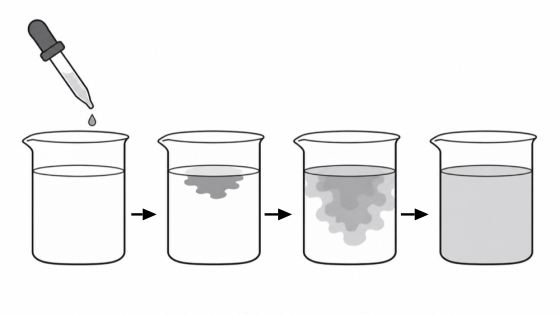
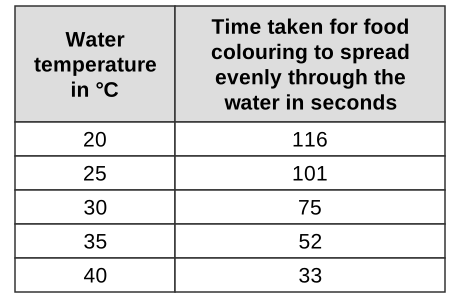
A teacher dripped a food colouring into a beaker of water, five drops in all, and timed how long the colour took to become even all through it. Figure 10 shows the stages. The teacher then did the same at five water temperatures, and Figure 11 holds the times.

Figure 10
Four beakers of water in a row joined by arrows. A dropper above the first beaker releases a drop. In the second a small dark patch sits near the surface, in the third a larger cloud spreads down, and in the fourth all the water is evenly shaded.
Figure 11
Two-column table pairing five water temperatures in degrees Celsius with the time in seconds for the food colouring to become even through the water.
Graph grid
Empty square grid of graph paper, six large squares across and six down, each large square split into ten small squares each way.
05.1[1 mark]

Name the process the teacher's food colouring demonstration shows (Figure 10).

See how you would score on Cell Transport
Show model answer for 05.1Hide model answer for 05.1

Diffusion.

1 mark

How the marks are earned

  1. Diffusion. A spelling that sounds like diffusion is credited.
Revise Cell Transport
05.2[2 marks]

A student wants to compare different food colourings. Give two variables that must be kept the same.

See how you would score on Cell Biology Practical Investigations
Show model answer for 05.2Hide model answer for 05.2

1. The same volume of water each time, for example 250 cm3. 2. The water kept at one temperature, for example 20 °C.

2 marks

How the marks are earned

  1. Any two of: the volume of water; the beaker; the temperature; the volume or the concentration of food colouring (keeping the count of colouring drops the same is credited here too); the pipette, or the volume or size of each drop (the word drop is needed).
  2. The word amount on its own earns nothing, for the water or for the food colouring.

Why it scores

Each controlled variable earns one mark. The food colouring is the only thing that should change.

Revise Cell Biology Practical Investigations
05.3[4 marks]

Plot the data in Figure 11 as a line graph on the grid.

See how you would score on Cell Biology Practical Investigations
Show model answer for 05.3Hide model answer for 05.3

x-axis label: water temperature in °C y-axis label: time taken in s

x-axis scale: 20 to 40, 5 °C for each large square y-axis scale: 0 to 120, 20 s for each large square

Plot all five crosses, warmest first: (40, 33) (35, 52) (30, 75) (25, 101) (20, 116) Join the crosses with straight lines using a ruler.

4 marks

How the marks are earned

  1. One mark: both axes labelled, each with its unit.
  2. One mark: water temperature along the x-axis and time up the y-axis.
  3. One mark: a linear scale on each axis.
  4. One mark: all five points plotted correctly and a correct line drawn through them.

Why it scores

Labels with units earn one mark, and putting temperature along the bottom and time up the side earns another.

Equal steps on each axis make the scale linear, which earns a mark. The points then fill more than half the grid.

The last mark needs every point in the right place and the line drawn through them correctly.

Revise Cell Biology Practical Investigations
05.4[2 marks]

Explain why the spreading time became shorter.

See how you would score on Cell Transport
Show model answer for 05.4Hide model answer for 05.4

As the water temperature goes up, its particles and the food colouring particles gain more kinetic energy.

The particles move faster, so the food colouring diffuses and mixes through the water more quickly.

2 marks

How the marks are earned

  1. Any two linked points: the temperature rises; the particles move faster, collide more often or diffuse faster; because they have more kinetic energy (the word kinetic is needed).
  2. Particles spreading out or mixing faster is credited for the second point (the word faster is needed).

Why it scores

The rise in temperature and the extra kinetic energy are each a mark point.

This links the energy to faster movement and faster diffusion, which completes the explanation.

Revise Cell Transport
Edexcel owns the copyright in its exam questions, so we cannot copy their wording. These descriptions and answers are ours. Not made or approved by Edexcel.[9 marks]
PrepWise guide: Edexcel GCSE Biology Paper 2 HigherQuestion 6

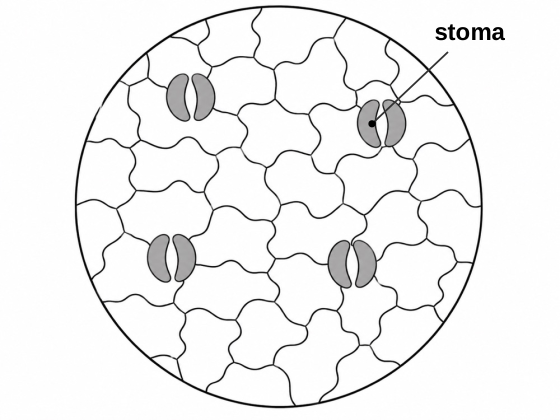
Figure 12 is a drawing of cells on the underside of a leaf, the lower epidermis. One of the pores in it carries the label stoma.

Figure 12
Line drawing of the lower surface of a leaf: a network of irregular epidermal cells with stomata scattered among them, one of them labelled stoma.
06.1[1 mark]

Count the guard cells drawn in Figure 12.

See how you would score on Transpiration
Show model answer for 06.1Hide model answer for 06.1

8. Every stoma in Figure 12 has a pair of guard cells round it, and there are four stomata.

1 mark

How the marks are earned

  1. 8, or eight.
Revise Transpiration
06.2[2 marks]

In daylight, name one gas that passes out of a leaf through its stomata and one gas that passes in.

See how you would score on Photosynthesis
Show model answer for 06.2Hide model answer for 06.2

Leaving: oxygen Entering: carbon dioxide

2 marks

How the marks are earned

  1. One mark, gas out: oxygen, or water vapour. The formula O2 or H2O is accepted.
  2. One mark, gas in: carbon dioxide. The formula CO2 is accepted.

Why it scores

Each gas earns one mark. In light, photosynthesis uses carbon dioxide and makes oxygen. Water vapour would also earn the mark for the gas going out.

Revise Photosynthesis
06.3[1 mark]

Give the reason stomata close.

See how you would score on Transpiration
Show model answer for 06.3Hide model answer for 06.3

Closing the stomata stops water escaping from the leaf, so the plant does not lose too much water and dry out.

1 mark

How the marks are earned

  1. To stop the plant losing water, or to stop it drying out.
Revise Transpiration
06.4[3 marks]

A prepared slide holds a thin cross-section of a leaf. Describe how to look at it with a light microscope.

See how you would score on Microscopy
Show model answer for 06.4Hide model answer for 06.4

Put the slide on the microscope stage and clip it in place.

Turn the nosepiece so the lowest power objective lens is over the slide, and turn the focusing wheel until the leaf cells look sharp.

Then swap to a higher power objective lens and focus again to see the cells in more detail.

3 marks

How the marks are earned

  1. Any three from the four below, linked. One mark each.
  2. The slide is placed on the stage.
  3. The lowest power objective lens is used first. Starting at the lowest magnification is accepted.
  4. The focusing wheel is turned to get a sharp image. Focus, alone, is accepted.
  5. A higher power objective lens is then chosen. Raising the magnification is accepted.

Why it scores

The first step earns one mark.

Starting on the lowest power lens and using the focusing wheel each earn a mark.

Moving up to a higher magnification is the fourth point. Any three of the four earn full marks.

Revise Microscopy
06.5[2 marks]

Leaves make sugars that are needed all over the plant. Explain how the plant moves them.

See how you would score on Plant Transport Systems
Show model answer for 06.5Hide model answer for 06.5

The sugar is turned into sucrose, which moves through the phloem tubes.

This movement is translocation. It takes sugar both upwards and downwards, to the growing tips and to the roots.

2 marks

How the marks are earned

  1. Any two from the five below. One mark each.
  2. The sugar is carried as sucrose.
  3. It moves in the phloem. Naming xylem is rejected.
  4. The process is translocation. Calling it transpiration is rejected.
  5. Active transport is involved.
  6. It flows both up and down the plant, in two directions.

Why it scores

Sucrose and phloem are one mark each.

Translocation, and flow in both directions, are further marking points. Any two points earn both marks.

Revise Plant Transport Systems
Edexcel owns the copyright in its exam questions, so we cannot copy their wording. These descriptions and answers are ours. Not made or approved by Edexcel.[9 marks]
PrepWise guide: Edexcel GCSE Biology Paper 2 HigherQuestion 7

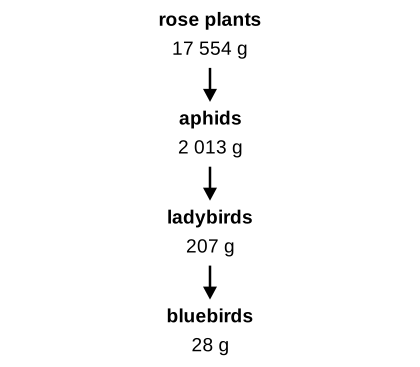
Figure 13 is a food chain that starts with rose plants and ends with bluebirds. The biomass, in grams, of each population is written under its name.

Figure 13
Food chain of four organisms joined by arrows that point downwards, rose plants at the top then aphids, ladybirds and bluebirds, with the biomass of each population in grams written under its name.
07.1[3 marks]

Using Figure 13, find the percentage efficiency from aphids to ladybirds: higher level biomass ÷ previous level biomass × 100. Round to a whole number.

See how you would score on Ecosystems Communities
Show model answer for 07.1Hide model answer for 07.1

share passed on = 207 ÷ 2013 = 0.1028

percentage efficiency = 0.1028 × 100 = 10.28

rounded to a whole number, the efficiency is 10%

3 marks

How the marks are earned

  1. One mark: ladybird biomass over aphid biomass, 207 ÷ 2013.
  2. One mark: that value × 100 (10.28 or 10.3).
  3. One mark: the final answer, 10%.
  4. A correct 10% earns all three marks even with no working.
  5. Two marks for 10.28 or 10.3, a right value that is not rounded to a whole number.

Why it scores

Dividing the ladybird biomass by the aphid biomass earns the first mark.

Multiplying by 100 earns the second mark.

Rounding to a whole number earns the third mark. A correct 10% alone earns all three.

Revise Ecosystems Communities
07.2[2 marks]

In Figure 13 the ladybirds have less biomass than the aphids they feed on. Give two reasons.

See how you would score on Ecosystems Communities
Show model answer for 07.2Hide model answer for 07.2

1. The aphids use much of their food in respiration, and the energy released is used for movement or lost as heat, so it does not become new body mass. 2. The ladybirds do not eat all of every aphid, and some of what they eat is not digested.

2 marks

How the marks are earned

  1. Any two from the five below. One mark each.
  2. Energy used to keep warm. Thermoregulation is accepted.
  3. Respiration.
  4. Excretion.
  5. Not all of each aphid is eaten, or not all of it is digested.
  6. Movement.

Why it scores

Each reason earns one mark. Excretion would also earn a mark.

Revise Ecosystems Communities
07.3[2 marks]

Rose growers lose leaves to aphids. Explain how releasing ladybirds could bring the aphid population down.

See how you would score on Ecosystems Communities
Show model answer for 07.3Hide model answer for 07.3

Ladybirds are predators that eat aphids, so releasing them among the roses lowers the number of aphids.

With fewer aphids, less damage is done to the leaves and the roses stay healthy. Using a living predator like this is called biological control.

2 marks

How the marks are earned

  1. Any two from the three below, linked. One mark each.
  2. Ladybirds eat the aphids. Preying on aphids is accepted.
  3. So the aphids no longer harm the roses. The roses staying healthy is accepted.
  4. Using a living predator this way is biological control.

Why it scores

Ladybirds eating aphids earns the first mark.

The effect on the roses, or naming biological control, earns the second mark.

Revise Ecosystems Communities
07.4[3 marks]

The world's population keeps growing. Name three factors that cut the amount of food people can get.

See how you would score on Biodiversity and Human Impacts
Show model answer for 07.4Hide model answer for 07.4

1. Pests and plant diseases destroy crops. 2. Climate change brings droughts and floods that ruin harvests. 3. Land is used for biofuel crops or for building houses instead of growing food.

3 marks

How the marks are earned

  1. Any three from the list below. One mark each.
  2. People eating more meat (the word more, or increased, is needed).
  3. More animal farming (the word more, or increased, is needed). Overfishing, or over farming of animals, is accepted.
  4. Changes to the environment, or climate change. Pollution or global warming is accepted.
  5. Pests, pathogens or disease in crops or livestock.
  6. Crops grown for biofuels, or crops grown to feed animals.
  7. Less land left for farming: houses built on farmland, or deforestation. Solar farms or landfill are accepted.
  8. Drought, floods, famine or wildfires.
  9. War or conflict.
  10. More food being wasted is also accepted for a mark.

Why it scores

Each different factor earns one mark.

Revise Biodiversity and Human Impacts
Edexcel owns the copyright in its exam questions, so we cannot copy their wording. These descriptions and answers are ours. Not made or approved by Edexcel.[10 marks]
PrepWise guide: Edexcel GCSE Biology Paper 2 HigherQuestion 8

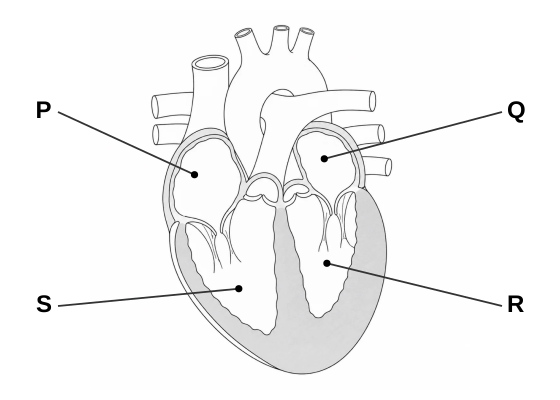
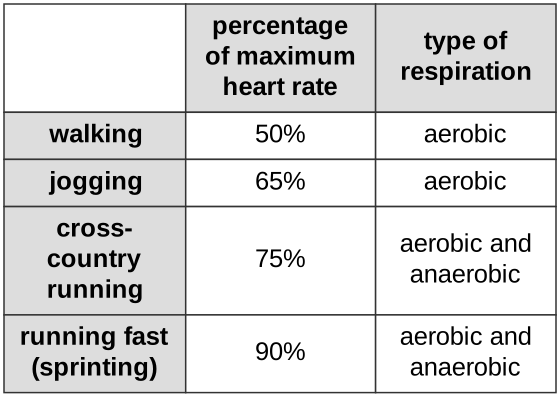
Figure 14 is a drawing of a section through a human heart, with its four chambers lettered P, Q, R and S. Figure 15 is a table that gives, for four activities, the share of maximum heart rate each needs and the kind of respiration used.

Figure 14
Drawing of a section through a human heart, with the main blood vessels at the top and four chambers, each marked by a letter P, Q, R or S on a leader line.
Figure 15
Table with a row for each of four activities, walking, jogging, cross-country running and sprinting, and two columns, one for percentage of maximum heart rate and one for type of respiration.
08.1[1 mark]

Which two chambers in Figure 14 hold nothing but oxygen-rich blood? Tick one box.

See how you would score on The Heart and Circulation
P with Q
S with R
P with S
Q with R
Show model answer for 08.1Hide model answer for 08.1

Q and R. They are the left atrium and left ventricle, which take blood from the lungs. P and S, on the right side of the heart, hold deoxygenated blood from the body.

1 mark

How the marks are earned

  1. Tick Q with R.
Revise The Heart and Circulation
08.2[2 marks]

The bicuspid valve lies between chambers Q and R in Figure 14. Explain what it does.

See how you would score on The Heart and Circulation
Show model answer for 08.2Hide model answer for 08.2

When the left ventricle, R, contracts, the bicuspid valve shuts.

This stops blood flowing backwards from the ventricle into the left atrium, Q, so the blood can only go one way, out through the aorta.

2 marks

How the marks are earned

  1. One mark: it stops blood flowing backwards. Keeping blood moving one way is accepted.
  2. One mark: the backflow it stops is into the atrium, or into Q (the word left is not needed). Flow from the left ventricle back to the left atrium is accepted.

Why it scores

This sets up when the valve works.

Preventing backflow earns one mark, and naming the atrium, Q, as where the blood would go earns the other.

Revise The Heart and Circulation
08.3[3 marks]

Your heart beats faster when you exercise. Explain why.

See how you would score on The Heart and Circulation
Show model answer for 08.3Hide model answer for 08.3

A faster heart rate pumps blood round the body faster.

More oxygen and glucose reach the working muscles, so they can carry out more aerobic respiration and release more energy for contraction.

The faster flow also carries away the extra carbon dioxide, and it helps stop lactic acid building up from anaerobic respiration.

3 marks

How the marks are earned

  1. Any three from the five below, linked. One mark each.
  2. The heart pumps blood faster. Pumping more blood is accepted.
  3. To deliver more oxygen, or more glucose.
  4. For more respiration.
  5. To release more energy for the muscles (the word muscles is needed).
  6. To take away carbon dioxide. Avoiding an oxygen debt, a build-up of lactic acid, or anaerobic respiration is accepted for this point.

Why it scores

This is the first mark.

Extra oxygen or glucose, and more respiration, each earn a mark. More energy for the muscles is a further point.

Removing carbon dioxide is another marking point. Any three points earn full marks.

Revise The Heart and Circulation
08.4[3 marks]

Someone's maximum is 190 beats per minute. Use Figure 15 to work out their heart rate while jogging, to 3 significant figures.

See how you would score on The Heart and Circulation
Show model answer for 08.4Hide model answer for 08.4

Jogging uses 65% of maximum heart rate. heart rate = 65 ÷ 100 × 190 = 123.5

rounded to 3 significant figures, the rate is 124 beats each minute

3 marks

How the marks are earned

  1. One mark: the jogging percentage applied to 190, as 190 ÷ 100 × 65 or 0.65 × 190.
  2. One mark: the unrounded value, 123.5.
  3. One mark: rounded to 3 significant figures, 124 beats per minute.
  4. A correct 124 earns all three marks even with no working.
  5. Two marks for 123 or for 123.5.

Why it scores

Taking 65% from Figure 15 and applying it to 190 earns the first mark. The correct unrounded value, 123.5, earns the second.

Rounding correctly earns the third mark. A correct 124 alone earns all three.

Revise The Heart and Circulation
08.5[3 marks]

Red blood cells, or erythrocytes, take oxygen to respiring cells. Explain the features that help them pick up and give out oxygen.

See how you would score on Blood Components and Vessels
Show model answer for 08.5Hide model answer for 08.5

Red blood cells are packed with haemoglobin, which binds to oxygen in the lungs and lets it go in the tissues. They have no nucleus, so there is more room for haemoglobin and more oxygen can be carried.

Their biconcave shape gives a large surface area, so oxygen diffuses in and out quickly.

They are small, thin and flexible, so they can squeeze through narrow capillaries, and the oxygen has only a short distance to diffuse.

3 marks

How the marks are earned

  1. Any three from the five below, each feature linked to its use. One mark each.
  2. No nucleus (the reason, more room for oxygen, is not needed).
  3. Biconcave shape, giving a bigger surface area or faster diffusion. A large surface area to volume ratio for more diffusion is accepted.
  4. Flexible, small or thin, so they can squeeze through capillaries (the word capillaries is needed).
  5. Full of haemoglobin, which binds to oxygen.
  6. Thin, so oxygen has only a short distance to diffuse.

Why it scores

Haemoglobin binding oxygen earns one mark, and no nucleus earns another.

Biconcave linked to surface area or diffusion earns a mark.

Either fitting through capillaries or the short diffusion distance is a further point. Any three earn full marks.

Revise Blood Components and Vessels
Edexcel owns the copyright in its exam questions, so we cannot copy their wording. These descriptions and answers are ours. Not made or approved by Edexcel.[12 marks]
PrepWise guide: Edexcel GCSE Biology Paper 2 HigherQuestion 9

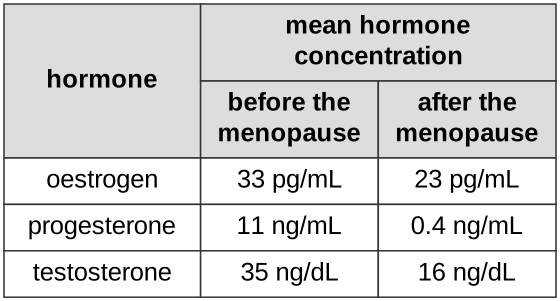
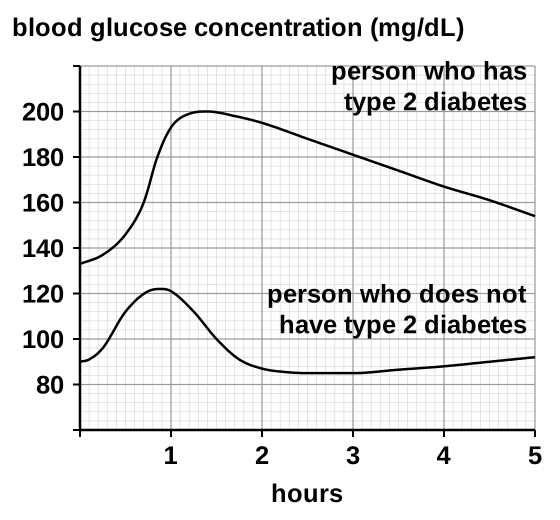
At the menopause, the menstrual cycle comes to an end. Figure 16 is a table of the mean blood levels of three hormones in women, before it and after it. Figure 17 is a graph of blood glucose over 5 hours for two people: one has type 2 diabetes and one does not.

Figure 16
Table with a row for each of three hormones, oestrogen, progesterone and testosterone, under one heading for mean blood concentration, with a column for before the menopause and one for after.
Figure 17
Line graph on a squared grid of blood glucose concentration in mg/dL against time in hours from 0 to 5, with two curves, each named at its right-hand end: one for someone with diabetes, one for someone without.
09.1[3 marks]

Use Figure 16 to compare and contrast how each hormone level changed once the menopause had happened.

See how you would score on Hormones & Behaviour
Show model answer for 09.1Hide model answer for 09.1

Each of the three hormones falls once the menstrual cycle has stopped.

oestrogen fall = 33 − 23 = 10 pg/mL progesterone fall = 11 − 0.4 = 10.6 ng/mL testosterone fall = 35 − 16 = 19 ng/dL

The size of the fall differs. Progesterone drops by about 96%, almost to nothing, testosterone by about 54%, and oestrogen by only about 30%.

3 marks

How the marks are earned

  1. Any three from the four below. One mark each.
  2. Every one of the three hormones is lower after the menopause.
  3. Oestrogen fell by 10 pg/mL. A fall of 30% is accepted.
  4. Progesterone fell by 10.6 ng/mL. A fall of 96% is accepted.
  5. Testosterone fell by 19 ng/dL. A fall of 54% is accepted.

Why it scores

The shared pattern earns the first mark.

Each fall worked out from Figure 16 earns a mark. Three points in all earn full marks.

This is the contrast. Percentage falls are accepted in place of the actual falls.

Revise Hormones & Behaviour
09.2[3 marks]

Explain what FSH and what LH each do during the menstrual cycle.

See how you would score on Hormones & Behaviour
Show model answer for 09.2Hide model answer for 09.2

FSH, from the pituitary gland, makes a follicle in the ovary develop, so that an egg matures inside it.

FSH also makes the ovaries release oestrogen.

LH causes ovulation: around day 14 a surge of LH makes the mature egg leave the ovary.

3 marks

How the marks are earned

  1. Any three from the five below, each linked to the right hormone. One mark each.
  2. FSH makes a follicle develop (the word mature is not needed).
  3. FSH makes an egg (ovum) mature. Egg is accepted for ovum.
  4. FSH makes the ovary produce oestrogen.
  5. LH causes ovulation. The egg being released is accepted.
  6. LH linked to the corpus luteum. For example, the corpus luteum forming from the empty follicle, but that detail is not required.

Why it scores

The follicle and the egg maturing are both FSH points.

Oestrogen production is another FSH point.

Ovulation, or the egg being released, is the LH point. Any three points earn full marks.

Revise Hormones & Behaviour
09.3[6 marks]

Using data from Figure 17, explain how blood glucose is kept in check in someone with type 2 diabetes and in someone without it.

See how you would score on Glucose Regulation
Show model answer for 09.3Hide model answer for 09.3

In the person without diabetes, blood glucose starts at about 90 mg/dL and rises to a peak of about 122 mg/dL after about 1 hour, as glucose from food is absorbed. The pancreas detects the rise and releases insulin.

Insulin makes body cells take in glucose, and the liver converts glucose into glycogen and stores it. So by about 2 hours the level is back down to about 87 mg/dL. Its lowest is about 85 mg/dL, and it stays between about 85 and 92 mg/dL for the rest of the time.

If blood glucose falls too low, the pancreas releases glucagon instead. Glucagon makes the liver turn glycogen back into glucose, which raises the blood glucose level again. The two hormones together keep the level in a narrow range.

In type 2 diabetes the body cells no longer respond properly to insulin, so glucose is not taken out of the blood quickly. The diabetic's curve starts higher, at about 133 mg/dL, rises more steeply to about 200 mg/dL at about 1.4 hours, and falls slowly, still about 154 mg/dL after 5 hours. It never comes down into the healthy range.

Type 2 diabetes is controlled by a diet low in sugar and carbohydrate and by regular exercise. If this is not enough, the person takes medicine, and some inject insulin, to bring their blood glucose down.

Levels of response, 6 marks

How the marks are earned

  1. Level marked. Level 3 (5 to 6 marks): a detailed, fully developed account of glucose control for both people, giving the job of insulin or glucagon, tied to glucose values from Figure 17, and naming both insulin and glucagon. Clear, logical order throughout.
  2. Level 2 (3 to 4 marks): a brief account of control in the person without diabetes, or in the type 2 diabetic, or a remark on each, linked to data from the graph.
  3. Level 1 (1 to 2 marks): a short remark on glucose control in either person, or one valid point from the graph. Two graph points, or one control point with one graph point, reach the top of the level.
  4. Control without diabetes: both insulin and glucagon act; insulin is released by the pancreas and lowers blood glucose by turning glucose into glycogen, which the liver stores; glucagon is released by the pancreas and raises blood glucose by turning glycogen back into glucose.
  5. Type 2 diabetes: the body cells resist insulin, so blood glucose stays high; it is managed by diet and exercise, by medicine, or by injecting insulin to bring glucose down.
  6. Graph points: the top curve sits above the bottom one at every time, spanning 135 up to 200 mg/dL, while the bottom curve spans 90 up to 125 mg/dL; the top curve climbs more steeply and falls more slowly. Close readings, such as 133 to 200 and 85 to 122 mg/dL, are credited.

Why it scores

This ties the healthy curve in Figure 17 to the release of insulin from the pancreas.

How insulin lowers glucose, with data from the graph, is detail needed for the top level.

Level 3 needs both insulin and glucagon.

This explains the type 2 curve and links it to values read from Figure 17: higher throughout, a steeper rise and a slower fall.

How type 2 is controlled completes a detailed account for both people, which earns 6 of 6.

Revise Glucose Regulation
Edexcel owns the copyright in its exam questions, so we cannot copy their wording. These descriptions and answers are ours. Not made or approved by Edexcel.[12 marks]
PrepWise guide: Edexcel GCSE Biology Paper 2 HigherQuestion 10

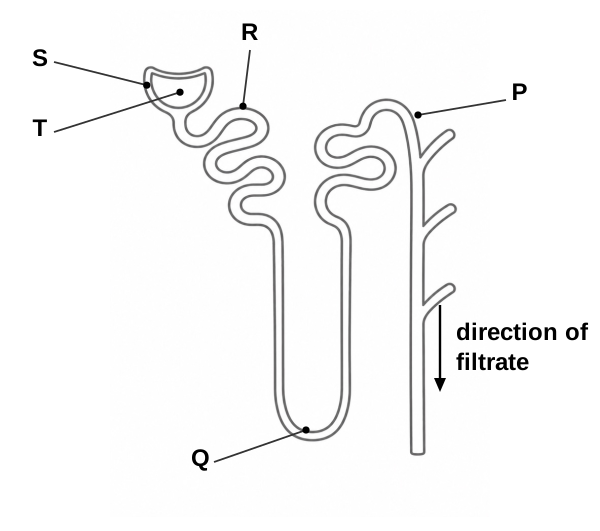
Figure 18 is a drawing of one nephron from a human kidney. Five parts carry the letters P, Q, R, S and T, and arrows show which way the filtrate flows.

Figure 18
Drawing of one nephron: a long tube with a rounded end at the top left, a coiled section, a long loop and a straight duct with side branches. The letters P, Q, R, S and T sit on leader lines, and arrows show the filtrate direction.
10.1[1 mark]

In Figure 18, which letter marks the glomerulus? Tick one box.

See how you would score on Water Regulation
S
T
Q
P
Show model answer for 10.1Hide model answer for 10.1

T. The glomerulus is the knot of capillaries at the start of the nephron, where blood is filtered. S is the Bowman's capsule round it, Q is the loop of Henle and P is the collecting duct.

1 mark

How the marks are earned

  1. Tick T.
Revise Water Regulation
10.2[1 mark]

In Figure 18, which letter marks the Bowman's capsule? Tick one box.

See how you would score on Water Regulation
T
S
R
P
Show model answer for 10.2Hide model answer for 10.2

S. The Bowman's capsule is the cup that surrounds the glomerulus, T, and collects the filtrate. R is the first coiled tubule and P is the collecting duct.

1 mark

How the marks are earned

  1. Tick S.
Revise Water Regulation
10.3[2 marks]

The PCT is the first coiled tubule after the Bowman's capsule. Describe what happens to the filtrate there.

See how you would score on Water Regulation
Show model answer for 10.3Hide model answer for 10.3

In the PCT, useful substances are taken back from the filtrate into the blood. This is selective reabsorption.

All of the glucose is reabsorbed here, using active transport.

2 marks

How the marks are earned

  1. Any two from the three below. One mark each.
  2. Selective reabsorption takes place (the word selective is needed).
  3. Of glucose. Glucose is reabsorbed is accepted (the words back into the blood are not needed).
  4. By active transport.

Why it scores

Naming selective reabsorption earns one mark.

Glucose, or active transport, earns the second mark.

Revise Water Regulation
10.4[2 marks]

Give the job of the ureters and the job of the bladder.

See how you would score on Water Regulation
Show model answer for 10.4Hide model answer for 10.4

Ureters: they carry urine away from each kidney down to the bladder. Bladder: it stores the urine until it is released.

2 marks

How the marks are earned

  1. One mark, ureters: carry urine to the bladder from the kidney (both the words kidney and bladder are needed). Waste material or urea is accepted for urine.
  2. One mark, bladder: stores urine. Waste material or urea is accepted for urine.

Why it scores

One mark for each organ's job.

Revise Water Regulation
10.5[6 marks]

Someone has drunk a lot of water and now has too much water in their blood. Explain how the body brings it back to normal.

See how you would score on Water Regulation
Show model answer for 10.5Hide model answer for 10.5

Drinking a large volume of water makes the blood too dilute. The hypothalamus in the brain detects that the water level of the blood is too high.

It sends a signal to the pituitary gland, which then releases less ADH into the blood. So less ADH is carried in the bloodstream to the kidneys.

ADH makes the walls of the collecting duct more permeable to water. With less ADH, the protein channels that carry water through those walls close, so the walls let far less water through.

So less water is reabsorbed from the filtrate back into the blood. The extra water stays in the nephron and passes on into the urine.

The kidneys make lots of dilute urine, so the blood's water level returns to normal. This is an example of negative feedback.

Levels of response, 6 marks

How the marks are earned

  1. Level marked. Level 3 (5 to 6 marks): a full, detailed account in a clear order. It says the collecting duct lets less water through, or takes none back, and links this to ADH and to either the pituitary gland or the hypothalamus.
  2. Level 2 (3 to 4 marks): a brief account of how the nephron changes the amount of water it takes back, tied to the hormone ADH.
  3. Level 1 (1 to 2 marks): a brief account of how the blood's water level is controlled, linked to a hormone (the hormone need not be named).
  4. Points that build the answer: the hypothalamus detects the water level and controls the response; it signals the pituitary gland; the pituitary releases less ADH; less ADH is carried in the blood to the kidneys; ADH acts on the collecting duct, or the loop of Henle; the duct becomes less permeable to water; the protein channels that let water through the duct wall close; less water is reabsorbed into the blood; the water is not reabsorbed and stays in the nephron; more urine is made, and it is more dilute.

Why it scores

The hypothalamus detecting the change is one of the links Level 3 needs.

Naming ADH and the pituitary gland, and saying less is released, ties the response to the hormone.

A collecting duct that lets less water out is the nephron detail needed for the top level.

This links the change in the duct to the effect on the blood.

Ending with more, dilute urine completes a detailed, ordered account, which earns 6 of 6.

Revise Water Regulation
Edexcel owns the copyright in its exam questions, so we cannot copy their wording. These descriptions and answers are ours. Not made or approved by Edexcel.[12 marks]
END OF QUESTIONS100 marks total
See how you would score on Water Regulation

Our own questions on this topic, marked straight away, so you see what to revise. Free now.