Bananas go from green to yellow as they ripen, and they get sweeter. Figure 1 shows an unripe bunch beside a ripe one. Unripe fruit stores more of its carbohydrate as starch.
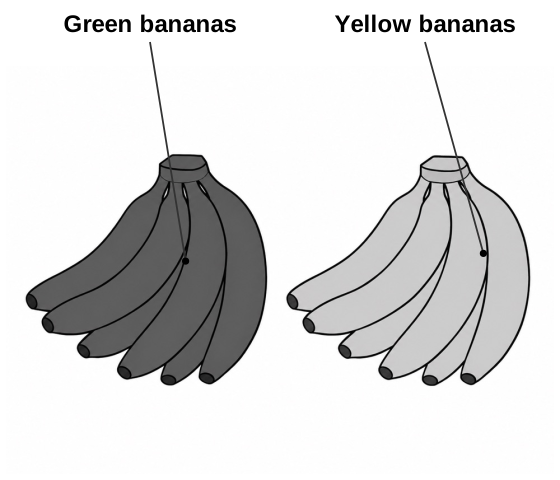
Unripe bananas hold more starch. Describe a chemical test that shows starch is present.
Our own questions on this topic, marked straight away, so you see what to revise. Free now.
Show model answer for 01.1Hide model answer for 01.1
Put a few drops of iodine solution on a slice of the banana.
If the iodine changes from orange-brown to blue-black, starch is present.
How the marks are earned
- One mark: add iodine. Iodine solution is the usual form, and the word iodine alone earns the mark.
- One mark: a blue-black colour means starch is there. Saying that the banana is what turns is not needed.
Why it scores
Naming iodine as the reagent earns the first mark.
The second mark is for the result, the blue-black colour that shows starch.
Revise The Human Digestive SystemRipening turns the starch into glucose. Describe how to test a banana for glucose.
See how you would score on The Human Digestive SystemShow model answer for 01.2Hide model answer for 01.2
Mash some banana with a little water and add Benedict's reagent.
Heat the tube in a hot water bath for about five minutes.
If the blue mixture turns brick red, glucose is present.
How the marks are earned
- One mark: Benedict's reagent (Benedict's solution counts).
- One mark: heat the sample, for example in a hot water bath. The heating step must be stated: the word heat, or heated, is needed. Saying it is heated with the reagent is not needed.
- One mark: a red colour shows glucose. The word brick is not needed. Yellow, green or orange is also credited in place of brick red.
Why it scores
The first mark is for naming Benedict's reagent.
The second mark is for heating. Benedict's reagent gives no change in the cold.
The third mark is for the positive colour. Green, yellow or orange also shows some glucose.
Revise The Human Digestive SystemA green banana gave starch but no glucose; a yellow one gave both. Why did the yellow banana contain glucose?
See how you would score on Enzymes in DigestionShow model answer for 01.3Hide model answer for 01.3
As the banana ripened, some of its starch was broken down into glucose.
Enzymes in the fruit, such as amylase, carry out this breakdown.
How the marks are earned
- One mark: starch in the banana has been changed into glucose. Mentioning ripening is not needed.
- One mark: enzymes carry out this change.
Why it scores
The first mark is for the starch being converted to glucose. Starch is still there, so only part of it was changed.
The second mark is for naming enzymes as the cause.
Revise Enzymes in Digestion