Test yourself on Sex Determination with exam style questions, marked instantly.
Flashcards that come back just before you would forget them.
A revision plan that remembers what you know and shows what to do next.
See which topics you have nailed and which need another look.
Quiz yourself on Sex DeterminationGet your flashcardsBuild my revision planTrack my progressSex Chromosomes
Humans have 23 pairs of chromosomes. The 23rd pair determines sex:
Female
Male
Inheritance of Sex
Mother (XX): Always passes on an X chromosome
Father (XY): Can pass on X or Y (50% chance of each)
| X | Y | |
| X | XX (female) | XY (male) |
| X | XX (female) | XY (male) |
Probability: 50% chance of boy, 50% chance of girl
Visual: Sex Determination
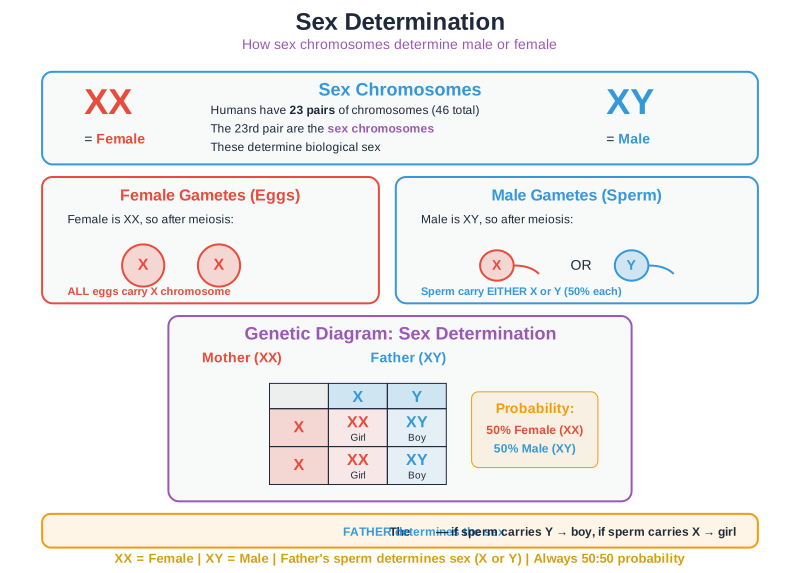
Remember: XX = female, XY = male | Father determines sex (passes X or Y) | 50% chance of each sex
How It Works: XX and XY Determine Sex
Humans have 46 chromosomes arranged in 23 pairs. The first 22 pairs are autosomes, identical in both males and females. The 23rd pair — the sex chromosomes — differs between the sexes. Females carry two X chromosomes (XX); males carry one X and one smaller Y chromosome (XY).
During meiosis, the sex chromosomes separate into gametes. Because a female has XX, all her eggs carry a single X chromosome — she can only contribute X. A male has XY, so during meiosis he produces two types of sperm in equal numbers: sperm carrying X and sperm carrying Y. The sex of a child is therefore determined entirely by which type of sperm fertilises the egg. If an X-bearing sperm fertilises the egg, the resulting XX zygote develops into a female. If a Y-bearing sperm fertilises the egg, the XY zygote develops into a male.
Because X- and Y-bearing sperm are produced in equal numbers, the theoretical probability of a male or female birth is exactly 50:50. However, this is a probability — in practice, families with several children of the same sex are not uncommon, because each conception is an independent event.
Key Definitions
Common Misconceptions
Misconception: "The mother determines the sex of the baby."
Reality: The father determines the sex. The mother always contributes an X chromosome (because she is XX). The father contributes either X or Y. If the father's sperm carries Y, the child is male (XY); if it carries X, the child is female (XX). Throughout history, women have been blamed for not producing male heirs, but genetically it is always the father's contribution that decides sex.
Misconception: "X-linked disorders affect males and females equally."
Reality: Because males only have one X chromosome (XY), a single copy of an X-linked recessive allele is sufficient to cause the condition — there is no second X with a dominant allele to mask it. Females (XX) need two copies of the recessive allele to be affected. This is why conditions such as colour blindness and haemophilia are far more common in males than females.
Misconception: "The probability of a boy is greater than 50% because more boys are born."
Reality: Theoretically, the probability is exactly 50:50, because X- and Y-bearing sperm are produced in equal numbers. Slight differences in the observed birth ratio (approximately 105 males : 100 females) are due to other biological factors, not a difference in the probability of fertilisation.
Misconception: "Since the 23rd pair determines sex, all other 22 pairs are identical in males and females."
Reality: The 22 autosome pairs are indeed the same in males and females in terms of the genes they carry. However, there are small individual differences in alleles between any two people — the point is that the sex chromosome pair is the key difference that determines biological sex.
Memory Aids
"XX or XY — Y decides": The presence of a Y chromosome makes someone male. No Y = female. The Y chromosome is the deciding factor — remember "Y for Yes, it's a boy."
Sperm type determines sex: "Mum gives X, always. Dad gives X or Y — that's the gamble." Mothers are not responsible for the sex of the baby because they can only contribute X.
Sex-linked mnemonics — "Males are more exposed": Males (XY) have only one X chromosome, so a recessive allele on that X has no partner to mask it. Females (XX) need two copies of the recessive allele. Think of males as having an "exposed" X.
Punnett square for sex determination: Always use X and Y as the symbols. Place the father's gametes (X and Y) along the top of the grid, and the mother's gametes (both X) along the side. This gives XX, XY, XX, XY — the standard 50:50 result.
Quick Check: Draw a genetic diagram to show how the sex of a child is determined, and explain why the theoretical probability of having a boy is 50%.
Mother (XX) x Father (XY). Gametes: all eggs carry X; sperm carry either X or Y in equal numbers. Punnett square: XX, XY, XX, XY — two female (XX) and two male (XY) outcomes. Probability of boy = 2/4 = 50%. The probability is 50% because the father produces equal numbers of X-bearing and Y-bearing sperm during meiosis. Any egg fertilised by a Y-bearing sperm will be XY (male); any fertilised by an X-bearing sperm will be XX (female).
Quick Check: Haemophilia is an X-linked recessive disorder (X^H is normal, X^h causes haemophilia). A carrier mother (X^H X^h) and an unaffected father (X^H Y) have children. What proportion of their sons will have haemophilia? Explain your reasoning.
Punnett square with mother X^H X^h and father X^H Y: gametes are X^H, X^h (mother) and X^H, Y (father). Offspring: X^H X^H (unaffected female), X^H X^h (carrier female), X^H Y (unaffected male), X^h Y (haemophiliac male). Of the two male offspring, one (X^h Y) has haemophilia. Therefore 50% (1 in 2) of sons will have haemophilia. Males are affected by X-linked recessive conditions more often than females because they only have one X chromosome — if it carries the recessive allele, there is no dominant allele to mask it.
Quick Check: A couple already have three daughters. Evaluate the claim that they are "more likely" to have a son next time.
The claim is incorrect. Each conception is an independent event with a 50% probability of being male and a 50% probability of being female. Having three daughters in a row does not change the probability for the fourth child — the sex of previous children has no influence on the outcome of future ones. This is the same as flipping a fair coin three times and getting heads each time: the fourth flip still has a 50% chance of each outcome. The sex of the child is determined by which type of sperm (X or Y) fertilises the egg, and this is a random event each time.
Higher X-Linked Inheritance and Pedigree Analysis
Many genetic conditions are caused by alleles carried on the X chromosome — these are called X-linked conditions. Because males have only one X chromosome, they are hemizygous for X-linked genes (they cannot be heterozygous or homozygous, just one copy). This means:
- Males with one X-linked recessive allele (X^a Y) will be affected.
- Females need two copies of the recessive allele (X^a X^a) to be affected — much rarer.
- Female carriers (X^A X^a) are unaffected but can pass the allele to sons.
Examples of X-linked conditions:
- Colour blindness — affects approximately 8% of males and 0.5% of females
- Haemophilia A — lack of blood clotting factor VIII; much more common in males
- Duchenne muscular dystrophy — progressive muscle weakness; almost exclusively males
Pedigree diagrams: Shaded = affected, circle = female, square = male, half-shaded = carrier. X-linked conditions show a characteristic pattern: affected males often have unaffected carrier mothers; daughters of affected fathers are often carriers.
Exam Focus
Regularly ExaminedSex determination is tested regularly in AQA Paper 2 and Edexcel 1BI0/1 (Paper 1). Common question formats:
- Genetic diagram: Draw the Punnett square for sex determination, identify gametes, state the probability as a ratio and percentage.
- Explain questions: "Explain why the father determines the sex of the child." Answer must include: mother always gives X, father gives X or Y, Y = male, X = female.
- Higher tier — X-linked disorders: Given a pedigree diagram, identify carriers and affected individuals. Calculate probability of an X-linked condition in sons.
- Common error question: "A couple say the mother determines the baby's sex. Evaluate this claim." Requires a clear correction with genetic explanation.
Edexcel 1BI0 style: Edexcel Paper 1 (1BI0/1) may present sex determination questions with a stimulus — for example, a pedigree chart showing an X-linked condition across three generations, or statistical data on sex ratios in a population. The command word "Suggest" is used when the condition or family pattern is unfamiliar. For X-linked questions, Edexcel mark schemes accept both superscript notation (X^H, X^h) and alternative notations — but using the superscript format is recommended as it makes chromosomal linkage explicit.
Mark-scheme tip: When completing a sex determination genetic diagram, always write the gametes explicitly (X and Y for father; both X for mother) before filling in the Punnett square — these carry method marks.
Exam Tips: Sex Determination
Father determines sex — state this explicitly: Examiners want to see "the father's sperm determines the sex of the child because the father produces X-bearing and Y-bearing sperm in equal numbers." Do not say "the mother determines sex" even if the question tries to mislead you.
Genetic diagram method marks: Always write parent genotypes, then gametes, then the Punnett square, then offspring genotypes, then offspring phenotypes. Each step can carry individual marks.
X-linked disorders — why males are affected more: Males are hemizygous for X-linked genes (only one copy). A single recessive allele on the X chromosome causes the condition in males. Females need two copies. Always state this when explaining X-linked inheritance.
Higher tier notation: Write X-linked alleles as superscripts on X: X^H (normal allele) and X^h (haemophilia allele). Do not use plain letters for X-linked questions — examiners need to see the allele is on the X chromosome.
Each pregnancy is independent: Previous children's sexes do not change the probability for the next child. Probability is always 50:50 per pregnancy regardless of family history.
Edexcel pedigree charts for X-linked conditions: Edexcel 1BI0/1 frequently uses three-generation pedigree charts as stimulus material for X-linked questions. Practice reading these: circles = females, squares = males, shaded = affected, half-shaded = carrier female. Work from the pedigree data to deduce genotypes before writing your Punnett square — Edexcel mark schemes reward logical deduction steps.
Make this stick
Signing in gives access to all PrepWise features.