The Plant Highway System
The Plant Highway System
Imagine a city without roads, pipes, or electricity lines - chaos! Plants face a similar challenge: they need to transport water from their roots to their leaves (sometimes over 100 meters high in tall trees) and move the food they make in their leaves to every other part of the plant. Unlike animals with their single circulatory system, plants have evolved two separate "highway systems" - xylem and phloem - each specialized for different cargo.
Think of xylem as the water supply pipes running up through the plant, while phloem is like the food delivery service running both up and down. This elegant dual system allows plants to thrive as some of the largest living organisms on Earth!
Tap any label to zoom into the tissue and see its function, structure, and exam tips.
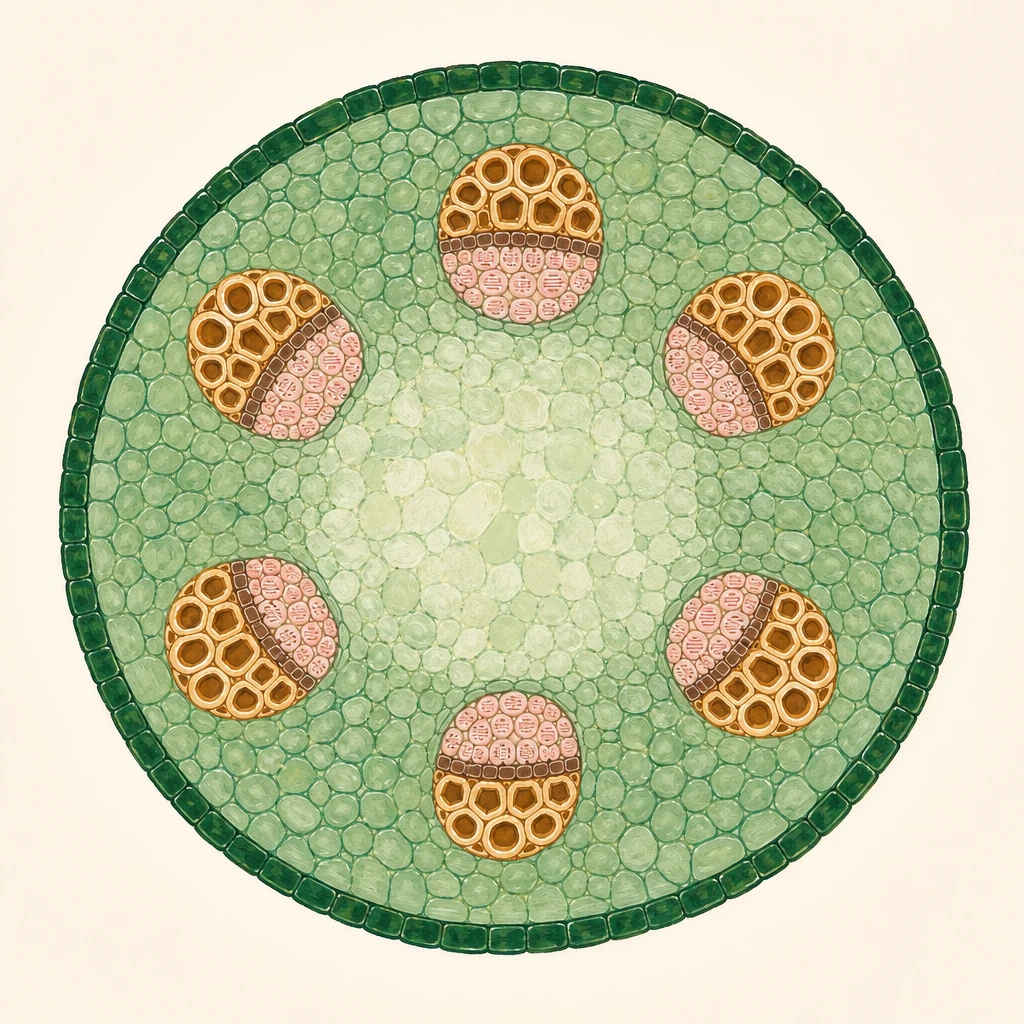
- 1Epidermis — Outer skin — one cell thick, waterproof coat
- 2Cortex — Ground tissue — packing, support and storage
- 3Xylem — Dead hollow tubes — water highway going UP
- 4Phloem — Alive and sieving — food moving BOTH ways
Tap any label to zoom into the tissue and see its function, structure, and exam tips.
Biology glossary
- What is xylem tissue?
- A plant tissue that transports water and mineral salts from the roots to the leaves.
- What is phloem tissue?
- A plant tissue that transports sugars and amino acids from the leaves to other parts of the plant.
Earn the mark scheme marks
Required Practical Investigations
1. Using a Potometer
Aim: Investigate factors affecting the rate of water uptake by plants
Method:
- Cut a shoot underwater to prevent air bubbles entering xylem
- Set up potometer ensuring all connections are airtight
- Allow air bubble to form in capillary tube
- Record bubble position and start timer
- Measure distance bubble travels in set time periods
- Calculate rate = distance ÷ time
Variables to investigate:
- Temperature - higher temperatures increase transpiration rate
- Humidity - lower humidity increases transpiration rate
- Air movement - wind increases transpiration rate
- Light intensity - light opens stomata, increasing transpiration
2. Tracking Water Transport with Dye
Aim: Observe the pathway of water transport in plants
Method:
- Cut celery stalks or white flowers under running water
- Place immediately in colored dye solution (food coloring)
- Observe color changes over time
- Cut sections to see dye distribution
- Use microscope to observe xylem vessels
Results: Dye travels up through xylem vessels, proving water transport pathway
3. Microscopy of Plant Transport Tissues
Aim: Observe and compare xylem and phloem structure
Method:
- Prepare thin cross-sections of plant stems
- Stain with appropriate dyes (lignin stains red with phloroglucinol)
- Observe under light microscope
- Identify xylem and phloem tissues
- Draw and label structures observed
Safety: Handle microscope slides carefully, be cautious with staining solutions
Now try it yourself
Quiz · Question 1 of 25
Which substance does xylem tissue transport?
Tap an answer to check it
This topic in real past papers
Every real exam question we've found on plant transport systems, with a full worked answer.
AQA Paper 1
Explain how [organ/tissue] is adapted for its function, or explain what happens to the body when [structure] is damaged or blocked
AQA Paper 1
Compare the structure of [cell/tissue A] with the structure of [cell/tissue B]
Edexcel Paper 2
Explain how air flow affects transpiration rate, using xylem and phloem structure