Edexcel Biology Paper 2

433 questions with model answers ยท Biology Paper 2 ยท GCSE Biology revision

The Heart and Circulation

Very common28
1.

In severe cases of heart failure, patients may receive either a heart transplant or an artificial heart. Evaluate the advantages and disadvantages of each treatment option.

6 marks ยท challenge๐Ÿ”ฅ Very common

Heart transplants involve replacing the patient's diseased heart with a healthy donor heart. Advantages include: it's a natural heart that can last for many years, potentially allowing full recovery and good quality of life. Disadvantages include: severe shortage of donor hearts leading to long waiting times (during which the patient may die), major surgery carries significant risks, the immune system will try to reject the foreign heart requiring lifelong immunosuppressant drugs (which reduce immune response and increase infection risk), and there's always some risk of rejection even with medication. Artificial hearts are mechanical pumps that replace the heart's function. Advantages include: they are readily available without waiting for a donor, they can be used temporarily to keep a patient alive while waiting for a transplant, and there's no immune rejection. Disadvantages include: they don't last as long as real hearts (parts can wear out or fail), there's a risk of blood clots forming on the mechanical surfaces requiring blood-thinning medication, infection risk where tubes enter the body, and patients are less mobile because some models require external power sources. In conclusion, heart transplants offer the best long-term solution if a suitable donor is available, but artificial hearts provide a valuable alternative or temporary solution. The choice depends on urgency, donor availability, patient age and health, and lifestyle considerations.

  • Heart transplant - Advantages: Natural heart that lasts long-term / can lead to full recovery / better quality of life (1m)
  • Heart transplant - Disadvantages: Shortage of donor hearts / long waiting time / major surgery with risks / immune rejection risk / lifelong immunosuppressant drugs needed (1.5m)
  • Artificial heart - Advantages: Readily available / no waiting for donor / can be used as temporary measure while waiting for transplant / no rejection issues (1m)
  • Artificial heart - Disadvantages: Don't last as long as real hearts / parts may wear out or fail / risk of blood clots / infection risk / patient less mobile due to external power source (1.5m)
  • Balanced conclusion comparing both options / consideration of patient circumstances (1m)

This is a high-level evaluation question requiring balanced analysis of both options. For transplants, emphasize the benefits of a natural heart but the critical problems of donor shortage and immune rejection. For artificial hearts, highlight availability and technological advances, but acknowledge limitations in durability and patient mobility. A strong answer will: (1) Cover both advantages AND disadvantages for EACH option, (2) Use scientific terminology correctly (immunosuppressants, rejection, mechanical failure), (3) Make direct comparisons between the options, (4) Reach a balanced conclusion that weighs up the options. EXAMINER TIP: In 6-mark evaluation questions, quality matters more than quantity. It's better to fully develop 3-4 points with clear explanations than to list 10 points superficially. Always provide a conclusion that weighs up the options.

Test yourself on this in PrepWise
2.

During a 100-metre sprint, cardiac output increases from 5 litres per minute at rest to 25 litres per minute. Explain the chain of events from the start of exercise that leads to this increase in cardiac output and explain why this increase is necessary for the muscles.

6 marks ยท challenge๐Ÿ”ฅ Very common

When exercise begins, the muscles contract more rapidly and require more energy from aerobic respiration. The brain detects the increased demand and the adrenal glands release adrenaline into the blood. Adrenaline acts on the heart, causing the heart rate to increase โ€” the heart beats faster. The heart also contracts with more force, increasing the stroke volume โ€” the volume of blood pumped per beat. Cardiac output equals heart rate multiplied by stroke volume, so both increases together raise cardiac output from 5 to 25 litres per minute. This increased cardiac output is necessary because the contracting muscles need more oxygen and glucose delivered to them for aerobic respiration to release the energy needed for contraction. The increased blood flow also carries away carbon dioxide and lactic acid, waste products that would otherwise build up and reduce muscle performance.

  • Muscles need more energy from aerobic respiration during exercise (1m)
  • Adrenaline is released (from adrenal glands) which acts on the heart (1m)
  • Heart rate increases โ€” heart beats faster (1m)
  • Stroke volume increases โ€” more blood pumped per beat due to stronger contractions (1m)
  • Cardiac output = heart rate x stroke volume, so both rising increases cardiac output (1m)
  • Increased blood flow delivers more oxygen and glucose to muscles for respiration AND removes waste products (CO2, lactic acid) (1m)

This question tests your ability to build a complete cause-chain from the trigger (exercise starting) through the hormonal response to the physiological outcome. The chain runs: exercise increases energy demand in muscles, which triggers adrenaline release, which increases both heart rate AND stroke volume, which together increase cardiac output (since cardiac output = heart rate x stroke volume). You then need to explain WHY this matters โ€” muscles need the extra oxygen and glucose for aerobic respiration to release energy. A common mistake is only mentioning heart rate and forgetting stroke volume โ€” both contribute to cardiac output. Another mistake is not explaining the PURPOSE of increased cardiac output (delivering substrates and removing waste). The best answers show clear causal links between each step using connecting phrases like 'this causes', 'which leads to', 'as a result'.

Test yourself on this in PrepWise
3.

A study followed 10,000 adults for 20 years. The table shows the percentage who developed coronary heart disease (CHD) in each group. | Group | Number in study | Developed CHD (%) | |---|---|---| | Non-smokers, healthy weight | 3,200 | 4% | | Smokers, healthy weight | 2,100 | 12% | | Non-smokers, obese | 2,500 | 11% | | Smokers, obese | 2,200 | 28% | Evaluate what the data shows about the risk factors for coronary heart disease. You should consider the strengths and limitations of this study.

5 marks ยท challenge๐Ÿ”ฅ Very common

The data shows a clear correlation between both smoking and obesity as risk factors for CHD. Non-smokers at healthy weight had only 4% CHD, but smokers at healthy weight had 12% โ€” three times higher โ€” suggesting smoking significantly increases CHD risk. Similarly, obese non-smokers had 11% CHD compared to 4% for healthy weight non-smokers, showing obesity also increases risk. Crucially, the group with both risk factors (smokers who are obese) had 28% CHD, which is higher than either factor alone, suggesting the risk factors have a combined effect. A strength of the study is the large sample size of 10,000 and the long 20-year duration, which makes the results more reliable. However, a limitation is that the study shows correlation, not causation โ€” other variables such as diet, exercise levels, genetics, or alcohol intake were not controlled and could have influenced the results.

  • Both smoking and obesity increase CHD risk โ€” supported by data comparison (e.g. 4% vs 12% for smoking, 4% vs 11% for obesity) (1m)
  • Combined risk factors give higher risk than either alone (28% vs 12% or 11%) โ€” suggesting combined/multiplicative effect (1m)
  • Strength: large sample size (10,000) and/or long duration (20 years) increases reliability of results (1m)
  • Limitation: study shows correlation not causation โ€” cannot prove smoking/obesity directly cause CHD (1m)
  • Limitation: confounding variables not controlled (e.g. diet, exercise, genetics, alcohol) could affect results (1m)

This question tests your ability to evaluate scientific data critically. You need to do three things: (1) describe what the data shows using actual numbers from the table, (2) identify the strengths of the study design, and (3) identify the limitations. When comparing groups, always quote the data โ€” saying 'smoking increases risk from 4% to 12%' is much stronger than just saying 'smoking increases risk'. The combined effect (28%) being higher than either risk factor alone is an important observation that many students miss. For evaluation, remember that observational studies show CORRELATION (a link between two things) but cannot prove CAUSATION (that one thing directly causes the other). This is because confounding variables โ€” factors the researchers did not measure โ€” could be responsible. For example, smokers might also drink more alcohol, and obese people might exercise less. Both of these could independently increase CHD risk.

Test yourself on this in PrepWise
4.

Explain the advantages of having a double circulatory system in mammals.

4 marks ยท higher๐Ÿ”ฅ Very common

In a double circulatory system, blood passes through the heart twice in one complete circuit - once through the pulmonary circulation (to the lungs) and once through the systemic circulation (to the body). This is advantageous because it maintains high blood pressure throughout the body. Blood loses pressure as it passes through the narrow capillaries in the lungs, but is then re-pumped by the left side of the heart before going to the body. This high pressure ensures rapid delivery of oxygen and nutrients to all cells, supporting the high metabolic rate needed by active mammals.

  • Blood passes through the heart twice in one complete circuit (1m)
  • One circuit to the lungs (pulmonary) and one to the rest of the body (systemic) (1m)
  • This maintains high blood pressure / prevents pressure drop (1m)
  • Ensures rapid delivery of oxygen and nutrients to cells / supports high metabolic rate (1m)

A double circulatory system means blood passes through the heart twice per complete circuit. In the pulmonary circuit, the right ventricle pumps deoxygenated blood to the lungs where it picks up oxygen. This blood returns to the left atrium, then the left ventricle pumps it out in the systemic circuit to the rest of the body. The key advantage is maintaining high blood pressure: blood pressure drops significantly as it passes through the narrow capillaries in the lungs, but instead of continuing to the body at this low pressure, it returns to the heart to be re-pumped. This ensures all organs receive blood at high pressure, allowing rapid delivery of oxygen and nutrients to support the high metabolic rate of mammals. EXAMINER TIP: Make sure you explain WHY high pressure is an advantage - it's about rapid delivery to support metabolism, not just 'it's better'.

Test yourself on this in PrepWise
5.

Explain how coronary heart disease develops and why it is dangerous.

4 marks ยท higher๐Ÿ”ฅ Very common

Coronary heart disease develops when fatty deposits (called atheroma or plaques) gradually build up in the walls of the coronary arteries. This narrows the lumen of these arteries, restricting blood flow to the heart muscle. As a result, the heart muscle receives less oxygen and glucose. If severely restricted, the heart muscle cells cannot carry out aerobic respiration and may die, causing a heart attack. This is dangerous because the heart must beat continuously - if part of the heart muscle dies, the heart may stop pumping effectively.

  • Fatty deposits/plaques/atheroma build up in coronary artery walls (1m)
  • This narrows the lumen of the coronary arteries / restricts blood flow (1m)
  • Reduces supply of oxygen (and glucose) to heart muscle (1m)
  • Heart muscle cells cannot respire (aerobically) / heart muscle cells die / causes heart attack (1m)

Coronary heart disease (CHD) is caused by atherosclerosis - the buildup of fatty deposits (atheroma/plaques) in the walls of coronary arteries. These deposits are made of cholesterol and other lipids. As they accumulate over time, they narrow the lumen of the arteries, restricting blood flow. This reduces the supply of oxygen and glucose to the heart muscle. The heart is constantly working and has a very high oxygen demand. If the oxygen supply becomes insufficient, the heart muscle cells cannot carry out enough aerobic respiration to meet their energy needs. In severe cases, sections of heart muscle can die (myocardial infarction - a heart attack), which can be fatal as the heart cannot pump blood effectively. EXAMINER TIP: Use correct scientific terminology (atheroma, lumen, aerobic respiration) and explain the sequence clearly: buildup โ†’ narrowing โ†’ reduced oxygen โ†’ muscle death.

Test yourself on this in PrepWise
6.

Heart valves can become damaged and may need to be replaced. Compare the use of biological (from animals or donated human) and mechanical (man-made) replacement valves.

4 marks ยท higher๐Ÿ”ฅ Very common

Biological valves (from pig hearts or donated human hearts) work very well and don't require the patient to take medication long-term. However, they only last 10-15 years and may need replacing, and there is a small risk of immune rejection. Mechanical valves are made from materials like titanium and last much longer (potentially a lifetime), making them suitable for younger patients. However, they require the patient to take blood-thinning medication (anticoagulants) for life to prevent blood clots forming on the valve surface.

  • Biological valves: work well / last 10-15 years / don't require lifelong medication (1m)
  • Biological valves: may need replacing / may be rejected by immune system (1m)
  • Mechanical valves: last longer/lifetime / very durable (1m)
  • Mechanical valves: require lifelong blood-thinning medication / risk of blood clots (1m)

Heart valve replacement is needed when valves become damaged by disease or age and can't prevent backflow properly. Biological valves (from pig or cow hearts, or donated human hearts) have the advantage of working naturally without requiring medication, but only last 10-15 years before needing replacement. There's also a small risk of immune rejection. Mechanical valves are made from durable materials like titanium and carbon, lasting a lifetime, which makes them suitable for younger patients who would otherwise need multiple replacements. However, blood can clot on the artificial surface, so patients must take anticoagulant (blood-thinning) drugs for life, which carries bleeding risks. The choice depends on patient age, lifestyle, and preference. EXAMINER TIP: This is an AO3 'analyze' question - you must evaluate both options, not just describe them. Make clear comparisons and explain the trade-offs.

Test yourself on this in PrepWise
7.

Explain how the structure of an artery is related to its function.

3 marks ยท standard๐Ÿ”ฅ Very common

Arteries have thick muscular and elastic walls to withstand the high pressure of blood being pumped from the heart. The elastic walls can stretch when blood surges through and recoil between heartbeats, helping to maintain a steady, high-pressure blood flow. The relatively small lumen also helps maintain this high pressure.

  • Arteries have thick muscular walls (1m)
  • To withstand high blood pressure / to help maintain high pressure (1m)
  • Elastic walls allow arteries to stretch and recoil / maintain steady blood flow (1m)

Arteries are perfectly adapted to their function of carrying blood away from the heart at high pressure. Their thick walls contain layers of muscle and elastic tissue - the muscle provides strength to withstand the high pressure, while the elastic tissue allows the artery to stretch as blood surges through with each heartbeat, then recoil between beats to maintain steady flow. The relatively small lumen also helps maintain high pressure. EXAMINER TIP: Always link STRUCTURE to FUNCTION - don't just describe what arteries look like, explain WHY they have these features.

Test yourself on this in PrepWise
8.

Explain how the structure of a vein is related to its function.

3 marks ยท standard๐Ÿ”ฅ Very common

Veins have much thinner walls than arteries because blood is at much lower pressure after passing through capillaries, so less strength is needed. Veins have valves to prevent backflow of blood, ensuring it flows towards the heart. The larger lumen helps blood flow despite the lower pressure.

  • Veins have thinner walls than arteries / contain less muscle and elastic tissue (1m)
  • Because blood is at lower pressure (than in arteries) (1m)
  • Veins have valves to prevent backflow of blood (1m)

Veins are adapted to carry blood back to the heart at low pressure. After blood passes through capillaries, pressure drops significantly, so veins don't need thick muscular walls like arteries. Instead, they have thinner walls and a larger lumen to allow blood to flow easily despite low pressure. Crucially, veins have valves that prevent backflow - without these, blood would flow backwards due to gravity, especially in the legs. EXAMINER TIP: Don't confuse structure with blood type - pulmonary veins carry oxygenated blood, so it's not about oxygen content, it's about direction of flow.

Test yourself on this in PrepWise
9.

Describe the pathway of blood through the heart, starting from the vena cava.

3 marks ยท standard๐Ÿ”ฅ Very common

Deoxygenated blood from the body enters the right atrium via the vena cava. The right atrium contracts, pushing blood through a valve into the right ventricle. The right ventricle contracts, pumping blood through the pulmonary artery to the lungs, where it picks up oxygen. Oxygenated blood returns from the lungs via the pulmonary vein to the left atrium. The left atrium contracts, pushing blood through a valve into the left ventricle. The left ventricle contracts powerfully, pumping blood through the aorta to the rest of the body.

  • Vena cava โ†’ right atrium โ†’ (through valve) โ†’ right ventricle (1m)
  • Right ventricle โ†’ pulmonary artery โ†’ lungs (where blood picks up oxygen) (1m)
  • Lungs โ†’ pulmonary vein โ†’ left atrium โ†’ (through valve) โ†’ left ventricle โ†’ aorta โ†’ body (1m)

Understanding the complete pathway of blood through the heart is essential. The key is to remember: RIGHT side โ†’ LUNGS โ†’ LEFT side โ†’ BODY. Deoxygenated blood from the body enters the right atrium via the vena cava, passes to the right ventricle, then is pumped via the pulmonary artery to the lungs for oxygenation. Oxygenated blood returns via the pulmonary vein to the left atrium, passes to the left ventricle, then is pumped via the aorta to the whole body. Note: The pulmonary artery carries deoxygenated blood (it's an artery because it carries blood AWAY from the heart, not because of oxygen content), and the pulmonary vein carries oxygenated blood. Valves between atria and ventricles, and at the start of arteries, prevent backflow throughout this pathway. EXAMINER TIP: Learn the pathway as a sequence and remember that arteries are defined by carrying blood AWAY from the heart, veins TO the heart - not by oxygen content.

Test yourself on this in PrepWise
10.

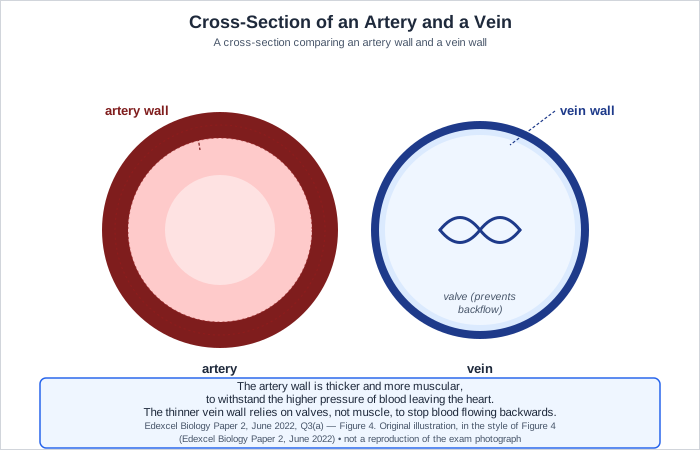
Using the diagram, compare the structure of arteries and veins.

3 marks ยท standard๐Ÿ”ฅ Very common

Arteries have thick muscular and elastic walls to withstand the high pressure of blood pumped from the heart, and a narrow lumen. Veins have thinner walls and a wider lumen because blood is at lower pressure. Veins also contain valves to prevent backflow of blood, whereas arteries do not have valves.

  • Arteries have thick muscular/elastic walls and a narrow lumen (to withstand/maintain high pressure) (1m)
  • Veins have thinner walls and a wider lumen (because blood is at lower pressure) (1m)
  • Veins have valves to prevent backflow / arteries do not have valves (1m)

Arteries and veins differ in structure because they carry blood under very different pressures. Arteries carry blood pumped directly from the heart โ€” at high pressure โ€” so their walls must be thick, muscular, and elastic to withstand and smooth out this pressure. Their lumen (the hollow channel) is relatively narrow. Veins return blood to the heart at much lower pressure after it has passed through capillaries; their walls are thinner and their lumen is wider to allow easy flow. Because blood pressure in veins is so low, blood could easily pool or flow backwards โ€” so veins contain valves to prevent backflow and ensure blood moves in one direction. A common mistake is saying arteries carry oxygenated blood and veins carry deoxygenated blood โ€” this is only true for the systemic circulation, not the pulmonary circuit.

Test yourself on this in PrepWise
11.

Describe how stents are used to treat coronary heart disease and give one advantage and one disadvantage of this treatment.

3 marks ยท higher๐Ÿ”ฅ Very common

Stents are mesh tubes that are inserted into narrowed coronary arteries to hold them open and restore normal blood flow to the heart muscle. Advantage: They are effective and long-lasting, quickly restoring blood supply. Disadvantage: There is a risk of blood clots forming on the stent, which could block the artery again.

  • Stents are tubes/mesh inserted into narrowed coronary arteries (1m)
  • Advantage: They keep the arteries open / improve blood flow / restore oxygen supply / are long-lasting / effective (1m)
  • Disadvantage: Risk of blood clots / infection / surgery required / may not work for severe blockages (1m)

Stents are small mesh tubes, usually made of metal, that are inserted into coronary arteries that have been narrowed by fatty deposits. They are placed during a procedure where a catheter with a deflated balloon is threaded into the artery; the balloon is inflated to expand the stent, which then stays in place to hold the artery open. Advantages include: quick recovery, long-lasting effectiveness, and immediate restoration of blood flow without major lifestyle changes needed. Disadvantages include: risk of blood clots forming on the stent surface (requiring blood-thinning medication), small risk of complications from the surgery (infection, damage to artery), and they don't prevent new blockages forming elsewhere. EXAMINER TIP: Don't just list advantages/disadvantages - explain them. Better to give one well-explained point than several vague ones.

Test yourself on this in PrepWise
12.

Explain why the septum (the muscular wall that divides the heart into left and right sides) is important.

3 marks ยท higher๐Ÿ”ฅ Very common

The septum is a thick muscular wall that completely divides the heart into left and right sides. It prevents oxygenated blood (returning from the lungs in the left side) from mixing with deoxygenated blood (returning from the body in the right side). This separation is crucial because it ensures that blood pumped to the body via the aorta has the maximum possible oxygen content, allowing efficient oxygen delivery to all tissues.

  • The septum prevents mixing of oxygenated and deoxygenated blood (1m)
  • Keeps oxygenated blood (from lungs) separate from deoxygenated blood (from body) (1m)
  • Ensures blood going to body has maximum oxygen content / maintains efficiency of oxygen delivery (1m)

The septum is the thick muscular wall running down the middle of the heart, completely separating it into two sides. Its function is to prevent any mixing between oxygenated blood (in the left side of the heart, returning from the lungs) and deoxygenated blood (in the right side of the heart, returning from the body). This complete separation is essential for maintaining efficient circulation. If the bloods mixed, the blood being pumped to the body would have a lower oxygen concentration, reducing oxygen delivery to tissues. This is why a hole in the septum (septal defect - a congenital heart defect) is serious and needs repair. Mammals have a complete septum, unlike fish which have a two-chambered heart with mixed blood. EXAMINER TIP: Link the structure (septum separating sides) to the consequence (no mixing) to the benefit (maximum oxygen to body). Don't just say 'it's important' - explain WHY.

Test yourself on this in PrepWise
13.

Explain why heart rate increases during exercise.

3 marks ยท higher๐Ÿ”ฅ Very common

During exercise, muscles are working harder and respiring more rapidly to release energy. This increases their demand for oxygen and glucose for aerobic respiration. The heart rate increases to pump blood faster, delivering more oxygen and glucose to the muscles and removing more carbon dioxide. The increase in heart rate is triggered by the hormone adrenaline and by the brain detecting higher carbon dioxide levels in the blood.

  • During exercise, muscles respire more / demand more energy / demand more oxygen (1m)
  • Heart rate increases to deliver more oxygen (and glucose) to muscles / remove more carbon dioxide (1m)
  • Increased by hormone adrenaline / detected by brain which increases heart rate (1m)

Heart rate increases during exercise to meet the increased metabolic demands of working muscles. When you exercise, your muscles contract more frequently and forcefully, requiring much more energy from aerobic respiration. This dramatically increases their demand for oxygen and glucose (the reactants) and produces more carbon dioxide (the waste product). The cardiovascular system responds by increasing heart rate (beats per minute) and stroke volume (volume per beat), increasing cardiac output. This pumps blood faster around the body, delivering oxygen and glucose to muscles more rapidly and removing carbon dioxide more quickly. The increase in heart rate is controlled by: (1) the hormone adrenaline, released during exercise, which directly stimulates the heart's pacemaker, and (2) the brain detecting increased carbon dioxide levels in the blood via chemoreceptors and sending nerve signals to speed up the heart. After exercise stops, heart rate gradually returns to resting level as oxygen demand decreases. EXAMINER TIP: Link the DEMAND (more oxygen needed) to the RESPONSE (faster heart rate) to the BENEFIT (faster delivery). Don't forget to mention control mechanisms (adrenaline/brain).

Test yourself on this in PrepWise
14.

Name the four chambers of the heart.

2 marks ยท foundation๐Ÿ”ฅ Very common

The four chambers are: right atrium, left atrium, right ventricle, and left ventricle.

  • Right atrium (0.5m)
  • Left atrium (0.5m)
  • Right ventricle (0.5m)
  • Left ventricle (0.5m)

The heart has four chambers. The upper chambers (atria - singular: atrium) receive blood: the right atrium receives deoxygenated blood from the body, and the left atrium receives oxygenated blood from the lungs. The lower chambers (ventricles) pump blood out: the right ventricle pumps to the lungs, and the left ventricle pumps to the rest of the body.

Test yourself on this in PrepWise
15.

Describe the function of the coronary arteries.

2 marks ยท foundation๐Ÿ”ฅ Very common

Coronary arteries supply the heart muscle with oxygenated blood. They deliver oxygen and glucose needed for respiration in the heart muscle cells, providing energy for the heart to keep beating continuously.

  • Supply/carry blood to the heart muscle/tissue (1m)
  • Provide/deliver oxygen (and glucose) to heart muscle for respiration (1m)

Coronary arteries are the blood vessels that supply the heart muscle itself with oxygenated blood. The heart is a muscle that works continuously throughout your life, so it needs a constant supply of oxygen and glucose for aerobic respiration to release energy for contraction. Blockage of coronary arteries leads to coronary heart disease.

Test yourself on this in PrepWise
16.

State two differences between arteries and veins shown in the diagram.

2 marks ยท foundation๐Ÿ”ฅ Very common

One difference is that arteries have thick muscular walls while veins have thinner walls. Arteries also have a narrower lumen while veins have a wider lumen. A further difference is that veins contain valves to prevent backflow of blood while arteries do not. Arteries carry blood at high pressure while veins carry blood at low pressure.

  • Any one structural or functional difference โ€” e.g. wall thickness (arteries thicker), lumen size (veins wider), valves (veins have them, arteries do not), blood pressure (arteries higher) (1m)
  • A second distinct difference from the above list (1m)

There are three key structural differences between arteries and veins that are commonly tested. First, arteries have thick muscular walls while veins have thinner walls โ€” arteries must handle the high pressure of blood from the heart, veins carry blood at lower pressure on the return journey. Second, arteries have a narrower lumen (the central channel) while veins have a wider lumen. Third, veins contain valves that prevent blood flowing backwards, while arteries do not need valves because blood is propelled by the heart's pumping force. For 2 marks, state any two of these three differences clearly โ€” examiners expect the comparison to go both ways (not just 'arteries have thick walls' but 'arteries have thick walls, veins have thinner walls').

Test yourself on this in PrepWise
17.

Explain how statins help to reduce the risk of coronary heart disease.

2 marks ยท standard๐Ÿ”ฅ Very common

Statins are drugs that reduce the level of cholesterol in the blood. By lowering cholesterol, they reduce the formation of fatty deposits in the coronary artery walls, slowing the development of atheroma and reducing the risk of the arteries becoming blocked.

  • Statins are drugs that reduce/lower blood cholesterol levels (1m)
  • This reduces fatty deposit formation / slows atheroma buildup / reduces risk of coronary arteries becoming blocked (1m)

Statins are drugs that reduce the amount of cholesterol in the blood by inhibiting the enzyme that produces it in the liver. Since fatty deposits (atheroma) in artery walls are made largely of cholesterol, lower blood cholesterol means less atheroma formation. This slows the progression of coronary heart disease and reduces the risk of heart attacks. However, statins must be taken long-term and can have side effects. EXAMINER TIP: Link the action (reduce cholesterol) to the consequence (less atheroma) - don't just say 'statins help CHD'.

Test yourself on this in PrepWise
18.

A person's heart beats 70 times per minute. If each beat pumps 70 cmยณ of blood, calculate the cardiac output per minute. Show your working.

2 marks ยท standard๐Ÿ”ฅ Very common

Cardiac output = heart rate ร— stroke volume = 70 beats/min ร— 70 cmยณ/beat = 4900 cmยณ/min (or 4.9 litres/min)

  • Correct method: cardiac output = heart rate ร— stroke volume (1m)
  • Correct answer: 4900 cmยณ/min (or 4.9 litres/min) (1m)

Cardiac output is the volume of blood pumped by the heart per minute. It's calculated by multiplying heart rate (beats per minute) by stroke volume (volume per beat): 70 ร— 70 = 4900 cmยณ/min. This can also be expressed as 4.9 litres per minute. During exercise, both heart rate and stroke volume increase, significantly increasing cardiac output to meet the body's increased oxygen demand. EXAMINER TIP: Always show your working and include units in your answer.

Test yourself on this in PrepWise
19.

Explain why capillaries have thin walls using the diagram.

2 marks ยท standard๐Ÿ”ฅ Very common

Capillaries have walls that are only one cell thick to allow efficient exchange of substances between the blood and body tissues. The thin walls allow oxygen, glucose and other substances to diffuse quickly out of the blood into cells, and allow carbon dioxide and waste to diffuse in from cells.

  • Walls are one cell thick / very thin to allow exchange of substances (1m)
  • This allows rapid diffusion of oxygen/glucose/nutrients into tissues and COโ‚‚/waste out of tissues (1m)

Capillary walls are only one cell thick โ€” the thinnest possible wall โ€” because their entire function is to allow rapid exchange of substances between the blood and the surrounding body cells. The shorter the diffusion distance, the faster substances can move by diffusion. Oxygen and glucose diffuse out of the capillary into cells; carbon dioxide and waste products diffuse in from cells. If capillary walls were as thick as artery walls, this exchange would be too slow to meet the cell's needs. A common misconception is that thin walls mean capillaries are fragile โ€” in fact, they are adapted for efficient exchange, not for withstanding pressure (that is the artery's role).

Test yourself on this in PrepWise
20.

How many chambers does the human heart have?

  • A. 2
  • B. 3
  • C. 4
  • D. 5
1 mark ยท foundation๐Ÿ”ฅ Very common

The heart has four chambers: two atria (upper chambers) and two ventricles (lower chambers). The right atrium and right ventricle pump blood to the lungs, while the left atrium and left ventricle pump blood to the rest of the body.

Test yourself on this in PrepWise
21.

What is the main function of the valves in the heart?

  • A. To prevent backflow of blood
  • B. To pump blood around the body
  • C. To filter waste products from blood
  • D. To produce red blood cells
1 mark ยท foundation๐Ÿ”ฅ Very common

Heart valves prevent the backflow of blood, ensuring blood flows in one direction only - from the atria to the ventricles, and from the ventricles into the arteries. This is essential for maintaining efficient circulation.

Test yourself on this in PrepWise
22.

Which type of blood vessel carries blood away from the heart?

  • A. Veins
  • B. Capillaries
  • C. Arteries
  • D. Lymph vessels
1 mark ยท foundation๐Ÿ”ฅ Very common

Arteries always carry blood away from the heart. Remember: Arteries = Away. The pulmonary artery carries deoxygenated blood to the lungs, while all other arteries carry oxygenated blood to the body.

Test yourself on this in PrepWise
23.

What is the function of the natural pacemaker in the heart?

1 mark ยท foundation๐Ÿ”ฅ Very common

The natural pacemaker controls the heart rate by producing electrical impulses that cause the heart muscle to contract regularly.

  • Controls/regulates heart rate / produces electrical impulses that cause heart to beat (1m)

The natural pacemaker (a group of cells in the right atrium) produces electrical impulses that spread through the heart muscle, causing it to contract. These impulses set the rhythm and rate of heartbeat. If the natural pacemaker becomes faulty (causing irregular heartbeat), an artificial pacemaker may be implanted to regulate heart rate.

Test yourself on this in PrepWise
24.

Which blood vessel in the diagram has the thickest muscular wall?

  • A. Capillary
  • B. Vein
  • C. Artery
  • D. Arteriole
1 mark ยท foundation๐Ÿ”ฅ Very common

Arteries have the thickest muscular and elastic walls of all blood vessels. This is because they carry blood under high pressure from the heart. The thick walls withstand and maintain this pressure. Veins have thinner walls and wider lumens, while capillaries have walls only one cell thick.

Test yourself on this in PrepWise
25.

Why does the left ventricle have a thicker muscular wall than the right ventricle?

  • A. It receives blood from the lungs
  • B. It has to pump blood to the whole body at high pressure
  • C. It contains more valves
  • D. It is larger in size
1 mark ยท standard๐Ÿ”ฅ Very common

The left ventricle has a much thicker muscular wall because it must generate enough force to pump blood all around the body through the systemic circulation. This requires much higher pressure than the right ventricle, which only pumps blood to the nearby lungs.

Test yourself on this in PrepWise
26.

Why are capillary walls only one cell thick?

  • A. To allow rapid exchange of substances between blood and tissues
  • B. To withstand high blood pressure
  • C. To store red blood cells
  • D. To prevent blood clotting
1 mark ยท standard๐Ÿ”ฅ Very common

Capillaries have walls that are only one cell thick to provide a very short diffusion distance. This allows rapid exchange of oxygen, glucose, carbon dioxide and other substances between the blood and body tissues.

Test yourself on this in PrepWise
27.

What is meant by a 'double circulatory system'?

  • A. The heart has two sides
  • B. There are two hearts in the body
  • C. Blood flows in two directions
  • D. Blood passes through the heart twice in one complete circuit
1 mark ยท standard๐Ÿ”ฅ Very common

In a double circulatory system, blood passes through the heart twice in one complete circuit of the body. One circuit goes from the heart to the lungs and back (pulmonary circulation), the other goes from the heart to the rest of the body and back (systemic circulation). This maintains high blood pressure to all organs.

Test yourself on this in PrepWise
28.

A blockage in the coronary arteries would most likely cause which problem?

  • A. Reduced oxygen supply to the brain
  • B. Reduced oxygen supply to the heart muscle
  • C. Increased blood pressure in the lungs
  • D. Slower heart rate
1 mark ยท higher๐Ÿ”ฅ Very common

Coronary arteries supply the heart muscle with oxygenated blood. If they become blocked (often by fatty deposits called atheroma), the heart muscle receives less oxygen, which can lead to a heart attack. This is called coronary heart disease.

Test yourself on this in PrepWise

Blood Components and Vessels

Very common20
1.

Explain why blood type compatibility is important for blood transfusions, using type A and type B blood as examples.

6 marks ยท higher๐Ÿ”ฅ Very common

Blood type compatibility is crucial because different blood types have different antigens on their red blood cells and different antibodies in their plasma. Type A blood has A antigens on the red cells and anti-B antibodies in the plasma. Type B blood has the opposite: B antigens on the cells and anti-A antibodies in the plasma. If a person with type A blood receives type B blood, the anti-B antibodies in the recipient's plasma will recognize the B antigens on the donor red cells as foreign and attack them. This causes the red blood cells to clump together in a process called agglutination. These clumped cells can block blood vessels, preventing blood flow to vital organs, which can be fatal. This is why blood must be carefully matched before transfusion.

  • Type A blood has A antigens on red blood cells (1m)
  • Type A blood has anti-B antibodies in plasma (1m)
  • Type B blood has B antigens and anti-A antibodies (1m)
  • If incompatible blood mixed, antibodies attack foreign antigens (1m)
  • This causes red blood cells to clump together (agglutination) (1m)
  • Clumped cells can block blood vessels and be fatal (1m)

Blood type compatibility is essential because incompatible transfusions cause antibodies to attack foreign antigens, resulting in dangerous agglutination that can block blood vessels and be fatal to the patient.

Test yourself on this in PrepWise
2.

Compare and contrast the structure and function of red blood cells, white blood cells, and platelets. Explain how each is adapted to its specific role in the blood.

6 marks ยท higher๐Ÿ”ฅ Very common

Red blood cells are biconcave discs without a nucleus, filled with haemoglobin protein. This structure is perfectly adapted for oxygen transport as the shape increases surface area for gas exchange, lack of nucleus provides space for more haemoglobin, and flexibility allows passage through capillaries. White blood cells are much larger, have a nucleus, and come in two main types: phagocytes that engulf pathogens and lymphocytes that produce antibodies. Their nucleus is essential for producing proteins needed for immune responses. Platelets are small cell fragments without nuclei that release clotting factors when they encounter damaged blood vessels, quickly forming plugs to seal wounds. Each component has a structure specifically adapted to its function in the blood.

  • Red blood cells: biconcave shape, no nucleus, contain haemoglobin - adapted for oxygen transport (2m)
  • White blood cells: have nucleus, can produce antibodies or engulf pathogens - adapted for defense (2m)
  • Platelets: cell fragments with no nucleus, release clotting factors - adapted for clotting (2m)

This 6-mark extended response requires comparing three blood components, linking each structure to its function. To reach full marks, you must cover all three components with structural details AND their functional adaptations. Red blood cells: biconcave shape (maximises surface area for gas exchange), no nucleus (creates more space for haemoglobin), contain haemoglobin (which binds oxygen). White blood cells: have a nucleus (needed to produce antibodies and direct immune response), can change shape (phagocytes engulf pathogens), two main types โ€” phagocytes and lymphocytes. Platelets: tiny cell fragments with no nucleus, release clotting factors when activated. A partial answer names the components without linking structure to function โ€” this scores 2-3 marks. Full marks require explicit structure-function links for all three, plus comparison (note similarities and differences). Common mistake: confusing white blood cells and platelets, or forgetting that red blood cells have no nucleus and no mitochondria at maturity.

Test yourself on this in PrepWise
3.

Explain how lymphocytes provide immunity against specific pathogens.

5 marks ยท higher๐Ÿ”ฅ Very common

Lymphocytes provide immunity by recognizing specific antigens on the surface of pathogens. They then produce antibodies that are complementary in shape to these antigens. The antibodies bind to the pathogens, neutralizing them and marking them for destruction. After the infection, memory lymphocytes remain in the blood. If the same pathogen invades again, these memory cells trigger a much faster secondary immune response, producing antibodies rapidly before the person becomes ill.

  • Lymphocytes recognize specific antigens on pathogens (1m)
  • Produce specific antibodies against the antigen (1m)
  • Antibodies bind to and neutralize the pathogen (1m)
  • Memory cells are produced after first infection (1m)
  • Memory cells provide faster response to same pathogen (1m)

Lymphocytes provide specific immunity through antigen recognition, antibody production, and the formation of memory cells that enable rapid response to repeat infections.

Test yourself on this in PrepWise
4.

Explain how blood connects the circulatory system with gas exchange in the lungs to deliver oxygen to body tissues.

5 marks ยท higher๐Ÿ”ฅ Very common

The heart pumps deoxygenated blood to the lungs via the pulmonary artery. In the lung capillaries surrounding the alveoli, oxygen diffuses from the air into the blood. Red blood cells pick up this oxygen as haemoglobin binds to it, forming bright red oxyhaemoglobin. The oxygenated blood returns to the heart through the pulmonary veins. The heart then pumps this oxygen-rich blood around the body via systemic circulation, where oxygen is released from haemoglobin to respiring tissues.

  • Heart pumps deoxygenated blood to lungs via pulmonary circulation (1m)
  • In lung capillaries, red blood cells pick up oxygen from alveoli (1m)
  • Haemoglobin in red blood cells binds with oxygen (1m)
  • Oxygenated blood returns to heart via pulmonary veins (1m)
  • Heart pumps oxygenated blood to body tissues via systemic circulation (1m)

Blood connects the circulatory system and gas exchange by transporting deoxygenated blood to the lungs, collecting oxygen via haemoglobin, returning to the heart, and being pumped to tissues throughout the body.

Test yourself on this in PrepWise
5.

Explain how red blood cells are adapted for their function of transporting oxygen.

4 marks ยท standard๐Ÿ”ฅ Very common

Red blood cells are adapted for oxygen transport in several ways. Their biconcave disc shape increases the surface area and allows more oxygen to diffuse in. They have no nucleus, which provides more space for haemoglobin. Haemoglobin binds and carries oxygen to the tissues. Finally, their flexible membrane allows them to squeeze through narrow capillaries.

  • Biconcave disc shape increases surface area for gas exchange (1m)
  • No nucleus provides more space for haemoglobin (1m)
  • Contains haemoglobin protein that binds with oxygen (1m)
  • Flexible membrane allows passage through narrow capillaries (1m)

Red blood cells have multiple adaptations that make them efficient at transporting oxygen: biconcave shape for increased surface area, no nucleus for maximum haemoglobin content, haemoglobin protein for oxygen binding, and flexible membranes for capillary passage.

Test yourself on this in PrepWise
6.

A person has iron deficiency anaemia. Explain why this condition causes fatigue and shortness of breath.

4 marks ยท higher๐Ÿ”ฅ Very common

Iron is essential for producing haemoglobin in red blood cells. In iron deficiency anaemia, reduced iron means less haemoglobin can be made, lowering the blood's oxygen-carrying capacity. This means tissues and organs receive insufficient oxygen for efficient aerobic respiration. Without enough oxygen, cells cannot release the energy they need, resulting in fatigue. The shortness of breath occurs as the body tries to compensate by breathing faster to get more oxygen.

  • Iron deficiency reduces haemoglobin production (1m)
  • Less haemoglobin means less oxygen can be carried (1m)
  • Reduced oxygen delivery to tissues/cells (1m)
  • Cells cannot respire efficiently, causing fatigue (1m)

Iron deficiency anaemia reduces haemoglobin production, lowering oxygen transport capacity and impairing cellular respiration, which causes fatigue and breathlessness as symptoms.

Test yourself on this in PrepWise
7.

Haemophilia is a genetic condition affecting blood clotting. Explain why people with haemophilia bruise easily and bleed for longer than normal.

4 marks ยท higher๐Ÿ”ฅ Very common

Haemophilia is caused by a deficiency in specific blood clotting factors (proteins needed for the clotting cascade). Without these factors, the process of converting fibrinogen to fibrin is impaired, meaning blood clots form very slowly or incompletely. This poor clotting ability means even minor injuries result in prolonged bleeding as wounds cannot be sealed quickly. Easy bruising occurs because small blood vessels damaged under the skin leak blood that cannot clot effectively.

  • Haemophilia causes deficiency in clotting factors (1m)
  • Without clotting factors, fibrin formation is impaired (1m)
  • Blood clots form slowly or incompletely (1m)
  • Results in prolonged bleeding and easy bruising (1m)

Haemophilia involves clotting factor deficiency, which impairs fibrin formation, slows clot development, and causes prolonged bleeding and easy bruising from minor injuries.

Test yourself on this in PrepWise
8.

Describe how phagocytes help protect the body from infection.

3 marks ยท standard๐Ÿ”ฅ Very common

Phagocytes help protect the body by first moving to the site of infection, attracted by chemicals released by pathogens. They then engulf the pathogens by phagocytosis, surrounding them with their cell membrane. Once inside, digestive enzymes break down and destroy the pathogens.

  • Phagocytes move to sites of infection (1m)
  • They engulf/surround pathogens by phagocytosis (1m)
  • Digest pathogens with enzymes to destroy them (1m)

Phagocytes are white blood cells that defend against infection through phagocytosis - they move to infection sites, engulf pathogens, and destroy them using digestive enzymes.

Test yourself on this in PrepWise
9.

Explain the role of platelets in blood clotting.

3 marks ยท standard๐Ÿ”ฅ Very common

When a blood vessel is damaged, platelets stick to the damaged area of the blood vessel wall. They release clotting factors which trigger a cascade of reactions, converting soluble fibrinogen into insoluble fibrin threads. These fibrin threads form a mesh that traps red blood cells, forming a solid clot that seals the wound and prevents blood loss.

  • Platelets stick to damaged blood vessel wall (1m)
  • Platelets release clotting factors/chemicals (1m)
  • Form platelet plug that helps stop bleeding/seal wound (1m)

Platelets play a crucial role in blood clotting by adhering to damaged vessels, releasing clotting factors, and forming a plug that seals wounds to prevent blood loss and infection.

Test yourself on this in PrepWise
10.

State three substances transported by blood plasma.

3 marks ยท standard๐Ÿ”ฅ Very common

Carbon dioxide (transported from tissues to lungs), glucose (from small intestine to cells for respiration), and urea (from liver to kidneys for excretion).

  • Carbon dioxide (from tissues to lungs) (1m)
  • Glucose/nutrients (from digestive system to cells) (1m)
  • Urea/waste products (from liver to kidneys) (1m)

Plasma transports many dissolved substances including waste gases (CO2), nutrients (glucose, amino acids), waste products (urea), hormones, and antibodies throughout the body.

Test yourself on this in PrepWise
11.

A blood test shows a patient has a much higher than normal white blood cell count. Suggest what this might indicate and explain your reasoning.

3 marks ยท standard๐Ÿ”ฅ Very common

A high white blood cell count most likely indicates the patient has an infection or disease. The body is producing more white blood cells as an immune response to fight off invading pathogens such as bacteria or viruses. However, a very high count could also indicate a more serious condition such as leukemia (blood cancer), where white blood cells multiply uncontrollably.

  • Higher white blood cell count suggests infection/disease (1m)
  • Body is producing more white blood cells to fight pathogens (1m)
  • Could also indicate blood cancer/leukemia (1m)

Elevated white blood cell counts typically indicate infection (the body fighting pathogens) but can also signal serious conditions like leukemia where white cells multiply abnormally.

Test yourself on this in PrepWise
12.

Name the two main types of white blood cell.

2 marks ยท foundation๐Ÿ”ฅ Very common

Phagocytes and lymphocytes

  • Phagocytes (1m)
  • Lymphocytes (1m)

The two main types of white blood cells are phagocytes (which engulf and digest pathogens) and lymphocytes (which produce antibodies).

Test yourself on this in PrepWise
13.

A student has 5.0 litres of blood. If plasma makes up 55% of blood volume, calculate the volume of blood cells in litres.

2 marks ยท standard๐Ÿ”ฅ Very common
  • Calculate percentage of cells: 100% - 55% = 45% (1m)
  • Calculate volume: 5.0 ร— 0.45 = 2.25 litres (1m)

If plasma is 55%, then cells make up 45%. Volume of cells = 5.0 ร— 0.45 = 2.25 litres.

Test yourself on this in PrepWise
14.

What is the main function of red blood cells?

  • A. To fight infection
  • B. To help blood clot
  • C. To transport oxygen
  • D. To carry hormones
1 mark ยท foundation๐Ÿ”ฅ Very common

Red blood cells contain haemoglobin which binds to oxygen in the lungs and transports it to body tissues where it is released for respiration.

Test yourself on this in PrepWise
15.

Which feature of red blood cells increases the surface area for oxygen absorption?

  • A. They have a biconcave disc shape
  • B. They have no nucleus
  • C. They contain haemoglobin
  • D. They are very small
1 mark ยท foundation๐Ÿ”ฅ Very common

The biconcave disc shape (curved inward on both sides) increases the surface area to volume ratio, allowing more efficient oxygen absorption and release.

Test yourself on this in PrepWise
16.

What is the main function of white blood cells?

  • A. To transport oxygen
  • B. To help blood clot
  • C. To transport nutrients
  • D. To defend against disease
1 mark ยท foundation๐Ÿ”ฅ Very common

White blood cells are part of the immune system and defend the body against pathogens by engulfing them (phagocytosis) and producing antibodies.

Test yourself on this in PrepWise
17.

What is the main function of platelets?

  • A. To help blood clot
  • B. To transport oxygen
  • C. To fight infection
  • D. To carry nutrients
1 mark ยท foundation๐Ÿ”ฅ Very common

Platelets are cell fragments that help blood clot at wound sites, preventing excessive blood loss and reducing the risk of infection entering the wound.

Test yourself on this in PrepWise
18.

What is plasma?

  • A. A type of white blood cell
  • B. The liquid part of blood
  • C. A protein in red blood cells
  • D. A cell fragment that helps clotting
1 mark ยท foundation๐Ÿ”ฅ Very common

Plasma is the pale yellow liquid component of blood that makes up about 55% of blood volume and transports dissolved substances around the body.

Test yourself on this in PrepWise
19.

In the blood clotting process, fibrin threads form a mesh. What is the main function of this fibrin mesh?

  • A. To attract more platelets to the wound
  • B. To trap blood cells and strengthen the clot
  • C. To produce antibodies against infection
  • D. To transport oxygen to damaged tissue
1 mark ยท standard๐Ÿ”ฅ Very common

The fibrin mesh traps red blood cells and platelets to form a strong, stable clot that effectively seals the wound and prevents further blood loss.

Test yourself on this in PrepWise
20.

What percentage of blood volume is made up of plasma?

  • A. 25%
  • B. 45%
  • C. 55%
  • D. 75%
1 mark ยท standard๐Ÿ”ฅ Very common

Plasma makes up approximately 55% of blood volume, with the remaining 45% being cells (mainly red blood cells, plus white blood cells and platelets).

Test yourself on this in PrepWise

Gas Exchange in Humans

Very common21
1.

Smoking damages the gas exchange system in several ways. Explain how smoking reduces the efficiency of gas exchange.

6 marks ยท higher๐Ÿ”ฅ Very common

Tobacco smoke contains tar which damages and eventually destroys the cilia (tiny hair-like projections) that line the airways (1). Without functioning cilia, the mucus produced by the airways cannot be swept upwards and removed - the cilia normally beat to move mucus up to the throat (1). This causes mucus to build up in the airways, blocking them and reducing the flow of air to the alveoli (1). In addition, harmful chemicals in cigarette smoke directly damage and destroy the walls of the alveoli, causing a disease called emphysema (1). Emphysema greatly reduces the total surface area available for gas exchange because alveoli merge into larger spaces with less surface area (1). All of this means less oxygen can diffuse into the blood and less carbon dioxide can be removed, causing breathlessness even during mild activity (1).

  • Tar in tobacco smoke damages and destroys cilia lining the airways (1m)
  • Without functioning cilia, mucus and pathogens cannot be removed from airways (1m)
  • Mucus builds up blocking airways and reducing airflow to alveoli (1m)
  • Chemicals in smoke damage and destroy alveolar walls causing emphysema (1m)
  • Emphysema reduces the surface area available for gas exchange (1m)
  • This reduces oxygen uptake and carbon dioxide removal, causing breathlessness (1m)

This is a 6-mark extended answer on smoking damage. You need TWO main pathways: (1) Cilia damage pathway: tar โ†’ cilia destroyed โ†’ mucus not cleared โ†’ airways blocked. (2) Emphysema pathway: chemicals โ†’ alveoli destroyed โ†’ surface area reduced โ†’ breathlessness. Both lead to reduced gas exchange. Common errors: mentioning cancer/nicotine (not relevant to gas exchange), saying cilia 'produce' mucus (they remove it), or only giving one pathway. Make sure you explain BOTH the immediate effects (mucus blockage) AND long-term structural damage (emphysema). Link everything back to gas exchange efficiency.

Test yourself on this in PrepWise
2.

The human gas exchange system is highly efficient at rest, but can struggle during intense exercise or disease. Evaluate the strengths and limitations of the human gas exchange system.

6 marks ยท challenge๐Ÿ”ฅ Very common

STRENGTHS: The human gas exchange system has an enormous surface area of approximately 70 mยฒ from 300 million alveoli, which allows extremely rapid diffusion of oxygen and carbon dioxide at rest and during moderate activity (1). The alveolar walls are only one cell thick, creating the shortest possible diffusion distance for gases to cross between air and blood (1). The system maintains steep concentration gradients through constant blood flow (bringing deoxygenated blood and removing oxygenated blood) and ventilation (bringing fresh air in and removing stale air), ensuring diffusion continues at high rates (1). LIMITATIONS: However, the surface area is anatomically fixed - we cannot grow more alveoli when oxygen demand increases dramatically during intense exercise, so athletes may become oxygen-limited (1). The system is also highly vulnerable to environmental damage - cigarette smoke causes emphysema which permanently destroys alveolar walls, irreversibly reducing surface area and causing lifelong breathlessness (1). EVALUATION: While the gas exchange system is superbly designed for everyday survival with excellent built-in adaptations, it has limited capacity to respond to extreme physiological demands and cannot repair structural damage from smoking or pollution, making it efficient but fragile (1).

  • STRENGTH: Huge surface area (70 mยฒ) from 300 million alveoli allows very rapid diffusion at rest and moderate exercise (1m)
  • STRENGTH: Thin alveolar walls (one cell thick) minimize diffusion distance ensuring fast gas transfer (1m)
  • STRENGTH: Rich blood supply and ventilation maintain steep concentration gradients continuously (1m)
  • LIMITATION: Surface area is fixed - cannot increase during intense exercise when oxygen demand soars (1m)
  • LIMITATION: System is vulnerable to damage - smoking causes irreversible emphysema reducing efficiency permanently (1m)
  • JUDGMENT: Overall the system is excellent for everyday needs but has limited capacity to adapt to extreme demands or recover from damage (1m)

This is a 6-mark evaluation question requiring you to assess BOTH strengths AND limitations, then make an overall judgment (AO3). Structure: 3 marks on strengths (surface area, thin walls, gradients), 2 marks on limitations (fixed capacity, vulnerable to damage), 1 mark for balanced conclusion.

Test yourself on this in PrepWise
3.

Explain how the structure of the thorax enables inhalation (breathing in).

5 marks ยท standard๐Ÿ”ฅ Very common

During inhalation, the intercostal muscles (between the ribs) contract (1), which pulls the ribcage upwards and outwards (1). At the same time, the diaphragm muscle contracts and moves downwards from its domed shape, becoming flatter (1). Both of these movements increase the volume of the thorax (chest cavity) (1). As volume increases, the pressure inside the thorax decreases below atmospheric pressure, causing air to be drawn into the lungs down the pressure gradient (1).

  • Intercostal muscles between the ribs contract (1m)
  • This pulls the ribcage upwards and outwards (1m)
  • The diaphragm muscle contracts and moves downwards (flattens) (1m)
  • These movements increase the volume of the thorax/chest cavity (1m)
  • This decreases the pressure inside the thorax, drawing air into the lungs (1m)

This is a high-value 5-mark question testing the mechanics of breathing. You need all 5 steps in sequence: (1) intercostal muscles contract, (2) ribs move up and out, (3) diaphragm contracts and flattens down, (4) thorax volume increases, (5) pressure decreases so air flows in. Common mistakes: saying diaphragm moves UP (it moves DOWN in inhalation), saying muscles relax (they contract), or missing the pressure explanation. Remember: volume โ†‘ โ†’ pressure โ†“ โ†’ air flows in. It's the opposite for exhalation: muscles relax โ†’ ribs down/in, diaphragm up โ†’ volume โ†“ โ†’ pressure โ†‘ โ†’ air flows out.

Test yourself on this in PrepWise
4.

Explain how the structure of alveoli is adapted for efficient gas exchange.

4 marks ยท standard๐Ÿ”ฅ Very common

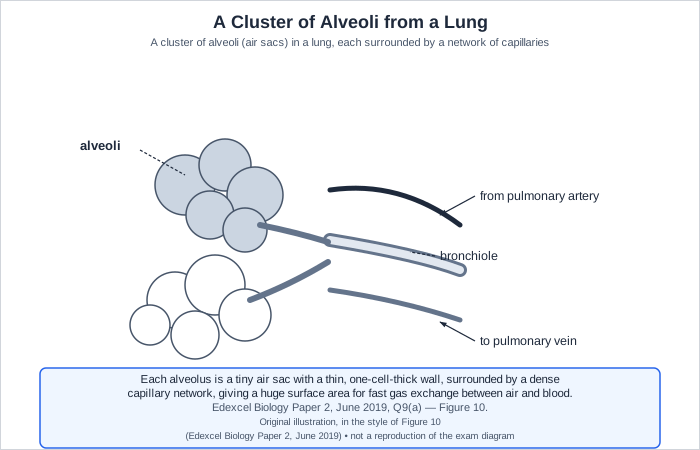
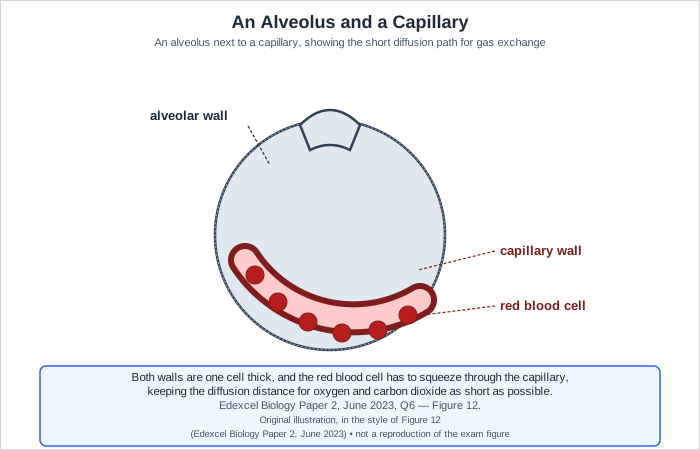
Alveoli have very thin walls, only one cell thick, which creates a short diffusion distance for oxygen and carbon dioxide to pass through (1). There are 300 million alveoli in the lungs, providing a huge total surface area of about 70 mยฒ for gas exchange to occur (1). Each alveolus is surrounded by a network of blood capillaries that constantly brings deoxygenated blood and removes oxygenated blood, maintaining a steep concentration gradient for rapid diffusion (1). The alveoli have a moist lining which allows oxygen and carbon dioxide to dissolve before diffusing across the membrane (1).

  • Thin walls (one cell thick) provide a short diffusion distance for oxygen and carbon dioxide (1m)
  • Large total surface area (from 300 million alveoli) increases rate of diffusion (1m)
  • Rich blood supply in surrounding capillaries maintains steep concentration gradient (1m)
  • Moist lining allows gases to dissolve before diffusing across membrane (1m)

This is a classic 4-mark adaptation question. You need to name FOUR adaptations and link each to the function (gas exchange). Use the pattern: [Feature] โ†’ [Why it helps]. The four key adaptations are: (1) thin walls = short diffusion path, (2) huge surface area = more diffusion, (3) rich blood supply = maintains gradient, (4) moist = gases dissolve. Common mistakes: saying alveoli have 'thick' walls (opposite!), forgetting to mention the 300 million number, or not explaining WHY each feature helps. Don't say active transport - it's all passive diffusion down concentration gradients.

Test yourself on this in PrepWise
5.

Explain what happens during exhalation (breathing out).

4 marks ยท standard๐Ÿ”ฅ Very common

During exhalation, the intercostal muscles relax, allowing the ribcage to move downwards and inwards under its own weight (1). The diaphragm muscle also relaxes and returns to its natural domed shape, moving upwards (1). Both of these movements decrease the volume of the thorax (1). As the volume decreases, the pressure inside the thorax increases above atmospheric pressure, forcing air out of the lungs (1).

  • Intercostal muscles relax, allowing the ribcage to move downwards and inwards (1m)
  • The diaphragm muscle relaxes and returns to its domed shape (moves upwards) (1m)
  • These movements decrease the volume of the thorax (1m)
  • Pressure inside the thorax increases, forcing air out of the lungs (1m)

This is a 4-mark question on exhalation - the opposite process to inhalation. Key differences: muscles RELAX (don't contract), diaphragm moves UP (not down), ribs move DOWN and IN (not up and out), volume DECREASES (not increases), pressure INCREASES (not decreases), air flows OUT (not in). The sequence is: (1) intercostal muscles relax โ†’ ribs down/in, (2) diaphragm relaxes โ†’ domes up, (3) volume decreases, (4) pressure increases โ†’ air pushed out. Most students get inhalation right but mix up exhalation - remember 'EX-hale = muscles relax, chest gets smaller'.

Test yourself on this in PrepWise
6.

Emphysema is a disease where alveolar walls break down. Explain why people with emphysema experience breathlessness.

4 marks ยท higher๐Ÿ”ฅ Very common

In emphysema, the delicate walls between alveoli break down, causing individual alveoli to merge together into larger air spaces (1). This drastically reduces the total surface area available for gas exchange - instead of millions of tiny alveoli, there are fewer large spaces (1). With less surface area, oxygen diffuses into the blood more slowly because there is less membrane for diffusion to occur across (1). This means blood oxygen levels fall and carbon dioxide cannot be removed efficiently, leading to breathlessness even during mild activity like walking (1).

  • Alveolar walls break down and alveoli merge into larger air spaces (1m)
  • This greatly reduces the total surface area available for gas exchange (1m)
  • Less surface area means slower diffusion of oxygen into blood (1m)
  • Blood oxygen levels drop and carbon dioxide removal is impaired, causing breathlessness even during mild activity (1m)

This 4-mark question requires you to link structural change โ†’ functional impact โ†’ symptoms. The chain is: walls break down โ†’ alveoli merge โ†’ surface area drops โ†’ diffusion slows โ†’ oxygen low, CO2 high โ†’ breathlessness. Key point: emphysema is about SURFACE AREA loss from structural damage (permanent), NOT airway narrowing like asthma (temporary). Common errors: confusing emphysema with bronchitis/asthma (different diseases), saying it's reversible (it's not - the damage is permanent), or not explaining WHY less surface area causes breathlessness (need the diffusion link).

Test yourself on this in PrepWise
7.

Explain how carbon dioxide moves from the blood into the alveoli.

3 marks ยท standard๐Ÿ”ฅ Very common

Carbon dioxide is produced as a waste product of aerobic respiration in body cells and is transported dissolved in blood plasma to the lungs (1). When blood reaches the alveoli, it has a high concentration of carbon dioxide, while the air in the alveoli has a low concentration because carbon dioxide has been exhaled (1). Therefore, carbon dioxide diffuses from the blood capillaries into the alveoli down the concentration gradient, where it can be breathed out (1).

  • Carbon dioxide is produced by respiration in body cells and transported in the blood to the lungs (1m)
  • Blood arriving at alveoli has a higher concentration of carbon dioxide than the air in the alveoli (1m)
  • Carbon dioxide diffuses from blood capillaries into alveoli down the concentration gradient (1m)

This is a 3-mark explain question. Mark 1: state where CO2 comes from (respiration in cells). Mark 2: explain the concentration gradient (high in blood, low in alveoli). Mark 3: state the process and direction (diffusion from blood to alveoli). Common error: confusing the direction with oxygen (which goes the opposite way). Another error: saying 'active transport' - gas exchange is ALWAYS passive diffusion. Don't just say 'breathing out' - you need to explain the diffusion mechanism BEFORE exhalation happens.

Test yourself on this in PrepWise
8.

Explain why a constant flow of blood through the capillaries around the alveoli is important for efficient gas exchange.

3 marks ยท standard๐Ÿ”ฅ Very common

Blood flow constantly brings deoxygenated blood (with low oxygen and high carbon dioxide) from the body to the alveolar capillaries (1). It also constantly removes oxygenated blood (with high oxygen and low carbon dioxide) away from the alveoli back to the heart (1). This continuous flow maintains steep concentration gradients - oxygen stays higher in alveoli than blood, and carbon dioxide stays higher in blood than alveoli, so diffusion continues rapidly in both directions (1).

  • Blood constantly delivers deoxygenated blood (low oxygen, high carbon dioxide) to the alveoli (1m)
  • Blood constantly removes oxygenated blood (high oxygen, low carbon dioxide) from the alveoli (1m)
  • This maintains steep concentration gradients for oxygen and carbon dioxide, keeping diffusion rapid (1m)

This 3-mark question tests understanding of how concentration gradients are maintained. If blood stopped flowing, oxygen would diffuse into blood until the concentrations equalized, then diffusion would stop. Continuous flow prevents this by constantly replacing blood - bringing in 'used' blood (low O2, high CO2) and removing 'fresh' blood (high O2, low CO2). This keeps the gradients steep so diffusion stays fast. Think of it like a conveyor belt - blood is constantly refreshed. Common error: saying blood 'pumps' or 'actively transports' gases - it just maintains the concentration difference that drives passive diffusion.

Test yourself on this in PrepWise
9.

Explain why breathing rate increases during exercise.

3 marks ยท standard๐Ÿ”ฅ Very common

During exercise, muscle cells need to respire more rapidly to transfer more energy for muscle contraction (1). This means they use up oxygen faster and produce more carbon dioxide as a waste product (1). To meet this increased demand, breathing rate increases to bring more oxygen into the alveoli for diffusion into blood, and to remove the extra carbon dioxide being produced by respiration (1).

  • During exercise, muscle cells respire more to transfer more energy for contraction (1m)
  • This increases oxygen demand and carbon dioxide production in cells (1m)
  • Faster breathing brings in more oxygen and removes more carbon dioxide to meet these increased demands (1m)

This is a classic 3-mark 'explain why' question linking exercise to breathing. The logic chain is: exercise โ†’ muscles work harder โ†’ more respiration needed โ†’ more O2 used and more CO2 made โ†’ breathing rate increases to supply O2 and remove CO2. Don't confuse breathing (ventilation) with respiration (the chemical reaction in cells). Common mistake: saying 'muscles need more air' - be specific: muscles need more OXYGEN (from air) for respiration. Another error: forgetting to mention carbon dioxide removal - breathing rate increases for BOTH oxygen supply AND CO2 removal.

Test yourself on this in PrepWise
10.

Oxygen diffuses from alveoli into blood down a partial pressure gradient. Explain what is meant by 'partial pressure gradient' and why it causes diffusion.

3 marks ยท standard๐Ÿ”ฅ Very common

Partial pressure is the pressure exerted by a single gas in a mixture - for example, oxygen's contribution to total air pressure (1). In the alveoli, the partial pressure of oxygen is high because air has just been inhaled, but in the blood arriving at the lungs it is low because body cells have used oxygen for respiration (1). Oxygen diffuses down this partial pressure gradient from the alveoli (high) into the blood (low) until equilibrium would be reached - but blood flow prevents equilibrium (1).

  • Partial pressure is the pressure exerted by one gas in a mixture of gases (1m)
  • Partial pressure of oxygen is higher in alveolar air than in blood arriving at lungs (1m)
  • Gases diffuse from regions of high partial pressure to low partial pressure (down the gradient) (1m)

This question tests a more sophisticated understanding of diffusion using the concept of partial pressure. Air is a mixture of gases (78% nitrogen, 21% oxygen, etc.). Each gas exerts its own pressure - its 'partial pressure'. Oxygen diffuses from where its partial pressure is HIGH (alveoli ~13 kPa) to where it's LOW (blood ~5 kPa). Same concept as concentration gradient, but using pressure instead. Don't confuse with blood pressure (heart pumping) or total atmospheric pressure (all gases combined). Higher tier students should use 'partial pressure' terminology, foundation tier can use 'concentration' - same idea.

Test yourself on this in PrepWise
11.

A student at rest takes 15 breaths per minute. During exercise, their breathing rate increases to 45 breaths per minute. Calculate the percentage increase in breathing rate.

3 marks ยท standard๐Ÿ”ฅ Very common

Calculate the increase in breathing rate: 45 - 15 = 30 breaths per minute (1). Use the percentage increase formula: (increase รท original value) ร— 100 (1). Percentage increase = (30 รท 15) ร— 100 = 200% (1).

  • Calculate the increase: 45 - 15 = 30 breaths per minute (1m)
  • Calculate percentage: (increase รท original) ร— 100 (1m)
  • (30 รท 15) ร— 100 = 200% (1m)

This is a standard percentage increase calculation. Step 1: Find the increase (new - old = 45 - 15 = 30). Step 2: Divide increase by original value (30 รท 15 = 2). Step 3: Multiply by 100 to get percentage (2 ร— 100 = 200%). A 200% increase means the breathing rate has TRIPLED (from 15 to 45). Common error: calculating 45รท15 = 3 and saying 300% - that's the new rate as a percentage of the old, not the INCREASE. Remember: percentage increase = [(new - old) รท old] ร— 100.

Test yourself on this in PrepWise
12.

State two differences between bronchi and bronchioles.

2 marks ยท foundation๐Ÿ”ฅ Very common

Bronchi are wider/larger in diameter than bronchioles (1). Bronchi have C-shaped rings of cartilage to hold them open, whereas bronchioles do not have cartilage (1).

  • Bronchi are larger/wider in diameter than bronchioles (1m)
  • Bronchi have cartilage rings for support, bronchioles do not (1m)

This is a simple 2-mark comparison. The two main differences are size (bronchi bigger, bronchioles smaller) and cartilage (bronchi have it, bronchioles don't). Other valid differences include: bronchi are closer to the trachea, bronchioles are more numerous, bronchioles end in alveoli. You only need TWO clear differences for full marks. Make sure you state BOTH sides of the comparison - don't just say 'bronchi are larger' without comparing to bronchioles.

Test yourself on this in PrepWise
13.

A single alveolus has a diameter of 0.2 mm and a wall thickness of 0.001 mm. Calculate how many times thicker the diameter is compared to the wall thickness.

2 marks ยท standard๐Ÿ”ฅ Very common

Divide the diameter by the wall thickness (1): 0.2 รท 0.001 = 200 times (1). This shows that the alveolus diameter is 200 times larger than the wall thickness, demonstrating how thin the walls are for efficient diffusion.

  • Divide diameter by wall thickness (1m)
  • 0.2 รท 0.001 = 200 times (1m)

This is a straightforward division calculation. Since both measurements are already in the same units (mm), you can divide directly: 0.2 รท 0.001 = 200. The answer shows that alveolar walls are extremely thin relative to their size - this short diffusion distance is one of the key adaptations for rapid gas exchange. If the walls were thicker (say 0.02 mm), the ratio would be only 10 times, meaning a longer diffusion path and slower gas exchange.

Test yourself on this in PrepWise
14.

Which is the correct order of structures air passes through to reach the lungs?

  • A. Trachea โ†’ bronchi โ†’ bronchioles โ†’ alveoli
  • B. Bronchi โ†’ trachea โ†’ bronchioles โ†’ alveoli
  • C. Trachea โ†’ bronchioles โ†’ bronchi โ†’ alveoli
  • D. Bronchioles โ†’ bronchi โ†’ trachea โ†’ alveoli
1 mark ยท foundation๐Ÿ”ฅ Very common

Air travels from the trachea (windpipe) which splits into two bronchi (one for each lung). Each bronchus divides into smaller bronchioles, which end in tiny air sacs called alveoli. This branching structure is like a tree - the trachea is the trunk, bronchi are main branches, bronchioles are smaller branches, and alveoli are the leaves. Remember: the structures get progressively smaller and more numerous as air moves deeper into the lungs.

Test yourself on this in PrepWise
15.

Approximately how many alveoli are there in the human lungs?

  • A. 300 thousand
  • B. 3 million
  • C. 30 million
  • D. 300 million
1 mark ยท foundation๐Ÿ”ฅ Very common

The lungs contain approximately 300 million alveoli. This huge number creates an enormous surface area (about 70 square metres - the size of a tennis court) packed into your chest. This massive surface area is essential because gas exchange happens by diffusion across the alveolar walls, and more surface area means faster diffusion. If you only had a few thousand or million alveoli, you wouldn't get enough oxygen into your blood to survive.

Test yourself on this in PrepWise
16.

In which direction does oxygen diffuse during gas exchange in the lungs?

  • A. From alveoli into blood capillaries
  • B. From blood capillaries into alveoli
  • C. From bronchioles into alveoli
  • D. From blood into body cells
1 mark ยท foundation๐Ÿ”ฅ Very common

Oxygen diffuses from the alveoli (where there is a high concentration from inhaled air) into the blood capillaries (where there is a lower concentration). Diffusion always goes from high to low concentration. In the alveoli, oxygen concentration is high because you've just breathed in fresh air. In the blood arriving at the lungs, oxygen is low because body cells have used it up. So oxygen moves from alveoli โ†’ blood. Carbon dioxide goes the opposite way (blood โ†’ alveoli) because it's high in blood (produced by respiration) and low in alveoli.

Test yourself on this in PrepWise
17.

Why is ventilation (breathing) essential for gas exchange?

  • A. It produces oxygen for the blood
  • B. It pumps gases across the alveolar membrane
  • C. It maintains concentration gradients in the alveoli
  • D. It provides energy for diffusion
1 mark ยท foundation๐Ÿ”ฅ Very common

Breathing (ventilation) brings fresh air with high oxygen and low carbon dioxide into the alveoli, and removes stale air with low oxygen and high carbon dioxide. This maintains the concentration gradients needed for diffusion: oxygen stays high in alveoli (low in blood), and carbon dioxide stays low in alveoli (high in blood). Without breathing, oxygen would run out and carbon dioxide would build up in the alveoli, stopping diffusion. Diffusion itself is passive (no energy needed) - it's driven by concentration differences, not by breathing movements.

Test yourself on this in PrepWise
18.

What type of tissue is the diaphragm made from?

  • A. Nervous tissue
  • B. Connective tissue
  • C. Epithelial tissue
  • D. Muscle tissue
1 mark ยท foundation๐Ÿ”ฅ Very common

The diaphragm is made of muscle tissue - specifically skeletal muscle that you can control consciously (though breathing also happens automatically). Muscle tissue can contract and relax to create movement. When the diaphragm contracts it flattens downwards for inhalation, when it relaxes it domes upwards for exhalation. Epithelial tissue (C) forms linings like the alveolar walls, nervous tissue (A) carries signals like in nerves, and connective tissue (B) includes things like cartilage in the trachea - none of these can contract like muscle.

Test yourself on this in PrepWise
19.

What is the approximate total surface area of all the alveoli in the lungs?

  • A. 7 square metres
  • B. 70 square metres
  • C. 700 square metres
  • D. 7000 square metres
1 mark ยท foundation๐Ÿ”ฅ Very common

The 300 million alveoli in your lungs provide a total surface area of approximately 70 square metres - about the size of a tennis court. This enormous area is packed into your chest through the branching structure of the respiratory system and the microscopic size of individual alveoli. You need this much surface area because gas exchange happens by diffusion, and the rate of diffusion is directly proportional to surface area. More surface = faster oxygen uptake and CO2 removal. If the area was only 7 mยฒ (A) it wouldn't be enough to keep you alive during exercise.

Test yourself on this in PrepWise
20.

What happens during an asthma attack?

  • A. The diaphragm muscle stops working
  • B. Airways become inflamed and narrowed
  • C. Alveoli walls break down permanently
  • D. Blood clots block the pulmonary artery
1 mark ยท foundation๐Ÿ”ฅ Very common

During an asthma attack, the airways (bronchi and bronchioles) become inflamed and the muscles around them contract, making them narrower. This makes it harder for air to flow in and out of the lungs, causing wheezing, coughing, and breathlessness. Unlike emphysema (C), asthma doesn't permanently damage alveoli - it's usually reversible with inhalers. The breathing muscles like the diaphragm (A) still work fine - the problem is that narrowed airways resist airflow. Asthma is managed with relievers (open airways quickly) and preventers (reduce inflammation over time).

Test yourself on this in PrepWise
21.

What process is responsible for gas exchange between alveoli and blood?

  • A. Active transport
  • B. Osmosis
  • C. Diffusion
  • D. Filtration
1 mark ยท foundation๐Ÿ”ฅ Very common

Gas exchange in the lungs occurs by diffusion - the passive movement of particles from high to low concentration. Oxygen diffuses from alveoli (high concentration) to blood (low concentration), while carbon dioxide diffuses from blood (high) to alveoli (low). No energy is needed because molecules move down their concentration gradients naturally. Active transport (A) uses energy to move substances AGAINST gradients. Osmosis (B) is specifically for water movement. Filtration (D) is used in kidneys to separate substances, not in gas exchange.

Test yourself on this in PrepWise

Plant Transport Systems

Very common24
1.

Plants have two separate transport systems (xylem and phloem) while animals have one system (blood) that transports everything. Evaluate the advantages and disadvantages of having separate transport systems in plants.

6 marks ยท higher๐Ÿ”ฅ Very common

Advantages of separate systems: Water transport through xylem can be entirely passive, using no energy as it's driven by transpiration pull, while sugar transport through phloem only uses energy where needed for loading and unloading (1). Each system can be structurally optimized - xylem has dead cells with lignin for strength, while phloem has living cells with sieve plates and companion cells perfectly designed for active translocation (1). Water can move upwards through xylem while sugars move downwards or sideways through phloem at the same time, without one affecting the other (1). Disadvantages: Plants need to develop and maintain two separate complex vascular systems rather than one multipurpose system like blood, which takes more resources to build (1). The separate systems are less flexible - they cannot rapidly redistribute all resources to different parts like blood does when animals need to respond quickly to threats (1). Overall, separate systems are well-suited to the plant lifestyle because plants are stationary and don't need rapid responses, and energy conservation is crucial since plants rely on photosynthesis. However, this system would not work for animals that need to quickly redirect oxygen, nutrients, and immune cells throughout the body (1).

  • Advantage: Water transport can be passive (no energy cost) while sugar transport is active where needed (1m)
  • Advantage: Each system can be optimized for its specific substance (e.g., lignin for water support, sieve plates for sugar flow) (1m)
  • Advantage: Water and sugars can move in different directions simultaneously without interfering (1m)
  • Disadvantage: More complex tissue structure required (two separate vascular bundles) (1m)
  • Disadvantage: Cannot rapidly redistribute all resources like blood does (1m)
  • Conclusion: Separate systems suit plant lifestyle (stationary, energy conservation) but would not suit animals (need rapid response) (1m)

This is a 6-mark evaluation question requiring balanced discussion. Give 2-3 advantages with explanations, 2 disadvantages with explanations, then a conclusion linking to plant lifestyle. Compare plants vs animals and explain WHY separate systems evolved in plants.

Test yourself on this in PrepWise
2.

A student wants to investigate how light intensity affects the rate of water uptake in a leafy shoot using a potometer. (a) Identify the independent, dependent, and three control variables for this investigation. [5 marks] (b) Explain why it's important to control the variables you identified. [1 mark]

6 marks ยท higher๐Ÿ”ฅ Very common

(a) Independent variable: light intensity - this is what the student deliberately changes (1). Dependent variable: rate of water uptake measured by timing how far the air bubble moves (1). Control variables that must be kept constant: temperature (affects evaporation rate), humidity (affects concentration gradient for water loss), air movement/wind (affects evaporation), number or size of leaves (affects surface area for transpiration), plant species (different plants have different transpiration rates) - any three for 3 marks (3). (b) These variables must be controlled to make it a fair test. If multiple variables changed at once, you wouldn't know which one caused any change in water uptake rate. By controlling everything except light intensity, you can be confident that light is the only factor affecting the results (1).

  • (a) Independent variable: light intensity (1m)
  • (a) Dependent variable: rate of water uptake (measured by bubble movement) (1m)
  • (a) Control variables: temperature, humidity, air movement/wind, number/size of leaves, plant species (3m)
  • (b) To ensure any change in water uptake rate is only due to light intensity and not other factors (fair test) (1m)

Part (a) worth 5 marks: correctly identify independent (1), dependent (1), and THREE control variables (3 marks). Part (b) worth 1 mark: explain the fair test principle. Common mistakes: confusing independent and dependent, or listing things that aren't variables.

Test yourself on this in PrepWise
3.

During a prolonged drought, many trees die even though their trunk and branches appear undamaged. Explain the chain of events, from the roots to the leaves, that leads to the death of a tree during drought.

6 marks ยท challenge๐Ÿ”ฅ Very common

During drought, the soil becomes very dry so the roots cannot absorb sufficient water by osmosis, because the water concentration in the soil drops below that in the root hair cells (1). With less water absorbed, less water is transported upward through the xylem vessels to the leaves and other parts of the tree (1). To reduce further water loss, the stomata on the leaves close. However, this also prevents carbon dioxide from diffusing into the leaf (1). Without an adequate supply of carbon dioxide, the rate of photosynthesis decreases significantly, meaning the tree produces much less glucose (1). As water is lost from cells faster than it is replaced, cells lose their turgor pressure and become flaccid, causing the leaves and young stems to wilt and droop (1). Critically, without sufficient glucose from photosynthesis, the tree cannot carry out enough aerobic respiration to release the energy needed for essential cell processes such as growth, repair, and active transport. Over time the cells starve of energy and die, eventually killing the tree (1).

  • Without rainfall, soil water is depleted so roots cannot absorb sufficient water by osmosis (1m)
  • Less water is transported up through the xylem vessels to the leaves (1m)
  • Stomata close to reduce water loss by transpiration, which also prevents carbon dioxide from entering the leaf (1m)
  • Without carbon dioxide entering, the rate of photosynthesis decreases so less glucose is produced (1m)
  • Cells lose turgor pressure and the plant wilts โ€” leaves and stems become flaccid and droop (1m)
  • Without glucose from photosynthesis, the tree cannot release enough energy by respiration for essential cell processes (growth, repair, active transport), and cells eventually die (1m)

This is a 6-mark cause-chain question modelled on AQA Higher paper patterns. It tests your ability to link multiple biological processes in a logical sequence from trigger to outcome. The chain runs: drought reduces soil water concentration so roots absorb less water by osmosis. Less water means less transport through the xylem to the leaves. The tree's defence mechanism is to close stomata to reduce water loss by transpiration, but this has the side effect of blocking carbon dioxide from entering. Without carbon dioxide, photosynthesis rate drops dramatically and much less glucose is produced. Cells also lose turgor pressure as water leaves by osmosis faster than it is replaced, causing wilting. The final lethal step is energy starvation. Glucose is the raw material for aerobic respiration, which releases the energy cells need for growth, repair, and active transport. Without enough glucose, respiration cannot provide sufficient energy, and cells gradually die. To score full marks, you must show the LINKS between each step โ€” do not just list facts. Use causal language: 'this means that...', 'as a result...', 'without this, the tree cannot...'.

Test yourself on this in PrepWise
4.

Explain how translocation moves sugars from source to sink in phloem tissue.

5 marks ยท higher๐Ÿ”ฅ Very common

At the source (leaves), sugars produced by photosynthesis are loaded into phloem sieve tubes by active transport using energy from companion cells (1). This active transport moves sugars against their concentration gradient, requiring ATP (1). The high sugar concentration in the phloem causes water to enter by osmosis from surrounding tissues (1). This creates high pressure that pushes the sugary sap by mass flow through the sieve tubes towards sink areas (1). At sinks (roots, storage organs, growing tips), sugars are actively unloaded for use or storage (1).

  • Sugars are loaded into phloem at the source (leaves) by active transport (1m)
  • Active transport uses energy from companion cells to move sugars against concentration gradient (1m)
  • High sugar concentration causes water to enter phloem by osmosis (1m)
  • This creates high pressure that pushes sap by mass flow to sink areas (1m)
  • Sugars are unloaded at sink (roots, storage organs, growing tips) by active transport (1m)

This is a 5-mark mechanism question. Explain the full process: (1) Active loading at source โ†’ (2) Energy from companion cells โ†’ (3) Osmosis creates pressure โ†’ (4) Mass flow to sink โ†’ (5) Active unloading. Common mistakes: saying sugars move by diffusion (NO - active transport at both ends). Water moves by osmosis (passive), not active transport. Translocation can go ANY direction (up/down/sideways) from source to sink, wherever needed. The pressure difference drives mass flow.

Test yourself on this in PrepWise
5.

Xylem and phloem are both transport tissues in plants but have very different structures. Compare the structural adaptations of xylem and phloem, and explain how each structure is suited to its specific transport function.

5 marks ยท challenge๐Ÿ”ฅ Very common

Xylem vessels are formed from dead cells with no end walls between them, creating a continuous hollow tube. This allows water to flow upward without interruption under tension created by transpiration (1). The walls of xylem vessels are reinforced with lignin, which waterproofs the vessels to prevent water leaking out and provides rigid structural support to withstand the negative pressure (pulling force) during transpiration (1). Phloem sieve tube elements are living cells that have perforated end walls called sieve plates between them. The pores in these sieve plates allow dissolved sugars (sucrose) to flow through from cell to cell (1). Sieve tube elements have lost their nucleus and most of their organelles, which creates maximum internal space for the flow of sugar solution through the tube (1). Alongside each sieve tube element sits a companion cell, which is a living cell packed with many mitochondria. The companion cells carry out the metabolic functions for both cells and provide energy (ATP) through respiration for the active loading of sucrose into the phloem against a concentration gradient (1).

  • Xylem vessels are made of dead cells with no end walls, forming a continuous hollow tube โ€” this allows uninterrupted water flow upward under tension (1m)
  • Xylem walls are thickened with lignin which provides waterproofing and structural support to withstand negative pressure (1m)
  • Phloem sieve tube elements are living cells with sieve plates (perforated end walls) that allow dissolved sugars to flow through (1m)
  • Phloem sieve tubes have lost most organelles (including the nucleus) to create maximum space for the flow of sugar solution (1m)
  • Companion cells sit alongside sieve tubes and carry out metabolic functions โ€” they have many mitochondria to provide energy for active loading of sugars into the phloem by active transport (1m)

This compare-contrast question tests whether you understand the link between structure and function in two different transport tissues. Xylem transports water and dissolved minerals upward from roots to leaves. Its key adaptations are: dead cells with no end walls (creating an unbroken hollow tube for free water flow), and walls strengthened with lignin (which waterproofs the vessel and gives structural rigidity to resist the negative pressure created by the transpiration pull). Phloem transports dissolved sugars (sucrose) from where they are made in the leaves to where they are needed elsewhere in the plant. Sieve tube elements have porous sieve plates between cells, allowing the sugar solution to flow through. They have lost their nucleus and most organelles to maximise the internal space for flow. Critically, companion cells sit alongside sieve tubes and act as their 'support cells'. They are packed with mitochondria because loading sucrose into the phloem requires active transport โ€” an energy-demanding process. Without companion cells providing ATP, sugars could not be loaded against the concentration gradient. A common mistake is confusing which tissue transports which substance, or saying phloem cells are dead (they are alive, just highly specialised).

Test yourself on this in PrepWise
6.

Explain how water moves from the roots to the leaves in the transpiration stream.

4 marks ยท standard๐Ÿ”ฅ Very common

Water evaporates from leaf cells and exits through stomata in a process called transpiration (1). This creates a negative pressure or suction effect in the xylem vessels (1). Water molecules are pulled up the xylem because they stick together due to cohesion (1). As water is lost from the leaves, more water enters the roots by osmosis to replace it, creating a continuous transpiration stream (1).

  • Water evaporates from leaf cells and exits through stomata (transpiration) (1m)
  • This creates a negative pressure or suction in the xylem vessels (1m)
  • Water molecules are pulled up the xylem due to cohesion (water molecules stick together) (1m)
  • More water enters the root by osmosis to replace water lost from leaves (1m)

This is a 4-mark process question. Explain the full cycle: (1) Transpiration at leaves โ†’ (2) Negative pressure created โ†’ (3) Cohesion pulls water up โ†’ (4) Osmosis at roots replaces water. Common mistakes: saying water is 'pushed' up (NO - it's pulled by suction) or that active transport moves water (NO - water uses osmosis, only minerals use active transport). The key is understanding it's a continuous pull from the top, not a push from the bottom.

Test yourself on this in PrepWise
7.

Explain why root hair cells absorb mineral ions by active transport rather than by diffusion.

4 marks ยท higher๐Ÿ”ฅ Very common

Soil water contains a very low concentration of mineral ions - it's a dilute solution (1). Root hair cells already contain a higher concentration of minerals than the surrounding soil (1). This means minerals need to move against their concentration gradient, from an area of lower concentration (soil) to an area of higher concentration (root cells) (1). Active transport uses energy from respiration in mitochondria (ATP) to pump minerals against this gradient, which diffusion cannot do (1).

  • Soil water has a very low concentration of mineral ions (dilute solution) (1m)
  • Root hair cells have a higher concentration of minerals than the soil (1m)
  • Minerals need to move against the concentration gradient (from low to high) (1m)
  • Active transport requires energy from mitochondria to move minerals against the gradient (1m)

This is a 4-mark explain question about WHY active transport is needed. Build the argument: (1) Soil is dilute โ†’ (2) Cells are concentrated โ†’ (3) Movement must be against gradient โ†’ (4) Active transport uses energy to do this. Common mistakes: saying minerals diffuse (NO - diffusion only works DOWN a gradient, but minerals need to go UP). Osmosis is for water, not minerals. Root hair cells have many mitochondria specifically to provide ATP for this active transport.

Test yourself on this in PrepWise
8.

Explain how root hair cells are adapted for their function.

3 marks ยท standard๐Ÿ”ฅ Very common

Root hair cells have long hair-like projections that increase their surface area, allowing them to absorb more water and minerals from the soil (1). They have thin cell walls that allow water to pass through easily by osmosis (1). They contain many mitochondria which provide energy for active transport of mineral ions from the dilute soil solution into the concentrated cell sap (1).

  • Long hair-like projections increase surface area for absorption (1m)
  • Thin cell walls allow water to pass through easily by osmosis (1m)
  • Many mitochondria provide energy for active transport of mineral ions (1m)

This is a 3-mark adaptation question. Give THREE adaptations linked to function: (1) Long projections = large surface area for absorption, (2) Thin walls = easy osmosis of water, (3) Many mitochondria = energy for active transport of minerals. Common mistakes: saying minerals enter by diffusion (NO - they use active transport because soil is dilute but cell sap is concentrated). Also, root hair cells have NO chloroplasts (underground, no light).

Test yourself on this in PrepWise
9.

Explain how the structure of phloem tissue is adapted for translocation.

3 marks ยท standard๐Ÿ”ฅ Very common

Phloem has sieve tubes with perforated end walls called sieve plates, which allow dissolved sugars to flow easily from cell to cell (1). The cells are living with cytoplasm but no nucleus, leaving maximum space for transporting sugars (1). Companion cells sit next to sieve tubes and provide energy (ATP) and support for actively loading sugars into the phloem (1).

  • Sieve tubes have perforated end walls (sieve plates) allowing sugars to flow through (1m)
  • Living cells with cytoplasm but no nucleus, leaving space for sugar transport (1m)
  • Companion cells provide energy and support for active loading of sugars (1m)

This is a 3-mark adaptation question. Give THREE structural features and link each to translocation: (1) Sieve plates = allow sugar flow, (2) No nucleus = more space for sugars, (3) Companion cells = provide energy for loading. Common mistakes: confusing phloem with xylem (phloem is LIVING, has NO lignin). Remember: phloem = living tubes with helpers (companion cells), xylem = dead tubes with strength (lignin).

Test yourself on this in PrepWise
10.

A student places a celery stalk in coloured dye to investigate water transport. Describe how they could use this to show that water moves through xylem vessels.

3 marks ยท standard๐Ÿ”ฅ Very common

Leave the celery stalk in the coloured dye for a set time, such as 30 minutes (1). Remove the celery and cut it across to expose a cross-section of the stem (1). Observe that only certain ring-like tubes are stained with dye - these are the xylem vessels, showing that water travels through xylem, not all tissues (1).

  • Leave the celery in dye for a set period of time (e.g. 30 minutes) (1m)
  • Cut the celery stalk across to see the cross-section (1m)
  • Observe that only certain tubes are stained (the xylem vessels), not all tissue (1m)

This is a practical method question worth 3 marks. Describe: (1) Time period in dye, (2) How to observe (cut cross-section), (3) What you'll see (only xylem stained). Common mistakes: not mentioning the time period, or expecting all tissues to be stained (NO - only xylem takes up water). The dye moves up through xylem vessels, staining them but not surrounding tissue, which proves water travels in xylem.

Test yourself on this in PrepWise
11.

Explain why a plant wilts when it loses more water by transpiration than it absorbs from the soil.

3 marks ยท standard๐Ÿ”ฅ Very common

When more water is lost than absorbed, the volume of water in the vacuoles of plant cells decreases (1). This reduces the turgor pressure - the pressure of water pushing outwards on the cell walls (1). Without turgor pressure to keep cells firm, the cells become soft and floppy, causing the plant to wilt and droop (1).

  • Water loss from cells reduces the volume of water inside vacuoles (1m)
  • This reduces turgor pressure (the pressure pushing outwards on cell walls) (1m)
  • Without turgor pressure, cells become soft and floppy, making the plant wilt (1m)

This is a 3-mark explain question about wilting. Link the sequence: (1) Water loss from vacuoles โ†’ (2) Reduced turgor pressure โ†’ (3) Cells soft and floppy = wilting. Common mistakes: saying the plant dies (NO - it can recover if watered) or focusing on photosynthesis (wilting is about TURGOR PRESSURE, not photosynthesis). Turgor is the pressure that keeps plant cells rigid - lose water, lose turgor, plant wilts.

Test yourself on this in PrepWise
12.

Describe how a student could use a potometer to measure the rate of water uptake by a plant shoot.

3 marks ยท standard๐Ÿ”ฅ Very common

Cut the plant shoot underwater and immediately insert it into the potometer tubing, keeping everything underwater to prevent air bubbles entering the xylem which would block water flow (1). Introduce a small air bubble into the capillary tube using the syringe, and measure its starting position against the scale (1). Time how long the bubble takes to move a set distance (e.g., 10 cm), then calculate the rate of water uptake using rate = distance รท time in mm per minute (1).

  • Cut the shoot underwater and insert into potometer tubing to prevent air bubbles entering xylem (1m)
  • Introduce an air bubble into the capillary tube and measure the starting position (1m)
  • Time how long the bubble takes to move a measured distance, then calculate rate = distance รท time (1m)

This is a 3-mark practical method question. Include: (1) Underwater cutting and setup, (2) Air bubble introduction and positioning, (3) Timing and rate calculation. Common mistakes: cutting in air (air would enter xylem and block it), or not explaining how to calculate the rate. The air bubble is a marker that moves as water is taken up - as the shoot absorbs water, the bubble moves along the capillary tube. Assumption: rate of bubble movement = rate of water uptake (though some water is used in cells, not just lost by transpiration).

Test yourself on this in PrepWise
13.

A horticulturalist uses a greenhouse to grow tomato plants. Describe three ways the growing conditions in the greenhouse could be altered to increase the rate of photosynthesis and improve crop yield. [3 marks]

3 marks ยท standard๐Ÿ”ฅ Very common

Increasing the light intensity provides more energy for the light-dependent reactions of photosynthesis, increasing the rate. Raising the temperature (up to the optimum of around 25โ€“30 ยฐC) increases enzyme activity, speeding up the Calvin cycle reactions. Increasing the carbon dioxide concentration provides more substrate for carbon fixation (the Calvin cycle), increasing the rate of photosynthesis and therefore biomass production.

  • Increase light intensity โ€” provides more energy for light-dependent reactions / photosynthesis (1m)
  • Increase COโ‚‚ concentration โ€” more substrate for carbon fixation / Calvin cycle (1m)
  • Increase temperature (up to optimum) โ€” increases enzyme activity / speeds up reactions (1m)

Photosynthesis rate is limited by whichever factor is in shortest supply โ€” the limiting factor principle. In a greenhouse, all three main limiting factors can be controlled: light intensity (can be supplemented with artificial lighting), COโ‚‚ (can be raised by burning fuels or adding COโ‚‚ gas), and temperature (controlled by heating). Increasing each one beyond the natural outdoor level accelerates photosynthesis and produces more biomass, improving crop yield.

Test yourself on this in PrepWise
14.

A root hair cell without its hair would have a surface area of 1200 ฮผmยฒ. With the hair projection, the total surface area is 1800 ฮผmยฒ. Calculate the percentage increase in surface area.

3 marks ยท higher๐Ÿ”ฅ Very common

Increase in surface area = 1800 - 1200 = 600 ฮผmยฒ (1). Percentage increase = (increase รท original) ร— 100 (1). (600 รท 1200) ร— 100 = 50% (1).

  • Increase in surface area = 1800 - 1200 = 600 ฮผmยฒ (1m)
  • Percentage increase = (increase รท original) ร— 100 (1m)
  • (600 รท 1200) ร— 100 = 50% (1m)

Three-step calculation: (1) Find the increase = new - original, (2) State the formula for percentage increase, (3) Calculate. Common mistakes: dividing by the new value (1800) instead of original (1200), or forgetting to multiply by 100. Check: the surface area went from 1200 to 1800 - that's a 50% increase (half as much again). This large increase is why root hairs are so effective at absorption.

Test yourself on this in PrepWise
15.

State two structural differences between xylem and phloem tissue.

2 marks ยท foundation๐Ÿ”ฅ Very common

Xylem vessels are made of dead cells with no cytoplasm, while phloem tubes are made of living cells with cytoplasm (1). Xylem has lignin reinforcement in the cell walls for strength, while phloem has sieve plates (perforated end walls) and companion cells (1).

  • Xylem vessels are made of dead cells, phloem tubes are made of living cells (1m)
  • Xylem has lignin in cell walls, phloem has sieve plates at cell junctions (1m)

This is a 2-mark state question - list two clear differences. Key structural differences: (1) Xylem = dead cells, phloem = living cells with cytoplasm but no nucleus. (2) Xylem = lignin for strength, phloem = sieve plates and companion cells. You could also mention: xylem has no end walls (continuous tubes), phloem has perforated end walls (sieve plates). Make sure you compare BOTH tissues - don't just describe one!

Test yourself on this in PrepWise
16.

State two functional differences between xylem and phloem tissue.

2 marks ยท foundation๐Ÿ”ฅ Very common

Xylem transports water and dissolved mineral ions from roots to leaves, while phloem transports dissolved sugars (mainly sucrose) from leaves to all parts of the plant (1). Xylem transport is always one-way upwards, while phloem can transport in any direction depending on where sugars are needed - up to growing tips, down to roots, or sideways to fruits (1).

  • Xylem transports water and minerals, phloem transports dissolved sugars (1m)
  • Xylem transport is one-way (upwards), phloem can transport in any direction (1m)

This is a 2-mark state question - list two functional differences. Key differences: (1) Substances: xylem = water/minerals, phloem = sugars. (2) Direction: xylem = one-way up, phloem = any direction. You could also mention: xylem = passive (no energy), phloem = active (needs energy). Make sure you compare BOTH - don't just describe one tissue!

Test yourself on this in PrepWise
17.

A student uses a potometer to measure water uptake by a plant shoot. An air bubble moves 40 mm along the capillary tube in 5 minutes. Calculate the rate of water uptake in mm per minute.

2 marks ยท standard๐Ÿ”ฅ Very common

Rate = distance รท time (1). Rate = 40 mm รท 5 minutes = 8 mm per minute (1).

  • Rate = distance รท time (1m)
  • 40 รท 5 = 8 mm per minute (1m)

Simple calculation using Rate = Distance รท Time. Make sure to include the units (mm per minute or mm/min). To find how far the bubble moves each minute, divide the total distance (40 mm) by the total time (5 minutes). Check your answer makes sense: the bubble moved 40 mm in 5 minutes, so it should move 8 mm each minute. Common mistake: calculating 5 รท 40 instead of 40 รท 5.

Test yourself on this in PrepWise
18.

Which substance does xylem tissue transport?

  • A. Sugars and amino acids
  • B. Oxygen and carbon dioxide
  • C. Water and dissolved mineral ions
  • D. Proteins and lipids
1 mark ยท foundation๐Ÿ”ฅ Very common

Xylem tissue transports water and dissolved mineral ions from the roots to the leaves. The xylem vessels are hollow tubes made of dead cells reinforced with lignin, perfect for carrying water upwards through the plant. Phloem (A) transports sugars, not xylem. Gases (B) move by diffusion through stomata. Remember: Xylem = water UP, Phloem = food (sugars) around the plant.

Test yourself on this in PrepWise
19.

What is the main substance transported by phloem tissue?

  • A. Water
  • B. Dissolved mineral ions
  • C. Oxygen
  • D. Dissolved sugars (sucrose)
1 mark ยท foundation๐Ÿ”ฅ Very common

Phloem tissue transports dissolved sugars (mainly sucrose) from the leaves (where they're made by photosynthesis) to other parts of the plant. This movement of sugars is called translocation. Water and minerals (A and B) are transported by xylem. Oxygen (C) diffuses through stomata. Key difference: phloem cells are LIVING (with cytoplasm but no nucleus), while xylem cells are DEAD.

Test yourself on this in PrepWise
20.

Which statement about xylem vessels is correct?

  • A. They are made of living cells with cytoplasm
  • B. They are made of dead cells with no end walls
  • C. They have sieve plates at the ends
  • D. They have companion cells for support
1 mark ยท foundation๐Ÿ”ฅ Very common

Xylem vessels are made of dead cells with no end walls, forming continuous hollow tubes. The cell walls are reinforced with lignin for strength, which also makes them waterproof. This structure is perfect for transporting water efficiently. Phloem cells (A) are living. Sieve plates (C) and companion cells (D) are features of phloem, not xylem. Think: xylem = dead tubes, phloem = living tubes with companion cells.

Test yourself on this in PrepWise
21.

Which statement about translocation is correct?

  • A. It requires energy from respiration
  • B. It is a passive process requiring no energy
  • C. It only moves substances upwards
  • D. It only occurs in xylem tissue
1 mark ยท foundation๐Ÿ”ฅ Very common

Translocation requires energy from respiration because sugars are loaded into phloem tubes by active transport (against concentration gradient). It's NOT passive (B). Translocation can move sugars in ANY direction - up to growing tips, down to roots, sideways to fruits (C). It happens in PHLOEM (D), not xylem. Remember: xylem = passive water transport, phloem = active sugar transport requiring energy.

Test yourself on this in PrepWise
22.

How do root hair cells increase water absorption?

  • A. By having long projections that increase surface area
  • B. By having thick cell walls
  • C. By containing many chloroplasts
  • D. By having many mitochondria
1 mark ยท standard๐Ÿ”ฅ Very common

Root hair cells have long projections (like tiny fingers) that massively increase their surface area. More surface area means more contact with soil water, so water can be absorbed faster by osmosis. Thin cell walls (not thick, B) also help. Root hair cells are underground (no light) so have NO chloroplasts (C). They do have mitochondria (D) to power active transport of minerals, but this doesn't increase water absorption - the large surface area does.

Test yourself on this in PrepWise
23.

What creates the 'pull' that moves water up the xylem?

  • A. Active transport by root cells
  • B. Evaporation of water from leaves (transpiration)
  • C. Photosynthesis in the leaves
  • D. Respiration in root cells
1 mark ยท standard๐Ÿ”ฅ Very common

Transpiration (water evaporating from leaves through stomata) creates a negative pressure that pulls water up through the xylem. As water molecules evaporate from the leaf surface, more water is drawn up from below to replace them - like sucking through a straw. Active transport (A) is for minerals, not water. Photosynthesis (C) and respiration (D) don't create this pull. This process is called the transpiration stream.

Test yourself on this in PrepWise
24.

Why do xylem vessels contain lignin in their walls?

  • A. To allow water to pass through easily
  • B. To speed up water transport
  • C. To provide waterproofing and structural support
  • D. To store sugars
1 mark ยท higher๐Ÿ”ฅ Very common

Lignin provides waterproofing and structural support to xylem vessels. It strengthens the cell walls so they don't collapse under the negative pressure created by transpiration pull. Lignin doesn't speed up transport (B) - it prevents the tubes from caving in. Water flows through the hollow centre of the tube (C), not through the lignified walls. Xylem transports water, not sugars (D). Think: lignin = strong skeleton for the water pipe.

Test yourself on this in PrepWise

Transpiration

Very common21
1.

Transpiration causes plants to lose large amounts of water. Evaluate the advantages and disadvantages of transpiration for plant survival. Include in your answer: the role of transpiration in transport, cooling, and mineral uptake, as well as the risks of water loss.

6 marks ยท challenge๐Ÿ”ฅ Very common

Transpiration has several important advantages for plant survival. First, it creates the transpiration stream - a continuous pull of water up through the xylem from roots to leaves. This is the main mechanism for long-distance water transport in plants. Second, evaporation of water from the leaf surface has a cooling effect, which prevents leaves from overheating when exposed to intense sunlight during photosynthesis. Third, the transpiration stream carries dissolved mineral ions from the soil to the leaves where they are needed - for example, magnesium for chlorophyll production and nitrate for protein synthesis. However, transpiration also has disadvantages. Plants can lose enormous volumes of water (a large tree can lose hundreds of liters per day), which must be continuously replaced by the roots absorbing water from soil. If the soil is dry, the plant cannot replace lost water and may wilt. In extreme conditions (hot, dry, windy), transpiration rate can exceed the rate of water uptake, leading to severe water stress that can kill the plant. Overall, while transpiration involves significant water loss, it is essential for the transport functions that keep plants alive. Plants have evolved various adaptations to manage this trade-off, including stomatal control (closing stomata when water is scarce) and xerophyte adaptations in dry environments. The benefits of nutrient and water transport generally outweigh the costs, as long as water is available.

  • ADVANTAGES: Transpiration creates the transpiration stream that pulls water and dissolved minerals up from roots to leaves through xylem (2m)
  • ADVANTAGES: Evaporation of water has a cooling effect, preventing leaves from overheating in sunlight (1m)
  • ADVANTAGES: Brings mineral ions dissolved in water to leaves where they are needed for processes like photosynthesis (e.g., magnesium for chlorophyll) (1m)
  • DISADVANTAGES: Plants can lose large amounts of water which must be replaced by roots, risking wilting if soil is dry (1m)
  • DISADVANTAGES: In hot, dry, or windy conditions transpiration rate can exceed water uptake leading to water stress and plant death (1m)
  • Overall judgment: Transpiration is essential for transport despite water loss risks, plants have evolved adaptations (stomatal control, xerophyte features) to balance these factors (1m)

This is a 6-mark evaluation question requiring a balanced discussion of advantages and disadvantages, with a concluding judgment. Students should cover multiple advantages (transport, cooling, minerals) and disadvantages (water loss risk, wilting), and reach a reasoned conclusion.

Test yourself on this in PrepWise
2.

Explain why increasing temperature increases the rate of transpiration.

4 marks ยท higher๐Ÿ”ฅ Very common

Higher temperature increases transpiration rate because it gives water molecules more kinetic energy. This increased kinetic energy causes water to evaporate more rapidly from the moist mesophyll cell surfaces into the air spaces. The faster evaporation creates a steeper concentration gradient of water vapor between the humid leaf interior and the drier outside air. This steeper concentration gradient increases the rate of diffusion of water vapor out through the stomata, increasing overall transpiration rate.

  • Higher temperature gives water molecules more kinetic energy (1m)
  • More kinetic energy increases the rate of evaporation from mesophyll cell surfaces (1m)
  • Increased evaporation creates a steeper concentration gradient for water vapor between the leaf interior and outside air (1m)
  • Steeper concentration gradient increases the rate of diffusion of water vapor out of the stomata (1m)

Temperature affects transpiration through multiple linked mechanisms: kinetic energy โ†’ evaporation rate โ†’ concentration gradient โ†’ diffusion rate. This is a chain of cause and effect.

Test yourself on this in PrepWise
3.

Marram grass is a xerophyte that grows in sand dunes. Describe and explain two adaptations that reduce water loss in marram grass.

4 marks ยท higher๐Ÿ”ฅ Very common

Marram grass has several adaptations to reduce water loss. First, it has a thick waxy cuticle coating the leaf surface, which provides a waterproof barrier that reduces evaporation of water directly through the epidermis. Second, the stomata are sunken in pits or grooves on the leaf surface, which traps a layer of humid air. This humid layer reduces the concentration gradient for water vapor between the inside and outside of the leaf, slowing diffusion and reducing transpiration rate. (Alternative: The leaves can roll up with the stomata on the inside, reducing the exposed surface area and protecting stomata from wind.)

  • Thick waxy cuticle on the leaf surface which reduces evaporation of water through the epidermis (1 mark for feature, 1 for explanation) (2m)
  • Stomata are sunken in pits/grooves which trap humid air, reducing the concentration gradient for water vapor diffusion (1 mark for feature, 1 for explanation) (2m)
  • Leaves can roll up to reduce the exposed surface area, minimizing water loss (1 mark for feature, 1 for explanation) (2m)
  • Reduced leaf size or leaves modified to spines decreases the total surface area available for transpiration (1 mark for feature, 1 for explanation) (2m)

Xerophytes have structural adaptations that minimize water loss. Students should describe TWO adaptations and explain HOW each reduces transpiration (2 marks each = 4 marks total).

Test yourself on this in PrepWise
4.

Describe the three stages of transpiration in a leaf.

3 marks ยท standard๐Ÿ”ฅ Very common

First, water evaporates from the moist surfaces of mesophyll cells into the air spaces inside the leaf. Then, water vapor diffuses through the air spaces in the spongy mesophyll layer towards the stomata. Finally, water vapor exits the leaf through the open stomata by diffusion, moving down the concentration gradient from the humid leaf interior to the drier air outside.

  • Water evaporates from the surfaces of mesophyll cells into the air spaces in the leaf (1m)
  • Water vapor diffuses through the air spaces in the spongy mesophyll layer (1m)
  • Water vapor exits the leaf through open stomata by diffusion down the concentration gradient (1m)

Transpiration involves three sequential stages: evaporation from cell surfaces, diffusion through air spaces, and exit via stomata. This process is driven by concentration gradients and the change of liquid water to water vapor.

Test yourself on this in PrepWise
5.

Explain how guard cells control the opening and closing of stomata.

3 marks ยท standard๐Ÿ”ฅ Very common

Guard cells control stomatal opening through changes in turgor pressure. When guard cells take up water by osmosis, they become turgid and swell. The turgid guard cells curve due to their special cell wall structure, creating a gap between them which opens the stoma. When guard cells lose water, they become flaccid and straighten, closing the gap and shutting the stoma.

  • Guard cells take up water by osmosis and become turgid (swollen with water) (1m)
  • When turgid, the guard cells curve and create a gap between them, opening the stoma (1m)
  • When guard cells lose water they become flaccid, the cells straighten and the stoma closes (1m)

Guard cell turgidity changes through osmosis control stomatal aperture. This mechanism allows plants to regulate gas exchange and water loss.

Test yourself on this in PrepWise
6.

Explain why low humidity increases the rate of transpiration.

3 marks ยท higher๐Ÿ”ฅ Very common

Low humidity increases transpiration rate because the air outside the leaf contains less water vapor. This creates a steeper concentration gradient for water vapor between the humid air inside the leaf (in the air spaces) and the drier air outside. Water vapor diffuses down concentration gradients, so the steeper gradient causes faster diffusion of water vapor out through the stomata, increasing transpiration rate.

  • Low humidity means the air outside the leaf contains less water vapor (1m)
  • This creates a steeper concentration gradient for water vapor between the inside of the leaf and the outside air (1m)
  • The steeper concentration gradient increases the rate of diffusion of water vapor out of the stomata (1m)

Humidity affects the concentration gradient for water vapor diffusion. Low humidity = large gradient = fast transpiration. High humidity = small gradient = slow transpiration.

Test yourself on this in PrepWise
7.

Explain why increased air movement (wind) increases the rate of transpiration.

3 marks ยท higher๐Ÿ”ฅ Very common

Increased air movement increases transpiration rate because wind removes the water vapor that accumulates around the stomata on the leaf surface. Without wind, this layer of humid air would reduce the concentration gradient. By removing this humid layer, wind maintains a steep concentration gradient for water vapor between the inside of the leaf and the air outside. This steeper concentration gradient increases the rate of diffusion of water vapor out through the stomata.

  • Wind or air movement removes water vapor from the area around the stomata on the leaf surface (1m)
  • This maintains a steep concentration gradient for water vapor between the inside of the leaf and outside air (1m)
  • The steep concentration gradient increases the rate of diffusion of water vapor out of the stomata (1m)

Wind prevents the buildup of a humid boundary layer around the leaf, maintaining the concentration gradient that drives water vapor diffusion.

Test yourself on this in PrepWise
8.

Explain why increased light intensity increases the rate of transpiration.

3 marks ยท higher๐Ÿ”ฅ Very common

Increased light intensity increases transpiration because light triggers stomata to open. Stomata open in light to allow carbon dioxide to enter the leaf for photosynthesis. However, when stomata are open for gas exchange, they also allow water vapor to diffuse out of the leaf. Therefore, higher light intensity leads to wider stomatal opening for more photosynthesis, which also increases the rate of water vapor loss through transpiration.

  • Increased light intensity causes stomata to open so that carbon dioxide can enter for photosynthesis (1m)
  • When stomata are open they allow gas exchange for photosynthesis (1m)
  • Open stomata also allow water vapor to diffuse out, increasing the rate of transpiration (1m)

Light controls stomatal opening primarily for photosynthesis needs, but this has the unavoidable consequence of increasing water loss through transpiration.

Test yourself on this in PrepWise
9.

A potometer capillary tube has a radius of 0.5 mm. An air bubble moves 30 mm in 10 minutes. Calculate the rate of water uptake in mmยณ per minute. (Use ฯ€ = 3.14, volume of cylinder = ฯ€rยฒh)

3 marks ยท higher๐Ÿ”ฅ Very common
  • Calculate distance per minute: 30 รท 10 = 3 mm/min (1m)
  • Calculate cross-sectional area: ฯ€rยฒ = 3.14 ร— 0.25 = 0.785 mmยฒ (1m)
  • Calculate volume: 0.785 ร— 3 = 2.355 mmยณ/min (accept 2.36 or 2.4) (1m)

First find the rate of bubble movement (3 mm/min), then calculate the cross-sectional area of the tube (0.785 mmยฒ), then multiply to find volume (2.355 mmยณ/min).

Test yourself on this in PrepWise
10.

A student uses a potometer to investigate transpiration. Explain why a potometer measures water uptake rather than transpiration directly, and state one precaution needed when setting up a potometer.

3 marks ยท higher๐Ÿ”ฅ Very common

A potometer measures water uptake rather than transpiration directly because not all the water taken up by the shoot is lost through transpiration. Some water is used in the plant cells for photosynthesis (as a raw material) and to maintain turgor pressure. The potometer measures water movement in the xylem, while transpiration is the loss of water vapor through stomata. When setting up a potometer, the shoot should be cut underwater to prevent air bubbles from entering the xylem, which would block water transport and make the results inaccurate.

  • Not all water taken up by the plant is transpired - some is used in cells for processes like photosynthesis or to maintain turgor (1m)
  • The potometer measures water movement into the xylem, not water vapor loss from the stomata (1m)
  • Precaution: Cut the shoot underwater to prevent air bubbles entering and blocking the xylem vessels (or seal all joints to prevent leaks, or ensure apparatus is airtight) (1m)

Understanding the difference between water uptake and transpiration is important for evaluating experimental methods. Precautions prevent air locks in the xylem.

Test yourself on this in PrepWise
11.

A student investigates transpiration rate using a potometer. Suggest and explain two environmental factors the student should control to make it a fair test when investigating the effect of temperature on transpiration rate.

3 marks ยท higher๐Ÿ”ฅ Very common

To make it a fair test when investigating temperature's effect on transpiration, the student should control: (1) Light intensity - use the same light source at the same distance throughout, because light causes stomata to open which increases transpiration rate. If light varies, you won't know if changes are due to temperature or light. (2) Humidity - conduct all measurements in the same room with constant humidity, because low humidity increases transpiration by creating a steeper concentration gradient for water vapor. Changing humidity would confound the results. (Alternative control factors: air movement, plant type/size)

  • Control light intensity - use the same light source at the same distance, because light affects stomatal opening (1 mark for factor, 1 for explanation) (2m)
  • Control humidity - conduct experiment in the same room with constant humidity, because humidity affects the concentration gradient for water vapor (1 mark for factor, 1 for explanation) (2m)
  • Control air movement - prevent draughts or use fan at constant speed, because wind removes water vapor and affects transpiration (1 mark for factor, 1 for explanation) (2m)
  • Use the same plant species and similar sized shoots, because different plants have different stomatal densities and leaf areas (1 mark for factor, 1 for explanation) (2m)

In a fair test investigating one factor (temperature), all other variables that affect transpiration must be controlled. Students should name TWO factors and explain WHY each affects transpiration.

Test yourself on this in PrepWise
12.

State what is meant by the transpiration stream.

2 marks ยท foundation๐Ÿ”ฅ Very common

The transpiration stream is the continuous movement of water from the roots, up through the xylem vessels, to the leaves. It is driven by transpiration creating a pull that draws water up the plant.

  • The continuous movement of water from roots to leaves (1m)
  • Through xylem vessels, caused by transpiration pulling water up (1m)

The transpiration stream describes the constant flow of water through the plant, pulled up by the loss of water from leaves.

Test yourself on this in PrepWise
13.

A student sets up a potometer. The air bubble moves 25 mm in 5 minutes. Calculate the rate of water uptake in mm per minute.

2 marks ยท standard๐Ÿ”ฅ Very common
  • Correct calculation: 25 รท 5 (1m)
  • Correct answer: 5 mm/min (or 5 with units) (1m)

Rate of water uptake is calculated by dividing the distance the bubble moved by the time taken. 25 mm รท 5 minutes = 5 mm per minute.

Test yourself on this in PrepWise
14.

State two gases that enter or leave the leaf through stomata and the process each is used for.

2 marks ยท standard๐Ÿ”ฅ Very common

Carbon dioxide enters the leaf through stomata and is used as a raw material for photosynthesis. Oxygen exits the leaf through stomata as it is produced during photosynthesis (or oxygen enters for use in respiration).

  • Carbon dioxide enters through stomata for use in photosynthesis (1m)
  • Oxygen exits through stomata as a product of photosynthesis (or oxygen enters for respiration) (1m)

Stomata allow gas exchange for photosynthesis and respiration. The main gases are carbon dioxide (in for photosynthesis) and oxygen (out from photosynthesis, or in for respiration).

Test yourself on this in PrepWise
15.

What is transpiration?

  • A. The evaporation of water from plant leaves through stomata
  • B. The movement of sugars through phloem
  • C. The absorption of water by root hair cells
  • D. The process of photosynthesis in leaves
1 mark ยท foundation๐Ÿ”ฅ Very common

Transpiration is the evaporation of water from plant leaves through stomata. This creates the transpiration stream that pulls water up from the roots.

Test yourself on this in PrepWise
16.

Which cells control the opening and closing of stomata?

  • A. Palisade cells
  • B. Guard cells
  • C. Root hair cells
  • D. Xylem cells
1 mark ยท foundation๐Ÿ”ฅ Very common

Guard cells surround each stoma and control its opening and closing by changing their turgor pressure through osmosis.

Test yourself on this in PrepWise
17.

Where are most stomata found on a typical leaf?

  • A. On the upper surface only
  • B. Evenly distributed on both surfaces
  • C. On the lower surface mainly
  • D. Only in the midrib
1 mark ยท foundation๐Ÿ”ฅ Very common

Most stomata are found on the lower surface of leaves, which reduces water loss as this surface receives less direct sunlight and is cooler.

Test yourself on this in PrepWise
18.

What happens to stomata when guard cells become turgid?

  • A. They close completely
  • B. They remain unchanged
  • C. They open to allow gas exchange
  • D. They release water vapor only
1 mark ยท standard๐Ÿ”ฅ Very common

When guard cells become turgid (full of water), they curve and create a gap between them, opening the stoma to allow gas exchange and transpiration.

Test yourself on this in PrepWise
19.

What does a potometer measure?

  • A. The rate of water uptake by a plant shoot
  • B. The rate of photosynthesis
  • C. The concentration of minerals in xylem
  • D. The pressure inside xylem vessels
1 mark ยท standard๐Ÿ”ฅ Very common

A potometer measures the rate of water uptake by a plant shoot. This is used as an estimate of transpiration rate, though not all water taken up is transpired (some is used in cells).

Test yourself on this in PrepWise
20.

Which adaptation is NOT typically found in xerophytes?

  • A. Thick waxy cuticle
  • B. Sunken stomata in pits
  • C. Rolled leaves to reduce exposed surface area
  • D. Large, broad leaves for maximum water loss
1 mark ยท higher๐Ÿ”ฅ Very common

Xerophytes are adapted to reduce water loss, not maximize it. They have small or reduced leaves (often spines), not large broad leaves. Large leaves increase transpiration.

Test yourself on this in PrepWise
21.

A student places a plant in a humid environment. What effect will this have on transpiration rate?

  • A. Transpiration rate will increase because more water vapor is available
  • B. Transpiration rate will decrease because the concentration gradient for water vapor is reduced
  • C. Transpiration rate will stay the same as humidity does not affect it
  • D. Transpiration rate will stop completely
1 mark ยท higher๐Ÿ”ฅ Very common

High humidity means the air already contains a lot of water vapor, reducing the concentration gradient between the inside of the leaf and the outside air. This slows the diffusion of water vapor out of the stomata, decreasing transpiration rate.

Test yourself on this in PrepWise

Ecosystems Communities

Common29
1.

Explain how temperature affects the distribution and survival of organisms in different ecosystems.

6 marks ยท higherCommon

Temperature affects enzyme activity and metabolic rate, which controls every biological process in an organism. Each species has an optimum temperature range within which its enzymes work effectively, and organisms are adapted to survive within specific temperature ranges. For example, polar bears are adapted to Arctic cold with thick insulating fat, while cacti are adapted to hot desert conditions. At extreme temperatures, enzymes can denature and cells may freeze, both of which can kill the organism. As a result, species are only distributed in ecosystems where temperatures match their adaptations. Climate change is altering temperature patterns globally, causing species to shift their distribution ranges as conditions change.

  • Temperature affects enzyme activity and metabolic rate (1m)
  • Each species has an optimum temperature range for survival (1m)
  • Organisms are adapted to specific temperature ranges (1m)
  • Examples: polar bears in Arctic, cacti in hot deserts (1m)
  • Temperature extremes can denature enzymes or freeze cells (1m)
  • Climate change altering temperatures affects species distribution (1m)

Temperature is a crucial abiotic factor. It affects enzyme activity and metabolic rate - each species has an optimum temperature range. Organisms show adaptations to their temperature environment (e.g., polar bears have thick fur for cold, cacti are adapted to heat). Extreme temperatures can denature enzymes or freeze cells, killing organisms. This is why different species are found in different climatic zones. Climate change is shifting temperature ranges, affecting species distributions.

Test yourself on this in PrepWise
2.

A new species of plant is introduced to a grassland ecosystem where it competes with native plants for light, water and nutrients. Evaluate the possible effects on the ecosystem.

6 marks ยท higherCommon

The introduced species may outcompete native plants for resources such as light, water and nutrients, giving it a competitive advantage. As a result, native plant populations may decline or disappear from the area. This in turn affects herbivores in the food chain that depend on native plants as their food source, so those animal populations could also decrease. The loss of native species would lead to reduced biodiversity across the ecosystem. However, some generalist herbivores might benefit from having a new food source available. Overall, the ecosystem stability is likely to be disrupted because the established balance of interdependence between species has been disturbed by the new competitor.

  • The new species may outcompete native plants for resources (1m)
  • Native plant populations may decrease (1m)
  • This affects herbivores that feed on native plants (1m)
  • May lead to reduced biodiversity (1m)
  • However, some organisms may benefit from new food source (1m)
  • Overall ecosystem stability may be disrupted (1m)

An invasive plant species can severely disrupt an ecosystem. It may outcompete native plants for light, water and nutrients, causing their populations to decline. This has knock-on effects on herbivores that depend on native plants, potentially reducing biodiversity. However, some generalist herbivores might benefit from a new food source. Overall, the ecosystem's stability would likely be disrupted due to changed species interactions and interdependence.

Test yourself on this in PrepWise
3.

A student wants to investigate whether the distribution of clover plants changes with distance from a hedgerow across a field. Plan a method the student could use. Include how to make the results reliable.

6 marks ยท challengeCommon

Place a tape measure from the hedgerow across the field to create a transect line. At regular intervals along the transect, such as every 2 metres, place a quadrat on the ground. Count the number of clover plants inside each quadrat, or use percentage cover if plants overlap. Record abiotic factors at each point such as light intensity using a light meter, because these may vary along the transect and affect distribution. Repeat the transect at least three times in different positions along the hedgerow to improve reliability. Calculate a mean number of clover plants at each distance to identify any pattern in distribution.

  • Use a transect line from hedgerow across the field (1m)
  • Place quadrats at regular intervals along the transect (1m)
  • Count clover plants / use percentage cover in each quadrat (1m)
  • Measure an abiotic factor at each position (e.g. light intensity) (1m)
  • Repeat the transect at least three times in different positions (1m)
  • Calculate mean values at each distance to identify a pattern (1m)

This experimental design question tests whether you can plan a fieldwork investigation. The key elements are: (1) a transect line provides a systematic way to sample across a changing environment, rather than random quadrats which would miss the distance pattern; (2) regular intervals ensure even coverage; (3) counting or percentage cover gives quantitative data; (4) measuring abiotic factors like light explains WHY distribution changes (the hedge creates shade); (5) repeating at different positions along the hedge means your results are not just from one unusual strip; (6) calculating means smooths out anomalies and reveals the true pattern. Students often lose marks by forgetting to say how they will make results reliable (repeats and means) or by not linking abiotic factors to distribution. This question mirrors how AQA tests Required Practical 9 at 6-mark level.

Test yourself on this in PrepWise
4.

A river once had a large population of wild salmon. Overfishing caused the population to fall sharply. The government introduced fishing quotas limiting the number of salmon caught each year. Population data collected over 10 years showed a slow but steady recovery. Evaluate how effective fishing quotas are as a conservation strategy for salmon populations. Use your knowledge of ecosystems and reproduction.

6 marks ยท challengeCommon

Fishing quotas reduce the number of salmon removed from the river each year, so more adults survive to reach breeding age. More breeding adults means more offspring are produced, which gradually increases the population size over time. The recovery is slow because salmon take several years to reach reproductive maturity, so it takes multiple generations for numbers to rebuild. Quotas are effective because they allow the population to reproduce faster than it is harvested, making fishing sustainable. However, quotas alone may not be sufficient because other factors such as pollution or habitat destruction could still limit recovery. Overall, the data showing a steady 10-year recovery suggests quotas are effective, but they work best alongside other conservation measures such as improving water quality.

  • Quotas reduce the number of salmon removed / more adults survive (1m)
  • More adults survive to breed / more offspring produced (1m)
  • Population increases because birth rate exceeds death/removal rate (1m)
  • Recovery is slow because salmon take time to reach reproductive maturity (1m)
  • Limitation: other factors (pollution, habitat loss) could prevent full recovery (1m)
  • Overall judgement: quotas are effective (supported by data) but work best with additional measures (1m)

This data evaluation question tests whether you can link conservation strategy to population biology. Fishing quotas work by a simple mechanism: fewer fish removed means more survive to breed, which means more offspring, which grows the population. The recovery is slow because salmon have a long generation time. AQA expects you to evaluate BOTH sides: quotas are effective (the 10-year data proves it) but have limitations (pollution, habitat loss, disease are uncontrolled). The top mark requires an overall judgement that weighs both sides. Students who only describe how quotas work without evaluating their effectiveness typically reach Level 2 (3-4 marks). The word 'evaluate' means you must make a judgement.

Test yourself on this in PrepWise
5.

Explain how light intensity affects plant distribution in a woodland ecosystem.

5 marks ยท higherCommon

Plants need light for photosynthesis to produce glucose and grow. In areas of high light intensity, plants can photosynthesize faster and achieve better growth. However, under the tree canopy where conditions are shaded and light is limited, the low light intensity means only shade-tolerant plants adapted to these conditions can survive. This creates distinct distribution zones, with different plant species found in different areas of the woodland depending on the light intensity available to them.

  • Light is needed for photosynthesis (1m)
  • Plants in high light areas can photosynthesize faster and grow better (1m)
  • In shaded areas, light intensity is lower (1m)
  • Only shade-tolerant plants adapted to low light can survive there (1m)
  • This creates different plant distributions in different light zones (1m)

Light intensity is an abiotic factor affecting plant distribution. Plants need light for photosynthesis - in high light areas plants can photosynthesize faster and grow better. Under the tree canopy, light intensity is lower, so only shade-tolerant plants adapted to low light can survive. This creates different plant communities in different light zones within the woodland.

Test yourself on this in PrepWise
6.

A disease affects oak trees in a woodland ecosystem, killing many of them. Evaluate the possible effects on the woodland community.

5 marks ยท higherCommon

Organisms that depend on oak trees for food, such as insects that feed on oak leaves, will be directly affected as their food source disappears. These insects will decrease in number, which in turn affects birds that eat those insects and rely on them as a food source, so bird populations may also fall. As the trees die and the canopy is removed, more light reaches the ground, allowing different shade-intolerant plants to grow in areas that were previously too dark. Overall, the biodiversity and community structure of the woodland will change significantly as the knock-on effects ripple through the ecosystem.

  • Organisms that depend on oak trees for food will be affected (1m)
  • For example, insects that feed on oak leaves will decrease (1m)
  • This affects birds that eat those insects (less food) (1m)
  • More light reaches ground as trees die, allowing different plants to grow (1m)
  • Overall biodiversity and community structure will change (1m)

Removing oak trees (a keystone species) has widespread effects due to interdependence. Organisms that depend on oaks for food (e.g., oak leaf insects) will decrease, affecting their predators (e.g., birds). As trees die, more light reaches the ground, changing which plants can grow. The overall community structure and biodiversity will be significantly altered.

Test yourself on this in PrepWise
7.

A student used 10 randomly placed 0.5m x 0.5m quadrats in a park to count buttercup plants. The results were: 3, 5, 2, 4, 6, 3, 5, 4, 3, 5. The park has a total area of 2000 mยฒ. Estimate the total number of buttercup plants in the park. Evaluate the reliability of your estimate.

5 marks ยท challengeCommon

First, calculate the mean number of buttercups per quadrat: (3+5+2+4+6+3+5+4+3+5) = 40 divided by 10 = 4 buttercups per quadrat. Each quadrat has an area of 0.5 x 0.5 = 0.25 mยฒ. The mean number per square metre is 4 divided by 0.25 = 16 buttercups per mยฒ. The estimated total population is 16 x 2000 = 32,000 buttercups. However, this is only an estimate because the quadrats were placed randomly and may not be representative of the whole park. Some areas may have more or fewer buttercups due to differences in soil, shade, or moisture. Using only 10 quadrats is a relatively small sample, so increasing the number of quadrats would improve reliability.

  • Calculate mean per quadrat: 40/10 = 4 (1m)
  • Calculate area of one quadrat: 0.5 x 0.5 = 0.25 mยฒ; density = 4/0.25 = 16 per mยฒ (1m)
  • Estimate total: 16 x 2000 = 32,000 buttercups (1m)
  • Small sample size (10 quadrats) may not be representative of whole park (1m)
  • Conditions vary across the park / distribution may be uneven / more quadrats would improve reliability (1m)

This question combines calculation with evaluation, which is typical of AQA 5-mark questions. The calculation follows three steps: (1) find the mean count per quadrat (total divided by number of quadrats = 4); (2) scale up to per square metre (divide by quadrat area 0.25 m2 = 16 per m2); (3) multiply by total area (16 x 2000 = 32,000). The evaluation marks require you to explain why this is only an estimate: random placement means some quadrats may land on unusual areas; 10 is a small sample; conditions like shade and moisture vary across the park so buttercup density will not be uniform. The improvement is always the same: use more quadrats spread more evenly. A common mistake is forgetting to divide by quadrat area when scaling up, or giving the answer as 4 x 2000 = 8000 (which treats the whole park as if it were made of 2000 quadrats).

Test yourself on this in PrepWise
8.

A disease kills all the rabbits in a grassland ecosystem. Explain the possible effects on other organisms in the ecosystem.

4 marks ยท standardCommon

Predators such as foxes that depend on rabbits as a food source will have less food available, so predator numbers may decrease due to starvation. At the same time, the plants that rabbits previously grazed will no longer be eaten, so vegetation will increase. Other herbivores may then increase in number as more food in the form of plants becomes available to them.

  • Predators that eat rabbits (e.g., foxes) will have less food (1m)
  • So predator numbers may decrease (1m)
  • Plants that rabbits eat will increase (1m)
  • Other herbivores may increase due to more available plants (1m)

Removing rabbits has knock-on effects because of interdependence. Predators like foxes that eat rabbits will have less food, so their numbers may decrease. Plants that rabbits ate will increase as they are no longer being grazed. Other herbivores might increase as there are more plants available.

Test yourself on this in PrepWise
9.

A student wants to investigate how the distribution of a plant species changes across a field. Describe how the student would use a belt transect to collect reliable data about the distribution and abundance of the plant.

4 marks ยท standardCommon

The student should lay a tape measure or string in a straight line across the field, ensuring the starting point is chosen systematically or randomly to reduce sampling bias. Quadrats are placed at regular intervals along the transect โ€” for example, every 5 metres โ€” to sample the distribution in a systematic way across the entire field. Within each quadrat, the student records either the percentage cover of the plant species or counts the number of individual plants. This is repeated at each interval along the full length of the transect so that changes in distribution across the field can be identified. To improve reliability, the student could use multiple transects across different sections of the field and calculate mean abundances.

  • Lay a tape measure / line across the field in a straight line as the transect (1m)
  • Place quadrats at regular (systematic) intervals along the transect, e.g. every 5 metres (1m)
  • In each quadrat, record percentage cover or count the number of individual plants (1m)
  • Repeat at each interval along the full transect / use multiple transects to improve reliability / calculate mean abundance (1m)

A belt transect is used when you want to study how species distribution and abundance change along a gradient โ€” for example across a field that varies from wet to dry. You place a measured line across the area, then use quadrats at regular intervals to sample abundance at each position. This is different from a line transect, which only records species touching the line without measuring abundance. Recording percentage cover or counting individuals in each quadrat gives quantitative data that lets you compare abundance at different points. Multiple transects or repeats at each interval are needed to get reliable average values, since plant distribution is naturally patchy.

Test yourself on this in PrepWise
10.

Describe the features of a stable community and explain why populations remain roughly constant.

4 marks ยท higherCommon

In a stable community, all species populations remain roughly constant over time rather than fluctuating dramatically. This stability exists because biotic factors such as predator and prey numbers are balanced through interdependence. Abiotic factors also remain within suitable ranges for the organisms present. Additionally, nutrients are recycled by decomposers, maintaining the resources that organisms need to survive.

  • All species populations remain roughly constant over time (1m)
  • Biotic factors are balanced (e.g., predator and prey numbers) (1m)
  • Abiotic factors remain within suitable ranges (1m)
  • Recycling of nutrients maintains resources (1m)

In a stable community, population sizes remain roughly constant because biotic and abiotic factors are balanced. Predator and prey numbers are in equilibrium, competition for resources is sustainable, abiotic factors stay within suitable ranges, and nutrients are recycled by decomposers.

Test yourself on this in PrepWise
11.

Explain how abiotic factors can affect the distribution of organisms in an ecosystem.

3 marks ยท standardCommon

Abiotic factors are non-living environmental components that influence where organisms can survive. Examples include temperature, light intensity, moisture levels and soil pH. Different organisms are adapted to different conditions, so they can only live in areas where the abiotic conditions suit their requirements.

  • Abiotic factors are non-living environmental factors (1m)
  • Examples include temperature, light intensity, moisture level, soil pH (1m)
  • Different organisms are adapted to different conditions, so they live where conditions suit them (1m)

Abiotic factors are non-living environmental factors like temperature, light, moisture, and soil pH. Different organisms are adapted to different abiotic conditions, so they can only survive in areas where the conditions suit their adaptations. For example, cacti are adapted to hot, dry conditions so are found in deserts.

Test yourself on this in PrepWise
12.

Explain how biotic factors can affect population size in an ecosystem.

3 marks ยท standardCommon

Biotic factors are the living components of the environment that interact with organisms. Examples include competition for resources, predation and disease. These factors can increase or decrease population numbers - for instance, predators reduce prey populations by eating them, while disease kills individuals and lowers population size.

  • Biotic factors are living components of the environment (1m)
  • Examples include competition, predation, disease, availability of food (1m)
  • These factors can increase or decrease population sizes (1m)

Biotic factors are living components that affect organisms, such as competition for food, predation, and disease. These can reduce population sizes (e.g., predators eat prey, disease kills organisms) or allow populations to increase (e.g., when food is plentiful).

Test yourself on this in PrepWise
13.

Explain how soil pH can affect plant distribution in an ecosystem.

3 marks ยท standardCommon

Soil pH affects nutrient availability in the soil, determining which minerals plants are able to absorb through their roots. Different plants are adapted to thrive at different pH levels - for example, heather prefers acidic conditions while other species prefer neutral or alkaline soil. As a result, plants can only grow successfully where the pH is suitable for them, which controls their distribution across the ecosystem.

  • Soil pH affects nutrient availability (1m)
  • Different plants are adapted to different pH levels (1m)
  • Plants only grow where soil pH is suitable for them (1m)

Soil pH is an abiotic factor that affects nutrient availability - certain nutrients are only available to plants at specific pH levels. Different plants are adapted to different pH ranges (e.g., heather likes acidic soil, clematis likes alkaline soil). Therefore, plants are distributed according to where the soil pH is suitable for them.

Test yourself on this in PrepWise
14.

Explain how carbon dioxide concentration affects plant growth in an ecosystem.

3 marks ยท standardCommon

Carbon dioxide is needed for photosynthesis, as plants use it along with water to produce glucose. When CO2 concentration is higher, the rate of photosynthesis increases, meaning plants can produce more glucose. This leads to faster growth and greater biomass production in the ecosystem.

  • Carbon dioxide is needed for photosynthesis (1m)
  • Higher COโ‚‚ concentration can increase photosynthesis rate (up to a limit) (1m)
  • This leads to faster plant growth and more biomass production (1m)

Carbon dioxide is an abiotic factor and a raw material for photosynthesis. Higher COโ‚‚ concentration can increase the rate of photosynthesis (until another factor becomes limiting), which leads to faster plant growth and increased biomass production in the ecosystem.

Test yourself on this in PrepWise
15.

Using the food chain diagram, explain what would happen if the secondary consumer were removed.

3 marks ยท higherCommon

If the secondary consumer (fox) were removed from the food chain, the primary consumer (rabbit) population would increase because there would be fewer predators eating them. This would cause the producer (grass) population to decrease because more rabbits would eat more grass. The tertiary consumer (eagle) population would decrease because their food source (foxes) has been removed.

  • Primary consumer (rabbit) population increases because predation is reduced / no predator controlling numbers (1m)
  • Producer (grass) population decreases because more primary consumers are eating it (1m)
  • Tertiary consumer (eagle) population decreases because its food source (fox) has been removed (1m)

When a species is removed from a food chain, the effects ripple through the entire system โ€” this is called interdependence. For a food chain grass โ†’ rabbit โ†’ fox โ†’ eagle, if the fox (secondary consumer) is removed: (1) rabbits (primary consumers) increase because they no longer have a predator controlling their numbers; (2) grass (producer) decreases because the larger rabbit population eats more of it; (3) eagles (tertiary consumers) decrease because their main food source (foxes) has been removed. Each mark point requires both the organism AND the direction of change (increase or decrease). The most common mistake is stating only one effect โ€” examiners expect the complete chain of consequences showing how the ecosystem is interconnected through feeding relationships.

Test yourself on this in PrepWise
16.

Explain what is meant by interdependence in an ecosystem.

2 marks ยท standardCommon

Interdependence means that different species depend on each other for survival. For example, bees rely on flowers for food while flowers rely on bees for pollination, showing that species need each other for resources such as food and shelter.

  • Different species depend on each other (1m)
  • For resources such as food, shelter, pollination or seed dispersal (1m)

Interdependence means that different species in an ecosystem depend on each other for survival. For example, bees depend on flowers for nectar (food) and flowers depend on bees for pollination. If one species is removed, it affects other species.

Test yourself on this in PrepWise
17.

Describe the relationship between predator and prey populations in a stable community.

2 marks ยท standardCommon

When prey population increases, predators have more food available so predator numbers also increase. When predator numbers increase, they eat more prey and so the prey population decreases, which eventually causes predator numbers to fall again as food becomes scarce.

  • When prey population increases, predator population increases (more food) (1m)
  • When predator population increases, prey population decreases (more eaten) (1m)

Predator and prey populations are linked through interdependence. When prey numbers increase, predators have more food so their numbers increase. When predator numbers increase, they eat more prey so prey numbers decrease. This creates a cyclical pattern.

Test yourself on this in PrepWise
18.

Explain how moisture levels affect where earthworms are found in soil.

2 marks ยท standardCommon

Earthworms need moisture to survive because they breathe through their skin and risk desiccation if the soil becomes too dry. Therefore, they are found in damp wet areas of soil and avoid dry regions where they cannot survive.

  • Earthworms need moisture to survive / prevent desiccation (1m)
  • They are found in moist areas of soil, not dry areas (1m)

Moisture level is an abiotic factor. Earthworms have thin, permeable skin and need moisture to survive and prevent desiccation (drying out). Therefore, they are distributed in moist areas of soil and are not found in dry soil.

Test yourself on this in PrepWise
19.

Describe the flow of energy through the food chain shown in the diagram.

2 marks ยท standardCommon

Energy enters the food chain when the producer (grass) absorbs light energy from the sun and converts it to chemical energy (glucose) via photosynthesis. Energy is then transferred to the primary consumer (rabbit) when it eats the grass, and on to the secondary consumer (fox) when it eats the rabbit. At each trophic level, energy is lost as heat through respiration, meaning less energy is available at higher levels.

  • Energy enters the food chain from the sun via photosynthesis in the producer (grass) (1m)
  • Energy is transferred from organism to organism along the food chain when one organism eats another / energy is lost at each trophic level (1m)

Energy flow in a food chain always begins with light energy from the sun. Producers (plants) absorb this light and convert it to chemical energy (glucose) via photosynthesis. When a primary consumer eats the producer, chemical energy is transferred. This continues as each organism eats the one below it in the chain. Crucially, energy is lost at every trophic level โ€” most energy is used in the organism's own respiration (released as heat) or is lost in urine, faeces, and movement, and is not available to pass on. Two mark points: (1) energy enters via the sun and is captured by the producer (plant) through photosynthesis, (2) energy is transferred from organism to organism as each is eaten, with losses at each level. A common mistake is saying 'energy is created by photosynthesis' โ€” energy is converted from light to chemical form, not created from nothing.

Test yourself on this in PrepWise
20.

State why the number of organisms decreases at higher trophic levels in the diagram.

2 marks ยท standardCommon

The number of organisms decreases at higher trophic levels because energy is lost at each stage of the food chain. Much of the energy consumed by each organism is used for respiration (released as heat) and is not passed on to the next level. Therefore, less energy is available to support organisms at higher trophic levels, meaning fewer organisms can be sustained.

  • Energy is lost at each trophic level / energy is lost as heat through respiration (1m)
  • Less energy is available at higher trophic levels so fewer organisms can be supported (1m)

The number (and biomass) of organisms decreases at higher trophic levels because energy is lost at every stage of the food chain. When an organism respires, most of the chemical energy in its food is converted to heat and lost to the environment โ€” typically only around 10% of the energy is passed on to the next trophic level. Because each level has far less energy available, it can only support a smaller number of organisms. This is why food chains rarely have more than four or five links โ€” there is simply not enough energy left to support a sixth or seventh trophic level. Two mark points: (1) energy is lost as heat through respiration at each trophic level, (2) less energy is available so fewer organisms can be supported. A common misconception is that organisms at higher levels simply 'eat less' โ€” the fundamental reason is the thermodynamic loss of energy as heat.

Test yourself on this in PrepWise
21.

What is a community in ecology?

  • A. All organisms of one species in an area
  • B. All the different species living in an area
  • C. The place where an organism lives
  • D. A community plus the abiotic environment
1 mark ยท foundationCommon

A community is defined as all the different species living and interacting in the same area at the same time.

Test yourself on this in PrepWise
22.

What is a population?

  • A. All organisms of one species in an area
  • B. All the different species in an ecosystem
  • C. The non-living parts of an ecosystem
  • D. The habitat where organisms live
1 mark ยท foundationCommon

A population is all the organisms of the same species living in a particular area at the same time.

Test yourself on this in PrepWise
23.

What is an ecosystem?

  • A. All organisms of one species
  • B. All different species in an area
  • C. Only the abiotic factors in an area
  • D. A community plus the non-living environment
1 mark ยท foundationCommon

An ecosystem is the interaction of a community (all the different species) with the abiotic (non-living) parts of their environment.

Test yourself on this in PrepWise
24.

Which of these is an abiotic factor?

  • A. Predation by foxes
  • B. Competition between plants
  • C. Soil pH level
  • D. Disease spread by bacteria
1 mark ยท foundationCommon

Abiotic factors are non-living components of the environment such as light, temperature, moisture, soil pH, and mineral content.

Test yourself on this in PrepWise
25.

Which of these is a biotic factor?

  • A. Temperature
  • B. Competition for food
  • C. Light intensity
  • D. Carbon dioxide concentration
1 mark ยท foundationCommon

Biotic factors are living components that affect organisms, including competition, predation, disease, and food availability.

Test yourself on this in PrepWise
26.

Define the term 'habitat'.

1 mark ยท foundationCommon

A habitat is the place where an organism lives.

  • The place where an organism lives (1m)

A habitat is the place where an organism lives. For example, the habitat of a fish is water, and the habitat of an oak tree is woodland.

Test yourself on this in PrepWise
27.

What is the producer in the food chain shown in the diagram?

  • A. Rabbit
  • B. Fox
  • C. Grass
  • D. Eagle
1 mark ยท foundationCommon

The producer in a food chain is always a plant (or other photosynthetic organism) that makes its own food using photosynthesis. In this food chain, grass is the producer. Rabbits, foxes, and eagles are consumers.

Test yourself on this in PrepWise
28.

Bees pollinate flowers while collecting nectar. What does this demonstrate?

  • A. Interdependence
  • B. Predation
  • C. Competition
  • D. Decomposition
1 mark ยท standardCommon

Interdependence occurs when species depend on each other. Bees need flowers for food (nectar) and flowers need bees for pollination to reproduce.

Test yourself on this in PrepWise
29.

What is a characteristic of a stable community?

  • A. Population sizes fluctuate dramatically
  • B. New species arrive constantly
  • C. Population sizes remain roughly constant
  • D. Only one species is present
1 mark ยท standardCommon

A stable community has populations that remain roughly constant over time because the biotic and abiotic factors affecting them are balanced.

Test yourself on this in PrepWise

Carbon Cycle

Common26
1.

Explain how human activities are disrupting the carbon cycle and the potential consequences.

5 marks ยท higherCommon

Burning fossil fuels releases carbon that was locked underground for millions of years, rapidly adding COโ‚‚ to the atmosphere. Deforestation reduces the number of trees available to remove COโ‚‚ through photosynthesis, meaning less COโ‚‚ is absorbed. Together these human activities cause atmospheric COโ‚‚ to increase, creating a carbon cycle imbalance. The enhanced greenhouse effect traps more heat, causing global warming. The consequences include climate change, sea level rise from melting ice, more extreme weather events such as storms and droughts, and widespread habitat loss leading to extinction of species.

  • Burning fossil fuels releases previously locked carbon as COโ‚‚ (1m)
  • Deforestation reduces COโ‚‚ removal by photosynthesis (1m)
  • Atmospheric COโ‚‚ levels increase / carbon cycle imbalance (1m)
  • Enhanced greenhouse effect causes global warming (1m)
  • Consequences: climate change, sea level rise, extreme weather, habitat loss (1m)

Burning fossil fuels and deforestation increase atmospheric COโ‚‚, disrupting the carbon cycle balance. This enhances the greenhouse effect, causing global warming and climate change with consequences including rising sea levels, extreme weather, and habitat loss.

Test yourself on this in PrepWise
2.

Explain how carbon cycles between the atmosphere and living organisms.

4 marks ยท standardCommon

Photosynthesis removes COโ‚‚ from the atmosphere, and plants convert it into glucose and other organic compounds. When animals eat plants, carbon passes along food chains from producers to consumers. All organisms, including plants and animals, respire and release COโ‚‚ back into the atmosphere, completing the cycle.

  • Photosynthesis removes COโ‚‚ from the atmosphere (1m)
  • Plants convert COโ‚‚ into glucose / organic compounds (1m)
  • Animals eat plants, carbon passes along food chains (1m)
  • All organisms respire, returning COโ‚‚ to the atmosphere (1m)

COโ‚‚ is removed from the atmosphere by photosynthesis and converted into glucose. Carbon passes through food chains as animals eat plants. All organisms respire, returning COโ‚‚ to the atmosphere.

Test yourself on this in PrepWise
3.

Explain the potential consequences of global warming on the environment.

4 marks ยท higherCommon

Global warming causes rising sea levels as melting ice caps and thermal expansion of the oceans increase water volume. It also leads to more extreme weather events such as storms, droughts and floods. As habitats change or disappear, species face habitat loss and may face extinction. These ecosystem changes also alter species distribution and migration patterns across the planet.

  • Rising sea levels due to melting ice caps / thermal expansion (1m)
  • More extreme weather events (storms, droughts, floods) (1m)
  • Loss of habitats / extinction of species (1m)
  • Changes to ecosystems / distribution of species / migration patterns (1m)

Global warming causes: rising sea levels (melting ice, thermal expansion), extreme weather (storms, droughts), habitat loss and extinctions, and changes to ecosystems and species distributions.

Test yourself on this in PrepWise
4.

Explain how decomposers return carbon to the atmosphere.

3 marks ยท standardCommon

Decomposers such as bacteria and fungi break down dead organisms using extracellular enzymes. The decomposers then respire the organic compounds from this dead material, which releases COโ‚‚ back into the atmosphere.

  • Decomposers (bacteria and fungi) break down dead organisms (1m)
  • Decomposers respire (1m)
  • Respiration releases COโ‚‚ into the atmosphere (1m)

Decomposers (bacteria and fungi) break down dead organisms through digestion. They respire to release energy, which produces COโ‚‚ that returns to the atmosphere.

Test yourself on this in PrepWise
5.

Explain how burning fossil fuels affects the carbon cycle.

3 marks ยท standardCommon

The combustion of fossil fuels releases COโ‚‚ into the atmosphere. This carbon was locked underground in the fossil fuels for millions of years and was not part of the active cycle. Adding this extra COโ‚‚ disrupts the balance of the carbon cycle, increasing atmospheric COโ‚‚ levels.

  • Combustion of fossil fuels releases COโ‚‚ into the atmosphere (1m)
  • This carbon was locked underground for millions of years (1m)
  • Adds extra COโ‚‚ to atmosphere, disrupting the balance / increasing atmospheric COโ‚‚ (1m)

Burning fossil fuels releases COโ‚‚ that was locked underground for millions of years, adding extra COโ‚‚ to the atmosphere and disrupting the natural carbon cycle balance.

Test yourself on this in PrepWise
6.

Explain why deforestation increases atmospheric COโ‚‚ levels.

3 marks ยท standardCommon

With fewer trees present, less photosynthesis takes place, so less COโ‚‚ is removed from the atmosphere. Additionally, the burning or decay of felled trees releases the stored carbon in them as COโ‚‚, further increasing atmospheric COโ‚‚ levels.

  • Fewer trees means less photosynthesis (1m)
  • Less COโ‚‚ is removed from the atmosphere (1m)
  • Burning or decay of trees releases stored carbon as COโ‚‚ (1m)

Deforestation reduces photosynthesis (less COโ‚‚ removed). Trees are often burned or left to decay, releasing their stored carbon as COโ‚‚ into the atmosphere.

Test yourself on this in PrepWise
7.

Explain why draining peat bogs increases atmospheric COโ‚‚ levels.

3 marks ยท higherCommon

Peat bogs store large amounts of carbon in dead plant material and organic matter that has not fully decomposed. When the bogs are drained, oxygen enters and aerobic decomposers gain access to the peat. These decomposers then respire, releasing the stored carbon as COโ‚‚ into the atmosphere.

  • Peat bogs store carbon in dead plant material / organic matter (1m)
  • Draining allows oxygen / decomposers to access the peat (1m)
  • Decomposers respire, releasing COโ‚‚ from the stored carbon (1m)

Peat bogs store carbon in dead plant material. When drained, oxygen allows decomposers to break down the peat through aerobic respiration, releasing the stored carbon as COโ‚‚.

Test yourself on this in PrepWise
8.

Using the carbon cycle diagram, explain how burning fossil fuels contributes to increased atmospheric COโ‚‚.

3 marks ยท higherCommon

Fossil fuels such as coal, oil and gas were formed from the remains of organisms that lived millions of years ago. The carbon in these organisms became locked underground when they died, removing it from the cycle. When fossil fuels are burned (combustion), this stored carbon is released as carbon dioxide. This adds carbon dioxide to the atmosphere that had been locked away for millions of years, increasing atmospheric COโ‚‚ levels above the natural balance.

  • Fossil fuels contain carbon that was locked underground / stored for millions of years from ancient organisms (1m)
  • Burning fossil fuels (combustion) releases this stored carbon as COโ‚‚ (1m)
  • This increases atmospheric COโ‚‚ levels because it adds carbon beyond what the natural cycle can reabsorb / the carbon cycle is unbalanced (1m)

This 3-mark question tests understanding of why fossil fuels disrupt the carbon cycle rather than simply contributing to it. Three mark points are needed. First, explain the origin of the carbon: fossil fuels (coal, oil, natural gas) formed over millions of years from the compressed remains of ancient organisms, and the carbon in those organisms became locked underground and removed from the cycle. Second, explain what burning does: combustion of fossil fuels releases this stored carbon as CO2 back into the atmosphere in a very short time (decades rather than millions of years). Third, explain why atmospheric CO2 increases: this adds carbon to the atmosphere far faster than the natural sinks (photosynthesis, ocean absorption) can reabsorb it, so CO2 levels rise above the natural balance. A common mistake is stating 'burning creates CO2' without explaining where the carbon comes from (ancient organisms) or why it unbalances the cycle (the time-scale mismatch).

Test yourself on this in PrepWise
9.

State two processes that release COโ‚‚ into the atmosphere.

2 marks ยท foundationCommon

Respiration in all living organisms releases COโ‚‚ into the atmosphere. Combustion of fossil fuels and wood also releases COโ‚‚.

  • Respiration (in all living organisms) (1m)
  • Combustion / decomposition / burning fossil fuels (1m)

Respiration (in all living things), combustion (burning fossil fuels/wood), and decomposition (by bacteria and fungi) all release COโ‚‚ into the atmosphere.

Test yourself on this in PrepWise
10.

State two human activities that increase atmospheric COโ‚‚ levels.

2 marks ยท standardCommon

Burning fossil fuels such as coal and oil in power stations and transport releases COโ‚‚ into the atmosphere. Deforestation also increases atmospheric COโ‚‚ by reducing the number of trees available to remove COโ‚‚ through photosynthesis.

  • Any two from: burning fossil fuels, deforestation, industrial processes, agriculture (2m)

Human activities that increase COโ‚‚: burning fossil fuels (transport, power), deforestation (less photosynthesis), industrial processes, and intensive agriculture.

Test yourself on this in PrepWise
11.

Explain how photosynthesis and respiration balance each other in the carbon cycle.

2 marks ยท standardCommon

Photosynthesis removes COโ‚‚ from the atmosphere as plants use it to make glucose. Respiration in all living organisms releases COโ‚‚ back into the atmosphere, balancing the carbon removed by photosynthesis.

  • Photosynthesis removes COโ‚‚ from the atmosphere (1m)
  • Respiration releases COโ‚‚ back into the atmosphere (1m)

Photosynthesis removes COโ‚‚ from the atmosphere while respiration returns it. In a balanced ecosystem, these processes cycle carbon between the atmosphere and living organisms.

Test yourself on this in PrepWise
12.

Name two major carbon reservoirs (stores) on Earth.

2 marks ยท standardCommon

The oceans are a major carbon reservoir, storing large amounts of dissolved carbon dioxide. Fossil fuels such as coal and oil also store large amounts of carbon locked underground.

  • Any two from: oceans, fossil fuels, atmosphere, soil, plants/forests, limestone rocks (2m)

Major carbon reservoirs include: oceans (largest store), fossil fuels (coal, oil, gas), atmosphere, soil, forests/plants, and limestone rocks.

Test yourself on this in PrepWise
13.

Describe how carbon moves through a food chain.

2 marks ยท standardCommon

Carbon in organic molecules is transferred when organisms are eaten and consumed. Carbon passes from producers such as plants to primary consumers and then to secondary consumers along the food chain.

  • Carbon in organic molecules is transferred when organisms are eaten / consumed (1m)
  • Carbon passes from producers to primary consumers to secondary consumers (1m)

Carbon in organic molecules (glucose, proteins, fats) is transferred along the food chain when organisms are eaten, moving from producers โ†’ primary consumers โ†’ secondary consumers.

Test yourself on this in PrepWise
14.

Using the diagram, describe two ways carbon dioxide is released into the atmosphere.

2 marks ยท standardCommon

Carbon dioxide is released into the atmosphere by respiration in living organisms, including plants and animals. It is also released by the combustion (burning) of fossil fuels such as coal and oil. Decomposition of dead organisms by microorganisms also releases CO2 as they respire.

  • Respiration (by living organisms / animals / plants / microorganisms) (1m)
  • Combustion / burning of fossil fuels OR decomposition / decay by microorganisms (1m)

Carbon dioxide is released into the atmosphere by three main processes, and this question asks for any two. The most important is respiration โ€” all living organisms (plants, animals, and microorganisms) carry out aerobic respiration, breaking down glucose and releasing CO2 as a waste product. The second is combustion (burning): when fossil fuels (coal, oil, natural gas) or wood are burned, the stored carbon is oxidised and released as CO2. The third is decomposition: when bacteria and fungi break down dead organisms and waste, they respire and release CO2. Each mark requires a valid process named or described โ€” a common mistake is only naming one process (respiration) without giving a second. Do not confuse combustion and respiration โ€” both release CO2, but combustion is a chemical reaction at high temperature, while respiration is an enzyme-controlled cellular process.

Test yourself on this in PrepWise
15.

Explain the role of decomposers in the carbon cycle shown in the diagram.

2 marks ยท standardCommon

Decomposers, such as bacteria and fungi, break down dead organisms and waste materials. As they respire, they release carbon dioxide back into the atmosphere, returning carbon to the carbon cycle.

  • Decomposers (bacteria / fungi / microorganisms) break down dead organisms / organic matter (1m)
  • Carbon dioxide is released into the atmosphere by their respiration (1m)

Decomposers โ€” mainly bacteria and fungi โ€” play a critical role in the carbon cycle by returning carbon from dead organic matter back to the atmosphere. When organisms die, decomposers break down their complex organic molecules (proteins, carbohydrates, fats) into simpler substances. As decomposers carry out this process, they respire, releasing carbon dioxide into the atmosphere. Without decomposers, dead organisms would accumulate and carbon would become permanently locked in dead tissues instead of cycling back. Two mark points: (1) decomposers (bacteria/fungi) break down dead organisms and organic matter, (2) carbon dioxide is released into the atmosphere by their respiration. A common mistake is saying decomposers 'photosynthesise' โ€” they do not. They are heterotrophs that respire just like animals, and it is this respiration that releases the CO2.

Test yourself on this in PrepWise
16.

Which process removes COโ‚‚ from the atmosphere?

  • A. Respiration
  • B. Photosynthesis
  • C. Combustion
  • D. Decomposition
1 mark ยท foundationCommon

Photosynthesis removes COโ‚‚ from the atmosphere as plants and algae use it to produce glucose using light energy.

Test yourself on this in PrepWise
17.

Which statement about respiration in the carbon cycle is correct?

  • A. Only animals carry out respiration
  • B. Only decomposers carry out respiration
  • C. All living organisms, including plants, carry out respiration
  • D. Plants do not respire because they photosynthesise
1 mark ยท foundationCommon

All living organisms, including plants, animals, fungi, and bacteria, carry out respiration continuously, releasing COโ‚‚ into the atmosphere.

Test yourself on this in PrepWise
18.

Name one greenhouse gas other than carbon dioxide.

1 mark ยท foundationCommon

Methane is a greenhouse gas other than carbon dioxide.

  • Methane / water vapour / nitrous oxide (1m)

Other greenhouse gases include methane (from agriculture and landfills), water vapour, and nitrous oxide.

Test yourself on this in PrepWise
19.

Which of the following is NOT part of the carbon cycle?

  • A. Photosynthesis
  • B. Respiration
  • C. Decomposition
  • D. Transpiration
1 mark ยท foundationCommon

Transpiration is the evaporation of water from plant leaves. It is part of the water cycle, not the carbon cycle.

Test yourself on this in PrepWise
20.

What happens to carbon dioxide during photosynthesis?

1 mark ยท foundationCommon

During photosynthesis, COโ‚‚ is absorbed by plants and converted into glucose and other organic compounds.

  • COโ‚‚ is converted into glucose / organic compounds by plants (1m)

During photosynthesis, plants absorb COโ‚‚ from the atmosphere and convert it into glucose (an organic compound). This removes carbon from the air and incorporates it into living organisms.

Test yourself on this in PrepWise
21.

Which process shown in the carbon cycle diagram removes COโ‚‚ from the atmosphere?

  • A. Respiration
  • B. Combustion
  • C. Photosynthesis
  • D. Decomposition
1 mark ยท foundationCommon

Photosynthesis removes carbon dioxide from the atmosphere and fixes it into organic molecules (glucose) in plants. Respiration, combustion, and decomposition all release COโ‚‚ back into the atmosphere.

Test yourself on this in PrepWise
22.

What process do plants use to take in carbon dioxide from the atmosphere?

  • A. Respiration
  • B. Transpiration
  • C. Decomposition
  • D. Photosynthesis
1 mark ยท foundationCommon

Plants absorb carbon dioxide from the atmosphere through their stomata and use it in photosynthesis to produce glucose. Respiration releases CO2; transpiration is the loss of water vapour; decomposition is the breakdown of dead organisms.

Test yourself on this in PrepWise
23.

How are fossil fuels formed?

  • A. From dead organisms buried and compressed over millions of years
  • B. From rocks that absorb COโ‚‚ from the atmosphere
  • C. From plants that undergo photosynthesis
  • D. From volcanic activity releasing carbon
1 mark ยท standardCommon

Fossil fuels (coal, oil, natural gas) form when dead organisms are buried and subjected to heat and pressure over millions of years, locking carbon underground.

Test yourself on this in PrepWise
24.

Why are peat bogs important carbon stores?

  • A. They have high rates of photosynthesis
  • B. Waterlogged conditions slow decomposition, trapping carbon in dead plant material
  • C. They release large amounts of oxygen into the atmosphere
  • D. They contain fossil fuels underground
1 mark ยท standardCommon

Peat bogs are waterlogged and acidic, which prevents decomposers from breaking down dead plant material. This means carbon is locked in the peat rather than released as COโ‚‚.

Test yourself on this in PrepWise
25.

What is the greenhouse effect?

  • A. The absorption of heat energy by greenhouse gases in the atmosphere
  • B. The release of oxygen by plants during photosynthesis
  • C. The breakdown of organic matter by decomposers
  • D. The formation of fossil fuels from dead organisms
1 mark ยท standardCommon

The greenhouse effect is when greenhouse gases (such as COโ‚‚ and methane) trap heat energy in the atmosphere, keeping Earth warm. Too much COโ‚‚ enhances this effect.

Test yourself on this in PrepWise
26.

Which of the following is a consequence of increased atmospheric COโ‚‚?

  • A. Decreased global temperatures
  • B. Reduced greenhouse effect
  • C. Global warming and climate change
  • D. Increased rate of photosynthesis in all plants
1 mark ยท standardCommon

Increased atmospheric COโ‚‚ enhances the greenhouse effect, trapping more heat energy and causing global warming and climate change.

Test yourself on this in PrepWise

Competition Adaptations

Common21
1.

Evaluate the importance of competition and adaptations in maintaining ecosystem stability and biodiversity. Use examples in your answer.

6 marks ยท challengeCommon

Competition prevents any single species from dominating an ecosystem, thereby maintaining balance between populations. It also acts as a selective pressure that drives natural selection and the evolution of adaptations, meaning species become better suited to their particular niches over time. When species develop different adaptations, they can use different resources or occupy different habitats, which reduces competition between them and allows more species to coexist. This increases biodiversity, and adaptations such as those seen in extremophiles allow organisms to colonize harsh environments that would otherwise be unoccupied. For example, Darwin's finches have evolved different beak shapes that allow multiple species to live in the same area by exploiting different food sources. However, intense interspecific competition can reduce biodiversity when one species outcompetes others to the point of extinction, as seen when grey squirrels displace native red squirrels in British woodlands.

  • Competition prevents any single species from dominating / maintains balance (1m)
  • Drives natural selection and evolution of adaptations / species become better suited to niches (1m)
  • Different species use different resources or occupy different habitats to reduce competition / allows coexistence (1m)
  • Adaptations increase species diversity / extremophiles colonize harsh environments (1m)
  • Named example given correctly showing how adaptations reduce competition for food (1m)
  • However, intense competition can reduce biodiversity if one species outcompetes others / grey vs red squirrels example (1m)

Competition maintains ecosystem balance by preventing domination, drives natural selection and adaptations, and can lead to species using different resources or habitats to reduce competition (e.g., birds with different beak shapes). Adaptations like those in extremophiles increase diversity. However, intense competition can reduce biodiversity when superior competitors displace others (e.g., grey squirrels outcompeting red squirrels).

Test yourself on this in PrepWise
2.

Desert plants (xerophytes) show multiple adaptations to conserve water. Evaluate how these adaptations work together to enable survival in extremely arid environments. Include specific examples.

6 marks ยท challengeCommon

Xerophytes such as cacti have a thick waxy cuticle that reduces water loss through evaporation from the leaf surface. Their spines are modified leaves with a greatly reduced surface area, which minimises transpiration compared to normal leaves. Water storage tissues in the succulent stems allow the plant to store water when it is available for use during dry periods. Extensive root systems spread widely through the soil to absorb water rapidly after rainfall, even when rainfall is infrequent. Sunken stomata located in pits reduce air movement over the leaf surface, creating a humid microenvironment that decreases the transpiration rate. These multiple adaptations work synergistically, with each one targeting a different aspect of water conservation, so that together they allow xerophytes to survive in environments where water is extremely scarce.

  • Structural: thick waxy cuticle reduces water loss through evaporation (1m)
  • Structural: spines instead of leaves reduce surface area / minimize transpiration (1m)
  • Structural: water storage tissues in stems / succulent stems (1m)
  • Structural: extensive root systems absorb water quickly when available (1m)
  • Structural: sunken stomata / stomata in pits reduce air movement over leaf surface, reducing transpiration (1m)
  • Evaluation: multiple adaptations work synergistically / each targets different aspect of water conservation / allows survival in environment where water is extremely scarce (1m)

Desert plants show multiple synergistic adaptations: thick waxy cuticles reduce evaporation, spines minimize transpiration surface area, succulent stems store water, extensive roots absorb scarce water quickly, and sunken stomata reduce air movement over the leaf surface, decreasing transpiration. These complementary strategies work together to enable survival in extremely arid conditions.

Test yourself on this in PrepWise
3.

Describe and explain the structural, functional and behavioural adaptations of the Arctic fox to its cold environment.

5 marks ยท higherCommon

The Arctic fox has thick white fur that provides both insulation to retain body heat and camouflage against the snow for hunting. Its small ears reduce the surface area through which heat can be lost, helping it conserve warmth. A thick bushy tail can be wrapped around the body for additional warmth when resting. As a functional adaptation, the fox can slow its metabolism to conserve energy during periods of food scarcity. It also undergoes a seasonal coat colour change from white in winter to brown in summer, providing structural camouflage throughout the year.

  • Structural: thick white fur provides insulation and camouflage (1m)
  • Structural: small ears reduce heat loss / reduce surface area (1m)
  • Structural: thick tail for warmth / can wrap around body (1m)
  • Functional: can slow metabolism to conserve energy (1m)
  • Structural: seasonal coat colour change from white to brown for camouflage (1m)

Arctic foxes have structural adaptations (thick white fur for insulation/camouflage, small ears to reduce heat loss, thick tail for warmth, seasonal coat colour change from white to brown) and functional adaptations (can slow metabolism to conserve energy).

Test yourself on this in PrepWise
4.

Bacteria living in hot springs can survive at temperatures above 80ยฐC. Explain how these extremophiles are adapted to their extreme environment.

4 marks ยท higherCommon

These thermophilic bacteria have enzymes with adapted active sites and a different protein structure compared to normal enzymes. As a result, their enzymes remain stable and do not denature at high temperatures that would kill most other organisms. This means the bacteria are able to grow and reproduce in hot springs, as their metabolic reactions can continue to function and the essential life processes of the organism are maintained.

  • Enzymes have adapted active sites / different protein structure (1m)
  • Enzymes remain stable / do not denature at high temperatures (1m)
  • Extremophiles can grow and reproduce at temperatures that would kill most organisms (1m)
  • This allows essential metabolic reactions to continue / organism can survive and reproduce (1m)

Thermophilic bacteria have heat-resistant enzymes with adapted structures that do not denature at high temperatures. This allows them to grow and reproduce at temperatures that would kill most organisms, as their metabolic reactions can continue to function.

Test yourself on this in PrepWise
5.

Red squirrels compete with each other for food in a woodland. Explain how intraspecific competition affects the population of red squirrels.

4 marks ยท higherCommon

All red squirrels need exactly the same food sources such as nuts and seeds, making this intraspecific competition intense. When food is scarce, more dominant individuals outcompete others and secure more resources while weaker individuals may not get enough food to survive or fail to reproduce. This limits population growth and can reduce or stabilise the overall population size of red squirrels in the woodland.

  • All red squirrels need exactly the same food sources / nuts, seeds, pine cones (1m)
  • When food is limited, stronger individuals get more resources (1m)
  • Weaker individuals may not get enough food to survive / may die or fail to reproduce (1m)
  • This limits population growth / keeps population size stable or reduces it (1m)

Red squirrels need identical resources (nuts, seeds). When food is scarce, stronger individuals obtain more food while weaker ones may die or fail to reproduce. This intraspecific competition limits population growth and regulates population size.

Test yourself on this in PrepWise
6.

Grey squirrels and red squirrels both eat similar foods in British woodlands. Grey squirrels are larger and can digest a wider range of foods. Explain what may happen to the red squirrel population.

4 marks ยท higherCommon

Grey and red squirrels undergo interspecific competition for the same food resources in the woodland. Because grey squirrels are larger and can digest a wider range of foods, they outcompete red squirrels and obtain more of the available food. Red squirrels receive insufficient food to survive and reproduce effectively, so the red squirrel population is likely to decline and they may be displaced from areas where grey squirrels are present, possibly leading to local extinction.

  • Grey and red squirrels compete for the same food resources / interspecific competition (1m)
  • Grey squirrels are more successful at obtaining food / outcompete red squirrels (1m)
  • Red squirrels may get insufficient food to survive or reproduce (1m)
  • Red squirrel population may decline / grey squirrels may displace red squirrels / local extinction of red squirrels possible (1m)

Grey and red squirrels undergo interspecific competition for food. Grey squirrels outcompete red squirrels due to their larger size and broader diet. Red squirrels receive insufficient food, leading to population decline and possible local extinction.

Test yourself on this in PrepWise
7.

Explain how the hump of a camel is adapted to help it survive in desert conditions.

3 marks ยท higherCommon

The camel's hump stores fat, which can be metabolised to release energy when food is scarce. When fat is broken down through metabolism, this process also releases metabolic water, allowing the camel to survive for extended periods without needing to drink.

  • Hump stores fat (1m)
  • Fat can be metabolized to release energy (1m)
  • Metabolism of fat also releases water / allows survival without drinking for long periods (1m)

The camel's hump stores fat which can be metabolized to release energy during food scarcity. The metabolic breakdown of fat also produces water, allowing the camel to survive long periods without drinking.

Test yourself on this in PrepWise
8.

Explain how the ability to produce very concentrated urine is a functional adaptation in desert mammals.

3 marks ยท higherCommon

Desert mammals produce concentrated urine that contains less water than normal urine, which conserves water by reducing the amount lost from the body. This functional adaptation allows the organism to survive in desert environments where water is extremely scarce.

  • Produces concentrated urine with less water (1m)
  • Conserves water / reduces water loss from the body (1m)
  • Helps organism survive in environment where water is scarce (1m)

Desert mammals can produce very concentrated urine containing less water. This conserves water in the body by reducing water loss, enabling survival in environments where water is scarce.

Test yourself on this in PrepWise
9.

Explain how migration is a behavioural adaptation that helps birds survive.

3 marks ยท higherCommon

Birds migrate to warmer regions during winter to avoid cold temperatures that would otherwise make survival very difficult. This movement also gives them access to food sources that would be unavailable in their original location during winter, which increases their survival and reproductive success.

  • Birds move to warmer regions in winter / avoid cold temperatures (1m)
  • Access to food sources that would otherwise be unavailable (1m)
  • Increases survival and reproductive success / avoids harsh winter conditions (1m)

Migration allows birds to move to warmer regions in winter, avoiding cold temperatures and accessing food sources that would be unavailable in their original location. This increases survival and reproductive success.

Test yourself on this in PrepWise
10.

Explain how the spines of a cactus are an adaptation to its desert environment.

2 marks ยท standardCommon

Cactus spines are modified leaves with a much smaller surface area than normal leaves, which reduces water loss through transpiration and helps the cactus conserve water in the dry desert environment.

  • Spines are modified leaves (1m)
  • Reduces water loss / reduces transpiration / smaller surface area (1m)

Cactus spines are modified leaves with a much smaller surface area. This reduces water loss through transpiration, helping the cactus conserve water in the dry desert environment.

Test yourself on this in PrepWise
11.

Explain how the white fur of a polar bear is a structural adaptation.

2 marks ยท standardCommon

The white fur provides camouflage against the snow and ice of the Arctic environment, allowing the bear to blend in with its surroundings and remain undetected when hunting prey, which increases its hunting success.

  • Provides camouflage in snowy/icy environment (1m)
  • Helps bear hunt prey / avoid detection by prey / increases hunting success (1m)

The white fur of a polar bear provides camouflage against the snow and ice. This helps the bear remain undetected by prey such as seals, increasing its hunting success.

Test yourself on this in PrepWise
12.

Explain how the streamlined shape of a fish is a structural adaptation for its aquatic environment.

2 marks ยท standardCommon

The streamlined body shape reduces water resistance and drag as the fish moves through water, allowing it to swim faster and more efficiently, which helps it catch prey and escape from predators.

  • Reduces water resistance / reduces drag (1m)
  • Allows faster movement / easier to swim / helps catch prey or escape predators (1m)

The streamlined body shape of a fish reduces water resistance (drag), allowing it to swim faster and more efficiently. This helps it catch prey and escape from predators.

Test yourself on this in PrepWise
13.

Which of the following do plants compete for?

  • A. Light, water, space and minerals
  • B. Light, water and territory
  • C. Food, water and mates
  • D. Oxygen, water and shelter
1 mark ยท foundationCommon

Plants compete for four main resources: light for photosynthesis, water for various processes, space to grow, and minerals (such as nitrates) from the soil.

Test yourself on this in PrepWise
14.

Which resource do animals NOT typically compete for?

  • A. Food
  • B. Light for photosynthesis
  • C. Territory
  • D. Mates
1 mark ยท foundationCommon

Animals compete for food, water, territory, mates and shelter. Only plants compete for light because only they photosynthesize.

Test yourself on this in PrepWise
15.

What is interspecific competition?

  • A. Competition within the same species
  • B. Competition between different species
  • C. Competition only for mates
  • D. Competition only between plants
1 mark ยท foundationCommon

Interspecific competition occurs between organisms of different species competing for the same limited resources such as food, water or space.

Test yourself on this in PrepWise
16.

Which of these is an example of a structural adaptation?

  • A. Migration of birds in winter
  • B. Hibernation of bears
  • C. Thick fur of a polar bear
  • D. Nocturnal hunting behaviour
1 mark ยท foundationCommon

Structural adaptations are physical features of an organism's body. Thick fur, streamlined shape, and camouflage coloring are structural. Behaviors like migration and hibernation are behavioural adaptations.

Test yourself on this in PrepWise
17.

Define the term 'intraspecific competition'.

1 mark ยท foundationCommon

Intraspecific competition is competition between organisms of the same species for the same limited resources.

  • Competition between organisms of the same species (1m)

Intraspecific competition is competition between organisms of the same species for the same resources. It is usually very intense because members of the same species need exactly the same resources.

Test yourself on this in PrepWise
18.

State what is meant by a behavioural adaptation.

1 mark ยท foundationCommon

A behavioural adaptation is an action or behaviour that an organism carries out to help it survive in its environment.

  • An action or behavior that helps an organism survive in its environment (1m)

A behavioural adaptation is an action or behavior that an organism carries out to help it survive in its environment. Examples include migration, hibernation, and nocturnal hunting.

Test yourself on this in PrepWise
19.

Why is intraspecific competition usually more intense than interspecific competition?

  • A. Because organisms of the same species need exactly the same resources
  • B. Because there are more individuals
  • C. Because different species never compete
  • D. Because it only happens in plants
1 mark ยท standardCommon

Intraspecific competition is more intense because members of the same species occupy exactly the same ecological niche and require precisely the same resources.

Test yourself on this in PrepWise
20.

What are extremophiles?

  • A. Large predatory animals
  • B. Plants that compete very intensely
  • C. Animals that migrate long distances
  • D. Organisms that live in extreme environments
1 mark ยท standardCommon

Extremophiles are organisms (often bacteria or archaea) that live in extreme environments such as deep-sea hydrothermal vents, hot springs, salt lakes, or highly acidic conditions.

Test yourself on this in PrepWise
21.

A desert fox hunts only at night when temperatures are cooler. What type of adaptation is this?

  • A. Structural adaptation
  • B. Functional adaptation
  • C. Behavioural adaptation
  • D. Physiological adaptation
1 mark ยท standardCommon

Nocturnal hunting is a behavioural adaptation - a change in behavior that helps the organism survive. Other behavioral adaptations include migration, hibernation, and courtship displays.

Test yourself on this in PrepWise

Decomposition

Common22
1.

A student used 5 quadrats (1m ร— 1m) placed randomly in a 200mยฒ field to estimate the daisy population. Evaluate the student's method and suggest improvements.

6 marks ยท higherCommon

Positive aspects: the student used random placement which avoids bias and ensures the sample is more representative of the whole field. Using quadrats is a practical systematic method that allows a population estimate to be calculated. However, there are limitations: only 5 quadrats is a very small sample size which may not be representative of the entire 200mยฒ field, making results unreliable. Using 1m ร— 1m quadrats is large and can make it difficult to count individuals accurately without errors. Improvements: the student should use more quadrats โ€” at least 20 โ€” to increase the reliability and representativeness of the data. Using smaller quadrats such as 0.5m ร— 0.5m would make counting individual daisies easier and more accurate.

  • POSITIVE: Random placement avoids bias / ensures representative sample (1m)
  • POSITIVE: Using quadrats is practical and allows calculation of population estimate (1m)
  • LIMITATION: Only 5 quadrats is a small sample size / may not be representative of whole field (1m)
  • LIMITATION: 1m ร— 1m quadrats are large and may be difficult to count accurately in (1m)
  • IMPROVEMENT: Use more quadrats (e.g., 20+) to increase reliability and representativeness (1m)
  • IMPROVEMENT: Use smaller quadrats (e.g., 0.5m ร— 0.5m) for easier, more accurate counting (1m)

POSITIVES: Random placement avoids bias. Quadrats allow systematic sampling and population calculation. LIMITATIONS: 5 quadrats is a small sample - unreliable and may not represent whole field. Large quadrats make counting difficult. IMPROVEMENTS: Use 20+ smaller quadrats (0.5m ร— 0.5m) for better reliability and accuracy.

Test yourself on this in PrepWise
2.

A gardener adds dead leaves and vegetable peelings to a compost heap. After several months, the compost is dark and crumbly and is spread on the soil to help plants grow. Explain how decomposition in the compost heap returns nutrients to the soil and why a warm compost heap decomposes material faster than a cold one.

6 marks ยท challengeCommon

Microorganisms such as bacteria and fungi feed on the dead organic matter in the compost heap by secreting enzymes that break down the complex organic molecules. This releases mineral ions such as nitrates and phosphates from the dead material. When the compost is added to soil, these mineral ions dissolve in soil water and are absorbed by plant roots through active transport. Plants use the nitrates to make amino acids and proteins for growth. A warm compost heap decomposes faster because the enzymes in the microorganisms work faster at higher temperatures, increasing the rate of decomposition. The microorganisms also respire faster at warmer temperatures, releasing more energy for growth and reproduction, so they multiply faster and break down more material.

  • Bacteria and fungi / decomposers break down dead organic matter by secreting enzymes (1m)
  • Mineral ions (nitrates, phosphates) are released from decomposed material (1m)
  • Minerals dissolve in soil water and are absorbed by plant roots / active transport (1m)
  • Plants use nitrates to make amino acids / proteins for growth (1m)
  • Warm temperatures increase enzyme activity / enzymes work faster (1m)
  • Microorganisms respire faster / reproduce more quickly at higher temperatures (1m)

This cause-chain question links decomposition to plant nutrition and enzyme kinetics. The chain is: (1) decomposers (bacteria, fungi) secrete enzymes to break down dead matter; (2) this releases mineral ions like nitrates; (3) nitrates dissolve in soil water and plant roots absorb them; (4) plants use nitrates to make amino acids and proteins. The temperature link requires enzyme knowledge: (5) warmer temperatures increase the rate of enzyme-catalysed reactions in the decomposers; (6) faster respiration provides more energy for growth and reproduction, so more decomposers means faster breakdown. Students often miss the active transport detail (roots absorb minerals against a concentration gradient) or confuse what happens at warm vs very hot temperatures (above optimum, enzymes denature). This question tests your ability to connect Unit 3 enzyme knowledge with Unit 4 ecology.

Test yourself on this in PrepWise
3.

Explain the importance of decomposition in the carbon cycle.

4 marks ยท higherCommon

Decomposers break down dead organisms and organic matter using extracellular enzymes. As they do this, they respire the organic compounds, releasing carbon dioxide back into the atmosphere. This COโ‚‚ is then available for plants to use in photosynthesis, keeping carbon moving through the cycle. Without decomposition, carbon would remain locked in dead organic matter and could not re-enter the cycle.

  • Decomposers break down dead organisms / organic matter using extracellular enzymes (1m)
  • Decomposers respire the organic compounds, releasing COโ‚‚ back into the atmosphere (1m)
  • COโ‚‚ is available for plants to use in photosynthesis (1m)
  • Without decomposition, carbon would remain locked in dead organic matter and could not re-enter the cycle (1m)

Decomposers break down dead organisms and respire, releasing COโ‚‚ to the atmosphere. This COโ‚‚ is used by plants in photosynthesis. Nutrients are also returned to soil for plant uptake. Without decomposition, carbon would be locked in dead matter and the cycle would stop.

Test yourself on this in PrepWise
4.

A gardener wants to speed up decomposition in a compost heap. Describe four ways the gardener can do this.

4 marks ยท higherCommon

The gardener should keep the compost moist by adding water regularly so that microorganisms remain active. They should also turn the compost regularly to add oxygen and ensure aerobic conditions for faster decomposition. Keeping the compost warm, for example by insulating the heap or placing it in a sunny location, will increase enzyme activity in the decomposers. Finally, shredding or chopping waste into smaller pieces will increase the surface area available for decomposer action.

  • Keep the compost moist / add water regularly (1m)
  • Turn the compost regularly to add oxygen / ensure aerobic conditions (1m)
  • Keep the compost warm / insulate the heap / place in sunny location (1m)
  • Shred or chop waste into smaller pieces to increase surface area (1m)

To speed decomposition: keep moist (microorganisms need water), turn regularly (oxygen for aerobic respiration), keep warm (increases enzyme activity), and shred waste (increases surface area for enzyme action).

Test yourself on this in PrepWise
5.

Describe how to carry out a valid investigation to estimate the population of clover plants in a 50m ร— 40m field using quadrats.

4 marks ยท higherCommon

Use random number generators to select random coordinates for quadrat placement, so as to avoid bias. Place quadrats at these random positions and count the number of clover plants in each quadrat. Calculate the mean number of clover per quadrat by dividing the total count by the number of quadrats. Finally, estimate the total population by multiplying the mean by the total field area divided by the quadrat area, scaling up the sample to the whole field.

  • Use random number generators to select coordinates for quadrat placement (avoid bias) (1m)
  • Place quadrats (e.g., 0.5m ร— 0.5m) at these random coordinates and count clover plants in each (1m)
  • Calculate mean number of clover per quadrat (sum รท number of quadrats) (1m)
  • Estimate population: mean ร— (total field area รท quadrat area) (1m)

Method: (1) Generate random coordinates using random number generators; (2) Place quadrats (e.g., 0.5m ร— 0.5m) at these positions; (3) Count clover in each quadrat; (4) Calculate mean count; (5) Population = mean ร— (field area รท quadrat area) = mean ร— (2000mยฒ รท 0.25mยฒ) = mean ร— 8000.

Test yourself on this in PrepWise
6.

State three conditions that speed up decomposition.

3 marks ยท foundationCommon

A warm temperature speeds up decomposition by increasing the activity of decomposer enzymes. Moist conditions are needed because microorganisms require water to be active. The presence of oxygen and aerobic conditions allow decomposers to carry out aerobic respiration, which releases more energy and increases their activity.

  • Warm temperature / higher temperature (1m)
  • Moist conditions / presence of water (1m)
  • Presence of oxygen / aerobic conditions (1m)

Decomposition is fastest when conditions are warm (increases enzyme activity), moist (microorganisms need water), and aerobic (oxygen allows aerobic respiration which releases more energy).

Test yourself on this in PrepWise
7.

Explain how temperature affects the rate of decomposition.

3 marks ยท standardCommon

As temperature increases, the kinetic energy of decomposer enzymes increases, leading to more enzyme-substrate collisions and a faster reaction rate up to the optimum temperature. Above the optimum temperature, the enzymes denature as the active site changes shape, so the decomposition rate decreases.

  • As temperature increases, enzymes in decomposers have more kinetic energy (1m)
  • More enzyme-substrate collisions occur / faster reaction rate up to an optimum temperature (1m)
  • At very high temperatures above the optimum, enzymes denature and decomposition rate decreases (1m)

As temperature increases, decomposer enzymes gain kinetic energy and collisions increase, speeding decomposition up to an optimum. Above the optimum, enzymes denature (active site changes shape) and decomposition rate decreases.

Test yourself on this in PrepWise
8.

Explain why decomposition is faster in aerobic conditions than anaerobic conditions.

3 marks ยท standardCommon

In aerobic conditions, oxygen is available so decomposers carry out aerobic respiration. Aerobic respiration releases much more energy than anaerobic respiration, which means decomposers can grow and reproduce faster, breaking down organic material more quickly.

  • In aerobic conditions, oxygen is available for aerobic respiration (1m)
  • Aerobic respiration releases more energy (ATP) than anaerobic respiration (1m)
  • More energy allows decomposers to grow and reproduce faster, breaking down material more quickly (1m)

In aerobic conditions, decomposers carry out aerobic respiration which releases much more energy than anaerobic respiration. This extra energy allows faster growth and reproduction, so decomposition is much faster.

Test yourself on this in PrepWise
9.

Explain why random sampling is important when using quadrats.

3 marks ยท standardCommon

Random sampling avoids bias by preventing the investigator from consciously or unconsciously choosing particular areas to sample. Random number generators are used to select coordinates for quadrat placement, ensuring each part of the area has an equal chance of being sampled. This ensures the sample is representative of the whole area, giving valid and reliable population estimates.

  • Random sampling avoids bias in where quadrats are placed (1m)
  • Use random number generators to select coordinates for quadrat placement (1m)
  • Ensures the sample is representative of the whole area / gives valid results (1m)

Random sampling (using random number generators for coordinates) avoids bias - the investigator cannot consciously or unconsciously choose areas. This ensures the sample is representative of the whole area, giving valid population estimates.

Test yourself on this in PrepWise
10.

A student placed 10 quadrats (each 0.5m ร— 0.5m) randomly in a field measuring 20m ร— 30m. The student counted the following number of daisies in each quadrat: 8, 12, 6, 9, 11, 7, 10, 8, 9, 10. Estimate the total population of daisies in the field.

3 marks ยท standardCommon
  • Calculate mean number of daisies per quadrat: (8+12+6+9+11+7+10+8+9+10) รท 10 = 90 รท 10 = 9 (1m)
  • Calculate total field area: 20m ร— 30m = 600mยฒ. Calculate quadrat area: 0.5m ร— 0.5m = 0.25mยฒ (1m)
  • Population = mean per quadrat ร— (total area รท quadrat area) = 9 ร— (600 รท 0.25) = 9 ร— 2400 = 21,600 (1m)

Mean per quadrat = 90 รท 10 = 9 daisies. Field area = 600mยฒ. Quadrat area = 0.25mยฒ. Number of quadrats that fit in field = 600 รท 0.25 = 2400. Total population = 9 ร— 2400 = 21,600 daisies.

Test yourself on this in PrepWise
11.

Explain why a transect is a better method than random quadrats for investigating how plant distribution changes from a beach to sand dunes.

3 marks ยท standardCommon

Environmental conditions change systematically along the beach to dunes gradient, for example salinity decreases and water availability changes with distance. A transect samples at different points along this gradient in sequence, allowing the investigator to see how distribution changes with changing environmental conditions. This reveals a correlation between abiotic factors and species distribution that random sampling would not show.

  • Environmental conditions change along the beach to dunes gradient (e.g., salinity, water availability, soil depth) (1m)
  • A transect samples organisms at different points along this gradient (1m)
  • This shows how distribution changes with changing environmental factors / shows correlation between abiotic factors and species (1m)

From beach to dunes, environmental factors change systematically (salinity decreases, soil depth increases, water stress increases). A transect samples along this gradient, showing how species distribution correlates with changing abiotic factors. Random quadrats would not reveal this pattern.

Test yourself on this in PrepWise
12.

Describe how to estimate percentage cover using a quadrat.

2 marks ยท foundationCommon

Place the quadrat over the area and estimate what percentage of the quadrat is covered by the organism. Using a gridded quadrat makes this easier because you can count how many small squares the organism covers and calculate the percentage from that number.

  • Place quadrat over area and estimate what percentage of the quadrat is covered by the organism (1m)
  • Use gridded quadrat to count how many small squares the organism covers, then calculate percentage (1m)

Percentage cover is useful for plants like grass or moss that are difficult to count individually. Place a gridded quadrat over the area, count how many small squares the organism covers, and calculate the percentage. E.g., if grass covers 40 out of 100 squares, percentage cover = 40%.

Test yourself on this in PrepWise
13.

Explain how decomposers break down dead organic matter.

2 marks ยท standardCommon

Decomposers secrete extracellular enzymes directly onto the dead organic matter outside their cells. These enzymes hydrolyse complex molecules such as proteins, lipids and carbohydrates into simpler, soluble substances that the decomposers can then absorb.

  • Decomposers secrete extracellular enzymes onto the dead organic matter (1m)
  • Enzymes hydrolyse / break down complex molecules (proteins, lipids, carbohydrates) into simpler soluble substances that can be absorbed (1m)

Decomposers secrete extracellular enzymes (outside their cells) onto dead organic matter. These enzymes hydrolyse complex molecules like proteins and carbohydrates into simpler, soluble substances which decomposers then absorb.

Test yourself on this in PrepWise
14.

A scientist counts 5, 8, 6, 9 and 7 buttercups in five 1mยฒ quadrats placed in a 100mยฒ meadow. Estimate the total buttercup population.

2 marks ยท standardCommon
  • Calculate mean per quadrat: (5+8+6+9+7) รท 5 = 35 รท 5 = 7 (1m)
  • Population = mean ร— (total area รท quadrat area) = 7 ร— (100 รท 1) = 7 ร— 100 = 700 (1m)

Mean buttercups per 1mยฒ quadrat = (5+8+6+9+7) รท 5 = 7. Total meadow area = 100mยฒ. Estimated total population = 7 ร— 100 = 700 buttercups.

Test yourself on this in PrepWise
15.

Describe the difference between a line transect and a belt transect.

2 marks ยท standardCommon

In a line transect, a tape measure is laid out and only organisms touching or along the line are recorded. In a belt transect, quadrats are placed continuously along the line, sampling organisms within a wider area either side of the line.

  • Line transect: tape measure is laid out and organisms touching/along the line are recorded (1m)
  • Belt transect: quadrats are placed continuously along a line to sample organisms within them (1m)

Line transect: a tape measure is laid down and only organisms touching or very close to the line are recorded. Belt transect: quadrats are placed continuously along a line, sampling a wider area and giving more detailed data about abundance.

Test yourself on this in PrepWise
16.

Explain why percentage cover is a better measure than counting individuals when sampling grass in a quadrat.

2 marks ยท standardCommon

Grass plants overlap and form very dense mats, making it very difficult to distinguish and count individual plants accurately. Percentage cover is a more practical and accurate method for such dense populations as it is faster and avoids the errors that would come from trying to count overlapping individuals.

  • Grass plants overlap and are very dense / difficult to distinguish individual plants (1m)
  • Percentage cover is faster / more practical / more accurate for dense populations (1m)

Grass forms dense, overlapping mats where individual plants cannot be distinguished. Counting individuals would be inaccurate and time-consuming. Percentage cover (estimating what % of quadrat area is covered) is much faster, more practical, and more accurate for dense populations.

Test yourself on this in PrepWise
17.

Which organisms are the main decomposers?

  • A. Plants and algae
  • B. Bacteria and fungi
  • C. Earthworms and insects
  • D. Herbivores and carnivores
1 mark ยท foundationCommon

Bacteria and fungi are the main decomposers. They secrete extracellular enzymes to break down dead organic matter into simpler molecules, recycling nutrients back into the ecosystem.

Test yourself on this in PrepWise
18.

What is the main role of decomposers in an ecosystem?

  • A. To produce oxygen through photosynthesis
  • B. To consume primary producers
  • C. To fix nitrogen from the atmosphere
  • D. To break down dead organisms and recycle nutrients
1 mark ยท foundationCommon

Decomposers break down dead organisms using extracellular enzymes, releasing nutrients (mineral ions) back into the soil where they can be absorbed by plant roots. This is essential for nutrient cycling.

Test yourself on this in PrepWise
19.

What is a quadrat used for in ecology?

  • A. To measure the pH of soil
  • B. To estimate population size or distribution of organisms
  • C. To measure light intensity
  • D. To measure temperature changes
1 mark ยท foundationCommon

A quadrat is a square frame (typically 0.5m ร— 0.5m) placed on the ground to count organisms within it. By sampling multiple random quadrats, scientists can estimate total population size or measure distribution.

Test yourself on this in PrepWise
20.

What is a transect used for in ecology?

  • A. To measure changes in distribution along a line
  • B. To estimate total population size randomly
  • C. To measure soil moisture
  • D. To identify species in a pond
1 mark ยท foundationCommon

A transect is a line along which organisms are sampled. It shows how distribution changes along an environmental gradient (e.g., from pond edge to deep water, or beach to dunes). Belt transects use quadrats placed continuously; line transects record organisms touching the line.

Test yourself on this in PrepWise
21.

A student wants to investigate whether the number of dandelions changes with distance from a path. Which sampling method should they use?

  • A. Random quadrats across the whole field
  • B. Using a single quadrat at different times of day
  • C. Counting all dandelions in the field
  • D. A transect from the path outwards
1 mark ยท standardCommon

The student is investigating how distribution changes along a gradient (distance from path). A transect is the best method because it samples systematically along this gradient, revealing how dandelion abundance correlates with distance.

Test yourself on this in PrepWise
22.

A scientist wants to estimate the total population of buttercups in a meadow. Which sampling method is most appropriate?

  • A. Line transect from one side to the other
  • B. Belt transect with quadrats placed continuously
  • C. Random quadrat sampling across the meadow
  • D. Counting every single buttercup in the meadow
1 mark ยท standardCommon

To estimate total population, use random quadrat sampling. Random placement avoids bias, and you can calculate population by: mean organisms per quadrat ร— (total area รท quadrat area). Transects are for distribution patterns, not total population.

Test yourself on this in PrepWise

Human Endocrine System

Common11
1.

Compare and contrast the nervous system and the endocrine system in coordinating responses in the body. Include in your answer: the type of signal used, how the signal is transmitted, the speed of response, the duration of the response, and the range of the response. [6 marks]

6 marks ยท higherCommon

The nervous system coordinates responses using electrical impulses that travel along neurones, whereas the endocrine system uses chemical messengers called hormones. Nervous impulses travel along neurones directly to the effector, while hormones are released into the blood by endocrine glands and carried to target organs throughout the body. The nervous system produces a much faster response because electrical impulses travel quickly along nerve fibres. In contrast, the endocrine system is slower because hormones must travel through the circulatory system. However, the nervous system produces a short-lived response, while hormonal responses are longer-lasting, sometimes persisting for hours or even days. Finally, the nervous system targets a very precise, specific area of the body, whereas the endocrine system can have a widespread effect, with the same hormone affecting multiple target organs simultaneously.

  • Nervous system uses electrical impulses; endocrine system uses chemical messengers (hormones) (1m)
  • Nervous impulses travel along neurones; hormones travel in the blood (1m)
  • Nervous system response is faster (because electrical signals travel faster than blood circulation) (1m)
  • Endocrine response is slower (hormones must travel through the bloodstream to reach target organs) (1m)
  • Nervous system produces a short-lived response; endocrine system produces a longer-lasting response (1m)
  • Nervous system targets a precise, specific area; endocrine system can produce a widespread/whole-body effect (1m)

For 6 marks, you need to address all five aspects: (1) type of signal โ€” electrical vs chemical; (2) transmission route โ€” neurones vs blood; (3) speed โ€” nervous is faster; (4) duration โ€” nervous is short-lived, endocrine is longer-lasting; (5) range โ€” nervous is precise, endocrine is widespread. Use linking phrases like 'in contrast', 'whereas', 'however' to show you are genuinely comparing. A common error is describing the two systems separately without actually comparing them โ€” always use comparative language.

Test yourself on this in PrepWise
2.

A student cuts their hand. A pain signal is sent rapidly to the brain. Later, as stress continues, cortisol is released from the adrenal glands. Use both examples to explain the differences between the nervous and endocrine systems. [4 marks]

4 marks ยท higherCommon

The pain signal uses the nervous system, which sends electrical impulses along neurones to the brain (1). This response is very fast because electrical signals travel quickly along nerve fibres (1). The cortisol response uses the endocrine system, which releases hormones into the blood that travel to target organs โ€” this is slower than the nervous system because the hormones must travel through the circulatory system (1). However, the hormonal (endocrine) response produces a longer-lasting effect than the short-lived nervous response (1).

  • The pain signal travels as an electrical impulse / along neurones (nervous system) (1m)
  • The nervous system is faster (because electrical signals travel quickly along nerve fibres) (1m)
  • Cortisol is a hormone released into the blood that travels to target organs (endocrine system) (1m)
  • The endocrine/hormonal response is slower but longer-lasting than the nervous response (1m)

This question links both systems in context. Key marks: (1) pain signal = electrical impulse along neurones; (2) nervous = faster; (3) cortisol = hormone in blood; (4) endocrine = slower but longer-lasting. The scenario just gives you the context โ€” the underlying biology is the same comparison. Common error: saying 'hormones travel through nerves' โ€” they travel in the BLOOD.

Test yourself on this in PrepWise
3.

Describe how negative feedback maintains a constant level of thyroxine in the blood. Include the roles of the hypothalamus, pituitary gland, and thyroid gland in your answer.

4 marks ยท higherCommon

When the blood thyroxine level falls below the normal range, the hypothalamus detects this and releases thyrotropin-releasing hormone (TRH). TRH travels in the blood to the pituitary gland, stimulating it to release thyroid-stimulating hormone (TSH). TSH travels in the blood to the thyroid gland and stimulates the thyroid to produce and release more thyroxine into the blood. As the blood thyroxine level rises back to the normal range, the hypothalamus and pituitary gland detect this rise and reduce their release of TRH and TSH respectively. This causes the thyroid to reduce its output of thyroxine โ€” this is negative feedback, as the rising thyroxine level inhibits the stimulus that caused it to rise in the first place.

  • Hypothalamus detects low thyroxine and releases TRH (thyrotropin-releasing hormone) / pituitary stimulated by low thyroxine (1m)
  • Pituitary gland releases TSH (thyroid-stimulating hormone) in response to TRH (1m)
  • TSH stimulates the thyroid gland to produce and release more thyroxine into the blood (1m)
  • When thyroxine level rises, hypothalamus/pituitary release less TRH/TSH โ€” thyroid reduces thyroxine output = negative feedback / rising level inhibits the mechanism that caused the rise (1m)

The HPT (hypothalamus-pituitary-thyroid) axis is a classic example of negative feedback hormonal control. The hypothalamus is the sensor โ€” it constantly monitors blood thyroxine levels. When levels fall, it releases TRH, which triggers the pituitary to release TSH. TSH then travels to the thyroid gland and stimulates thyroxine production. The rising thyroxine then feeds back to the hypothalamus and pituitary, suppressing TRH and TSH release โ€” this is the 'negative' part of negative feedback (the output reduces the stimulus). The most common exam error is describing only the TSH-thyroid step without mentioning the hypothalamus's role in detecting low thyroxine and initiating the chain.

Test yourself on this in PrepWise
4.

Compare how the nervous system and the endocrine system coordinate responses in the body. [3 marks]

3 marks ยท standardCommon

The nervous system uses electrical impulses that travel along neurones, producing a fast but short-lasting response that affects a precise area (1). The endocrine system uses chemical messengers called hormones that travel in the blood to reach target organs, producing a slower but longer-lasting response (1). The nervous system targets a specific area while the endocrine system can have a widespread effect on the whole body (1).

  • Nervous system uses electrical impulses / travels along neurones; endocrine system uses chemical messengers (hormones) / travels in blood (1m)
  • Nervous system is faster; endocrine system is slower (1m)
  • Nervous system response is short-lived / precise; endocrine system response is longer-lasting / widespread (1m)

Compare questions need clear contrasts. Always address three features: (1) TYPE of signal โ€” nervous = electrical impulses along neurones; endocrine = chemical hormones via blood; (2) SPEED โ€” nervous = fast; endocrine = slower; (3) DURATION and RANGE โ€” nervous = short-lived, precise; endocrine = longer-lasting, widespread. Common mistake: saying hormones travel through nerves โ€” they travel in the BLOOD.

Test yourself on this in PrepWise
5.

Explain why the pituitary gland is called the 'master gland'. [3 marks]

3 marks ยท standardCommon

The pituitary gland is called the master gland because it secretes hormones that control the activity of other endocrine glands in the body (1). For example, it releases TSH which stimulates the thyroid gland to produce thyroxine, and FSH and LH which act on the ovaries and testes (1). This means the pituitary gland coordinates the activity of the entire endocrine system (1).

  • The pituitary gland secretes/produces hormones that act on / control other endocrine glands (1m)
  • Example of a pituitary hormone and the gland it controls (e.g. TSH โ†’ thyroid; FSH/LH โ†’ ovaries/testes) (1m)
  • Therefore the pituitary coordinates/regulates the whole endocrine system (1m)

The pituitary = master gland because it controls OTHER glands. For full marks: (1) state it releases hormones that act on other glands; (2) give a named example (TSH โ†’ thyroid; FSH/LH โ†’ ovaries/testes); (3) summarise that it therefore coordinates the whole endocrine system. Do not say the pituitary 'makes all hormones' โ€” that is wrong; it controls other glands which make their own hormones.

Test yourself on this in PrepWise
6.

State two features of how endocrine glands release hormones into the body.

2 marks ยท foundationCommon

Endocrine glands secrete hormones directly into the blood (1). Hormones are chemical messengers that travel in the blood to target organs (1).

  • Endocrine glands secrete/release hormones directly into the blood (no ducts) (1m)
  • Hormones travel in the blood to target organs/cells (1m)

Endocrine glands are ductless glands โ€” they secrete hormones directly into the blood (unlike exocrine glands which use ducts, e.g. salivary glands). Once in the blood, hormones travel to target organs whose cells have specific receptors for that hormone.

Test yourself on this in PrepWise
7.

Name two endocrine glands and state one hormone produced by each gland.

2 marks ยท foundationCommon

The pancreas produces insulin (or glucagon) (1). The adrenal glands produce adrenaline (1). [Accept: thyroid produces thyroxine; ovaries produce oestrogen; testes produce testosterone]

  • One correct gland-hormone pair (e.g. pancreas โ€” insulin/glucagon; thyroid โ€” thyroxine; adrenal โ€” adrenaline; ovaries โ€” oestrogen; testes โ€” testosterone) (1m)
  • A second correct, different gland-hormone pair (1m)

Key gland-hormone pairs to memorise: pancreas produces insulin and glucagon (blood glucose control); thyroid gland produces thyroxine (metabolic rate); adrenal glands produce adrenaline (fight-or-flight); ovaries produce oestrogen and progesterone (female reproduction); testes produce testosterone (male reproduction). The pituitary gland produces many hormones including FSH and LH which control other glands.

Test yourself on this in PrepWise
8.

Which gland is known as the 'master gland' because it controls other endocrine glands?

  • A. Pituitary gland
  • B. Thyroid gland
  • C. Adrenal gland
  • D. Pancreas
1 mark ยท foundationCommon

The pituitary gland is called the 'master gland' because it secretes hormones that act on other endocrine glands, effectively controlling their output. For example, it releases FSH and LH which act on the ovaries and testes. The thyroid (B), adrenal (C), and pancreas (D) all produce their own specific hormones but are regulated by signals from the pituitary.

Test yourself on this in PrepWise
9.

How do hormones reach their target organ after being secreted by an endocrine gland?

  • A. They travel along neurones to reach the target organ
  • B. They travel in the blood to reach the target organ
  • C. They travel through ducts in the digestive system
  • D. They are absorbed directly by nearby cells only
1 mark ยท foundationCommon

Endocrine glands are ductless โ€” they release hormones directly into the blood. The blood then carries hormones to target organs throughout the body, where cells with specific receptor proteins respond to the hormone. This is what distinguishes the endocrine system from the nervous system (which uses electrical impulses along neurones) and from exocrine glands (which use ducts to deliver secretions to nearby areas).

Test yourself on this in PrepWise
10.

How does the speed of response in the endocrine system compare to the nervous system?

  • A. The endocrine system responds faster because hormones are lighter than electrical impulses
  • B. Both systems respond at exactly the same speed
  • C. The endocrine system responds more slowly because hormones travel in the blood, not along neurones
  • D. The endocrine system responds more slowly because hormones need to be digested first
1 mark ยท standardCommon

The endocrine system is slower than the nervous system because hormones are released into the blood and must travel through the circulatory system to reach their target organs. The nervous system uses electrical impulses along neurones, which travel much faster. However, the endocrine system produces effects that last longer โ€” nervous responses are short-lived, whereas hormonal effects can last hours or days.

Test yourself on this in PrepWise
11.

A student is startled by a loud noise. Their heart rate increases from 70 beats per minute to 110 beats per minute. By how many beats per minute did their heart rate increase?

1 mark ยท standardCommon

110 - 70 = 40 beats per minute.

  • 110 - 70 = 40 beats per minute (1m)

This is a simple subtraction: 110 - 70 = 40 beats per minute. In the context of this topic, the increase in heart rate is triggered by adrenaline released from the adrenal glands as part of the fight-or-flight response. Adrenaline prepares the body for action by increasing heart rate and breathing rate, and redirecting blood to muscles.

Test yourself on this in PrepWise

Glucose Regulation

Common14
1.

Describe and explain how blood glucose concentration is controlled in a person after they eat a meal containing carbohydrates. Your answer should include a description of the role of both hormones involved and how negative feedback maintains blood glucose within the normal range.

6 marks ยท challengeCommon

When a person eats a carbohydrate-rich meal, digestion releases glucose which is absorbed into the blood, causing blood glucose concentration to rise above normal. The pancreas detects this rise and secretes insulin into the bloodstream. Insulin causes cells throughout the body to take up glucose from the blood, and the liver converts excess glucose into glycogen for storage. As a result, blood glucose concentration falls back towards the normal level โ€” the response opposes the original change, which is negative feedback. If blood glucose then falls below normal, the pancreas detects this and secretes glucagon. Glucagon travels to the liver and causes glycogen to be converted back into glucose, which is released into the blood. Blood glucose concentration rises back to normal. Insulin and glucagon act antagonistically โ€” they have opposite effects on blood glucose. Together they maintain blood glucose within a narrow normal range, which is an example of homeostasis.

  • Carbohydrates are digested and glucose is absorbed into the blood, causing blood glucose concentration to rise above normal (1m)
  • The pancreas detects the rise in blood glucose and secretes insulin into the blood (1m)
  • Insulin causes cells throughout the body to take up glucose from the blood, and causes the liver (and muscles) to convert excess glucose into glycogen for storage (1m)
  • Blood glucose concentration falls back towards the normal level โ€” this is negative feedback (the response opposes the original change) (1m)
  • If blood glucose falls below normal, the pancreas secretes glucagon; glucagon causes the liver to convert glycogen back into glucose, which is released into the blood, raising blood glucose back to normal (1m)
  • Insulin and glucagon act antagonistically to each other, working together to keep blood glucose within a narrow normal range โ€” this is an example of homeostasis (1m)

This 6-mark Level of Response (LoR) question is one of the most common high-tariff questions in AQA past papers. To reach Level 3 (5-6 marks) you need a coherent, detailed account covering ALL six mark points: (1) glucose absorbed โ†’ blood glucose rises, (2) pancreas detects rise โ†’ secretes insulin, (3) insulin causes glucose uptake and glycogen storage in liver, (4) blood glucose falls โ€” negative feedback, (5) if falls too low โ†’ glucagon โ†’ glycogen converted to glucose โ†’ released โ†’ blood glucose rises, (6) insulin and glucagon act antagonistically โ€” homeostasis. Common errors: only describing insulin and forgetting glucagon; saying insulin 'breaks down glucose'; forgetting to use the term 'negative feedback'; not mentioning the liver's role in glycogen storage and release.

Test yourself on this in PrepWise
2.

A student eats a large bowl of pasta for lunch. Explain how the body responds to the rise in blood glucose concentration after digestion, and describe how negative feedback ensures blood glucose returns to and is maintained at the normal level. [6 marks]

6 marks ยท challengeCommon

When the student eats pasta, the carbohydrates are digested into glucose, which is absorbed into the blood causing blood glucose concentration to rise above normal. The pancreas detects this rise and its beta cells secrete insulin into the bloodstream. Insulin causes body cells to take up more glucose from the blood and causes the liver to convert excess glucose into glycogen for storage. As a result, blood glucose concentration falls back towards the normal level. This is negative feedback because the response opposes the original change. If blood glucose then falls below normal, alpha cells in the pancreas secrete glucagon. Glucagon causes the liver to convert glycogen back into glucose and release it into the blood, raising blood glucose back to normal. Insulin and glucagon work antagonistically โ€” they have opposite effects โ€” to keep blood glucose within a narrow normal range. This is an example of homeostasis.

  • Carbohydrates in pasta are digested into glucose, which is absorbed into the blood, causing blood glucose concentration to rise above the normal level (1m)
  • The pancreas detects the rise in blood glucose and beta cells secrete insulin into the bloodstream (1m)
  • Insulin causes body cells to take up more glucose from the blood and causes the liver to convert excess glucose into glycogen for storage (1m)
  • As a result, blood glucose concentration falls back towards the normal level โ€” this fall is negative feedback because the response (lowering glucose) opposes the original change (glucose rising) (1m)
  • If blood glucose falls below normal, alpha cells in the pancreas secrete glucagon, which causes the liver to convert glycogen back into glucose and release it into the blood, raising blood glucose (1m)
  • Insulin and glucagon work antagonistically (have opposite effects) to maintain blood glucose within a narrow normal range โ€” this is homeostasis (1m)

This 6-mark cause-chain follows the full insulin-glucagon cycle after a carbohydrate meal. The six mark points are: (1) carbohydrate digested to glucose, absorbed, blood glucose rises; (2) pancreas beta cells detect the rise and secrete insulin; (3) insulin causes cells to absorb glucose AND the liver to convert excess to glycogen; (4) blood glucose falls back to normal โ€” this IS negative feedback because the response opposes the change; (5) if glucose falls too low, alpha cells release glucagon which makes the liver convert glycogen back to glucose; (6) insulin and glucagon are antagonistic โ€” they have opposite effects โ€” maintaining homeostasis. The most common error is only describing insulin and forgetting glucagon entirely. Another common mistake: saying insulin 'breaks down' glucose โ€” it causes cells to absorb it and the liver to store it as glycogen.

Test yourself on this in PrepWise
3.

Compare and contrast Type 1 and Type 2 diabetes. In your answer, explain the cause of each type, how insulin is involved, and the treatment used to manage each condition. [5 marks]

5 marks ยท challengeCommon

Type 1 diabetes is an autoimmune condition in which the immune system attacks and destroys the beta cells in the pancreas. This means the pancreas cannot produce insulin, so blood glucose cannot be regulated. Without insulin, cells cannot absorb glucose from the blood and the liver cannot convert glucose to glycogen. Type 1 requires insulin injections to control blood glucose and cannot be prevented because it is not linked to lifestyle. Type 2 diabetes occurs when the body's cells become resistant to insulin โ€” they do not respond to it properly even though the pancreas still produces it. It is often linked to obesity and an inactive lifestyle. Blood glucose remains high after meals because cells do not absorb glucose effectively. Type 2 is managed by eating a controlled diet low in simple sugars and taking regular exercise to improve insulin sensitivity. In some cases, medication such as metformin may be needed. Unlike Type 1, Type 2 can often be prevented or managed through lifestyle changes.

  • Type 1 diabetes is an autoimmune condition where the immune system destroys the beta cells in the pancreas, so no insulin is produced (1m)
  • Type 2 diabetes is where the body's cells become resistant to insulin / do not respond to insulin properly, often linked to obesity and lifestyle (1m)
  • In Type 1, blood glucose cannot be controlled because there is no insulin to cause cells to absorb glucose or the liver to store glycogen; treatment requires insulin injections (1m)
  • In Type 2, insulin is still produced but cells do not respond to it, so blood glucose remains high after meals; managed by a controlled diet low in simple sugars and regular exercise (1m)
  • Type 1 cannot be prevented or cured (it is not related to lifestyle); Type 2 can often be prevented or managed through lifestyle changes, and in some cases medication such as metformin may be needed (1m)

This 5-mark compare-contrast question tests whether you understand the fundamental difference between the two types of diabetes. Type 1 is AUTOIMMUNE โ€” the immune system destroys the insulin-producing beta cells in the pancreas, meaning NO insulin is produced. Treatment MUST be insulin injections because the body cannot make its own. It is not caused by lifestyle and cannot be prevented. Type 2 is caused by cells becoming RESISTANT to insulin โ€” the pancreas still makes insulin but the cells do not respond to it properly. It is strongly linked to obesity and sedentary lifestyle. It is managed by diet (low sugar) and exercise (improves insulin sensitivity). The key comparison: Type 1 = no insulin production (autoimmune, injections needed); Type 2 = insulin resistance (lifestyle-linked, managed by diet/exercise). Common error: saying Type 1 is caused by eating too much sugar โ€” this is wrong, it is autoimmune.

Test yourself on this in PrepWise
4.

Compare Type 1 and Type 2 diabetes. In your answer, refer to the cause, the hormone involved, and how each condition is treated.

4 marks ยท higherCommon

In Type 1 diabetes, the immune system attacks and destroys the insulin-producing cells in the pancreas, so the pancreas produces little or no insulin. This is an autoimmune condition. In Type 2 diabetes, the pancreas still produces insulin but the body's cells no longer respond to it โ€” they have developed insulin resistance. Type 1 is treated with regular insulin injections to replace the missing hormone. Type 2 is treated primarily through changes in diet and exercise to reduce blood glucose naturally, and medication may be used to improve the response to insulin.

  • In Type 1 diabetes, the pancreas produces little or no insulin because the immune system destroys the insulin-producing cells (autoimmune condition) (1m)
  • In Type 2 diabetes, the pancreas still produces insulin but the body's cells no longer respond to it (insulin resistance) (1m)
  • Type 1 is treated by regular insulin injections to replace the missing hormone (1m)
  • Type 2 is treated by changes in diet and exercise, and sometimes medication to improve insulin sensitivity or reduce blood glucose (1m)

This is a 4-mark comparison question requiring you to address BOTH types across four areas: cause of Type 1 (autoimmune), cause of Type 2 (insulin resistance), treatment of Type 1 (insulin injections), treatment of Type 2 (diet/exercise/medication). The most common mistake: saying 'Type 2 means no insulin is produced' โ€” this is WRONG. In Type 2, insulin is often still produced but cells don't respond to it. Another common mistake: saying Type 1 is caused by poor diet โ€” it is an autoimmune condition unrelated to lifestyle.

Test yourself on this in PrepWise
5.

Explain why obesity increases the risk of developing Type 2 diabetes and describe how Type 2 diabetes can be managed without insulin injections.

4 marks ยท higherCommon

Obesity is associated with cells becoming less responsive to insulin over time, developing insulin resistance. As a result, even when insulin is released by the pancreas, the body's cells cannot take up glucose effectively, so blood glucose concentration remains elevated after meals. Type 2 diabetes can be managed without insulin injections by eating a healthy balanced diet low in simple sugars, which reduces the amount of glucose entering the blood. Regular exercise helps muscles take up glucose and can make cells more responsive to insulin, helping to control blood glucose concentration.

  • Obesity (excess body fat, especially around the abdomen) is associated with cells becoming less responsive to insulin over time (1m)
  • As cells develop insulin resistance, blood glucose concentration remains elevated after meals because cells cannot take up glucose effectively (1m)
  • A healthy balanced diet, low in simple sugars, reduces the amount of glucose entering the blood after meals (1m)
  • Regular exercise increases glucose uptake by muscles and can help cells become more responsive to insulin, lowering blood glucose (1m)

This 4-mark question requires two parts: (1) why obesity links to Type 2 (cells become insulin resistant), and (2) how to manage without injections (diet + exercise). Key point: in Type 2 the issue is cells not responding to insulin, NOT a lack of insulin production. The explanation for why diet helps: fewer simple sugars = less glucose spike in blood. For exercise: muscles use glucose directly AND improve insulin sensitivity. Never say exercise 'cures' diabetes.

Test yourself on this in PrepWise
6.

Explain how blood glucose concentration is raised when it falls below the normal level.

3 marks ยท standardCommon

The pancreas detects the fall in blood glucose and secretes glucagon into the blood. Glucagon travels to the liver, where it causes glycogen to be converted back into glucose. Glucose is then released from the liver into the blood, raising blood glucose concentration back to normal.

  • The pancreas detects the fall in blood glucose and secretes glucagon into the blood (1m)
  • Glucagon travels to the liver, where it causes glycogen to be converted back into glucose (1m)
  • Glucose is released from the liver into the blood, raising blood glucose concentration back to normal (1m)

Three key steps for 3 marks: (1) pancreas secretes glucagon when blood glucose is low, (2) glucagon causes the liver to convert glycogen back into glucose, (3) glucose is released into the blood raising blood glucose. The biggest mistake students make is confusing insulin and glucagon โ€” remember: INsulin goes IN (glucose goes into cells/storage), GLUcagon releases GLUcose (back out of storage).

Test yourself on this in PrepWise
7.

Explain how negative feedback is used to control blood glucose concentration.

3 marks ยท standardCommon

A change in blood glucose is detected by the pancreas, which responds to oppose the change and return blood glucose to normal. If blood glucose rises, the pancreas secretes insulin, which lowers blood glucose. If blood glucose falls, the pancreas secretes glucagon, which raises blood glucose. Insulin and glucagon act antagonistically โ€” they have opposite effects that together maintain blood glucose at a normal, stable level.

  • A change in blood glucose is detected by the pancreas, which responds to oppose the change (1m)
  • If blood glucose rises, insulin is secreted; if blood glucose falls, glucagon is secreted (1m)
  • Insulin and glucagon act antagonistically โ€” they have opposite effects that together maintain blood glucose at a normal level (1m)

Negative feedback means: a change is detected, and the response OPPOSES that change to restore normal levels. For blood glucose: rise โ†’ insulin โ†’ glucose taken up โ†’ falls back to normal. Fall โ†’ glucagon โ†’ glycogen converted โ†’ rises back to normal. The word 'antagonistic' means two things working in opposite directions โ€” insulin and glucagon are antagonistic because one lowers and the other raises blood glucose. Examiners award a mark for explicitly stating this.

Test yourself on this in PrepWise
8.

Explain the role of the liver in the regulation of blood glucose concentration.

3 marks ยท higherCommon

The liver stores excess glucose as glycogen when insulin is present and blood glucose is high. When blood glucose falls and glucagon is released, the liver converts glycogen back into glucose and releases it into the blood. By storing and releasing glucose in this way, the liver acts as a buffer that helps maintain blood glucose concentration within the normal range.

  • The liver stores excess glucose as glycogen when insulin is present and blood glucose is high (1m)
  • The liver converts glycogen back into glucose when glucagon is present and blood glucose is low (1m)
  • By storing and releasing glucose, the liver acts as a glucose buffer that maintains blood glucose within the normal range (1m)

The liver performs two opposite functions in blood glucose regulation: (1) removing glucose from the blood and storing it as glycogen (in response to insulin), and (2) converting glycogen back to glucose and releasing it into the blood (in response to glucagon). A common error is saying 'the liver monitors blood glucose' โ€” that role belongs to the pancreas. Another error is saying 'glycogen is released into the blood' โ€” glycogen must first be converted to glucose before it can enter the bloodstream.

Test yourself on this in PrepWise
9.

After eating a carbohydrate-rich meal, blood glucose concentration rises. Explain how the body responds to return blood glucose to normal.

2 marks ยท foundationCommon

The pancreas detects the rise in blood glucose and secretes insulin into the blood. Insulin causes cells to take up glucose from the blood, and the liver converts the excess glucose into glycogen for storage. Blood glucose concentration falls back to normal.

  • The pancreas detects the rise and secretes insulin into the blood (1m)
  • Insulin causes cells to take up glucose and the liver to convert glucose into glycogen for storage (1m)

This 2-mark question requires two linked steps: (1) pancreas detects rise โ†’ secretes insulin, and (2) insulin causes glucose uptake by cells / liver stores glucose as glycogen. The most common error is writing 'insulin breaks down glucose' โ€” insulin does NOT break down glucose; it causes cells to absorb it and the liver to store it as glycogen. Glucagon is the hormone that raises blood glucose, not lowers it.

Test yourself on this in PrepWise
10.

Which organ monitors blood glucose concentration and secretes insulin and glucagon?

  • A. Pancreas
  • B. Liver
  • C. Kidney
  • D. Adrenal gland
1 mark ยท foundationCommon

The pancreas contains specialised cells that constantly monitor blood glucose concentration. When levels are too high it secretes insulin; when levels are too low it secretes glucagon. The liver (B) stores glycogen but does not make these hormones. The kidneys (C) filter blood and regulate water balance. The adrenal glands (D) sit above the kidneys and produce adrenaline โ€” a completely different hormone with no direct role in glucose homeostasis.

Test yourself on this in PrepWise
11.

When blood glucose concentration rises above the normal level, the pancreas secretes insulin. What does insulin cause to happen?

  • A. Glycogen is converted back into glucose and released into the blood
  • B. Glucose is taken up by cells and stored as glycogen in the liver and muscles
  • C. Glucagon is secreted to break down glucose into carbon dioxide and water
  • D. The liver releases extra glucose into the blood to provide energy
1 mark ยท foundationCommon

Insulin lowers blood glucose by causing cells (especially liver and muscle cells) to take up glucose from the blood. In the liver and muscles, the excess glucose is converted into glycogen for storage. This is the opposite of option A, which describes glucagon's action. Option C confuses the two antagonistic hormones โ€” glucagon is released when glucose is LOW, not high. Option D is the opposite of what happens: when glucose is already high, the liver stores it as glycogen, it does not release more.

Test yourself on this in PrepWise
12.

A student has Type 1 diabetes. Which statement best describes why they need insulin injections every day?

  • A. Their body cells have become resistant to insulin
  • B. Their liver has stopped storing glycogen
  • C. Their pancreas no longer produces enough insulin
  • D. Their blood glucose is permanently too low
1 mark ยท standardCommon

In Type 1 diabetes, the immune system attacks and destroys the insulin-producing cells in the pancreas. With little or no insulin being produced, blood glucose cannot be lowered after meals, leading to dangerously high blood glucose. Daily insulin injections replace the hormone the pancreas can no longer make. Option A describes Type 2 diabetes (insulin resistance). Option D is wrong โ€” without insulin, blood glucose rises too HIGH, not too low. If blood glucose were permanently too low, the treatment would be to eat sugar, not inject insulin.

Test yourself on this in PrepWise
13.

Which statement correctly describes Type 2 diabetes?

  • A. The immune system destroys cells in the pancreas that produce insulin
  • B. The pancreas produces too much insulin causing blood glucose to become too low
  • C. Blood glucose cannot be regulated because the liver has no glycogen stores
  • D. The body's cells no longer respond to insulin, so blood glucose remains too high
1 mark ยท standardCommon

In Type 2 diabetes, the pancreas often still produces insulin, but the body's cells have become resistant to it โ€” they no longer respond to the insulin signal. As a result, glucose cannot be taken up by cells and blood glucose remains dangerously high. Option A describes Type 1 (autoimmune). Option B is incorrect because in Type 2 the problem is cells not responding, not too much insulin. Option C is a misconception โ€” the liver's ability to store glycogen is secondary to the insulin resistance issue.

Test yourself on this in PrepWise
14.

A student measures their blood glucose concentration at different times of day. The results are shown below. | Time | Blood glucose (mmol/L) | |------|------------------------| | 08:00 (before breakfast) | 4.8 | | 09:00 (after breakfast) | 8.6 | | 10:30 | 5.1 | | 13:00 (after lunch) | 9.2 | | 14:30 | 4.9 | At 09:00, the blood glucose concentration was 8.6 mmol/L and rising. Which hormone was being secreted by the pancreas at this time?

1 mark ยท standardCommon

Insulin โ€” the pancreas secretes insulin when blood glucose concentration rises above normal, to lower it back towards the normal range.

  • Insulin โ€” because blood glucose was above normal and rising (high blood glucose triggers insulin release) (1m)

After breakfast, carbohydrates are digested and absorbed into the blood, causing blood glucose to rise to 8.6 mmol/L. This is above the normal fasting range (~4.0โ€“6.0 mmol/L), so the pancreas detects the rise and secretes insulin. By 10:30 the blood glucose has returned to 5.1 mmol/L, showing the insulin response has worked. Glucagon would be secreted if blood glucose fell TOO LOW โ€” the opposite situation.

Test yourself on this in PrepWise

Temperature Regulation

Common11
1.

Describe and explain the responses of the body when temperature rises above 37 ยฐC AND when temperature falls below 37 ยฐC. Include reference to negative feedback in your answer. [5 marks]

5 marks ยท challengeCommon

The thermoregulatory centre in the brain (hypothalamus) continuously monitors blood temperature. When temperature rises above 37 ยฐC, it is detected and two responses are triggered: vasodilation โ€” blood vessels near the skin dilate so more blood flows near the surface and heat is lost by radiation; and sweating โ€” sweat evaporates from the skin surface, taking heat energy with it and cooling the skin. When temperature falls below 37 ยฐC, vasoconstriction occurs โ€” blood vessels near the skin narrow so less heat is lost at the surface; and shivering occurs โ€” rapid muscle contraction releases heat energy from respiration, warming the body. In both cases, the response opposes the original change and returns temperature to the normal 37 ยฐC set point. This is negative feedback.

  • Thermoregulatory centre (in brain or hypothalamus) detects the change in body temperature from the normal set point of 37 ยฐC (1m)
  • Too hot: vasodilation occurs โ€” blood vessels near skin dilate, more blood flows near surface, heat is lost by radiation (1m)
  • Too hot: sweating increases โ€” sweat evaporates from skin surface, which requires heat energy and cools the skin (1m)
  • Too cold: vasoconstriction occurs โ€” blood vessels near skin constrict, less blood near surface, less heat lost to surroundings (1m)
  • Too cold: shivering occurs โ€” rapid muscle contraction releases heat energy via respiration (1m)
  • (Bonus) Both responses are examples of negative feedback โ€” they oppose the change and restore temperature to the set point of 37 ยฐC (1m)

This 5-mark extended response is based on the type of question seen in AQA Nov21 Q03. To score all 5 marks: (1) name the thermoregulatory centre or hypothalamus; (2) vasodilation + mechanism for losing heat; (3) sweating + evaporation mechanism; (4) vasoconstriction + mechanism for retaining heat; (5) shivering + muscle contraction releasing heat. Organise as two paragraphs โ€” one for too hot, one for too cold โ€” then a brief linking sentence for negative feedback. Avoid classic errors: 'blood vessels move closer to skin' (they dilate or constrict); 'no sweating when cold' (less sweating); mentioning sweating without explaining evaporation.

Test yourself on this in PrepWise
2.

On a hot day, a marathon runner's body temperature rises above 37 ยฐC. Explain how the body responds to return the temperature to normal. [5 marks]

5 marks ยท challengeCommon

When the runner's body temperature rises above 37 ยฐC, thermoreceptors in the skin and blood detect the increase and send signals to the hypothalamus (the thermoregulatory centre). The hypothalamus coordinates two cooling responses. First, blood vessels near the skin surface undergo vasodilation โ€” they widen so that more blood flows near the surface, increasing heat loss by radiation to the cooler surroundings. Second, sweat glands produce more sweat. As the sweat evaporates from the skin surface, it removes heat energy from the body, cooling the skin. As body temperature falls back towards 37 ยฐC, these responses are switched off. This is negative feedback because the response opposes the original rise in temperature and restores the set point.

  • Thermoreceptors in the skin / blood or the hypothalamus detects the rise in body temperature above the set point of 37 ยฐC (1m)
  • The hypothalamus (thermoregulatory centre) sends signals to effectors in the skin โ€” blood vessels near the skin surface undergo vasodilation, widening to allow more blood to flow near the surface (1m)
  • More blood near the skin surface increases heat loss by radiation to the surroundings (1m)
  • Sweat glands produce more sweat; as sweat evaporates from the skin surface it removes heat energy, cooling the skin (1m)
  • As body temperature falls back to 37 ยฐC the responses are reduced โ€” this is negative feedback because the response opposes the original rise and restores the set point (1m)

This 5-mark cause-chain follows the cooling responses to overheating. The five mark points are: (1) thermoreceptors / hypothalamus detects the rise in temperature above 37 ยฐC; (2) vasodilation โ€” blood vessels near the skin widen so more blood flows near the surface; (3) more blood near the surface means more heat is lost by radiation to the surroundings; (4) sweat glands produce more sweat and evaporation removes heat energy, cooling the skin; (5) as temperature returns to 37 ยฐC the responses reduce โ€” this is negative feedback because the response opposes the original change. The most common errors are: saying blood vessels 'move to' the skin (they dilate, they do not move); saying sweating 'absorbs' heat (evaporation REMOVES latent heat). A strong answer will use the words vasodilation, radiation, evaporation, hypothalamus, and negative feedback.

Test yourself on this in PrepWise
3.

Explain how negative feedback is used to maintain a constant body temperature.

4 marks ยท higherCommon

The thermoregulatory centre in the brain (hypothalamus) monitors blood temperature continuously. If body temperature rises above the normal set point of 37 ยฐC, it is detected and responses are triggered โ€” such as vasodilation and sweating โ€” which oppose the increase and cool the body. If temperature falls below 37 ยฐC, vasoconstriction and shivering are triggered to warm the body. In both cases, the response opposes the change and returns temperature to the normal 37 ยฐC set point. This is negative feedback.

  • The thermoregulatory centre (in the brain / hypothalamus) monitors body temperature (1m)
  • If temperature deviates from normal (37 ยฐC), a change is detected (1m)
  • A response is triggered that OPPOSES the change (e.g., if too hot then vasodilation and sweating; if too cold then vasoconstriction and shivering) (1m)
  • The response returns body temperature back to the normal set point of 37 ยฐC (1m)

Negative feedback has four key parts for full marks: (1) the thermoregulatory centre (hypothalamus) monitors temperature; (2) a deviation from 37 ยฐC is detected; (3) a response is triggered that OPPOSES the change; (4) the response restores temperature to the set point. The word 'opposes' is central โ€” it is what makes feedback NEGATIVE (the response acts against the change). Positive feedback (not relevant here) would amplify the change. Exam shortcut: negative feedback = any deviation triggers a response that brings the variable back to normal.

Test yourself on this in PrepWise
4.

Explain how sweating helps to reduce body temperature.

3 marks ยท standardCommon

Sweat glands produce sweat which is released onto the skin surface. The sweat then evaporates from the skin. Evaporation requires heat energy, which is taken from the skin surface, so the skin and blood flowing near it are cooled.

  • Sweat glands produce sweat which is released onto the skin surface (1m)
  • Sweat evaporates from the skin surface (1m)
  • Evaporation requires heat energy, which is taken from the skin, cooling it (1m)

This is a 3-mark process question. The three steps are: (1) sweat is produced and released onto the skin surface; (2) sweat evaporates; (3) evaporation requires heat energy taken from the skin โ€” cooling the body. Exam tip: you MUST mention all three steps. A very common error is saying 'sweat makes you cold' without explaining evaporation. The key word is EVAPORATION โ€” this is the physical process that removes heat. Sweating in a very humid environment cools you less because evaporation is slowed when the air is already saturated with water vapour.

Test yourself on this in PrepWise
5.

Explain two ways in which the body responds to a drop in body temperature below 37 ยฐC.

3 marks ยท standardCommon

Vasoconstriction occurs โ€” blood vessels near the skin surface constrict (narrow), so less blood flows near the skin and less heat is lost to the surroundings. Shivering occurs โ€” skeletal muscles contract rapidly, and this muscle contraction releases heat energy, helping to warm the body.

  • Vasoconstriction โ€” blood vessels near the skin constrict (narrow), reducing blood flow near the skin surface so less heat is lost (1m)
  • Shivering โ€” skeletal muscles contract rapidly (1m)
  • Muscle contraction releases heat energy (via respiration), warming the body (1m)

Two cold responses are always tested: vasoconstriction and shivering. Vasoconstriction: blood vessels near the skin narrow, less warm blood reaches the skin surface, so less heat is radiated away. Shivering: skeletal muscles contract rapidly and repeatedly; this contraction requires respiration which releases heat energy as a by-product. A third response (less sweating) is also acceptable. Big mistake: saying 'blood vessels move closer to the skin' โ€” they CONSTRICT, they do not move.

Test yourself on this in PrepWise
6.

Suggest why body temperature increases during vigorous exercise.

3 marks ยท higherCommon

During vigorous exercise, muscles contract more frequently and intensely. This requires more respiration to release energy for contraction. Respiration releases heat energy as a by-product, and this increased heat production raises body temperature.

  • During exercise, muscles contract more frequently or more intensely (1m)
  • Muscle contraction requires more respiration (aerobic or anaerobic) (1m)
  • Respiration releases heat energy as a by-product, increasing body temperature (1m)

This 'suggest why' question requires you to chain three ideas: muscles contract more โ†’ respiration increases โ†’ heat released as by-product. All three steps earn marks. Common mistakes: saying 'you generate heat to warm up for exercise' (heat is a BY-PRODUCT, not a purpose); or stopping after 'more respiration' without mentioning that respiration releases heat. The heat from respiration is why the body needs to activate its cooling mechanisms (sweating, vasodilation) during exercise.

Test yourself on this in PrepWise
7.

State two responses of the body when body temperature rises above 37 ยฐC.

2 marks ยท foundationCommon

Vasodilation occurs โ€” blood vessels near the skin dilate to allow more blood to flow close to the skin surface. Sweating increases โ€” sweat is produced and evaporates from the skin, removing heat energy.

  • Vasodilation โ€” blood vessels near the skin dilate (widen) (1m)
  • Sweating โ€” sweat is produced and evaporates from the skin surface (1m)

The two main responses to overheating are: (1) vasodilation โ€” blood vessels near the skin dilate, allowing more blood to flow close to the surface so heat can radiate out; and (2) sweating โ€” sweat is secreted onto the skin surface and evaporates, which requires heat energy and cools the skin. Also acceptable: reduced shivering. Common mistakes: saying 'no sweating' when cold (it is less sweating, not none) and saying blood vessels move closer to the skin (they dilate โ€” they do not move).

Test yourself on this in PrepWise
8.

What is the normal core body temperature in humans?

  • A. 37 ยฐC
  • B. 36 ยฐC
  • C. 38 ยฐC
  • D. 42 ยฐC
1 mark ยท foundationCommon

Normal core body temperature is 37 ยฐC. This is the optimum temperature for enzymes in the body to work efficiently. The thermoregulatory centre in the brain (specifically the hypothalamus) constantly monitors blood temperature and coordinates responses to keep it at this set point. A temperature above 37 ยฐC causes enzyme-controlled reactions to speed up and can eventually denature enzymes; below 37 ยฐC reactions slow down. Both deviations are corrected by negative feedback.

Test yourself on this in PrepWise
9.

When the body becomes too hot, what happens to blood vessels near the skin surface?

  • A. They constrict, reducing blood flow to the skin
  • B. They move closer to the skin surface
  • C. They dilate, allowing more blood to flow near the skin
  • D. They burst, releasing blood onto the skin
1 mark ยท foundationCommon

When the body is too hot, blood vessels near the skin surface DILATE (widen) โ€” this is called vasodilation. More blood flows close to the skin surface, allowing heat to be lost to the surroundings by radiation and convection. This cools the blood down. Common mistake: saying blood vessels 'move closer to the skin' โ€” they do not move, they dilate (widen) or constrict (narrow) in place. Vasoconstriction is the opposite response when the body is too cold: vessels narrow to keep warm blood away from the cool skin surface.

Test yourself on this in PrepWise
10.

Which of the following is a response to the body becoming too cold?

  • A. Vasodilation of blood vessels near the skin
  • B. Shivering due to rapid muscle contraction
  • C. Increased sweating to cool the body
  • D. Decreased activity in the thermoregulatory centre
1 mark ยท standardCommon

When the body is too cold, skeletal muscles contract rapidly and repeatedly โ€” this is shivering. Muscle contraction releases heat energy as a by-product of respiration, warming the body. The other cold responses are: vasoconstriction (blood vessels narrow to keep blood away from the cold skin surface), and reduced sweating (less water lost, less cooling). Vasodilation (A) and sweating (C) are the TOO HOT responses โ€” they are the opposite of what happens when cold.

Test yourself on this in PrepWise
11.

A student measured their body temperature before exercise, during exercise, and after exercise. Their results are shown below. Before exercise: 37.0 ยฐC During exercise: 38.4 ยฐC After exercise: 37.1 ยฐC By how many degrees Celsius did body temperature increase from before exercise to its highest recorded value?

1 mark ยท standardCommon

38.4 - 37.0 = 1.4 ยฐC

  • 38.4 - 37.0 = 1.4 ยฐC (1m)

The highest recorded temperature is 38.4 ยฐC (during exercise). The baseline before exercise is 37.0 ยฐC. Difference = 38.4 - 37.0 = 1.4 ยฐC. After exercise the temperature returned almost to normal (37.1 ยฐC), which demonstrates negative feedback โ€” the body's thermoregulatory responses (sweating and vasodilation) opposed the temperature rise and brought it back towards 37 ยฐC.

Test yourself on this in PrepWise

Water Regulation

Common11
1.

Evaluate the use of kidney dialysis and kidney transplant as treatments for kidney failure. In your answer, consider the advantages and disadvantages of each treatment. [5 marks]

5 marks ยท challengeCommon

Dialysis is always available and does not require a matching donor, making it a reliable short-term option. It also avoids the surgical risks of a transplant and does not require immunosuppressant medication. However, dialysis is very time-consuming, requiring sessions several times a week, which significantly restricts the patient's lifestyle and quality of life. A kidney transplant offers a more permanent solution, allowing the patient to live a more normal life without ongoing dialysis sessions. The main disadvantage of a transplant is the risk of organ rejection, which means the patient must take immunosuppressant drugs for the rest of their life. These drugs reduce the ability to fight infections. Additionally, there is a shortage of donor kidneys, so patients may wait years for a suitable match.

  • Dialysis advantage: Always available / no waiting for donor organ (1m)
  • Dialysis advantage: Lower risk than surgery / no surgical complications / no immunosuppressant drugs needed (1m)
  • Dialysis disadvantage: Time-consuming / must attend clinic 3 times a week / restricts lifestyle (1m)
  • Transplant advantage: More convenient / one operation replaces long-term treatment / patient can live more normal life (1m)
  • Transplant disadvantage: Risk of rejection / must take immunosuppressant drugs for life / risk of infection / shortage of donor organs (1m)

This is an evaluate question (AO3) โ€” you must present BOTH sides with judgement, not just list facts. For dialysis: advantages are reliability (always available, no donor needed), lower surgical risk. Disadvantages are the lifestyle impact (3+ sessions per week, each lasting 3-5 hours). For transplant: advantages are permanent solution, better quality of life. Disadvantages are rejection risk (body may attack foreign organ), immunosuppressant drugs for life (which lower immune response), and the shortage of suitable donors. A good answer ends with a reasoned conclusion about which treatment is better overall, or states it depends on individual circumstances.

Test yourself on this in PrepWise
2.

On a hot day, a runner becomes dehydrated. Explain how the body responds to restore the water balance of the blood. In your answer, describe the complete pathway from detection of the change to the effect on urine production. [5 marks]

5 marks ยท challengeCommon

When the runner sweats, water is lost from the blood, causing it to become more concentrated. Osmoreceptors in the hypothalamus detect this increase in blood concentration. In response, the pituitary gland releases more ADH into the bloodstream. ADH travels to the kidney tubules and makes them more permeable to water, so more water is reabsorbed from the tubules back into the blood. As a result, less water remains in the tubules and a smaller volume of more concentrated urine is produced. This is an example of negative feedback because the body's response โ€” retaining more water โ€” opposes the original change of becoming dehydrated.

  • Blood becomes more concentrated / water potential of blood decreases due to sweating and water loss (1m)
  • Osmoreceptors in the hypothalamus detect the increase in blood concentration (1m)
  • The pituitary gland releases more ADH (antidiuretic hormone) into the blood (1m)
  • ADH travels to the kidney tubules and causes them to become more permeable to water, so more water is reabsorbed back into the blood (1m)
  • Less water remains in the tubule, so a smaller volume of more concentrated urine is produced; this is an example of negative feedback as the response opposes the original change (1m)

This 5-mark cause-chain traces the dehydration response from detection to effect. The full pathway is: (1) sweating causes blood to become more concentrated, (2) osmoreceptors in the hypothalamus detect this change, (3) the pituitary gland releases more ADH, (4) ADH makes kidney tubules more permeable to water so more is reabsorbed into the blood, (5) less and more concentrated urine is produced โ€” this is negative feedback. The most common error is saying the hypothalamus produces ADH โ€” the hypothalamus DETECTS the change via osmoreceptors, but the PITUITARY GLAND releases ADH. Another common mistake is saying the kidneys detect dehydration โ€” the detection happens in the brain (hypothalamus), and the kidneys are just the target organs where ADH acts.

Test yourself on this in PrepWise
3.

Describe and explain how the kidneys produce urine, starting with filtration at the glomerulus.

4 marks ยท higherCommon

Blood is filtered at the glomerulus under high pressure, forcing small molecules such as water, glucose, urea, and ions through into the kidney tubule โ€” this is ultrafiltration. During selective reabsorption, all glucose, amino acids, and some water and ions are reabsorbed from the tubule back into the blood capillaries because they are useful to the body. The remaining filtrate, containing urea and excess water and ions, passes into the collecting duct and becomes urine. ADH controls how much water is reabsorbed in the collecting duct โ€” more ADH means more water is reabsorbed, producing concentrated urine.

  • High pressure filtration at the glomerulus forces small molecules (water, glucose, urea, ions) into the kidney tubule (1m)
  • Selective reabsorption: all glucose, amino acids, and useful water and ions reabsorbed back into blood from tubule (1m)
  • Remaining filtrate (urea + excess water + excess ions) travels to collecting duct and forms urine (1m)
  • ADH controls water reabsorption in collecting duct โ€” more ADH = more water reabsorbed = more concentrated urine (1m)

Urine formation has four stages: (1) FILTRATION at the glomerulus โ€” high blood pressure forces small molecules (water, glucose, amino acids, urea, ions) into the Bowman's capsule. Proteins and blood cells are too large to pass through. (2) SELECTIVE REABSORPTION along the kidney tubule โ€” ALL glucose and amino acids are reabsorbed back into the blood; some water and ions are also reabsorbed. (3) REMAINING FILTRATE (urea + excess water + excess ions) flows into the collecting duct. (4) ADH controls water reabsorption in the collecting duct: high ADH = more water reabsorbed = concentrated urine; low ADH = less water reabsorbed = dilute urine.

Test yourself on this in PrepWise
4.

Describe the process of selective reabsorption in the kidney and explain why it is important.

3 marks ยท standardCommon

During selective reabsorption, useful substances that were filtered out at the glomerulus are reabsorbed back into the blood. Glucose, amino acids, water, and ions are reabsorbed from the kidney tubule into the surrounding blood capillaries. This is important because these substances are needed by the body and must not be lost in urine.

  • Useful substances are reabsorbed from the kidney tubule back into the blood / capillaries (1m)
  • Named useful substances: glucose and/or amino acids (and/or water and/or ions) (1m)
  • This prevents loss of essential substances in urine / ensures body keeps what it needs (1m)

Selective reabsorption: after filtration at the glomerulus, the filtrate contains both useful substances (glucose, amino acids, water, ions) AND waste (urea). As the filtrate passes down the kidney tubule, ALL glucose and amino acids are reabsorbed back into the blood capillaries around the tubule. Some water and ions are also reabsorbed. Urea is NOT reabsorbed โ€” it stays in the filtrate and becomes urine. The word 'selective' means the kidney picks which substances to reabsorb and which to leave in the urine.

Test yourself on this in PrepWise
5.

Explain how ADH controls urine concentration when a person has not drunk enough water.

3 marks ยท standardCommon

When a person has not drunk enough water, their blood becomes too concentrated. The pituitary gland releases more ADH into the blood. ADH causes the kidney tubules and collecting ducts to become more permeable to water, so more water is reabsorbed from the filtrate back into the blood. This produces a small volume of concentrated urine.

  • Blood becomes too concentrated / dehydrated โ†’ pituitary releases more ADH (1m)
  • ADH makes kidney tubules / collecting ducts more permeable to water (1m)
  • More water is reabsorbed from filtrate into blood โ†’ small volume of concentrated urine produced (1m)

The key sequence for dehydration: (1) Not enough water โ†’ blood becomes more concentrated โ†’ detected by hypothalamus. (2) Pituitary gland releases MORE ADH into the blood. (3) ADH travels to the kidney and makes the tubule/collecting duct walls MORE permeable to water. (4) More water diffuses out of the filtrate back into the blood. (5) Result: small volume of dark, concentrated urine. This is a negative feedback loop โ€” as blood water levels rise again, ADH release decreases.

Test yourself on this in PrepWise
6.

Explain why urea is produced in the body and describe how it is eventually removed.

3 marks ยท standardCommon

Excess amino acids cannot be stored in the body, so they are broken down in the liver by a process called deamination. During deamination, the amino group is removed from each amino acid and converted into urea. Urea is a toxic waste product that is transported in the blood to the kidneys, where it is filtered out and excreted in urine.

  • Excess amino acids cannot be stored / proteins cannot be stored (1m)
  • Amino acids are broken down by deamination in the liver, forming urea (1m)
  • Urea is transported in blood to the kidneys and excreted in urine (1m)

Urea production pathway: Proteins in food โ†’ digested to amino acids โ†’ used for protein synthesis โ†’ EXCESS amino acids cannot be stored. In the liver, excess amino acids undergo DEAMINATION: the amino group (-NH2) is removed and converted to AMMONIA, which is immediately converted to the less toxic UREA. Urea travels in the blood to the kidneys, is filtered at the glomerulus, is NOT reabsorbed, and leaves the body in urine. Key mistake to avoid: students often say kidneys make urea โ€” NO. Liver makes urea, kidneys excrete it.

Test yourself on this in PrepWise
7.

State two substances found in urine and explain why each is excreted.

2 marks ยท foundationCommon

Urine contains urea, which is excreted because it is a toxic waste product formed when excess amino acids are broken down in the liver. Urine also contains excess water and ions, which are excreted to maintain the correct water balance and ion concentration in the blood.

  • Urea โ€” formed from deamination of excess amino acids in the liver; toxic waste product that must be removed (1m)
  • Excess water / ions โ€” excreted to maintain correct blood concentration / water balance / homeostasis (1m)

Two key substances in urine are: (1) Urea โ€” made in the liver when excess amino acids are broken down (deamination). Urea is toxic so must be removed from the body via the kidneys. (2) Excess water and ions โ€” the kidneys adjust how much water and salt to excrete in order to maintain the correct blood concentration. Remember: urea is always in urine because we cannot store excess amino acids. Water and ion levels in urine vary depending on intake.

Test yourself on this in PrepWise
8.

A student collected urine samples after drinking 2 litres of water and again after exercising for 1 hour with no water. Sample A (after drinking water) had a urea concentration of 15 g/dmยณ. Sample B (after exercise) had a urea concentration of 45 g/dmยณ. Calculate how many times more concentrated Sample B is than Sample A.

2 marks ยท standardCommon

45 รท 15 = 3. Sample B is 3 times more concentrated than Sample A.

  • Method: 45 รท 15 (1m)
  • Answer: 3 (times more concentrated) (1m)

To find how many times more concentrated: divide the larger value by the smaller value. 45 รท 15 = 3. Sample B (after exercise) is 3 times more concentrated because exercising without water leads to dehydration, the hypothalamus detects increased blood concentration, the pituitary releases MORE ADH, and the kidney tubules reabsorb more water โ€” producing a smaller volume of much more concentrated urine. Sample A is dilute because after drinking 2 litres, blood becomes more dilute, less ADH is released, and more water is excreted. Always show your working: 45 รท 15 = 3.

Test yourself on this in PrepWise
9.

Where does the filtration of blood take place in the kidney?

  • A. Kidney tubule
  • B. Collecting duct
  • C. Glomerulus
  • D. Ureter
1 mark ยท foundationCommon

Filtration of blood occurs at the glomerulus โ€” a knot of capillaries inside the Bowman's capsule of each nephron. High blood pressure forces small molecules (water, glucose, urea, ions) out of the blood into the kidney tubule. Large molecules like proteins and blood cells are too big to pass through and stay in the blood. The tubule (A) is where useful substances are reabsorbed afterwards. The collecting duct (B) is where ADH controls final water reabsorption. The ureter (D) is just a pipe carrying finished urine to the bladder.

Test yourself on this in PrepWise
10.

Which gland releases ADH to control water reabsorption in the kidney tubules?

  • A. Pituitary gland
  • B. Adrenal gland
  • C. Thyroid gland
  • D. Pancreas
1 mark ยท foundationCommon

ADH (antidiuretic hormone) is released from the pituitary gland. The pituitary gland is the 'master gland' in the brain and releases several hormones including ADH. When blood water content is too low (blood is too concentrated), the hypothalamus detects this and stimulates the pituitary to release more ADH. ADH travels in the blood to the kidney tubules and collecting ducts, making them more permeable to water so more water is reabsorbed. The adrenal gland (B) releases adrenaline. The thyroid (C) releases thyroxine. The pancreas (D) releases insulin and glucagon.

Test yourself on this in PrepWise
11.

A student drinks a large volume of water. Which row correctly describes what happens to their ADH level and urine concentration?

  • A. ADH level increases; urine becomes more concentrated
  • B. ADH level increases; urine becomes more dilute
  • C. ADH level decreases; urine becomes more concentrated
  • D. ADH level decreases; urine becomes more dilute
1 mark ยท standardCommon

After drinking a large volume of water, blood becomes more dilute (lower concentration). The hypothalamus detects this and the pituitary gland releases LESS ADH. With less ADH, the kidney tubules and collecting ducts become less permeable to water, so less water is reabsorbed. More water remains in the filtrate and is excreted in urine. This produces large volumes of dilute urine, helping restore blood concentration back to normal. Remember: High water intake โ†’ low ADH โ†’ dilute urine. Low water intake (dehydration) โ†’ high ADH โ†’ concentrated urine.

Test yourself on this in PrepWise

Homeostasis Intro

Common6
1.

Describe and explain how the body uses homeostasis and negative feedback to maintain a stable internal environment. Refer to at least two specific examples in your answer.

6 marks ยท challengeCommon

Homeostasis is the maintenance of a stable internal environment. The body uses negative feedback to keep internal conditions close to the set point. When conditions deviate from the optimum, receptors detect the change and send signals to a coordination centre. The coordination centre activates effectors that produce a response opposing the change, returning conditions to the set point. One example is temperature regulation. The thermoregulatory centre in the hypothalamus acts as the coordination centre and monitors blood temperature. If body temperature rises too high, effectors such as sweat glands and blood vessels in the skin respond: sweating increases and vasodilation occurs, allowing more heat to be lost. If temperature falls too low, shivering and vasoconstriction occur to generate and conserve heat. In both cases the response opposes the original change, demonstrating negative feedback. A second example is blood glucose regulation. After a meal, blood glucose concentration rises. The pancreas detects this and secretes insulin. Insulin causes body cells to take up glucose and the liver to store glucose as glycogen, lowering blood glucose back towards the set point. If blood glucose falls too low, the pancreas secretes glucagon, which stimulates the liver to convert glycogen back to glucose and release it into the blood. Again, the response opposes the change, restoring the set point.

  • Homeostasis defined as maintenance of a stable / constant internal environment (1m)
  • Negative feedback: response opposes the change / deviation from the set point (1m)
  • General mechanism: receptors detect change โ†’ coordination centre โ†’ effectors produce response (1m)
  • Example 1 (temperature): named correct effector response to high or low temperature (e.g. sweating / vasodilation for too hot; shivering / vasoconstriction for too cold) (1m)
  • Example 2 (blood glucose): insulin released when glucose high, causes uptake / storage as glycogen; OR glucagon released when glucose low, converts glycogen to glucose (1m)
  • Both examples explicitly linked back to negative feedback โ€” response opposes the original change and restores the set point (1m)

This is a 6-mark extended response question worth a Level of Response mark. To reach Level 3 (5-6 marks) you must: (1) define homeostasis accurately, (2) explain negative feedback fully, (3) give at least two specific examples with detail, and (4) link both examples back to the concept of negative feedback. Weaker answers list facts without linking them. Strong answers use the word 'opposes' or 'reverses' explicitly and describe both the 'too high' and 'too low' scenarios for at least one example.

Test yourself on this in PrepWise
2.

Explain how negative feedback maintains a stable internal environment in the body.

3 marks ยท higherCommon

Negative feedback maintains a stable internal environment by detecting and reversing changes from the set point. When conditions deviate from the optimum, receptors detect the change and send a signal to the coordination centre. The coordination centre activates effectors that produce a response which opposes the original change. This returns conditions to the set point, reducing the signal to the effectors and preventing over-correction.

  • Receptors detect a change / deviation from the set point / optimum level (1m)
  • Effectors produce a response that opposes / reverses the change (1m)
  • Conditions are restored to the set point / optimum, and the stimulus is reduced (1m)

Negative feedback is a 3-step loop: DETECT (receptors detect deviation from set point) โ†’ RESPOND (effectors produce a response that opposes the change) โ†’ RESTORE (conditions return to set point, stimulus is reduced). Key exam trap: students often say 'the response reduces the change' without making clear the response OPPOSES (i.e. is in the opposite direction to) the original change. Also, 'negative' does not mean harmful โ€” it means the response subtracts from the deviation.

Test yourself on this in PrepWise
3.

State the definition of homeostasis and give two examples of what the body regulates.

2 marks ยท standardCommon

Homeostasis is the maintenance of a stable internal environment. The body regulates blood glucose concentration and body temperature.

  • Homeostasis is the maintenance of a stable / constant internal environment (1m)
  • Names any two correct examples: body temperature / blood glucose concentration / water balance / blood pH (1m)

Homeostasis = keeping internal conditions constant. The two-mark split here is definition (1 mark) + example(s) (1 mark). The exam awards the second mark for ANY correct example: body temperature, blood glucose, water balance, or blood pH. A common mistake is giving the definition without examples, or giving examples without stating what homeostasis actually is.

Test yourself on this in PrepWise
4.

What is homeostasis?

  • A. The maintenance of a stable internal environment in the body
  • B. The process by which cells divide and grow
  • C. The movement of substances across a cell membrane
  • D. The release of hormones during exercise
1 mark ยท foundationCommon

Homeostasis is the maintenance of a stable internal environment within the body despite changes in external conditions. This covers control of body temperature, blood glucose concentration, water balance, and other key variables. Options B and C describe other biological processes. Option D confuses one possible mechanism (hormone release) with the overall concept. Remember: homeostasis = keeping internal conditions constant.

Test yourself on this in PrepWise
5.

In homeostasis, what does negative feedback do?

  • A. Amplifies the original change to make it larger
  • B. Has no effect on internal conditions
  • C. Produces a response that opposes the change and restores the optimum level
  • D. Permanently alters the set point of the body
1 mark ยท foundationCommon

Negative feedback is the key mechanism behind homeostasis. When conditions deviate from the set point, receptors detect the change and send a signal to the coordination centre (e.g. the hypothalamus or pancreas). Effectors then produce a response that OPPOSES the original change, returning conditions to the set point. This is 'negative' because the response counters (negates) the change. Do not confuse with positive feedback, which amplifies changes (e.g. childbirth contractions).

Test yourself on this in PrepWise
6.

Which of the following correctly describes the three components of a homeostatic control system?

  • A. Hormone, nerve, and enzyme
  • B. Receptor, coordination centre, and effector
  • C. Brain, heart, and kidneys
  • D. Stimulus, impulse, and response only
1 mark ยท standardCommon

Every homeostatic control system has three components: (1) RECEPTORS detect changes from the set point; (2) the COORDINATION CENTRE (e.g. hypothalamus, pancreas) processes the signal and decides the response; (3) EFFECTORS (e.g. sweat glands, muscles) carry out the response to restore conditions. This framework applies whether control is nervous (fast, electrical) or hormonal (slower, chemical via blood).

Test yourself on this in PrepWise

Hormones & Behaviour

Common9
1.

Compare the effects and control of adrenaline and thyroxine in the human body. In your answer, include: the source of each hormone, their effects, the speed of their action, and how thyroxine levels are regulated by negative feedback. [6 marks]

6 marks ยท challengeCommon

Adrenaline is released from the adrenal glands in response to a threat, causing the fight-or-flight response. Its effects include increased heart rate, increased breathing rate, and redirection of blood to the skeletal muscles. Adrenaline acts very quickly โ€” within seconds โ€” and its effects are short-lived. Thyroxine is released from the thyroid gland and controls the body's metabolic rate โ€” the speed at which chemical reactions occur in cells. Thyroxine acts more slowly over a longer period of time. Thyroxine levels are controlled by negative feedback: the pituitary gland releases TSH which stimulates the thyroid to produce thyroxine. When thyroxine levels rise too high, the pituitary detects this and reduces TSH release, so less thyroxine is produced and levels return to normal.

  • Adrenaline is released from the adrenal glands (1) (1m)
  • Thyroxine is released from the thyroid gland (1) (1m)
  • Adrenaline increases heart rate and breathing rate / redirects blood to muscles / fight-or-flight response (1) (1m)
  • Thyroxine controls the metabolic rate / rate of chemical reactions in cells (1) (1m)
  • Adrenaline acts quickly (seconds) / thyroxine acts slowly over a longer period / thyroxine has a longer-lasting effect (1) (1m)
  • Thyroxine negative feedback: high thyroxine โ†’ pituitary reduces TSH โ†’ thyroid produces less thyroxine โ†’ levels fall to normal (1 โ€” full loop required) (1m)

For a 6-mark extended response, you need to cover all the bullet points in the stem. Structure your answer in paragraphs: (1) Source of adrenaline + its effects + speed; (2) Source of thyroxine + its function + speed; (3) Full negative feedback loop for thyroxine. A Level of Response (LoR) mark scheme rewards answers that show clear comparisons and accurate use of terminology. Key contrasts to make: adrenal glands vs thyroid gland; fast vs slow-acting; short-term vs long-term effects. The negative feedback loop mark requires the full cycle โ€” high thyroxine โ†’ pituitary reduces TSH โ†’ thyroid makes less thyroxine โ†’ levels fall.

Test yourself on this in PrepWise
2.

Describe the roles of FSH, oestrogen, LH and progesterone in controlling the menstrual cycle. Explain how the interaction between these hormones leads to ovulation and the preparation of the uterus for pregnancy. [5 marks]

5 marks ยท challengeCommon

FSH is released from the pituitary gland and stimulates the maturation of an egg inside a follicle in the ovary. As the follicle develops, it produces oestrogen. Oestrogen causes the uterine lining to thicken, preparing for possible implantation, and it also stimulates the pituitary to release a surge of LH. This LH surge triggers ovulation โ€” the release of the mature egg from the ovary. After ovulation, the empty follicle becomes the corpus luteum, which secretes progesterone. Progesterone maintains the thick uterine lining so it is ready for a fertilised egg to implant. If no fertilisation occurs, the corpus luteum breaks down, progesterone levels drop, and the uterine lining sheds during menstruation. The fall in progesterone allows FSH levels to rise again, restarting the cycle.

  • FSH is released from the pituitary gland and stimulates the maturation of an egg in the ovary / stimulates follicle development (1m)
  • The developing follicle produces oestrogen, which causes the uterine lining to thicken and stimulates LH release from the pituitary (1m)
  • A surge of LH triggers ovulation โ€” the release of the mature egg from the ovary (1m)
  • After ovulation, the empty follicle becomes the corpus luteum and secretes progesterone, which maintains the thick uterine lining ready for implantation (1m)
  • If no fertilisation occurs, progesterone levels drop, the uterine lining breaks down (menstruation), and low progesterone allows FSH to rise again โ€” restarting the cycle (1m)

This 5-mark question tests the complete menstrual cycle hormone chain. The sequence is: (1) FSH from the pituitary stimulates follicle development and egg maturation, (2) the growing follicle produces oestrogen which thickens the uterine lining AND stimulates an LH surge, (3) the LH surge triggers ovulation โ€” the egg is released, (4) the empty follicle becomes the corpus luteum which produces progesterone to maintain the thick lining, (5) if no fertilisation occurs, progesterone drops, the lining sheds (menstruation), and falling progesterone allows FSH to rise and restart the cycle. Key distinction: oestrogen THICKENS the lining but progesterone MAINTAINS it โ€” mixing these up is the most common exam error. Also note: FSH stimulates maturation but LH triggers the actual release.

Test yourself on this in PrepWise
3.

Explain how adrenaline prepares the body for a fight-or-flight response.

3 marks ยท standardCommon

Adrenaline is released from the adrenal glands when a threat is detected. It increases heart rate so that more oxygenated blood is pumped to the muscles. It also increases breathing rate to deliver more oxygen to the blood. Blood is redirected away from non-essential organs and towards skeletal muscles so that they are ready for action.

  • Adrenaline is released from the adrenal glands (1) (1m)
  • Increases heart rate AND/OR increases breathing rate (1) (1m)
  • Blood redirected to skeletal muscles / body prepared for action (1) (1m)

For this 3-mark 'explain' question you need three separate points: (1) source โ€” adrenal glands release adrenaline; (2) physiological effects โ€” increases heart rate and breathing rate; (3) redistribution โ€” blood redirected to skeletal muscles. A common error is stating the effects without naming the adrenal glands as the source. Another error is confusing adrenaline (fast, seconds) with thyroxine (slow, days). Always link each effect to the purpose: faster heart rate = more oxygen delivered to muscles.

Test yourself on this in PrepWise
4.

Explain how the concentration of thyroxine in the blood is controlled by negative feedback.

3 marks ยท higherCommon

The pituitary gland releases TSH (thyroid-stimulating hormone) which stimulates the thyroid gland to release thyroxine. When thyroxine levels in the blood rise too high, the pituitary gland detects this and reduces the release of TSH. Less TSH means the thyroid gland produces less thyroxine, so thyroxine levels fall back to normal. This is negative feedback โ€” the high thyroxine level opposes its own further production.

  • Pituitary gland releases TSH which stimulates thyroid to produce thyroxine (1) (1m)
  • When thyroxine levels rise, pituitary detects this and reduces TSH release (1) (1m)
  • Less TSH means less thyroxine is produced so levels fall back to normal / negative feedback stated (1) (1m)

For this 3-mark negative feedback question, use the three-step approach: (1) state how thyroxine is normally stimulated โ€” pituitary releases TSH; (2) explain the detection โ€” pituitary detects high thyroxine levels; (3) explain the corrective response โ€” TSH is reduced, so less thyroxine is produced. The key phrase to use is 'negative feedback' โ€” this tells the examiner you understand the mechanism, not just the individual steps. Common error: students say the thyroid detects high thyroxine โ€” it is the PITUITARY GLAND that detects blood thyroxine levels and adjusts TSH accordingly.

Test yourself on this in PrepWise
5.

State two effects of adrenaline on the body during a fight-or-flight response.

2 marks ยท standardCommon

Adrenaline increases heart rate and increases breathing rate. It also redirects blood flow to the skeletal muscles so the body is ready for action.

  • Increases heart rate (1) (1m)
  • Increases breathing rate OR redirects blood to skeletal muscles (1) (1m)

Adrenaline produces two key physiological effects to prepare the body for fight or flight: (1) it increases heart rate โ€” pumping blood faster to deliver more oxygen and glucose to working muscles; (2) it increases breathing rate โ€” taking in more oxygen and removing CO2 faster. It also redirects blood away from non-essential organs (digestive system) towards skeletal muscles. For 2-mark 'state' questions, write two clear, separate points. Do not confuse effects of adrenaline with effects of thyroxine โ€” thyroxine affects metabolic rate long-term, adrenaline acts fast.

Test yourself on this in PrepWise
6.

A patient's blood test shows a very high thyroxine level and a very low TSH level. A second patient has a very low thyroxine level and a very high TSH level. For the second patient, suggest where the fault in the feedback system lies. Give a reason for your answer.

2 marks ยท higherCommon

The fault lies in the thyroid gland (1). The high TSH shows the pituitary gland is working correctly and sending the signal, but the thyroid gland is not responding to TSH and is failing to produce enough thyroxine (1).

  • The fault lies in the thyroid gland (1) (1m)
  • Reason: TSH is high (pituitary is working and producing TSH normally) but thyroxine is still low, so the thyroid gland is not responding to TSH / not producing enough thyroxine (1) (1m)

This is a data interpretation question applying negative feedback knowledge. For Patient 2: TSH is very high, which means the pituitary is trying hard to stimulate the thyroid. But thyroxine is very low despite this stimulation โ€” so the problem must be in the thyroid gland itself (it is not responding to TSH). Contrast with Patient 1: thyroxine is very high but TSH is very low โ€” this is the correct negative feedback response, and suggests the pituitary is working fine but something is causing excessive thyroxine production (e.g. an overactive thyroid). Exam skill: always look at the TSH level to deduce where the problem is โ€” high TSH with low thyroxine = thyroid fault; low TSH with high thyroxine = thyroid overactive or pituitary not detecting properly.

Test yourself on this in PrepWise
7.

Which response does adrenaline prepare the body for?

  • A. Fight or flight
  • B. Rest and digest
  • C. Growth and repair
  • D. Cooling down
1 mark ยท foundationCommon

Adrenaline is the 'fight or flight' hormone released by the adrenal glands when a threat is perceived. It prepares the body for action by increasing heart rate, increasing breathing rate, and redirecting blood flow to skeletal muscles. Option B (rest and digest) describes the opposite state. Options C and D describe other biological responses unrelated to adrenaline. Remember: adrenaline = danger response.

Test yourself on this in PrepWise
8.

Which gland produces thyroxine?

  • A. Adrenal gland
  • B. Pancreas
  • C. Thyroid gland
  • D. Pituitary gland
1 mark ยท foundationCommon

Thyroxine is produced by the thyroid gland, which is found in the neck. Thyroxine controls the body's metabolic rate โ€” how quickly chemical reactions happen in cells. The adrenal gland (A) makes adrenaline. The pancreas (B) makes insulin and glucagon. The pituitary gland (D) produces TSH (thyroid-stimulating hormone), which tells the thyroid to release more thyroxine โ€” but the thyroxine itself comes from the thyroid gland. Classic exam trap: distinguish between the gland that controls another gland (pituitary) and the gland that actually produces the hormone (thyroid).

Test yourself on this in PrepWise
9.

When blood thyroxine levels are too high, what happens to the release of TSH from the pituitary gland?

  • A. TSH increases to produce even more thyroxine
  • B. TSH stays the same as it is not affected by thyroxine
  • C. TSH increases to break down the excess thyroxine
  • D. TSH decreases so less thyroxine is produced
1 mark ยท standardCommon

This is negative feedback in action. When thyroxine levels rise above normal, the pituitary gland detects this and reduces TSH (thyroid-stimulating hormone) release. Less TSH means the thyroid gland receives a weaker signal to produce thyroxine, so thyroxine levels fall back towards normal. This is the classic pattern: high level of hormone โ†’ reduced stimulating hormone โ†’ less hormone produced โ†’ levels fall โ†’ negative feedback restores balance. Option A describes positive feedback (amplifying the change), which is wrong here.

Test yourself on this in PrepWise

Contraception

Common9
1.

A woman takes a combined hormonal contraceptive pill containing oestrogen and progesterone. Explain how these hormones prevent pregnancy. In your answer, describe the chain of events from hormone intake to why fertilisation cannot occur. [6 marks]

6 marks ยท challengeCommon

The combined pill contains synthetic oestrogen and progesterone. When these hormones enter the blood, they maintain high levels of oestrogen and progesterone. This inhibits the pituitary gland from releasing FSH through negative feedback. Without FSH, the follicles in the ovary are not stimulated, so no egg matures. Because no egg matures, there is no LH surge and ovulation does not occur. In addition, progesterone thickens the cervical mucus, creating a physical barrier that prevents sperm from passing through to reach the egg. Since no egg is released and sperm cannot travel through the thickened mucus, fertilisation cannot take place and pregnancy is prevented.

  • The pill contains synthetic oestrogen and progesterone that enter the blood (1m)
  • High levels of oestrogen and progesterone inhibit the release of FSH from the pituitary gland (negative feedback) (1m)
  • Without FSH, follicles in the ovary are not stimulated / eggs do not mature (1m)
  • Without mature eggs, LH surge does not occur / ovulation does not happen (1m)
  • Progesterone also thickens cervical mucus, making it harder for sperm to reach the egg (1m)
  • Without ovulation and with thickened mucus, sperm cannot reach or fertilise an egg, so pregnancy is prevented (1m)

This 6-mark cause-chain question tests whether you can trace the full hormonal pathway from pill intake to pregnancy prevention. The chain is: (1) pill contains oestrogen + progesterone, (2) these inhibit FSH release from the pituitary via negative feedback, (3) without FSH follicles don't develop and eggs don't mature, (4) no mature egg means no LH surge so no ovulation, (5) progesterone also thickens cervical mucus blocking sperm, (6) without ovulation AND with mucus barrier, fertilisation cannot occur. The key concept is negative feedback โ€” high levels of oestrogen and progesterone from the pill tell the pituitary to stop producing FSH. Common mistake: saying the pill 'kills eggs' โ€” it prevents them from maturing in the first place.

Test yourself on this in PrepWise
2.

Evaluate the advantages and disadvantages of hormonal contraception compared with barrier methods. In your answer, refer to how each method works.

5 marks ยท challengeCommon

Hormonal contraception, such as the pill, contains synthetic oestrogen and progesterone. These inhibit FSH and LH release from the pituitary gland via negative feedback. Without the LH surge, ovulation is prevented, making it over 99% effective when used correctly. An advantage is that it does not interrupt intercourse and can be very reliable. However, a disadvantage is that hormonal methods can cause side effects such as nausea, mood changes, or increased risk of blood clots. Importantly, they do not protect against sexually transmitted infections (STIs). Barrier methods, such as condoms or diaphragms, physically prevent sperm from reaching the egg without affecting hormone levels. An advantage of condoms is that they protect against STIs and have no systemic side effects. A disadvantage is that they require correct use every time and can fail if used incorrectly. Overall, hormonal methods offer higher pregnancy prevention reliability, while barrier methods also protect against STIs.

  • Hormonal contraception (e.g. pill) contains oestrogen and progesterone which inhibit FSH and LH via negative feedback, preventing ovulation (1m)
  • Advantage of hormonal methods: very high effectiveness (>99%) when used correctly; does not interrupt intercourse (1m)
  • Disadvantage of hormonal methods: side effects (e.g. nausea, mood changes, blood clots); does not protect against sexually transmitted infections (STIs) (1m)
  • Barrier methods (e.g. condom, diaphragm) physically prevent sperm from reaching the egg; do not affect hormone levels or ovulation (1m)
  • Advantage of barrier methods: protect against STIs (especially condoms); fewer side effects; no systemic hormonal changes / Disadvantage: must be used correctly every time to be effective; can fail if not used properly (1m)

For a 5-mark evaluate question, students must describe how each method works (not just name it), give at least one advantage and one disadvantage for each, and make a comparison or judgment. The word 'evaluate' signals AO3 โ€” students must weigh up evidence, not just describe.

Test yourself on this in PrepWise
3.

Compare how hormonal contraception and barrier methods prevent pregnancy.

4 marks ยท higherCommon

Hormonal contraception, such as the pill, contains oestrogen and progesterone which inhibit FSH and LH via negative feedback on the pituitary. Without the LH surge, ovulation is prevented so no egg is released. Barrier methods, such as a condom or diaphragm, work physically by preventing sperm from reaching the egg. Barrier methods do not affect hormone levels or ovulation.

  • Hormonal contraception contains oestrogen and/or progesterone (1m)
  • These inhibit FSH and LH via negative feedback / prevent ovulation (1m)
  • Barrier methods (e.g. condom/diaphragm) physically prevent sperm reaching the egg (1m)
  • Barrier methods do not affect hormone levels / ovulation still occurs with barrier methods (1m)

This compare question requires describing how each type of contraception works AND identifying a key difference between them โ€” four mark points. For hormonal contraception (e.g. the pill, implant, injection): (1) it contains synthetic oestrogen and/or progesterone; (2) these inhibit FSH and LH via negative feedback on the pituitary, preventing the LH surge so ovulation does not occur. For barrier methods (e.g. condoms, diaphragms): (3) they physically prevent sperm from reaching and fertilising the egg. (4) The fundamental difference: hormonal methods prevent ovulation by altering the hormonal system; barrier methods allow ovulation to occur but physically block fertilisation. Note that hormonal methods do not prevent ovulation 100% of the time in practice (hence they are described as 99% effective), while barrier methods have lower effectiveness because they can fail physically. Higher-tier answers should articulate this mechanism difference clearly.

Test yourself on this in PrepWise
4.

Explain the role of oestrogen in the menstrual cycle.

3 marks ยท standardCommon

Oestrogen is released from the ovary as the follicle matures. It causes the uterus lining to thicken, preparing the uterus for implantation of a fertilised egg. Oestrogen also inhibits FSH production and stimulates the release of LH from the pituitary gland, which triggers ovulation.

  • Oestrogen causes the uterus lining to thicken / prepares uterus lining for implantation (1m)
  • Oestrogen inhibits FSH production / inhibits secretion of FSH from pituitary (1m)
  • Oestrogen stimulates / promotes the release of LH from the pituitary gland (1m)

Oestrogen has three distinct roles in the menstrual cycle, each worth one mark. (1) Oestrogen causes the uterus lining to thicken and rebuild (following menstruation) โ€” this prepares the uterus to receive a fertilised egg should ovulation and fertilisation occur. (2) Oestrogen inhibits the release of FSH (follicle-stimulating hormone) from the pituitary gland via negative feedback, preventing further follicle development once one is mature. (3) At high concentrations, oestrogen stimulates the pituitary to release a surge of LH (luteinising hormone), which directly triggers ovulation at approximately day 14. A very common mistake is saying 'oestrogen triggers ovulation' โ€” it is LH that directly triggers ovulation. Oestrogen triggers the LH surge, which then triggers ovulation. This indirect mechanism distinction is what higher-tier answers must capture.

Test yourself on this in PrepWise
5.

Explain the role of progesterone in the menstrual cycle.

3 marks ยท standardCommon

After ovulation, the corpus luteum in the ovary releases progesterone. Progesterone maintains the uterus lining, keeping it thick so a fertilised egg can implant. Progesterone also inhibits FSH and LH, preventing further ovulation.

  • Progesterone is released from the corpus luteum / ovary after ovulation (1m)
  • Progesterone maintains / keeps thick the uterus lining to allow implantation (1m)
  • Progesterone inhibits FSH and LH / prevents further ovulation (1m)

Progesterone acts in the second half of the menstrual cycle, after ovulation. Three mark points: (1) Progesterone is produced and secreted by the corpus luteum โ€” the structure that forms from the ruptured follicle after the egg is released at ovulation. (2) Progesterone maintains the thickened uterus lining, keeping it ready for implantation of a fertilised egg. (3) Progesterone inhibits both FSH and LH from the pituitary, preventing another follicle from maturing and preventing another ovulation from occurring during the same cycle. If no fertilisation occurs, the corpus luteum breaks down, progesterone levels fall, the uterus lining breaks down (menstruation begins), and FSH rises again to start a new cycle. A common mistake is saying progesterone is released from the pituitary โ€” it comes from the corpus luteum in the ovary. FSH and LH come from the pituitary.

Test yourself on this in PrepWise
6.

Explain how the contraceptive pill prevents pregnancy.

3 marks ยท higherCommon

The contraceptive pill contains synthetic oestrogen and progesterone. These hormones maintain high levels in the blood, which inhibit FSH and LH release from the pituitary gland via negative feedback. Without the LH surge, ovulation does not occur and the egg is not released, preventing fertilisation.

  • The pill contains synthetic oestrogen and/or progesterone (1m)
  • These inhibit FSH and LH release from the pituitary gland / via negative feedback (1m)
  • Without the LH surge, ovulation does not occur / no egg is released (1m)

The contraceptive pill works by exploiting the hormonal feedback mechanism that normally controls the cycle. Three mark points: (1) The pill contains synthetic oestrogen and/or progesterone โ€” these are artificial versions of the hormones naturally produced by the ovary. (2) These synthetic hormones maintain constantly high blood hormone levels, which inhibit the pituitary from releasing FSH and LH via negative feedback โ€” the pituitary 'detects' high oestrogen/progesterone and suppresses hormone production. (3) Without the LH surge, ovulation does not occur โ€” no egg is released, so fertilisation is impossible and pregnancy cannot occur. A common mistake is saying the pill 'kills sperm' or 'thickens the cervical mucus' โ€” while some pill types do affect cervical mucus, the primary mechanism at GCSE level is preventing ovulation by suppressing FSH and LH. Do not confuse hormonal contraception with emergency contraception (the 'morning after pill') which works differently.

Test yourself on this in PrepWise
7.

Which hormone triggers the release of an egg from the ovary (ovulation)?

  • A. FSH (follicle-stimulating hormone)
  • B. Oestrogen
  • C. LH (luteinising hormone)
  • D. Progesterone
1 mark ยท foundationCommon

LH (luteinising hormone) is released from the pituitary gland and triggers ovulation โ€” the release of an egg from the ovary at around day 14 of the menstrual cycle. FSH stimulates follicle development, oestrogen thickens the uterus lining, and progesterone maintains it.

Test yourself on this in PrepWise
8.

Where is FSH (follicle-stimulating hormone) released from?

  • A. The ovary
  • B. The pituitary gland
  • C. The uterus
  • D. The corpus luteum
1 mark ยท foundationCommon

FSH is released from the pituitary gland (a small gland at the base of the brain). It travels in the blood to the ovaries, where it stimulates the maturation of a follicle and the egg inside. Both FSH and LH are released from the pituitary gland โ€” not the ovary.

Test yourself on this in PrepWise
9.

On approximately which day of a 28-day menstrual cycle does the LH surge trigger ovulation?

1 mark ยท standardCommon
Test yourself on this in PrepWise

Fertility Treatment

Common8
1.

Evaluate the use of IVF as a fertility treatment. In your answer you should consider the benefits and the limitations of IVF treatment. [6 marks]

6 marks ยท challengeCommon

IVF has several important benefits. It allows couples who are infertile to have children when they would otherwise be unable to conceive naturally. Multiple embryos can be created and the healthiest selected for transfer, and pre-implantation genetic diagnosis can screen embryos for genetic diseases before implantation. IVF has enabled millions of people worldwide to have families. However, IVF also has significant limitations. The success rate is low โ€” around 20-30% per cycle โ€” and falls further with the woman's age, meaning many couples need multiple cycles. The treatment places a physical toll on the woman through hormone injections that cause side effects such as bloating and mood swings, and egg collection requires an invasive surgical procedure. The emotional toll of failed cycles can also be severe. There are also ethical concerns. Unused embryos that are not transferred are typically destroyed, which some people consider to be morally wrong as each embryo is a potential life. Multiple embryos may implant simultaneously, leading to multiple pregnancies which carry higher risks. Overall, IVF offers a valuable treatment for infertility but its low success rate, cost, physical demands, and ethical issues mean it is not a straightforward choice for all couples.

  • BENEFIT: IVF allows couples who cannot conceive naturally to have children / treats infertility (1m)
  • BENEFIT: Multiple embryos are created so the healthiest can be selected / pre-implantation genetic diagnosis (PGD) can screen for genetic diseases (1m)
  • BENEFIT: Has helped millions of people worldwide have families who would otherwise be unable to (1m)
  • LIMITATION: Success rate is low โ€” approximately 20-30% per cycle, lower for older women (1m)
  • LIMITATION: Physical and emotional toll on the woman โ€” hormone side effects (bloating, mood swings), invasive egg collection, and emotional distress if unsuccessful (1m)
  • LIMITATION: Ethical concerns โ€” unused embryos are destroyed, which some consider morally wrong; risk of multiple pregnancies (1m)

This 6-mark evaluate question requires a balanced argument with at least 3 benefits AND 3 limitations, plus ideally a concluding judgment. Benefits: (1) treats infertility โ€” allows couples to have children; (2) embryo selection / PGD can screen for genetic disease; (3) millions helped worldwide. Limitations: (1) low success rate (~20-30% per cycle, lower with age); (2) physical and emotional toll โ€” hormone side effects, invasive egg collection, distress of failure; (3) ethical concerns โ€” unused embryos destroyed, multiple pregnancy risk. The AO3 marks come from weighing these points and reaching a judgment. A common mistake is only listing positives or only listing negatives โ€” you must do both. Another mistake is not including the ethical dimension.

Test yourself on this in PrepWise
2.

Explain why the success rate of IVF treatment is low and what physical effects the treatment can have on the woman.

4 marks ยท higherCommon

The success rate of IVF is low because not all fertilised eggs develop into healthy embryos, and not all embryos successfully implant into the uterus lining. The older the woman, the lower the success rate because egg quality decreases with age. The physical effects of IVF on the woman include side effects from the hormone injections such as bloating, mood swings, and discomfort. The process of egg collection requires a minor surgical procedure carried out under sedation, which carries a small risk. Women can also experience multiple pregnancies if more than one embryo implants.

  • Not all embryos successfully implant into the uterus / low implantation rate (1m)
  • Success rate decreases with age / older women have lower egg quality (1m)
  • Physical side effects from hormone injections (e.g. bloating, mood swings, discomfort) (1m)
  • Egg collection is an invasive surgical procedure / carries risk; or multiple pregnancies possible (1m)

This 4-mark question has two parts: (1) why success rates are low, and (2) physical effects on the woman. For low success rates: not all embryos implant (main reason) and success decreases with age. For physical effects: hormone side effects (bloating, mood swings) and the surgical egg collection procedure. A common mistake is only discussing one aspect โ€” make sure you cover both why success is low AND what physical effects there are. Do not say IVF always works or has no side effects.

Test yourself on this in PrepWise
3.

Describe the stages of IVF treatment from hormone stimulation to embryo transfer.

3 marks ยท standardCommon

The woman is given FSH and LH to stimulate the ovaries to produce multiple eggs. The eggs are collected from the ovaries and mixed with sperm in a laboratory dish where fertilisation takes place. The fertilised eggs develop into embryos, and one or two embryos are transferred into the uterus to implant and develop.

  • FSH and LH given to stimulate the ovaries to produce multiple eggs (1m)
  • Eggs collected and fertilised with sperm in a laboratory dish (1m)
  • One or two embryos transferred into the uterus to implant (1m)

This 3-mark question requires three distinct stages. Mark 1: hormone stimulation (FSH and LH cause superovulation). Mark 2: egg collection and fertilisation in the laboratory. Mark 3: embryo transfer into the uterus. A common mistake is saying fertilisation happens in the uterus or fallopian tube โ€” in IVF it happens outside the body in a laboratory dish. Another mistake is omitting the hormone stage and starting from egg collection.

Test yourself on this in PrepWise
4.

Explain the roles of FSH and LH in the IVF process.

3 marks ยท standardCommon

FSH (follicle stimulating hormone) stimulates the ovaries to mature several follicles and produce multiple eggs โ€” this is called superovulation. LH (luteinising hormone) triggers ovulation so the mature eggs are released. The eggs are then collected before they travel down the fallopian tube so they can be fertilised in the laboratory.

  • FSH stimulates the ovaries to mature / produce multiple eggs (1m)
  • LH triggers ovulation / release of mature eggs from follicles (1m)
  • Multiple eggs collected so more can be fertilised in the laboratory / superovulation described (1m)

This 3-mark question distinguishes the separate roles of FSH and LH. Key distinction: FSH = egg MATURATION (makes follicles develop); LH = OVULATION trigger (causes eggs to be released). A common error is mixing up which hormone does which โ€” remember FSH is for Follicle Stimulating. The third mark goes for explaining why multiple eggs are needed (superovulation โ€” so more are available to increase success rates). Never say 'FSH causes ovulation' or 'LH stimulates egg production' โ€” these are the classic mix-up.

Test yourself on this in PrepWise
5.

Explain why FSH and LH are given to a woman before eggs are collected during IVF.

2 marks ยท standardCommon

FSH and LH are given to stimulate the ovaries to produce multiple eggs (superovulation). This means more eggs are available to be fertilised in the laboratory, increasing the chances of a successful embryo developing.

  • FSH and LH stimulate the ovaries to produce / mature multiple eggs (superovulation) (1m)
  • More eggs available increases the chance of successful fertilisation / a viable embryo developing (1m)

This 2-mark question needs two separate points. Mark 1: state the direct effect โ€” FSH and LH stimulate the ovaries to produce multiple eggs (superovulation). Mark 2: link this to the purpose โ€” more eggs available means a greater chance of at least one being successfully fertilised and developing into a viable embryo. Don't just say 'FSH stimulates egg production' without explaining WHY this is needed for IVF.

Test yourself on this in PrepWise
6.

A fertility clinic carried out 200 IVF cycles in one year. 52 of these resulted in a live birth. Calculate the percentage success rate of IVF treatment at this clinic. Give your answer to the nearest whole number.

2 marks ยท higherCommon

Success rate = (52 / 200) ร— 100 = 26%

  • Correct method: (52 / 200) ร— 100 (1m)
  • Answer: 26% (or 26) (1m)

Percentage = (part / whole) ร— 100 = (52 / 200) ร— 100 = 26%. This reflects the real-world success rate of IVF, which is approximately 20-30% per cycle for women under 35. This low success rate is one reason IVF is expensive โ€” many couples need multiple cycles. Note: always check the question asks for a percentage; if it asks for a fraction or decimal, adjust accordingly.

Test yourself on this in PrepWise
7.

Which two hormones are given to a woman at the start of IVF treatment to stimulate the production of multiple eggs?

  • A. FSH and LH
  • B. Oestrogen and progesterone
  • C. Insulin and glucagon
  • D. ADH and thyroxine
1 mark ยท foundationCommon

At the start of IVF, a woman is given FSH (follicle stimulating hormone) and LH (luteinising hormone) in high doses. FSH stimulates several follicles to mature and produce eggs, while LH triggers ovulation. Together these hormones cause superovulation โ€” the release of multiple eggs in one cycle โ€” so that several eggs are available for fertilisation in the laboratory. Oestrogen and progesterone (B) are involved in the menstrual cycle but are not the main stimulating hormones used in IVF. Insulin and glucagon (C) regulate blood glucose. ADH and thyroxine (D) regulate water balance and metabolic rate respectively.

Test yourself on this in PrepWise
8.

In IVF treatment, where does fertilisation of the egg take place?

  • A. Inside the fallopian tube
  • B. Inside the uterus
  • C. In a laboratory dish
  • D. In the ovary
1 mark ยท foundationCommon

IVF stands for 'in vitro fertilisation' โ€” 'in vitro' is Latin for 'in glass'. The eggs collected from the woman's ovaries are mixed with sperm in a laboratory dish, where fertilisation occurs outside the body. The resulting embryos are then cultured for a few days before 1 or 2 are transferred into the uterus. This is distinct from natural conception where fertilisation happens inside the fallopian tube (A). The uterus (B) receives the embryo after fertilisation. The ovary (D) is where eggs mature and are collected from, not where fertilisation takes place in IVF.

Test yourself on this in PrepWise

Respiration

Common28
1.

Explain the differences between aerobic and anaerobic respiration.

6 marks ยท higherCommon

Aerobic respiration uses oxygen while anaerobic respiration does not use oxygen. Aerobic respiration occurs in the mitochondria whereas anaerobic respiration occurs in the cytoplasm. Aerobic completely breaks down glucose and releases more energy and more ATP. Aerobic produces carbon dioxide and water, while anaerobic produces lactic acid in animals or ethanol and carbon dioxide in yeast.

  • Aerobic uses oxygen, anaerobic doesn't (1m)
  • Aerobic in mitochondria, anaerobic in cytoplasm (1m)
  • Aerobic completely breaks down glucose (1m)
  • Anaerobic incompletely breaks down glucose (1m)
  • Aerobic releases more energy/ATP (1m)
  • Different products - aerobic: CO2 + H2O, anaerobic: lactic acid (animals) or ethanol + CO2 (yeast) (1m)

Aerobic (mitochondria, uses O2, produces CO2+H2O, more ATP) vs anaerobic (cytoplasm, no O2, produces lactic acid or ethanol+CO2, less ATP).

Test yourself on this in PrepWise
2.

A student wants to investigate how glucose concentration affects the rate of anaerobic respiration in yeast. Describe a method the student could use to carry out this investigation. You should include details of the equipment, the independent and dependent variables, control variables, and how to make the results reliable.

6 marks ยท challengeCommon

The student should set up several conical flasks each containing a yeast suspension mixed with a different concentration of glucose solution. Each flask is connected by a delivery tube to an inverted measuring cylinder filled with water so the volume of carbon dioxide gas produced can be collected and measured. The independent variable is the glucose concentration, and the dependent variable is the volume of carbon dioxide produced in a set time period. Temperature must be controlled using a water bath set at a constant temperature such as 35 degrees Celsius, because temperature affects enzyme activity in yeast. The same mass of yeast and the same total volume of liquid should be used in each flask. To make the results reliable, the experiment should be repeated at least three times at each glucose concentration and a mean volume of gas calculated.

  • Set up flasks with yeast and different glucose concentrations connected to a gas collection method (delivery tube to inverted measuring cylinder / gas syringe) (1m)
  • Measure the volume of carbon dioxide gas produced in a set time period (dependent variable) (1m)
  • Independent variable is glucose concentration (1m)
  • Temperature controlled using a water bath at a constant temperature (1m)
  • Control variables: same mass of yeast, same total volume of liquid (1m)
  • Repeat at least three times at each concentration and calculate a mean for reliability (1m)

To investigate anaerobic respiration in yeast, you set up a gas collection experiment. Yeast ferments glucose anaerobically, producing ethanol and carbon dioxide. By measuring the volume of CO2 collected over a fixed time, you can determine the rate of respiration. The independent variable (what you change) is glucose concentration. The dependent variable (what you measure) is the volume of CO2 produced. Temperature must be controlled with a water bath because enzyme activity in yeast is temperature-dependent โ€” if temperature varies, you cannot tell whether changes in gas production are due to glucose concentration or temperature. Other control variables include the mass of yeast and total volume of liquid. Repeating the experiment at least three times at each concentration and calculating a mean makes results more reliable by reducing the effect of random errors.

Test yourself on this in PrepWise
3.

A student runs a 100m sprint. Explain what happens to respiration in their muscles during and after the race.

5 marks ยท higherCommon

Initially aerobic respiration occurs in the muscles. During the sprint oxygen supply cannot meet demand, so anaerobic respiration begins and lactic acid is produced. After the race heavy breathing continues to repay the oxygen debt and break down lactic acid.

  • Initially aerobic respiration occurs (1m)
  • Oxygen supply can't meet demand (1m)
  • Anaerobic respiration begins/lactic acid produced (1m)
  • After race, heavy breathing continues (1m)
  • Extra oxygen breaks down lactic acid/repays oxygen debt (1m)

During sprint: aerobic then anaerobic (lactic acid) as oxygen supply is insufficient. After sprint: heavy breathing continues to repay oxygen debt (break down lactic acid).

Test yourself on this in PrepWise
4.

Athletes often train at high altitude. Explain how this improves their performance at sea level.

5 marks ยท higherCommon

At high altitude there is less oxygen available, so the body produces more red blood cells to increase oxygen-carrying capacity. At sea level these extra red blood cells transport more oxygen to muscles, enabling more aerobic respiration and producing less lactic acid.

  • Less oxygen available at high altitude (1m)
  • Body produces more red blood cells (1m)
  • Increases oxygen-carrying capacity (1m)
  • At sea level, can transport more oxygen to muscles (1m)
  • More aerobic respiration/delays anaerobic/less lactic acid (1m)

High altitude training stimulates production of more red blood cells, increasing oxygen-carrying capacity so muscles can respire aerobically for longer at sea level.

Test yourself on this in PrepWise
5.

After a 100-metre sprint, an athlete continues to breathe heavily for several minutes even though they have stopped running. Explain the causes of oxygen debt and describe how the body removes the lactic acid that has built up during the sprint.

5 marks ยท challengeCommon

During the sprint, the muscles could not get enough oxygen for aerobic respiration so they respired anaerobically. Anaerobic respiration in muscles produces lactic acid as a waste product. The lactic acid builds up in the muscles causing fatigue and an oxygen debt. After exercise, the athlete breathes heavily to take in extra oxygen. The blood transports the lactic acid from the muscles to the liver, where it is converted back into glucose. The extra oxygen taken in is used to break down the lactic acid, which is why breathing rate stays elevated โ€” this repays the oxygen debt.

  • Muscles respire anaerobically during the sprint because oxygen supply is insufficient (1m)
  • Anaerobic respiration produces lactic acid which accumulates in muscles (1m)
  • Breathing rate stays high after exercise to take in extra oxygen (oxygen debt) (1m)
  • Blood transports lactic acid from muscles to the liver (1m)
  • Lactic acid is converted back into glucose in the liver (using the extra oxygen) (1m)

During intense exercise like sprinting, muscles need energy faster than the blood can deliver oxygen. So muscles switch to anaerobic respiration, which does not require oxygen but produces lactic acid as a waste product. This lactic acid accumulates in the muscles, causing fatigue and creating what is called an 'oxygen debt'. After exercise stops, breathing rate and heart rate remain elevated so that extra oxygen can be delivered. The blood transports the lactic acid from the muscles to the liver, where it is converted back into glucose. The extra oxygen is used to break down the lactic acid โ€” this process of repaying the oxygen debt is why you keep breathing heavily for several minutes after intense exercise. A common mistake is confusing breathing (ventilation) with respiration (the chemical reaction in cells) โ€” they are related but different processes.

Test yourself on this in PrepWise
6.

A marathon runner and a 100-metre sprinter both need energy from respiration, but they rely on different respiration pathways. Explain why the marathon runner mainly uses aerobic respiration while the sprinter mainly uses anaerobic respiration, and describe the consequences of each pathway for the athlete's muscles.

5 marks ยท challengeCommon

The marathon runner exercises at a moderate intensity for a long time, so the heart and lungs can deliver enough oxygen to the muscles for aerobic respiration. Aerobic respiration takes place in the mitochondria and completely breaks down glucose, releasing a large amount of energy per glucose molecule without producing harmful waste products โ€” only carbon dioxide and water. This allows the marathon runner to sustain activity for hours. The sprinter exercises at maximum intensity for a very short time, meaning there is not enough oxygen delivered to the muscles. So the muscles switch to anaerobic respiration, which occurs in the cytoplasm and does not require oxygen. However, anaerobic respiration only partially breaks down glucose and produces lactic acid, which accumulates in the muscles causing fatigue and pain, limiting how long the sprinter can maintain top speed.

  • Marathon runner: moderate intensity means enough oxygen delivered for aerobic respiration (1m)
  • Aerobic respiration completely breaks down glucose releasing more energy (in mitochondria), producing CO2 and water (1m)
  • Sprinter: high intensity means oxygen supply insufficient so muscles switch to anaerobic respiration (1m)
  • Anaerobic respiration only partially breaks down glucose and releases less energy (in cytoplasm) (1m)
  • Anaerobic produces lactic acid which accumulates causing muscle fatigue, limiting sprint duration (1m)

Marathon runners work at moderate intensity, allowing the cardiovascular system to deliver sufficient oxygen to muscles for aerobic respiration. Aerobic respiration occurs in mitochondria, completely breaking down glucose to release a large amount of energy, with only carbon dioxide and water as waste products โ€” this allows sustained activity for hours. Sprinters work at maximum intensity, demanding energy faster than oxygen can be delivered. Their muscles switch to anaerobic respiration (in the cytoplasm), which does not need oxygen but only partially breaks down glucose, releasing less energy per molecule. The key consequence is lactic acid production โ€” it accumulates in muscles causing fatigue and pain, which is why a sprinter can only maintain top speed for about 10-15 seconds. The common misconception that 'respiration is breathing' should be avoided: breathing delivers oxygen to the blood, but respiration is the chemical reaction inside cells.

Test yourself on this in PrepWise
7.

Explain why respiration is described as an exothermic reaction.

4 marks ยท standardCommon

Respiration is exothermic because energy is released to the surroundings. This energy comes from breaking bonds in glucose molecules and is transferred as heat and ATP.

  • Energy is released/given out (1m)
  • To the surroundings/environment (1m)
  • From breaking bonds in glucose (1m)
  • Energy transferred as heat/ATP (1m)

Respiration is exothermic because energy is released from breaking bonds in glucose molecules and transferred to the surroundings as heat and ATP.

Test yourself on this in PrepWise
8.

A student uses a respirometer to measure the rate of respiration in germinating peas. Describe how the respirometer works and explain the role of soda lime in the apparatus.

4 marks ยท standardCommon

Germinating peas are placed in a sealed tube connected to a capillary tube containing coloured liquid. Soda lime inside the tube absorbs all carbon dioxide produced by respiration. As the peas respire they use up oxygen, causing the gas volume to decrease. This makes the coloured liquid move along the capillary tube towards the peas, and the distance moved measures the rate of oxygen consumption.

  • Germinating peas are placed in a sealed tube/container (1m)
  • Soda lime absorbs CO2 produced by respiration (1m)
  • As oxygen is used up, the volume of gas decreases (1m)
  • The coloured liquid in the capillary tube moves towards the peas, measuring oxygen uptake (1m)

A respirometer measures oxygen uptake. Peas are placed in a sealed container with soda lime (which absorbs CO2). As oxygen is consumed by respiration the gas volume decreases, drawing coloured liquid along the capillary tube. The distance moved per unit time gives the rate of oxygen consumption.

Test yourself on this in PrepWise
9.

Explain why plant roots need oxygen from the soil.

4 marks ยท standardCommon

Plant roots carry out aerobic respiration and need oxygen to release energy as ATP. This energy is used for active transport to absorb mineral ions from the soil.

  • Roots carry out respiration (1m)
  • Need oxygen for aerobic respiration (1m)
  • To release energy/ATP (1m)
  • For active transport of minerals/water uptake (1m)

Plant roots respire aerobically using oxygen to release energy (ATP) needed for active transport of mineral ions from the soil.

Test yourself on this in PrepWise
10.

A student measured their breathing rate before, during, and after exercise. Before exercise: 15 breaths/min. During exercise: 40 breaths/min. Five minutes after exercise: 22 breaths/min. Explain why the breathing rate increased during exercise and why it remained above resting level for several minutes after exercise stopped.

4 marks ยท higherCommon

During exercise, muscles need more energy so the rate of respiration increases. More oxygen must be delivered to muscle cells for aerobic respiration to break down glucose faster. After exercise, the breathing rate remains elevated to repay the oxygen debt. The extra oxygen is needed to oxidise the lactic acid that accumulated in muscles during anaerobic respiration in the liver.

  • During exercise muscles need more energy so respiration rate increases (1m)
  • More oxygen is needed for aerobic respiration to break down glucose faster (1m)
  • After exercise, breathing stays elevated to repay the oxygen debt (1m)
  • Extra oxygen is needed to break down lactic acid that built up during anaerobic respiration (1m)

During exercise muscles need more energy โ†’ more aerobic respiration โ†’ more oxygen needed โ†’ breathing rate rises. After exercise, breathing stays elevated to repay the oxygen debt โ€” extra oxygen oxidises the lactic acid that accumulated during anaerobic respiration in the liver.

Test yourself on this in PrepWise
11.

Fish farms bubble air through the water. Explain why this increases fish growth.

4 marks ยท higherCommon

Bubbling air increases dissolved oxygen in the water, so fish can carry out more aerobic respiration. This produces more energy and ATP, which is used for growth and protein synthesis.

  • Increases dissolved oxygen in water (1m)
  • Fish can do more aerobic respiration (1m)
  • More energy/ATP available (1m)
  • For growth/protein synthesis/movement (1m)

Bubbling air raises dissolved oxygen, enabling more aerobic respiration, producing more ATP for protein synthesis and growth.

Test yourself on this in PrepWise
12.

A student set up three tubes containing yeast and glucose solution at different temperatures. After 30 minutes, they measured the volume of COโ‚‚ produced. Tube A (15ยฐC): 2 cmยณ. Tube B (35ยฐC): 18 cmยณ. Tube C (65ยฐC): 0 cmยณ. Explain the results for each tube.

4 marks ยท higherCommon

At 15ยฐC the enzymes in yeast work slowly because molecules have less kinetic energy, so fermentation rate is low producing only 2 cmยณ of COโ‚‚. At 35ยฐC the temperature is near the optimum for yeast enzymes, giving the highest rate of anaerobic respiration and 18 cmยณ of COโ‚‚. At 65ยฐC the enzymes are denatured because the high temperature has changed their active site shape, so no fermentation occurs and no COโ‚‚ is produced.

  • At 15ยฐC enzymes work slowly because molecules have less kinetic energy, so fermentation rate is low (1m)
  • At 35ยฐC is near the optimum temperature for yeast enzymes, giving the highest rate of anaerobic respiration (1m)
  • At 65ยฐC enzymes are denatured so no fermentation occurs (1m)
  • Temperature affects enzyme activity which controls the rate of anaerobic respiration (1m)

At 15ยฐC: enzymes have low kinetic energy โ†’ slow fermentation. At 35ยฐC: near optimum temperature for yeast enzymes โ†’ fastest rate. At 65ยฐC: enzymes denatured (active site shape permanently changed) โ†’ no fermentation. Temperature controls enzyme activity which determines fermentation rate.

Test yourself on this in PrepWise
13.

Give three uses of energy released from respiration.

3 marks ยท standardCommon

Energy from respiration is used for muscle contraction, maintaining body temperature, and active transport of substances across cell membranes.

  • Muscle contraction/movement (1m)
  • Keeping warm/maintaining temperature (1m)
  • Active transport/chemical reactions/building molecules (1m)

Energy from respiration is used for: muscle contraction, maintaining body temperature, and active transport or building molecules.

Test yourself on this in PrepWise
14.

Describe what happens to breathing rate during exercise and explain why.

3 marks ยท standardCommon

Breathing rate increases during exercise because muscles need more energy and ATP for aerobic respiration, so more oxygen must be delivered and more carbon dioxide removed.

  • Breathing rate increases (1m)
  • Muscles need more energy/ATP (1m)
  • More oxygen needed for aerobic respiration / remove CO2 (1m)

Breathing rate increases during exercise because muscles need more oxygen for aerobic respiration to produce ATP, and more CO2 needs to be removed.

Test yourself on this in PrepWise
15.

Describe how to investigate the effect of temperature on respiration rate in yeast.

3 marks ยท standardCommon

Mix yeast with sugar solution and place the mixture in a water bath at different temperatures. Count the bubbles or measure the volume of CO2 produced in a set time at each temperature.

  • Mix yeast with sugar solution (1m)
  • Place in water bath at different temperatures (1m)
  • Count bubbles/measure CO2 produced in set time (1m)

Mix yeast with sugar solution, use water baths at different temperatures, measure CO2 produced (bubbles) per unit time.

Test yourself on this in PrepWise
16.

After intense exercise, a runner's muscles contain a build-up of lactic acid. Explain how the body removes the lactic acid.

3 marks ยท standardCommon

Lactic acid is transported by the blood from the muscles to the liver. In the liver, the lactic acid is converted back into glucose using oxygen. This is why breathing rate remains elevated after exercise โ€” the body needs extra oxygen to break down the lactic acid, which is called repaying the oxygen debt.

  • Blood transports lactic acid from muscles to the liver (1m)
  • In the liver, lactic acid is converted back to glucose (1m)
  • This requires oxygen, which is why breathing rate stays high (oxygen debt) (1m)

After exercise: blood transports lactic acid from muscles to the liver, where it is converted back to glucose using oxygen. This is why breathing stays elevated after exercise โ€” extra oxygen is needed to repay the oxygen debt by breaking down accumulated lactic acid.

Test yourself on this in PrepWise
17.

A respirometer is set up with germinating seeds. The coloured liquid in the capillary tube moves 6 mm in 10 minutes. The capillary tube has a cross-sectional area of 1 mmยฒ. Calculate the rate of oxygen uptake in mmยณ per minute. Show your working.

3 marks ยท higherCommon

Volume of oxygen used = distance ร— cross-sectional area = 6 mm ร— 1 mmยฒ = 6 mmยณ Rate = volume รท time = 6 mmยณ รท 10 minutes = 0.6 mmยณ per minute

  • Volume = length ร— area = 6 ร— 1 = 6 mmยณ (1m)
  • Rate = volume รท time = 6 รท 10 (1m)
  • = 0.6 mmยณ per minute (1m)

Rate of oxygen uptake is calculated as: volume = distance ร— cross-sectional area (6 ร— 1 = 6 mmยณ), then rate = volume รท time (6 รท 10 = 0.6 mmยณ/min).

Test yourself on this in PrepWise
18.

Define the term 'metabolism' and give two examples of metabolic reactions in the body.

3 marks ยท higherCommon

Metabolism is the sum of all the chemical reactions that occur in a cell or in the body. An example of an anabolic (building-up) reaction is the synthesis of proteins from amino acids, which requires energy from respiration. An example of a catabolic (breaking-down) reaction is aerobic respiration itself, where glucose is broken down to release energy as ATP.

  • Metabolism is the sum of all the chemical reactions in a cell or the body (1m)
  • Example of building up (anabolic): forming amino acids into proteins / glucose into starch or glycogen / fatty acids and glycerol into lipids (1m)
  • Example of breaking down (catabolic): breaking down glucose in respiration / breaking down excess amino acids (deamination in liver) / breaking down glycogen into glucose (1m)

Metabolism is the sum of all the chemical reactions that occur in a cell or organism. It includes anabolic reactions (building up larger molecules from smaller ones, e.g., joining amino acids to make proteins, converting glucose to starch for storage) and catabolic reactions (breaking down larger molecules into smaller ones, e.g., respiration breaking down glucose to release energy). Energy from respiration drives many metabolic reactions โ€” this is why cells need a constant supply of glucose and oxygen.

Test yourself on this in PrepWise
19.

State the word equation for aerobic respiration.

2 marks ยท foundationCommon

Glucose and oxygen react to produce carbon dioxide and water.

  • Glucose + oxygen (1m)
  • carbon dioxide + water (+ energy) (1m)

Aerobic respiration: glucose + oxygen โ†’ carbon dioxide + water (+ energy released as ATP).

Test yourself on this in PrepWise
20.

What is oxygen debt?

2 marks ยท standardCommon

Oxygen debt is the extra oxygen needed after exercise to break down the lactic acid that built up during anaerobic respiration.

  • Extra oxygen needed after exercise (1m)
  • To break down/oxidise lactic acid (1m)

Oxygen debt is the extra oxygen needed after exercise to break down the lactic acid that accumulated during anaerobic respiration.

Test yourself on this in PrepWise
21.

State two differences between breathing and respiration.

2 marks ยท standardCommon

Breathing is a physical and mechanical process occurring in the lungs, whereas respiration is a chemical process occurring in the mitochondria of cells.

  • Breathing is physical/mechanical, respiration is chemical (1m)
  • Breathing in lungs, respiration in cells/mitochondria (1m)

Breathing: physical process in lungs moving air. Respiration: chemical process in mitochondria/cells releasing energy from glucose.

Test yourself on this in PrepWise
22.

Write the balanced symbol equation for aerobic respiration.

2 marks ยท higherCommon

The balanced symbol equation for aerobic respiration is C6H12O6 + 6O2 โ†’ 6CO2 + 6H2O

  • C6H12O6 + 6O2 (1m)
  • 6CO2 + 6H2O (+ energy) (1m)

Balanced equation for aerobic respiration: C6H12O6 + 6O2 โ†’ 6CO2 + 6H2O (+ energy/ATP).

Test yourself on this in PrepWise
23.

Where in the cell does aerobic respiration take place?

  • A. Nucleus
  • B. Mitochondria
  • C. Chloroplasts
  • D. Cytoplasm
1 mark ยท foundationCommon

Aerobic respiration occurs in the mitochondria, often called the 'powerhouse of the cell' because they generate ATP energy.

Test yourself on this in PrepWise
24.

Which type of respiration releases more energy?

  • A. Aerobic respiration
  • B. Anaerobic respiration
  • C. Both release the same
  • D. It depends on temperature
1 mark ยท foundationCommon

Aerobic respiration releases much more energy (38 ATP) because glucose is completely broken down. Anaerobic only releases 2 ATP.

Test yourself on this in PrepWise
25.

What is produced during anaerobic respiration in human muscle cells?

  • A. Ethanol and carbon dioxide
  • B. Ethanol only
  • C. Carbon dioxide and water
  • D. Lactic acid only
1 mark ยท standardCommon

During intense exercise when oxygen supply is limited, muscle cells respire anaerobically, producing lactic acid which causes muscle fatigue.

Test yourself on this in PrepWise
26.

What is fermentation?

  • A. Aerobic respiration in plants
  • B. Anaerobic respiration in yeast
  • C. Photosynthesis in bacteria
  • D. Digestion in the stomach
1 mark ยท standardCommon

Fermentation is anaerobic respiration in yeast and some bacteria, producing ethanol and CO2. It's used in brewing and bread-making.

Test yourself on this in PrepWise
27.

Why is yeast used in bread making?

  • A. It produces oxygen which makes bread rise
  • B. It produces ethanol which preserves bread
  • C. It produces CO2 which makes bread rise
  • D. It produces lactic acid which flavors bread
1 mark ยท standardCommon

Yeast ferments sugars anaerobically, producing CO2 gas which gets trapped and makes the bread rise. The ethanol evaporates during baking.

Test yourself on this in PrepWise
28.

Why do athletes have more mitochondria in their muscle cells than non-athletes?

  • A. To store more glucose
  • B. To prevent lactic acid build-up
  • C. To produce more energy aerobically
  • D. To increase muscle size
1 mark ยท higherCommon

Training increases mitochondria numbers, allowing muscles to produce more ATP through aerobic respiration, delaying the need for anaerobic respiration.

Test yourself on this in PrepWise

Photosynthesis

Common30
1.

Greenhouses are used to grow plants commercially. Discuss how farmers can use their knowledge of limiting factors to increase the rate of photosynthesis in greenhouses, and evaluate whether the benefits outweigh the costs.

6 marks ยท higherCommon

Farmers can manipulate limiting factors to maximize photosynthesis. They can provide artificial lighting to increase light intensity, especially in winter or at night. They can heat the greenhouse to maintain an optimal temperature (around 25-30ยฐC) even in cold weather. They can also add extra carbon dioxide using COโ‚‚ generators or by burning fuel (which produces COโ‚‚). These methods increase the rate of photosynthesis, leading to faster plant growth and higher yields. This means more crop can be sold, increasing profit. Plants can be grown year-round rather than just in summer. However, there are significant costs. Heating and lighting require electricity or fuel, which is expensive. The equipment (heaters, lights, COโ‚‚ systems) also costs money to install. Whether it's worthwhile depends on the value of the crop - it may be profitable for high-value crops like tomatoes or strawberries, but not for low-value crops. The farmer must ensure the extra income from higher yields exceeds the running costs.

  • Provide artificial light (to increase light intensity) / keep lights on longer (1m)
  • Heat the greenhouse / use heaters (to increase temperature) (1m)
  • Add COโ‚‚ (e.g., from burning fuel / COโ‚‚ generators) (1m)
  • This increases rate of photosynthesis / increases plant growth / increases yield (1m)
  • Benefits: higher yield / more profit / grow plants year-round / faster growth (1m)
  • Costs: expensive to run / requires fuel/electricity / equipment costs / may not be profitable if crop value is low (1m)

This extended response question requires students to apply knowledge of limiting factors, explain the benefits of controlling them, and evaluate the economic viability. It tests AO1 (knowledge), AO2 (application), and AO3 (evaluation). Students should present both sides and reach a conclusion.

Test yourself on this in PrepWise
2.

A scientist grew identical plants in three sealed chambers for four weeks. Chamber A had normal atmospheric COโ‚‚ concentration (0.04%). Chamber B had double the COโ‚‚ concentration (0.08%). Chamber C had four times the COโ‚‚ concentration (0.16%). All chambers had the same temperature and light intensity. At the end of the experiment, the scientist measured the dry mass of each plant. Results: โ€ข Chamber A: dry mass = 12.4 g โ€ข Chamber B: dry mass = 18.7 g โ€ข Chamber C: dry mass = 19.1 g Explain these results, including why the difference in dry mass between Chamber B and Chamber C was much smaller than between Chamber A and Chamber B.

5 marks ยท challengeCommon

Increasing COโ‚‚ concentration from 0.04% to 0.08% caused a large increase in dry mass because carbon dioxide is a raw material for photosynthesis, so more COโ‚‚ means a faster rate of photosynthesis. A faster rate of photosynthesis produces more glucose, which is used to make biological molecules like starch, cellulose, and proteins that increase the plant's biomass. The difference between Chamber B and Chamber C was much smaller because at higher COโ‚‚ concentrations, another factor such as light intensity or temperature became the limiting factor. Even though more COโ‚‚ was available, the rate of photosynthesis could not increase further because it was limited by the amount of light energy or the temperature affecting enzyme activity. This shows that increasing COโ‚‚ alone only increases photosynthesis rate up to a point โ€” after that, other factors limit the rate.

  • Increasing COโ‚‚ increases the rate of photosynthesis because COโ‚‚ is a raw material / reactant (1m)
  • More photosynthesis produces more glucose which is converted into biomass (starch, cellulose, proteins) (1m)
  • Chamber A to B: large increase because COโ‚‚ was the limiting factor (1m)
  • Chamber B to C: small increase because another factor (light intensity or temperature) became the limiting factor (1m)
  • At higher COโ‚‚ levels, extra COโ‚‚ cannot increase the rate further because the rate is now limited by a different factor (1m)

Carbon dioxide is one of the raw materials for photosynthesis (along with water and light). When CO2 concentration increases, the rate of photosynthesis increases because more reactant is available. This produces more glucose, which the plant uses to build biomass โ€” cellulose for cell walls, starch for storage, proteins for growth. The large increase from Chamber A to B happened because CO2 was the factor limiting the rate. However, the small increase from B to C illustrates a key GCSE concept: limiting factors. Once CO2 is no longer limiting (because there is plenty of it), another factor โ€” such as light intensity or temperature โ€” becomes the bottleneck. No matter how much extra CO2 you add, the rate cannot increase until that new limiting factor is also increased. This is why the graph of photosynthesis rate vs CO2 concentration levels off โ€” it plateaus when a different factor takes over as the limit.

Test yourself on this in PrepWise
3.

Farmers use greenhouses to increase crop yield. Some greenhouses have heaters, artificial lights, and COโ‚‚ generators. Explain how controlling temperature, light intensity, and carbon dioxide concentration inside a greenhouse increases the rate of photosynthesis and therefore crop yield.

5 marks ยท challengeCommon

Carbon dioxide is a raw material for photosynthesis, so increasing COโ‚‚ concentration using a generator provides more reactant, increasing the rate of photosynthesis. Light provides the energy needed to drive photosynthesis, so adding artificial lights means the plant can photosynthesise for longer and at a higher rate, especially on cloudy days or at night. Temperature affects the rate of enzyme-controlled reactions in photosynthesis โ€” a heater keeps the temperature at an optimum level where enzymes work fastest. If all three factors are optimised together, none of them is a limiting factor, so the rate of photosynthesis is maximised. More photosynthesis means more glucose is produced, which the plant converts into biomass โ€” larger fruits, more leaves, bigger roots โ€” increasing the overall crop yield.

  • COโ‚‚ generator increases carbon dioxide concentration (a raw material), increasing rate of photosynthesis (1m)
  • Artificial lights increase light intensity (energy for photosynthesis), increasing rate especially in low-light conditions (1m)
  • Heaters maintain optimum temperature for enzyme-controlled reactions in photosynthesis (1m)
  • Controlling all three means none is a limiting factor, so rate of photosynthesis is maximised (1m)
  • More photosynthesis produces more glucose converted to biomass, increasing crop yield (1m)

Greenhouses increase crop yield by controlling the three main limiting factors of photosynthesis. Carbon dioxide generators add more CO2 โ€” a raw material for the reaction โ€” so there is more reactant available, increasing the rate. Artificial lights boost light intensity, providing the energy plants need to drive photosynthesis, particularly useful on cloudy days or to extend the growing period into darkness. Heaters maintain the optimum temperature for enzyme-controlled reactions inside the plant โ€” enzymes catalyse the steps of photosynthesis and work fastest at their optimum temperature (typically around 25-35 degrees Celsius for most crops). The key concept is limiting factors: if only one factor is increased but others remain low, the rate will plateau. By controlling ALL THREE factors simultaneously, farmers ensure none of them is limiting, so the rate of photosynthesis is maximised. Faster photosynthesis means more glucose is produced, which the plant converts into biomass (cellulose, starch, proteins), resulting in larger, heavier crops and higher overall yield.

Test yourself on this in PrepWise
4.

A student investigated the effect of light intensity on the rate of photosynthesis using pondweed. She placed a lamp at different distances from the pondweed and counted the number of oxygen bubbles produced per minute. Her results: โ€ข 10 cm: 48 bubbles/min โ€ข 20 cm: 12 bubbles/min โ€ข 30 cm: 5 bubbles/min โ€ข 40 cm: 3 bubbles/min โ€ข 50 cm: 3 bubbles/min Explain the pattern shown in these results. Include an explanation of why the rate decreases as the lamp is moved further away and why the rate levels off at greater distances.

5 marks ยท challengeCommon

As the lamp is moved further from the pondweed, light intensity decreases, which reduces the rate of photosynthesis. This is because light provides the energy needed to drive the photosynthesis reaction, so less light means less energy available and fewer glucose molecules produced per unit time. The relationship between distance and light intensity follows the inverse square law โ€” doubling the distance reduces the light intensity to a quarter. This explains why moving from 10 cm to 20 cm caused a dramatic drop from 48 to 12 bubbles per minute. The rate levels off at 40-50 cm because at very low light intensities, another factor such as carbon dioxide concentration or temperature has become the limiting factor. Even reducing light further has almost no additional effect because the rate is already constrained by a different factor. The bubbles produced represent oxygen โ€” a product of photosynthesis โ€” so counting them is a valid measure of photosynthesis rate.

  • Increasing distance decreases light intensity (inverse square law: intensity proportional to 1/dยฒ) (1m)
  • Less light means less energy available to drive photosynthesis, reducing the rate (1m)
  • Large drop from 10 to 20 cm because doubling distance reduces light intensity to one quarter (1m)
  • Rate levels off at 40-50 cm because another factor (COโ‚‚ concentration or temperature) becomes the limiting factor (1m)
  • Oxygen bubbles are a product of photosynthesis and are used as a measure of the rate of photosynthesis (1m)

This experiment uses the classic pondweed method: as the lamp moves further from the plant, light intensity decreases following the inverse square law. This law states that light intensity is proportional to 1 divided by distance squared (1/d squared). So doubling the distance (10 to 20 cm) reduces light intensity to one quarter โ€” explaining why there is a dramatic drop from 48 to just 12 bubbles per minute. Light provides the energy needed to split water molecules and drive the photosynthesis reaction, so less light means a slower rate. The levelling off at 40-50 cm (both giving 3 bubbles/min) happens because at very low light intensities, light is no longer the main limiting factor โ€” instead, CO2 concentration or temperature is now limiting the rate. Even making the light dimmer has little effect because the reaction is already bottlenecked by something else. The oxygen bubbles are a valid measure of photosynthesis rate because oxygen is a direct product of the reaction. A common error is saying the bubbles are CO2 โ€” remember, photosynthesis uses CO2 and produces O2.

Test yourself on this in PrepWise
5.

A student investigates the effect of light intensity on the rate of photosynthesis. Describe and explain the expected pattern in the results as light intensity increases.

4 marks ยท standardCommon

Initially, as light intensity increases, the rate of photosynthesis increases proportionally. This is because light is the limiting factor and more light energy provides more energy for the reaction. However, after a certain point, the rate plateaus and stops increasing. This is because another factor (such as carbon dioxide concentration or temperature) becomes limiting, so increasing light intensity further has no effect on the rate.

  • Rate of photosynthesis increases (as light intensity increases) (1m)
  • Rate increases proportionally / directly at first / in a linear fashion (1m)
  • Rate plateaus / levels off / stops increasing (1m)
  • Because another factor becomes limiting (e.g., COโ‚‚ concentration or temperature) / light is no longer limiting (1m)

This pattern is typical of limiting factor investigations. When one factor is limiting, increasing it increases the rate. Once that factor is no longer limiting (i.e., there's enough of it), another factor takes over as the limiting factor. This produces the characteristic curve with an initial increase followed by a plateau.

Test yourself on this in PrepWise
6.

Explain why the rate of photosynthesis increases with temperature up to a certain point, but then decreases at higher temperatures.

4 marks ยท higherCommon

As temperature increases, molecules gain more kinetic energy and move faster. This increases the frequency of successful collisions between enzymes and substrates, so the rate of photosynthesis increases. However, at high temperatures (typically above 40-45ยฐC), enzymes involved in photosynthesis denature. This means the active site changes shape and can no longer bind to substrates, so the reaction cannot be catalysed and the rate decreases sharply.

  • As temperature increases, molecules/enzymes have more kinetic energy (1m)
  • More frequent/successful collisions / enzymes work faster / increased enzyme-substrate activity (1m)
  • At high temperatures, enzymes denature (1m)
  • Active site changes shape / enzyme can no longer bind to substrate / reaction cannot be catalysed (1m)

This question tests understanding of enzyme kinetics and temperature effects. The optimum temperature for photosynthesis is typically around 25-30ยฐC for temperate plants. Beyond this, the negative effect of denaturation outweighs the positive effect of increased kinetic energy.

Test yourself on this in PrepWise
7.

Describe how you would investigate the effect of light intensity on the rate of photosynthesis using pondweed. Include how you would measure the rate and which variables you would control.

4 marks ยท higherCommon

Place a piece of pondweed in a test tube of water with the cut end pointing upwards. Position a lamp at a measured distance from the pondweed (e.g., 10 cm). Count the number of oxygen bubbles produced per minute - this is the rate of photosynthesis. Repeat at different distances (e.g., 20 cm, 30 cm, 40 cm) to vary light intensity. Control variables: use the same temperature (water bath or same room), same COโ‚‚ concentration (use fresh water from the same source), and the same mass/length of pondweed.

  • Place pondweed in water/test tube (with light source/lamp) (1m)
  • Measure rate by counting (oxygen) bubbles (per minute) OR measure volume of oxygen collected (1m)
  • Vary distance of lamp from pondweed (to change light intensity) (1m)
  • Control variables: same temperature / same COโ‚‚ concentration / same type/mass of pondweed (any two) (1m)

This is a required practical investigation for AQA. The rate of photosynthesis is measured by counting oxygen bubbles because oxygen is a product of photosynthesis. As the lamp is moved further away, light intensity decreases according to the inverse square law, allowing investigation of light intensity as a limiting factor. Control variables must be identified to ensure it's a fair test.

Test yourself on this in PrepWise
8.

A plant produces 8 cmยณ of oxygen per hour from photosynthesis. Its cells use 3 cmยณ of oxygen per hour for respiration. Calculate the net oxygen released. Explain what would happen if the plant were moved to dim light where photosynthesis only produces 2 cmยณ of oxygen per hour.

4 marks ยท higherCommon

Net oxygen released is 8 minus 3 equals 5 cmยณ per hour. In dim light, photosynthesis only produces 2 cmยณ of oxygen but respiration still uses 3 cmยณ. The plant now consumes more oxygen than it produces, so the net change is minus 1 cmยณ per hour. The compensation point is the light intensity where photosynthesis rate exactly equals respiration rate.

  • Net oxygen released = 8 - 3 = 5 cmยณ per hour (1m)
  • In dim light, photosynthesis rate drops below respiration rate (2 < 3) (1m)
  • Plant would consume more oxygen than it produces / net change is -1 cmยณ per hour / plant is a net consumer of oxygen (1m)
  • The compensation point is where photosynthesis rate equals respiration rate (1m)

Net photosynthesis = gross photosynthesis - respiration. When light is too dim, photosynthesis falls below respiration, so the plant becomes a net consumer of oxygen and cannot grow. The compensation point is a key concept: it is the light intensity at which the rate of photosynthesis exactly matches the rate of respiration, so there is zero net gas exchange.

Test yourself on this in PrepWise
9.

Describe three ways that plants use glucose produced in photosynthesis.

3 marks ยท foundationCommon

Plants use glucose for respiration to release energy for life processes. Glucose is also converted to cellulose to make strong cell walls. Some glucose is converted to starch for storage, as starch is insoluble and won't affect the cell's water balance.

  • For respiration (to release/transfer energy) (1m)
  • Making cellulose (for cell walls/strength) (1m)
  • Making starch (for storage) OR making amino acids (for proteins, with nitrate ions) OR making lipids/oils (for storage) (1m)

Glucose from photosynthesis has multiple uses in plants: immediate energy release through respiration, structural support through cellulose synthesis, storage as starch (which can be converted back to glucose when needed), protein synthesis when combined with nitrate ions, and lipid/oil synthesis for seed storage.

Test yourself on this in PrepWise
10.

State three factors that can limit the rate of photosynthesis.

3 marks ยท foundationCommon

The three limiting factors for photosynthesis are light intensity, carbon dioxide concentration, and temperature.

  • Light intensity (or amount of light) (1m)
  • Carbon dioxide concentration (or COโ‚‚ level) (1m)
  • Temperature (1m)

A limiting factor is a variable that, when in short supply, restricts the rate of photosynthesis. At low light levels, not enough energy is available. At low COโ‚‚, there's insufficient reactant. At low temperatures, enzymes work slowly; at high temperatures, they denature.

Test yourself on this in PrepWise
11.

A student wants to show that light is needed for photosynthesis. Describe the method they should use, including how to test the leaf for starch.

3 marks ยท standardCommon

First destarch the plant by keeping it in the dark for 48 hours. Then cover part of a leaf with foil to block light and place the plant in bright light for several hours. Remove the leaf and test it with iodine solution. The exposed part turns blue-black showing starch is present from photosynthesis, while the covered part stays yellow-brown showing no starch was produced without light.

  • Destarch the plant by placing it in the dark for 24-48 hours (1m)
  • Cover part of the leaf with foil/tape then expose to light (1m)
  • Test the leaf with iodine solution โ€” blue-black = starch present (photosynthesis occurred); yellow-brown = no starch (1m)

This is a required practical for AQA Biology. Destarching removes any existing starch so results are valid. Covering part of the leaf acts as a control โ€” comparing covered vs uncovered regions proves it is light specifically that is needed. Iodine solution is the standard test for starch: blue-black is a positive result, yellow-brown is negative.

Test yourself on this in PrepWise
12.

Explain why plants store glucose as starch rather than keeping it as glucose.

3 marks ยท standardCommon

Starch is insoluble in water, whereas glucose is soluble. If plants stored large amounts of glucose, it would dissolve and affect the water concentration in cells. This would cause water to move in by osmosis, potentially bursting the cells. Starch can be stored in large quantities without affecting the cell's water balance.

  • Starch is insoluble (in water) (1m)
  • Glucose is soluble / would affect water concentration (1m)
  • Storing glucose would cause osmotic problems / water would move in by osmosis / starch doesn't affect osmosis (1m)

This question tests understanding of osmosis and storage adaptations. Soluble glucose would increase the concentration of dissolved substances in cells, causing osmotic water movement. Insoluble starch avoids this problem. When energy is needed, starch can be converted back to glucose.

Test yourself on this in PrepWise
13.

A student plotted a graph showing the effect of carbon dioxide concentration on the rate of photosynthesis. The graph shows a positive correlation at first, then levels off. Suggest what is limiting the rate when the graph levels off.

3 marks ยท standardCommon

When the graph levels off, either light intensity or temperature (or both) is limiting the rate. This is because there is now sufficient carbon dioxide, so COโ‚‚ is no longer the limiting factor. Another factor must be in short supply to prevent the rate increasing further.

  • Light intensity (is the limiting factor) (1m)
  • OR temperature (is the limiting factor) (1m)
  • Explanation: COโ‚‚ is no longer limiting / there is enough COโ‚‚ / another factor takes over as limiting (1m)

This tests understanding of limiting factors and graph interpretation. When a graph plateaus, it means the variable on the x-axis is no longer limiting. At high COโ‚‚ concentrations, there's plenty of COโ‚‚ available, so another factor (light or temperature) must be restricting the rate.

Test yourself on this in PrepWise
14.

Explain how plants use glucose to make amino acids, and why they also need nitrate ions from the soil.

3 marks ยท standardCommon

Plants use glucose to provide the carbon, hydrogen and oxygen atoms needed for amino acids. However, amino acids also contain nitrogen atoms. Plants cannot get nitrogen from the air, so they absorb nitrate ions from the soil through their roots. These nitrate ions provide the nitrogen needed to make amino acids. The amino acids are then joined together to make proteins.

  • Glucose provides carbon/hydrogen/oxygen (for amino acids) (1m)
  • Amino acids contain nitrogen / nitrogen is needed to make amino acids (1m)
  • Nitrate ions (from soil) provide the nitrogen (1m)

This tests understanding of nutrient requirements. Glucose (Cโ‚†Hโ‚โ‚‚Oโ‚†) contains only C, H, and O. Amino acids have the general structure with an amino group (-NHโ‚‚), so they require nitrogen. Plants get this from nitrate ions (NOโ‚ƒโป) absorbed from the soil.

Test yourself on this in PrepWise
15.

A student measures the rate of photosynthesis using a lamp. At 10 cm from the lamp, the light intensity is 400 arbitrary units. Calculate the light intensity when the lamp is moved to 40 cm from the plant. Show your working.

3 marks ยท higherCommon

Using the inverse square law: light intensity โˆ 1/dยฒ New intensity = 400 ร— (10/40)ยฒ = 400 ร— (1/4)ยฒ = 400 ร— 1/16 = 25 arbitrary units

  • Correct method: light intensity โˆ 1/dยฒ or shows understanding of inverse square law (1m)
  • Correct calculation: 400 ร— (10/40)ยฒ or 400 ร— (1/16) or 400/16 (1m)
  • Correct answer: 25 (arbitrary units) (1m)

Light intensity follows the inverse square law. When distance increases by a factor of 4 (from 10 cm to 40 cm), intensity decreases by a factor of 4ยฒ = 16. So 400 รท 16 = 25 arbitrary units.

Test yourself on this in PrepWise
16.

Explain how increasing light intensity affects the rate of photosynthesis using the diagram.

3 marks ยท higherCommon

Increasing light intensity increases the rate of photosynthesis because light is a reactant needed to drive the light-dependent reactions. More light provides more light energy, allowing chlorophyll to absorb more energy and produce more glucose. This increases the rate at which glucose is produced. However, at a certain point, increasing light intensity no longer increases the rate, because another factor (such as COโ‚‚ concentration or temperature) becomes the limiting factor.

  • Increasing light intensity provides more light energy for photosynthesis / chlorophyll absorbs more energy (1m)
  • Rate of photosynthesis increases / more glucose is produced (1m)
  • Rate levels off / plateaus when another factor (COโ‚‚, temperature) becomes the limiting factor (1m)

This 3-mark question has three distinct mark points. First, explain the mechanism: light energy is absorbed by chlorophyll in the chloroplasts โ€” more intense light provides more light energy for the light-dependent reactions. Second, state the effect: the rate of photosynthesis increases, so more glucose (and oxygen) is produced per unit time. Third, explain why the rate eventually plateaus: at high light intensities, another factor (such as CO2 concentration or temperature) becomes the limiting factor, so increasing light intensity further has no effect. A common mistake is stopping at 'more light = faster photosynthesis' without explaining WHY (role of chlorophyll and light energy) or WHAT LIMITS further increase (the concept of limiting factors). Full marks require all three logical steps.

Test yourself on this in PrepWise
17.

Write the word equation for photosynthesis.

2 marks ยท foundationCommon

carbon dioxide + water โ†’ glucose + oxygen

  • Reactants: carbon dioxide + water (or COโ‚‚ + Hโ‚‚O) (1m)
  • Products: glucose + oxygen (or Cโ‚†Hโ‚โ‚‚Oโ‚† + Oโ‚‚) (1m)

The word equation shows the reactants (carbon dioxide and water) on the left and the products (glucose and oxygen) on the right. Light energy is required but is not a reactant in the chemical sense, so it's shown above the arrow.

Test yourself on this in PrepWise
18.

Using the diagram, state the reactants and products of photosynthesis.

2 marks ยท foundationCommon

The reactants of photosynthesis are carbon dioxide and water. The products are glucose and oxygen.

  • Both reactants correctly identified: carbon dioxide AND water (1m)
  • Both products correctly identified: glucose AND oxygen (1m)

Photosynthesis has two reactants (the substances that go in) and two products (the substances made). Reactants: carbon dioxide (absorbed from the air through stomata) and water (absorbed from the soil via roots). Products: glucose (stored as starch or used in respiration) and oxygen (released through stomata โ€” this is where the oxygen we breathe comes from). The word equation is: carbon dioxide + water โ†’ glucose + oxygen. One mark is awarded for correctly naming both reactants, one mark for correctly naming both products. A common mistake is listing 'light' as a reactant โ€” light is an energy source, not a reactant, so it is written above the arrow in the equation, not on the left-hand side.

Test yourself on this in PrepWise
19.

Explain what happens to the oxygen produced during photosynthesis.

2 marks ยท standardCommon

Some of the oxygen produced during photosynthesis is used by the plant itself for aerobic respiration in its mitochondria. The excess oxygen that is not needed diffuses out of the leaf through the stomata and is released into the atmosphere.

  • Some oxygen is used (by the plant) for (aerobic) respiration (1m)
  • Excess oxygen is released / diffuses out (through stomata) / goes into the air (1m)

This tests understanding that plants both produce oxygen (in photosynthesis) and use oxygen (in respiration). During daylight when photosynthesis is occurring rapidly, plants produce more oxygen than they use, so there is a net release of oxygen to the atmosphere.

Test yourself on this in PrepWise
20.

Describe where in the plant cell photosynthesis takes place and explain why.

2 marks ยท standardCommon

Photosynthesis takes place in the chloroplasts of plant cells. This is because chloroplasts contain chlorophyll, the green pigment that absorbs light energy needed to drive photosynthesis.

  • Photosynthesis takes place in the chloroplasts (1m)
  • Because chloroplasts contain chlorophyll which absorbs light energy (1m)

Photosynthesis takes place in the chloroplasts โ€” these are green organelles found in plant cells (and not in animal cells). The reason photosynthesis occurs there is because chloroplasts contain chlorophyll, the green photosynthetic pigment that absorbs light energy. Without chlorophyll, no light energy can be captured and the reaction cannot take place. Two mark points: (1) photosynthesis takes place in the chloroplasts, (2) because chloroplasts contain chlorophyll which absorbs light energy. A common misconception is that photosynthesis occurs in the 'leaf' or 'cell' rather than in a specific organelle โ€” you must name the chloroplast. Another mistake is saying chlorophyll 'makes' light or 'creates' energy โ€” chlorophyll absorbs light energy, it does not produce it.

Test yourself on this in PrepWise
21.

A graph shows the net rate of gas exchange in a plant plotted against light intensity. Point X on the graph is where the curve crosses the x-axis. Explain what is happening at Point X.

2 marks ยท standardCommon

At Point X the rate of photosynthesis exactly equals the rate of respiration. This means net gas exchange is zero โ€” the carbon dioxide released by respiration is exactly used up by photosynthesis, and no oxygen or carbon dioxide is exchanged with the surroundings. This is called the compensation point.

  • Rate of photosynthesis equals/balances the rate of respiration (1m)
  • Net gas exchange is zero โ€” no net Oโ‚‚ or COโ‚‚ exchanged with surroundings (1m)

Point X is the compensation point. This is the specific light intensity at which the rate of photosynthesis is exactly equal to the rate of respiration. Because both processes are running at the same rate, all the COโ‚‚ released by respiration is immediately consumed by photosynthesis, and all the Oโ‚‚ produced by photosynthesis is immediately used by respiration. From the plant's perspective, there is no net gas exchange with the surroundings โ€” the curve crosses the x-axis because net gas exchange is zero. Below the compensation point, respiration exceeds photosynthesis so the plant has a net consumption of Oโ‚‚. Above it, photosynthesis exceeds respiration so the plant has a net release of Oโ‚‚. This concept is assessed in OCR A Biology (B1.4e) and is particularly relevant to understanding how plants survive in low-light conditions.

Test yourself on this in PrepWise
22.

Where does photosynthesis take place in plant cells?

  • A. Chloroplasts
  • B. Mitochondria
  • C. Nucleus
  • D. Cell membrane
1 mark ยท foundationCommon

Photosynthesis takes place in chloroplasts, which contain the green pigment chlorophyll that absorbs light energy. Mitochondria are the site of aerobic respiration, not photosynthesis.

Test yourself on this in PrepWise
23.

What is the function of chlorophyll in photosynthesis?

  • A. To store glucose
  • B. To absorb light energy
  • C. To release oxygen
  • D. To control cell division
1 mark ยท foundationCommon

Chlorophyll is a green pigment found in chloroplasts that absorbs light energy from the sun. This energy is then used to convert carbon dioxide and water into glucose during photosynthesis.

Test yourself on this in PrepWise
24.

Why is photosynthesis described as an endothermic reaction?

  • A. It releases heat energy to the surroundings
  • B. It absorbs energy from light
  • C. It produces oxygen gas
  • D. It only occurs at high temperatures
1 mark ยท foundationCommon

Photosynthesis is endothermic because it absorbs energy from light (not heat). This light energy is transferred from the environment to the glucose molecules that are formed. The reaction does not release heat to the surroundings.

Test yourself on this in PrepWise
25.

Which two substances are the reactants in photosynthesis?

  • A. Glucose and oxygen
  • B. Carbon dioxide and oxygen
  • C. Glucose and water
  • D. Carbon dioxide and water
1 mark ยท foundationCommon

The reactants in photosynthesis are carbon dioxide (from the air) and water (from the soil). These react in the presence of light energy to produce glucose and oxygen. The word equation is: carbon dioxide + water โ†’ glucose + oxygen.

Test yourself on this in PrepWise
26.

What is the word equation for photosynthesis shown in the diagram?

  • A. glucose + oxygen โ†’ carbon dioxide + water
  • B. carbon dioxide + water โ†’ glucose + oxygen
  • C. carbon dioxide + glucose โ†’ water + oxygen
  • D. water + oxygen โ†’ glucose + carbon dioxide
1 mark ยท foundationCommon

The correct word equation for photosynthesis is: carbon dioxide + water โ†’ glucose + oxygen. This reaction uses light energy and takes place in the chloroplasts. Option A is the equation for aerobic respiration.

Test yourself on this in PrepWise
27.

Why do plants convert glucose to starch for storage?

  • A. Starch is easier to transport than glucose
  • B. Starch contains more energy than glucose
  • C. Starch is insoluble and won't affect osmosis
  • D. Starch can be used directly in respiration
1 mark ยท standardCommon

Plants store glucose as starch because starch is insoluble in water. If glucose were stored in cells, it would affect the water concentration and cause osmotic problems. Starch can be stored in large quantities without affecting the cell's water balance. When energy is needed, starch is converted back to glucose for respiration.

Test yourself on this in PrepWise
28.

A plant is placed in bright light with plenty of carbon dioxide, but the temperature is 5ยฐC. Which factor is most likely limiting the rate of photosynthesis?

  • A. Light intensity
  • B. Carbon dioxide concentration
  • C. Temperature
  • D. Oxygen concentration
1 mark ยท standardCommon

At 5ยฐC, the temperature is too low for enzymes involved in photosynthesis to work efficiently. Since light and carbon dioxide are in good supply, temperature is the limiting factor. Enzyme activity is very slow at low temperatures, restricting the rate of photosynthesis.

Test yourself on this in PrepWise
29.

Write the balanced symbol equation for photosynthesis.

1 mark ยท standardCommon

6COโ‚‚ + 6Hโ‚‚O โ†’ Cโ‚†Hโ‚โ‚‚Oโ‚† + 6Oโ‚‚

  • Correct balanced equation: 6COโ‚‚ + 6Hโ‚‚O โ†’ Cโ‚†Hโ‚โ‚‚Oโ‚† + 6Oโ‚‚ (allow without subscripts) (1m)

The balanced symbol equation shows that 6 molecules of carbon dioxide react with 6 molecules of water to produce 1 molecule of glucose and 6 molecules of oxygen. The coefficients ensure that atoms are balanced on both sides.

Test yourself on this in PrepWise
30.

A lamp is placed 10 cm from a plant and produces a light intensity of 400 arbitrary units. If the lamp is moved to 20 cm away, what will be the new light intensity?

  • A. 100 arbitrary units
  • B. 200 arbitrary units
  • C. 800 arbitrary units
  • D. 50 arbitrary units
1 mark ยท higherCommon

Light intensity follows the inverse square law: intensity โˆ 1/distanceยฒ. When distance doubles (10 cm โ†’ 20 cm), the intensity becomes 1/4 of the original value. 400 รท 4 = 100 arbitrary units. This relationship is important in photosynthesis practical investigations.

Test yourself on this in PrepWise

Plant Hormones

Common16
1.

Explain how auxin causes a plant shoot to grow towards a light source. [6 marks]

6 marks ยท challengeCommon

Auxin is a plant hormone produced at the tip of the shoot. When light shines from one side, auxin moves laterally away from the light source and accumulates on the shaded side. This means the shaded side has a higher concentration of auxin than the lit side. Auxin causes cell elongation in shoot cells โ€” it stimulates cells to absorb water and expand. Because the shaded side has more auxin, the cells there elongate more than those on the lit side. This unequal (differential) growth means the shoot curves and bends towards the light source.

  • Auxin is produced in / at the tip of the shoot (shoot apex) (1m)
  • Auxin moves laterally / sideways away from the light source to the shaded side (1m)
  • The shaded side has a higher concentration of auxin than the lit side (1m)
  • Auxin causes / promotes cell elongation in shoot cells (1m)
  • Cells on the shaded side elongate more / grow longer than cells on the lit side (differential growth) (1m)
  • The shoot curves / bends towards the light as a result of this unequal growth (1m)

This is the classic 6-mark Level of Response (LoR) question for plant hormones. AQA June 2024 awarded 15 marks to plant hormones including this type of extended question. A Level 3 (5-6 marks) answer must include all of: auxin produced at tip, moves to shaded side, higher concentration on shaded side, auxin promotes elongation, cells on shaded side elongate more (differential growth), and shoot bends towards light. A Level 2 answer (3-4 marks) covers most of the mechanism but misses one or two steps. A Level 1 answer (1-2 marks) mentions auxin and bending but lacks mechanism. The key causal chain is: unequal auxin distribution โ†’ differential cell elongation โ†’ bending.

Test yourself on this in PrepWise
2.

A student investigates gravitropism in plant roots. Describe a method the student could use, including how they would ensure their results are valid. [6 marks]

6 marks ยท challengeCommon

First, germinate seeds of the same species (e.g. cress) until the roots are visible, ensuring all seedlings are of a similar age. Place the seedlings horizontally on their sides so the root is growing horizontally relative to the direction of gravity. Keep the seedlings in the dark or in a covered box โ€” this eliminates phototropism so that any bending of the root is due to gravitropism only. After 24 or 48 hours, measure the angle of root growth from the horizontal using a protractor and record the results. Control all other variables to ensure a fair test: use the same species, same age seedlings, and maintain the same temperature. Repeat the investigation using multiple seedlings and calculate a mean angle; this improves the reliability of the results.

  • Germinate a number of seeds (e.g. cress or bean seeds) until roots are visible / use seedlings of the same species and similar age (1m)
  • Place seeds / seedlings horizontally (on their side) so that the root is horizontal relative to the direction of gravity (1m)
  • Keep the seedlings in the dark / cover the box to eliminate phototropism, ensuring any bending is due to gravity alone (1m)
  • Measure the angle of root growth (from horizontal) after a set time period (e.g. 24 or 48 hours) and record results (1m)
  • Control variables to ensure a fair test: use the same species, same age seedlings, same temperature and light conditions (1m)
  • Repeat the investigation with multiple seedlings and calculate a mean angle to improve reliability of results (1m)

This 6-mark experimental design question (RPA8 style) tests whether you can plan a valid investigation into gravitropism. The six mark points are: (1) germinate seeds / use seedlings of the same species and age; (2) place seedlings horizontally so roots are horizontal relative to gravity; (3) keep in dark / covered box to eliminate phototropism โ€” crucial for validity; (4) measure the angle of root growth from horizontal after a set time and record results; (5) control variables (same species, age, temperature) to make it a fair test; (6) repeat with multiple seedlings and calculate a mean to improve reliability. The most common error is forgetting to mention keeping the seedlings in the dark โ€” without this, students cannot be sure whether bending is due to gravity or light. Another common omission is failing to mention repeating and calculating a mean.

Test yourself on this in PrepWise
3.

A student investigating phototropism measured the angle of bending in 3 seedlings after 5 days. Their results were: 15ยฐ, 18ยฐ, and 42ยฐ. Suggest two improvements the student could make to this investigation. Explain how each improvement would make the results more valid or reliable.

4 marks ยท higherCommon

The student should use more seedlings, such as at least 10, so that anomalous results such as the 42ยฐ reading have less effect on the mean angle of bending. This improves reliability because it reduces the impact of individual variation between plants. The student should also repeat the investigation and calculate a mean angle of bending to further improve reliability and reduce the effect of random error on the final result.

  • Improvement 1: Use more seedlings (accept: at least 10 or a larger number) (1m)
  • Reason 1: So anomalous results / the 42ยฐ reading have less effect on the mean / reduces impact of individual plant variation (1m)
  • Improvement 2: Repeat the investigation and calculate a mean (1m)
  • Reason 2: This improves reliability / reduces the effect of random error on the result (1m)

This RPA8 evaluation question follows a standard pattern: (1) increase sample size โ€” so anomalous results affect the mean less, and (2) repeat and calculate a mean โ€” to reduce random error and improve reliability. Always link the improvement to WHY it helps. The 42ยฐ result is clearly anomalous (much higher than 15ยฐ and 18ยฐ), so pointing this out in your answer shows good data interpretation. Marks are earned in pairs: improvement + reason.

Test yourself on this in PrepWise
4.

A student carried out an experiment with seedlings. One set was grown with light shining from one side (Group A). A second set had the tips removed before the experiment (Group B). After five days, Group A seedlings had bent towards the light but Group B seedlings remained straight. Explain these results.

4 marks ยท higherCommon

In Group A, light from one side caused auxin produced at the tip to move to the shaded side. The shaded side had a higher concentration of auxin, which caused greater cell elongation on that side. Because the shaded side grew more than the lit side (differential growth), the shoot bent towards the light. In Group B, the tips were removed so no auxin was produced. Without auxin, there was no differential elongation between the two sides, so both sides grew equally and the shoot remained straight.

  • Group A: Auxin produced at tip / moves to shaded side (1m)
  • Group A: Greater cell elongation on shaded side (differential growth) (1m)
  • Group B: Tip removed so no auxin produced (1m)
  • Group B: No differential elongation so both sides grow equally / shoot stays straight (1m)

This comparative experiment question is worth 4 marks โ€” 2 for Group A and 2 for Group B. Always address BOTH groups in the explanation. Group A explanation: (1) auxin moves to shaded side, (2) greater elongation on shaded side causes bending. Group B explanation: (1) tip removed so no auxin produced, (2) no differential elongation so shoot grows straight. This type of question demonstrates understanding of the CONTROL condition (Group B with no tip) and why it is included in the investigation.

Test yourself on this in PrepWise
5.

Explain how auxin causes gravitropism (geotropism) in plant roots.

3 marks ยท standardCommon

Auxin redistributes to the lower side of the root in response to gravity. In roots, high concentrations of auxin inhibit cell elongation. Therefore, cells on the lower side elongate less than cells on the upper side, causing the root to bend and grow downwards.

  • Auxin redistributes to / accumulates on the lower side of the root (due to gravity) (1m)
  • High auxin concentration inhibits cell elongation in roots (1m)
  • Lower side elongates less / upper side elongates more, so root bends / curves downwards (1m)

This 3-mark question tests gravitropism in roots. The three points are: (1) auxin moves to the lower side, (2) high auxin INHIBITS elongation in roots (contrast with shoots where it PROMOTES it), and (3) because the lower side elongates less, the root curves downwards. The key contrast is that auxin has opposite effects in roots vs shoots โ€” this is a very common exam question.

Test yourself on this in PrepWise
6.

State two commercial uses of gibberellins and explain how each works.

3 marks ยท standardCommon

Gibberellins are used to end seed dormancy and promote germination, which is useful for encouraging seeds to germinate at the right time. They are also used to increase fruit size in crops such as grapes by promoting cell elongation in the developing fruit.

  • Use 1: End / break seed dormancy to promote / trigger germination (1m)
  • Use 2: Increase fruit size (e.g., in grapes / seedless fruit) by promoting cell elongation (1m)
  • Both uses linked to mechanism: breaking dormancy for germination OR elongation for fruit size (1m)

Gibberellins have two key commercial uses: (1) breaking seed dormancy to trigger germination โ€” useful in brewing (barley malting) and horticulture, and (2) increasing fruit size by promoting cell elongation โ€” used commercially on grapes and other crops. Do not confuse with ethene (fruit ripening) or auxin (rooting powders, weedkillers). A common exam error is writing 'gibberellin ripens fruit' when this is ethene's role.

Test yourself on this in PrepWise
7.

A student investigates phototropism by placing 10 seedlings in a box with a hole on one side to let light in. After five days, the student measures the angle at which each shoot has bent. State two variables the student should control in this investigation and explain why each must be kept the same.

3 marks ยท standardCommon

The student should control temperature because changes in temperature would affect the rate of cell elongation and growth, making it difficult to conclude that bending was caused by light alone. The student should also control the amount of water given to each seedling because if some seedlings receive more water they will grow more, affecting the angle of bending and making results unreliable.

  • Named control variable 1: temperature (accept: light intensity, type of seedling, size/age of seedling) (1m)
  • Reason: temperature affects growth/elongation rate so results would not be valid if it varied (1m)
  • Named control variable 2: water / amount of water given (accept: different valid variable with reason) (1m)

In RPA8 control variable questions, always name the variable AND explain WHY it must be controlled. Valid control variables include: temperature (affects growth rate), water/watering amount (affects growth), type/size/age of seedlings (different seedlings have different responses), and number of seedlings. DO NOT suggest keeping light intensity the same โ€” that is the independent variable being tested in phototropism. Marks are awarded for the variable AND the reason.

Test yourself on this in PrepWise
8.

In an investigation into phototropism, a student needs to measure the degree of bending in seedlings. Describe how the student could measure the angle of bending accurately.

3 marks ยท higherCommon

The student could place a thread along the bent seedling from base to tip, then straighten the thread and measure its length with a ruler to find the arc length. Alternatively, the student could use a protractor to measure the angle between the seedling and a vertical reference line. To increase accuracy, the student should use a flexible ruler laid along the curve of the seedling to measure the degree of curvature.

  • Method described: use a protractor to measure the angle against a vertical line OR use thread placed along the seedling then measured (1m)
  • How to improve accuracy: use multiple measurements / flexible ruler / careful positioning of protractor at the base of the seedling (1m)
  • Reference to a specific measurement being taken (e.g., angle in degrees, or length in cm) (1m)

This RPA8 measurement question has three accepted techniques: (1) protractor against a vertical line, (2) thread placed along the stem then measured with a ruler, or (3) flexible ruler laid along the curve. For a 3-mark answer, name a method, describe how you take the measurement, and state how accuracy is improved. This is a common 'describe how to measure' question in AQA past papers.

Test yourself on this in PrepWise
9.

A student placed a tin foil cap over the tip of a seedling and shone light from one side. The seedling did not bend towards the light. Explain why the seedling did not bend.

3 marks ยท higherCommon

Auxin is produced in the shoot tip. The tin foil cap covered the tip, preventing auxin from being produced and distributed. Without auxin, there could be no unequal distribution across the shoot. Because both sides received equal amounts of auxin, or none at all, there was no differential cell elongation and so the shoot did not bend towards the light.

  • Auxin is produced in / at the shoot tip (1m)
  • The cap prevented auxin production or distribution / blocked auxin from moving to the cells below (1m)
  • Without unequal auxin distribution, no differential elongation occurred / both sides grew equally, so no bending (1m)

This classic Went-experiment style question tests whether students know auxin is produced at the TIP. The three mark points are: (1) auxin produced at tip, (2) cap blocked auxin production/movement, (3) no unequal distribution = no differential elongation = no bending. This experiment type appears frequently in AQA past papers because it isolates the role of the tip in producing auxin.

Test yourself on this in PrepWise
10.

Explain why a plant shoot bends towards a light source.

2 marks ยท foundationCommon

Auxin is produced at the shoot tip and moves to the shaded side of the shoot. The higher concentration of auxin on the shaded side causes cells on that side to elongate more. Because the shaded side grows longer than the lit side, the shoot bends towards the light.

  • Auxin moves to / accumulates on the shaded side of the shoot (1m)
  • Greater cell elongation on shaded side causes the shoot to bend towards the light (1m)

This is a classic 2-mark question testing phototropism. The two mark points are: (1) auxin moves to the SHADED side, and (2) greater elongation on the shaded side causes bending towards the light. The most common mistake is saying auxin moves to the light side โ€” it is the OPPOSITE. Think of it as auxin 'running away' from the light.

Test yourself on this in PrepWise
11.

A seedling was placed near a light source. After 24 hours, the angle of bending was 12ยฐ. After 48 hours, the angle had increased to 15ยฐ. Calculate the percentage increase in the angle of bending between 24 hours and 48 hours. Give your answer to one decimal place.

2 marks ยท standardCommon

Percentage increase = (change / original) ร— 100 = (15 - 12) / 12 ร— 100 = 3/12 ร— 100 = 25.0%

  • Correct working: (15 - 12) / 12 ร— 100 = 3/12 ร— 100 (1m)
  • Correct final answer: 25% (or 25.0%) (1m)

Percentage increase formula: (change / original) ร— 100. Change = 15 - 12 = 3ยฐ. Original = 12ยฐ (the value at 24 hours). Percentage increase = 3/12 ร— 100 = 25.0%. Common mistake: using the final value (15) as the denominator instead of the original value (12). Always divide by the ORIGINAL (starting) value.

Test yourself on this in PrepWise
12.

When a plant shoot is lit from one side, where does auxin accumulate?

  • A. On the side facing the light
  • B. Equally on both sides
  • C. On the shaded side, away from the light
  • D. At the base of the shoot
1 mark ยท foundationCommon

Auxin is produced at the shoot tip and moves laterally AWAY from the light source, accumulating on the shaded side. This is the key fact that trips up many students โ€” it is the SHADED side that gets more auxin. Because auxin causes cell elongation in shoots, the shaded side grows longer than the lit side, and the shoot bends towards the light. Remember: more auxin = more elongation in shoots.

Test yourself on this in PrepWise
13.

A fruit grower harvests bananas while still unripe so they can be transported safely. Which plant hormone would the grower spray on the bananas on arrival at the supermarket to ripen them?

  • A. Auxin
  • B. Ethene
  • C. Gibberellin
  • D. Abscisic acid
1 mark ยท foundationCommon

Ethene (also written as ethylene) is the plant hormone responsible for fruit ripening. It is a gas, which means one ripe fruit releases ethene that can trigger ripening in surrounding fruits. Fruit growers exploit this by harvesting fruit while unripe for safe transport, then exposing them to ethene gas to trigger ripening just before sale. Gibberellins promote seed germination and stem elongation; auxin is used in rooting powders and weedkillers. Abscisic acid controls dormancy and stomatal closure.

Test yourself on this in PrepWise
14.

Which row correctly matches the plant hormone to one of its commercial uses?

  • A. Auxin โ€” ripens fruit during transport
  • B. Ethene โ€” stimulates root growth in cuttings
  • C. Gibberellin โ€” used as a selective weedkiller
  • D. Auxin โ€” used in rooting powders to stimulate root growth
1 mark ยท foundationCommon

The commercial uses of plant hormones are a common exam topic. Auxin: rooting powders (stimulates root growth in cuttings) and selective weedkillers (causes excessive growth in broad-leaved weeds). Ethene: ripening fruit during transport and storage. Gibberellins: breaking seed dormancy and increasing fruit size. Learn these pairings carefully โ€” the exam often mixes them up across distractor options.

Test yourself on this in PrepWise
15.

A farmer uses a selective weedkiller containing a synthetic auxin to kill broad-leaved weeds in a wheat field. The wheat is unharmed. Which of the following best explains how this weedkiller works?

  • A. The auxin prevents the weeds from photosynthesising
  • B. The high dose of auxin causes such rapid, uncontrolled growth in broad-leaved weeds that they die
  • C. The auxin causes roots of broad-leaved weeds to grow away from the soil
  • D. The auxin prevents the weeds from absorbing water
1 mark ยท standardCommon

Selective weedkillers contain synthetic auxins at high concentrations. Broad-leaved plants (like dandelions and daisies) are much more sensitive to auxin than narrow-leaved cereals like wheat and barley. When the high-dose auxin is absorbed by the broad-leaved weed, it causes such rapid and uncontrolled cell elongation and growth that the plant cannot sustain itself and dies. The wheat's narrow leaves absorb less of the spray, and its cells respond less strongly to the auxin. This is an excellent example of using biological knowledge for agriculture.

Test yourself on this in PrepWise
16.

A gardener dips the cut end of a plant stem into rooting powder before planting it in compost. What does the rooting powder contain and what is its effect?

  • A. Auxin โ€” it stimulates adventitious root growth from the cut end
  • B. Gibberellin โ€” it breaks seed dormancy in the cutting
  • C. Ethene โ€” it ripens the tissue so it forms roots faster
  • D. Gibberellin โ€” it promotes stem elongation to help the cutting establish
1 mark ยท standardCommon

Rooting powders contain synthetic auxins. When auxin is applied to the cut end of a stem, it stimulates the formation of adventitious roots โ€” roots that grow from stem tissue rather than from existing root tissue. This allows gardeners to clone plants easily and cheaply from cuttings, without needing seeds. This is a commercial application of knowledge about auxin's role in controlling plant growth. Gibberellins and ethene have different roles and do not stimulate root formation from cuttings.

Test yourself on this in PrepWise

Plant Diseases and Defenses

Common21
1.

Compare the effectiveness of physical and chemical defences in plants. In your answer, discuss the advantages and disadvantages of each type of defence.

6 marks ยท higherCommon

Physical defences such as the waxy cuticle, cellulose cell walls, and bark provide a permanent structural barrier that prevents most pathogens from entering the plant. The advantage of physical defences is that they are always present and don't require the plant to expend additional energy once they are formed. However, the disadvantage is that if the barrier is damaged (for example, by herbivores or physical damage), pathogens can easily enter the plant tissue. Chemical defences include antimicrobial compounds, antifungal substances, and toxins that actively kill or inhibit pathogens. The advantage of chemical defences is that they can target pathogens that have already breached the physical barriers and entered the plant tissue. They provide an active response to infection. The disadvantage is that producing these chemical compounds requires ongoing investment of energy and resources from the plant, which could otherwise be used for growth. Overall, both types of defence are important. Physical defences provide the first line of protection, while chemical defences act as a backup system if the physical barriers are breached. The most effective protection comes from using both defence strategies together.

  • Physical defences (e.g., waxy cuticle, cell walls, bark) provide a constant barrier that prevents most pathogens from entering (1m)
  • Advantage: Physical defences are always present and require no additional energy once formed (1m)
  • Disadvantage: If physical barrier is breached (damaged), pathogens can enter easily (1m)
  • Chemical defences (antimicrobial compounds, toxins) actively kill or inhibit pathogens that breach physical barriers (1m)
  • Advantage: Chemical defences can target pathogens that have already entered plant tissue (1m)
  • Disadvantage: Producing chemical defences requires ongoing energy/resources from the plant (1m)

Physical defences like the waxy cuticle and cell walls provide passive, constant protection that prevents pathogen entry, but they can be breached if damaged. Chemical defences actively kill pathogens and work even after barriers are breached, but they require the plant to continuously invest energy in producing defensive compounds. The most effective defence strategy combines both approaches.

Test yourself on this in PrepWise
2.

A student says: 'All plant diseases can be cured if you use the right chemicals.' Using examples of rose black spot and tobacco mosaic virus (TMV), evaluate this statement.

6 marks ยท challengeCommon

The statement is not entirely correct and oversimplifies plant disease management. Rose black spot is caused by a fungus and CAN be effectively treated using fungicides. These chemicals kill the fungus and can cure the infection, especially when combined with removing and destroying infected leaves to prevent re-infection. This shows that some plant diseases are treatable with the right chemicals. However, tobacco mosaic virus (TMV) demonstrates that the statement is incorrect for viral diseases. TMV CANNOT be cured once the plant is infected because the virus reproduces inside the plant cells where chemical treatments cannot reach it. No chemicals exist that can eliminate the virus without killing the plant cells themselves. Once a plant has TMV, it will always be infected. This shows that the effectiveness of chemical treatment depends on the type of pathogen. Fungal and bacterial diseases can often be treated with fungicides and bactericides respectively, but viral diseases cannot be cured. For TMV and other viral diseases, prevention is far more important than treatment. This involves controlling insect vectors, avoiding contact between infected and healthy plants, and removing infected plants to prevent spread. Therefore, the student's statement is incorrect. While some plant diseases can be treated chemically, viral diseases like TMV cannot be cured, making prevention the only effective strategy for these infections.

  • Rose black spot is a fungal disease that CAN be treated with fungicides (1m)
  • However, treatment must be combined with removing infected leaves to be fully effective (1m)
  • TMV is a viral disease that CANNOT be cured once the plant is infected (1m)
  • Viruses reproduce inside plant cells where chemicals cannot reach them (1m)
  • Therefore the statement is incorrect - not all plant diseases can be cured chemically (1m)
  • Prevention is more important for viral diseases, while fungal diseases can often be treated (1m)

The statement is only partially correct. Fungal diseases like rose black spot can be treated with fungicides, though this works best combined with physical removal of infected material. However, viral diseases like TMV cannot be cured because viruses are inside cells where chemicals cannot reach them. This demonstrates that the type of pathogen determines whether chemical treatment is effective, and prevention is crucial for diseases that cannot be cured.

Test yourself on this in PrepWise
3.

Describe how plants use both physical and chemical defences to protect themselves from disease.

4 marks ยท higherCommon

Plants use several physical defences including a waxy cuticle on leaf surfaces that forms a waterproof barrier preventing pathogen entry, and cellulose cell walls that provide a tough structural barrier. They also have bark on stems and may have thorns to deter herbivores. Chemical defences include producing antimicrobial compounds that kill bacteria, antifungal substances that destroy fungi, and toxins that poison or deter pathogens and herbivores.

  • Physical defence example: waxy cuticle (waterproof barrier) (1m)
  • Physical defence example: cellulose cell walls, bark, or thorns/spines (1m)
  • Chemical defence example: antimicrobial/antifungal compounds (1m)
  • Chemical defence example: toxins/poisons (1m)

Plants use multiple defence strategies. Physical defences like the waxy cuticle and cell walls create barriers that prevent pathogen entry. Chemical defences include producing antimicrobial compounds and toxins that kill or inhibit pathogens that manage to penetrate the physical barriers.

Test yourself on this in PrepWise
4.

Explain why tobacco mosaic virus (TMV) causes reduced photosynthesis in infected plants.

3 marks ยท standardCommon

TMV causes a mosaic pattern of discolouration on the leaves, which is caused by reduced chlorophyll production in the infected areas. The discoloured patches have less chlorophyll, which means they cannot absorb as much light energy for photosynthesis. This reduces the overall rate of photosynthesis in the plant, leading to less glucose production and stunted growth.

  • TMV causes a mosaic pattern of discolouration on leaves (1m)
  • This is due to reduced chlorophyll production in infected areas (1m)
  • Less chlorophyll means less light energy can be absorbed for photosynthesis (1m)

TMV interferes with chlorophyll production in infected leaf cells, creating the characteristic mosaic pattern of light and dark areas. The discoloured areas have less chlorophyll and therefore cannot absorb as much light energy for photosynthesis, reducing the plant's overall rate of photosynthesis.

Test yourself on this in PrepWise
5.

Describe the symptoms of rose black spot disease.

3 marks ยท standardCommon

Rose black spot causes black or purple spots to appear on the leaves of infected plants. The leaves then turn yellow (chlorosis) and drop off the plant earlier than normal. This reduces the leaf area available for photosynthesis.

  • Black or purple spots on leaves (1m)
  • Leaves turn yellow (chlorosis) (1m)
  • Leaves drop off early/premature leaf fall (1m)

Rose black spot causes distinctive black or purple spots to develop on rose leaves. The infection causes affected leaves to turn yellow and eventually drop off the plant earlier than they normally would, reducing the plant's ability to photosynthesize.

Test yourself on this in PrepWise
6.

Explain why the treatment for rose black spot includes both using fungicide and removing infected leaves.

3 marks ยท higherCommon

Fungicide is used to kill the fungus that causes the infection on the plant. Removing infected leaves prevents the fungus from producing spores that could spread to other plants. The removed leaves must be destroyed (such as by burning) to ensure the spores cannot re-infect the plant or spread to nearby plants.

  • Fungicide kills the fungus/treats the fungal infection (1m)
  • Removing infected leaves prevents the spread of spores (1m)
  • Infected leaves should be destroyed (e.g., burned) to prevent re-infection (1m)

Treatment involves both killing the existing infection (fungicide) and preventing its spread (removing infected leaves). The fungicide treats active infections, while removing and destroying infected leaves prevents fungal spores from spreading to healthy plants.

Test yourself on this in PrepWise
7.

Explain why prevention is more important than treatment for tobacco mosaic virus (TMV) in plants.

3 marks ยท higherCommon

TMV cannot be cured once the virus has infected the plant because viruses reproduce inside plant cells where treatments cannot reach them. This means prevention is essential. Prevention methods include avoiding direct contact between infected and healthy plants, controlling insect vectors that spread the virus, and removing and destroying infected plants to prevent them spreading the disease to others.

  • TMV cannot be cured/treated once the plant is infected (1m)
  • The virus is inside plant cells where chemicals cannot reach it (1m)
  • Prevention methods include avoiding contact between plants, controlling insect vectors, or removing infected plants (1m)

Unlike bacterial or fungal infections, viral infections like TMV cannot be cured once they are inside plant cells. Therefore, the focus must be on prevention by avoiding transmission through direct contact, controlling insect vectors, and removing infected plants to prevent spread.

Test yourself on this in PrepWise
8.

A commercial greenhouse grows tomatoes for sale. Suggest three methods the growers could use to reduce the spread of plant diseases.

3 marks ยท higherCommon

The growers should remove and destroy any infected plants immediately to prevent disease spreading. They should use appropriate chemical treatments such as fungicides to treat fungal diseases or insecticides to control insects that spread viral diseases. They should also practice good hygiene by sterilizing tools between uses and washing hands after handling infected plants to avoid transferring pathogens.

  • Remove and destroy infected plants/leaves (1m)
  • Use appropriate chemical treatments (fungicides/pesticides/insecticides) (1m)
  • Any one from: control insect vectors, practice good hygiene (sterilize tools/wash hands), grow resistant varieties, ensure good plant spacing/ventilation, crop rotation (1m)

Disease prevention in commercial growing involves multiple strategies including removing infection sources, chemical control, controlling vectors, hygiene practices, and using resistant plant varieties. Good air circulation and plant spacing also help reduce disease spread.

Test yourself on this in PrepWise
9.

Describe how rose black spot disease spreads between plants.

2 marks ยท foundationCommon

Rose black spot spreads through fungal spores that are produced on infected leaves. The spores are carried by wind and water (such as rain splashing) to other rose plants, where they land on leaves and cause new infections.

  • The fungus produces spores (1m)
  • Spores are spread by wind and/or water (e.g., rain splash) (1m)

Rose black spot is caused by a fungus that produces spores. These spores are carried by wind or water (such as rain splashing from infected leaves) to other rose plants, where they can germinate and cause new infections.

Test yourself on this in PrepWise
10.

Give two examples of physical defences used by plants.

2 marks ยท foundationCommon

Two examples of physical defences in plants are cellulose cell walls and bark. Cell walls provide a structural barrier that is difficult for pathogens to penetrate, while bark forms a protective outer layer on stems.

  • Any two from: waxy cuticle, cellulose cell walls, bark, thorns/spines (1 mark each) (2m)

Plants have several physical defences including: waxy cuticle (waterproof barrier), cellulose cell walls (structural barrier), bark (protective outer layer), and thorns/spines (deter herbivores).

Test yourself on this in PrepWise
11.

Explain how rose black spot affects the growth of infected plants.

2 marks ยท standardCommon

Rose black spot causes black or purple spots on leaves which reduce the area available for photosynthesis. The infection also causes leaves to turn yellow and drop off early. This reduces the plant's ability to produce glucose through photosynthesis, resulting in stunted growth.

  • Black or purple spots reduce the leaf area available for photosynthesis (1m)
  • Leaves may yellow and drop early, further reducing photosynthesis and therefore growth (1m)

Rose black spot damages leaves by creating spots that reduce the area for photosynthesis. Infected leaves often turn yellow and fall off early, which further reduces the plant's ability to photosynthesize and produce glucose for growth.

Test yourself on this in PrepWise
12.

Explain how the waxy cuticle acts as a defence against pathogens.

2 marks ยท standardCommon

The waxy cuticle is a waterproof layer on the surface of leaves that acts as a physical barrier. It prevents pathogens from entering the plant tissue by blocking their access to the cells beneath, protecting the plant from infection.

  • The waxy cuticle is a waterproof barrier/layer on the leaf surface (1m)
  • It prevents pathogens from entering the plant tissue/cells (1m)

The waxy cuticle is a waterproof layer that covers the surface of leaves and stems. This physical barrier prevents water and pathogens from penetrating into the plant tissue, protecting the internal cells from infection.

Test yourself on this in PrepWise
13.

A farmer notices that some potato plants have irregular brown patches on their leaves and the plants are wilting. Suggest what type of pathogen might be causing this and give a reason for your answer.

2 marks ยท standardCommon

The pathogen is likely to be a fungus. Brown patches on leaves are characteristic of fungal infections, similar to rose black spot. The fungus damages the leaf tissue creating the discoloured areas, and this can lead to wilting if the infection is severe.

  • Fungus OR bacterium (acceptable) (1m)
  • Appropriate reason linked to symptoms (e.g., brown patches/spots typical of fungal infection, OR wilting suggests blocked water transport from bacterial infection) (1m)

Brown patches could suggest a fungal infection (similar to rose black spot), while wilting could indicate bacterial infection affecting water transport. Both answers are acceptable if justified with appropriate reasoning linking symptoms to pathogen type.

Test yourself on this in PrepWise
14.

What type of pathogen causes rose black spot disease?

  • A. Fungus
  • B. Virus
  • C. Bacterium
  • D. Protist
1 mark ยท foundationCommon

Rose black spot is caused by a fungus. The fungal spores spread by wind and water, infecting rose plants and causing characteristic black or purple spots on leaves.

Test yourself on this in PrepWise
15.

Which symptom is characteristic of tobacco mosaic virus (TMV)?

  • A. Black or purple spots on leaves
  • B. Mosaic pattern of light and dark patches on leaves
  • C. White powdery coating on stems
  • D. Root rot and wilting
1 mark ยท foundationCommon

TMV causes a distinctive mosaic pattern of light and dark patches on leaves. This is caused by reduced chlorophyll production in infected areas, leading to discolouration.

Test yourself on this in PrepWise
16.

Which of these is a physical defence used by plants?

  • A. Producing antimicrobial compounds
  • B. Releasing toxins
  • C. Waxy cuticle on leaves
  • D. Making antibodies
1 mark ยท foundationCommon

The waxy cuticle is a physical barrier on the surface of leaves. It acts as a waterproof layer that prevents pathogens from entering the plant tissue.

Test yourself on this in PrepWise
17.

How is tobacco mosaic virus (TMV) typically spread between plants?

  • A. Through soil bacteria
  • B. Through fungal spores in the air
  • C. By direct contact or insect vectors
  • D. By water droplets only
1 mark ยท foundationCommon

TMV spreads through direct contact between plants (e.g., when handling infected then healthy plants) or by insect vectors that transfer the virus. Unlike fungal diseases, it is not spread by spores.

Test yourself on this in PrepWise
18.

Give one example of a chemical defence used by plants.

1 mark ยท foundationCommon

An example of a chemical defence is antimicrobial compounds that plants produce to kill bacteria and other pathogens.

  • Any one from: antimicrobial compounds, antifungal substances, toxins/poisons (1m)

Chemical defences involve plants producing substances that kill or deter pathogens and herbivores. Examples include antimicrobial compounds, antifungal substances, and toxins.

Test yourself on this in PrepWise
19.

Which treatment would be most effective against rose black spot?

  • A. Antiviral medication
  • B. Antibiotics
  • C. Increasing watering frequency
  • D. Fungicide and removing infected leaves
1 mark ยท standardCommon

Rose black spot is a fungal disease, so it is treated with fungicides. Removing and destroying infected leaves prevents the spread of spores to healthy plants.

Test yourself on this in PrepWise
20.

A gardener notices that their tomato plants have discoloured patches on the leaves and are growing much slower than usual. What is the most likely cause?

  • A. Lack of water
  • B. Viral infection such as TMV
  • C. Too much sunlight
  • D. Soil pH too high
1 mark ยท standardCommon

Discoloured patches (mosaic pattern) and stunted growth are characteristic symptoms of tobacco mosaic virus (TMV). The virus reduces chlorophyll production, affecting photosynthesis and growth.

Test yourself on this in PrepWise
21.

Which of these describes a chemical defence mechanism in plants?

  • A. Production of antimicrobial compounds
  • B. Thick bark protecting the stem
  • C. Cellulose cell walls providing structure
  • D. Thorns deterring herbivores
1 mark ยท standardCommon

Chemical defences involve producing substances that kill or inhibit pathogens. Antimicrobial compounds, toxins, and antifungal substances are examples of chemical defences.

Test yourself on this in PrepWise

Nitrogen Cycle

15
1.

Describe the complete nitrogen cycle, naming the types of bacteria involved at each stage and the conditions they require.

4 marks ยท higher

Nitrogen-fixing bacteria (such as Rhizobium in legume root nodules) convert atmospheric nitrogen gas into ammonia โ€” this works in both aerobic and anaerobic conditions depending on species. Nitrifying bacteria convert ammonia into nitrites and then nitrates in the soil โ€” they are aerobic and require oxygen. Plants absorb nitrates via active transport through roots and use them to make amino acids and proteins. When organisms die, decomposers (bacteria and fungi) break down proteins and release ammonia through ammonification. Denitrifying bacteria convert nitrates back into nitrogen gas and release it to the atmosphere โ€” they are anaerobic and thrive in waterlogged soils.

  • Nitrogen-fixing bacteria convert Nโ‚‚ to ammonia (Rhizobium / root nodules mentioned) (1m)
  • Nitrifying bacteria convert ammonia to nitrates (aerobic / need oxygen) (1m)
  • Decomposers break down dead organisms releasing ammonia (ammonification) (1m)
  • Denitrifying bacteria convert nitrates to Nโ‚‚ (anaerobic / waterlogged conditions) (1m)

A full description of the nitrogen cycle must cover all four bacterial roles in order. Nitrogen enters the cycle via nitrogen fixation (nitrogen-fixing bacteria convert Nโ‚‚ to ammonia). Ammonia is made plant-available via nitrification (nitrifying bacteria, aerobic, convert ammonia to nitrites then nitrates). Plants absorb nitrates by active transport and make proteins. Nitrogen returns to the soil when organisms die via ammonification (decomposers break down proteins to ammonia). Nitrogen returns to the atmosphere via denitrification (anaerobic denitrifying bacteria in waterlogged soil convert nitrates to Nโ‚‚). Students scoring 4/4 name all four bacterial types and give their correct conditions.

Test yourself on this in PrepWise
2.

Compare the roles of bacteria in the nitrogen cycle and in the carbon cycle. Explain one key difference between the two cycles.

4 marks ยท higher

In the nitrogen cycle, bacteria play essential roles at every stage: nitrogen-fixing bacteria convert Nโ‚‚ to ammonia, nitrifying bacteria convert ammonia to nitrates, and denitrifying bacteria return nitrates to Nโ‚‚. Bacteria are also decomposers in the nitrogen cycle. In the carbon cycle, bacteria only appear as decomposers โ€” they break down dead organic material, releasing COโ‚‚ through respiration. A key difference is that in the nitrogen cycle, no nitrogen enters living organisms without bacterial activity, whereas in the carbon cycle, plants remove carbon directly from the atmosphere via photosynthesis โ€” no bacteria are needed for carbon to enter the food chain.

  • In the nitrogen cycle bacteria are involved at every stage (fixation, nitrification, ammonification, denitrification) (1m)
  • In the carbon cycle bacteria only act as decomposers / bacteria have a smaller role in the carbon cycle (1m)
  • Key difference: carbon enters organisms directly via photosynthesis / plants can absorb COโ‚‚ directly (1m)
  • Nitrogen must first be fixed by bacteria before plants can absorb it / plants cannot use Nโ‚‚ directly (1m)

This comparison question tests whether students understand the fundamental difference in how the two cycles work. The nitrogen cycle is entirely bacteria-dependent: without bacteria performing fixation, nitrification, and denitrification, the whole cycle would collapse. The carbon cycle, by contrast, has photosynthesis as its entry mechanism โ€” plants absorb COโ‚‚ directly from the atmosphere without needing any other organism. Bacteria appear in the carbon cycle only as decomposers. Students who score 4/4 make both observations AND explain why the difference exists (plants can use COโ‚‚ directly but cannot break the Nโ‰กN triple bond).

Test yourself on this in PrepWise
3.

A farmer adds excess nitrate fertiliser to a field. Heavy rain washes the nitrates into a nearby lake. Describe and explain the sequence of events that would occur in the lake.

4 marks ยท higher

Excess nitrates in the lake cause rapid growth of algae (an algal bloom), as nitrates are a limiting factor for algae. The algal bloom blocks sunlight from reaching aquatic plants below the surface. These plants die because they cannot photosynthesise. Aerobic decomposers (bacteria) multiply rapidly to break down the dead plant material. The decomposers use up the dissolved oxygen in the water through aerobic respiration. Fish and other aquatic organisms die due to lack of oxygen (deoxygenation). This process is called eutrophication.

  • Nitrates cause algal bloom / rapid growth of algae on the water surface (1m)
  • Algae block light / aquatic plants below die (cannot photosynthesise) (1m)
  • Aerobic decomposers multiply and decompose dead plant material, using up dissolved oxygen (1m)
  • Fish/aquatic organisms die due to lack of oxygen / deoxygenation (1m)

Eutrophication is a chain reaction triggered by excess nutrients (especially nitrates) entering a water body. The sequence must be described in the correct order to score all 4 marks: (1) nitrates cause algal bloom; (2) algae block light so underwater plants die; (3) aerobic decomposers multiply and consume dissolved oxygen; (4) fish and aquatic animals die from deoxygenation. The critical link that students often miss is step 3 โ€” the oxygen removal is caused by decomposers respiring aerobically, not by the algae or the nitrates directly. Students who jump from 'algal bloom' to 'fish die' without explaining the oxygen-decomposer link typically score 2/4.

Test yourself on this in PrepWise
4.

Explain the difference between nitrifying bacteria and denitrifying bacteria, including the conditions in which each type thrives.

3 marks ยท standard

Nitrifying bacteria convert ammonia into nitrites and then into nitrates in the soil. They are aerobic and require oxygen to function, so they thrive in well-drained, aerated soils. Denitrifying bacteria convert nitrates back into nitrogen gas (Nโ‚‚), which is released into the atmosphere. They are anaerobic and thrive in waterlogged, oxygen-poor soils. Nitrifying bacteria increase soil fertility, while denitrifying bacteria reduce it.

  • Nitrifying bacteria convert ammonia to nitrates (nitrification) and are aerobic (1m)
  • Denitrifying bacteria convert nitrates to nitrogen gas (Nโ‚‚) and are anaerobic (1m)
  • Nitrifying bacteria increase soil fertility / denitrifying bacteria decrease soil fertility (or correct statement about conditions: well-drained vs waterlogged) (1m)

These two types of bacteria have opposing effects on soil fertility. Nitrifying bacteria are aerobic organisms that carry out nitrification โ€” converting ammonia to nitrites then nitrates โ€” increasing the supply of plant-available nitrogen. Denitrifying bacteria are anaerobic and do the reverse: they use nitrates as an alternative electron acceptor when oxygen is absent, converting them back to Nโ‚‚. The practical implication is that well-aerated soil favours nitrifying bacteria and high fertility, while waterlogged soil shifts the balance towards denitrifying bacteria and nitrogen loss.

Test yourself on this in PrepWise
5.

Explain why farmers include legume crops (such as peas or beans) in their crop rotation.

3 marks ยท standard

Legume plants have a mutualistic relationship with nitrogen-fixing bacteria (Rhizobium) in their root nodules. The bacteria convert atmospheric nitrogen gas into ammonia. When the legume crop is ploughed in, decomposers break down the plant material, releasing ammonia. Nitrifying bacteria convert this to nitrates, enriching the soil. This improves the nitrogen supply for the next crop without the farmer needing to apply as much artificial fertiliser.

  • Legumes have nitrogen-fixing bacteria (Rhizobium) in root nodules that convert Nโ‚‚ to ammonia (1m)
  • When the legume crop decomposes, ammonia is released and converted to nitrates by nitrifying bacteria (1m)
  • This enriches the soil with nitrates, improving growth of the following crop / reducing need for fertiliser (1m)

Crop rotation with legumes is a natural way to replenish soil nitrogen. Rhizobium bacteria in the root nodules fix atmospheric nitrogen into ammonia through a mutualistic relationship โ€” the plant provides sugars, the bacteria provide fixed nitrogen. After the legume crop, the nitrogen-rich plant material decomposes, releasing ammonia (ammonification). Nitrifying bacteria convert this to nitrates. The following crop benefits from this enriched soil, meaning farmers need less artificial fertiliser. This is why legumes have been used in crop rotation for thousands of years.

Test yourself on this in PrepWise
6.

Explain why the relationship between Rhizobium bacteria and legume plants is described as mutualistic.

3 marks ยท higher

The relationship is mutualistic because both organisms benefit. The Rhizobium bacteria receive sugars (glucose) from the plant's photosynthesis, which provides them with energy and carbon. The legume plant benefits because the bacteria fix atmospheric nitrogen into ammonia, which the plant uses to make amino acids and proteins. Neither organism could achieve the same outcome alone โ€” the plant cannot fix nitrogen and the bacteria would have less energy without the plant's sugars.

  • Both organisms benefit from the relationship (1m)
  • Bacteria receive sugars/glucose from the plant (for energy) (1m)
  • Plant receives fixed nitrogen / ammonia from bacteria (to make amino acids / proteins) (1m)

A mutualistic relationship is one where both organisms benefit โ€” distinguishing it from parasitism (one benefits, one harmed) or commensalism (one benefits, one unaffected). In this case: Rhizobium bacteria gain a stable supply of glucose (from the plant's photosynthesis) which fuels their own respiration and growth inside the protected nodule environment. The legume gains access to fixed nitrogen in the form of ammonia, which it cannot produce itself, allowing it to synthesise amino acids and proteins even in nitrogen-poor soils. Examiners expect students to identify BOTH benefits to score full marks โ€” stating only one side scores 1/3.

Test yourself on this in PrepWise
7.

State the role of nitrogen-fixing bacteria in the nitrogen cycle.

2 marks ยท foundation

Nitrogen-fixing bacteria convert atmospheric nitrogen gas (Nโ‚‚) into ammonia (NHโ‚ƒ). This makes nitrogen available to other organisms in the soil.

  • Convert/fix nitrogen gas (Nโ‚‚) from the atmosphere (1m)
  • Into ammonia (NHโ‚ƒ) / ammonium ions (1m)

Nitrogen-fixing bacteria perform the critical first step in making atmospheric nitrogen available to living things. They contain the enzyme nitrogenase, which breaks the very strong triple bond in Nโ‚‚ and combines the nitrogen with hydrogen to form ammonia (NHโ‚ƒ). Without this step, no new nitrogen could enter the food chain from the atmosphere. Rhizobium is the most important example โ€” it lives in root nodules of legume plants in a mutualistic relationship.

Test yourself on this in PrepWise
8.

Describe what happens to nitrogen when organisms die, before it can be absorbed by plants again.

2 marks ยท foundation

When organisms die, decomposers (bacteria and fungi) break down the proteins and other nitrogen-containing molecules in the dead material. This releases ammonia into the soil (ammonification). Nitrifying bacteria then convert this ammonia into nitrates, which plants can absorb.

  • Decomposers (bacteria/fungi) break down dead organisms / proteins to release ammonia (ammonification) (1m)
  • Nitrifying bacteria convert ammonia to nitrates (1m)

When organisms die, nitrogen locked in their proteins and DNA must be recycled. Decomposers (bacteria and fungi) break down these nitrogen-containing molecules, releasing ammonia through a process called ammonification. The ammonia is then converted to nitrites and then nitrates by nitrifying bacteria. This two-step sequence returns nitrogen to a plant-available form. Without this cycle, nitrogen would quickly become permanently locked in dead organic matter and unavailable to living organisms.

Test yourself on this in PrepWise
9.

What percentage of the atmosphere is made up of nitrogen gas (Nโ‚‚)?

  • A. 21%
  • B. 0.04%
  • C. 78%
  • D. 50%
1 mark ยท foundation

Nitrogen gas (Nโ‚‚) makes up approximately 78% of the Earth's atmosphere, making it by far the most abundant gas. Despite this abundance, plants cannot absorb or use Nโ‚‚ directly โ€” they need bacteria to convert it into nitrates first. Option A (21%) is oxygen, and option B (0.04%) is carbon dioxide. These three percentages โ€” 78% Nโ‚‚, 21% Oโ‚‚, 0.04% COโ‚‚ โ€” are all worth memorising.

Test yourself on this in PrepWise
10.

In what form do plants absorb nitrogen from the soil?

  • A. Nitrogen gas (Nโ‚‚)
  • B. Ammonia (NHโ‚ƒ)
  • C. Nitrites (NOโ‚‚โป)
  • D. Nitrates (NOโ‚ƒโป)
1 mark ยท foundation

Plants can only absorb nitrogen in the form of nitrates (NOโ‚ƒโป), which are dissolved in soil water and taken up through root hair cells via active transport. This is why nitrogen gas (78% of the air) is useless to plants directly โ€” bacteria must first convert it through several steps into nitrates. Ammonia and nitrites are intermediate products in the nitrogen cycle but are not the form plants use.

Test yourself on this in PrepWise
11.

Where do Rhizobium bacteria live inside legume plants?

  • A. In the leaves
  • B. In the root nodules
  • C. In the stem
  • D. On the surface of the roots
1 mark ยท foundation

Rhizobium bacteria live inside root nodules โ€” small swellings that form on the roots of legume plants such as peas, beans, and clover. The bacteria enter through root hair cells and are housed in nodules where they have access to sugars from the plant. In return, they fix atmospheric nitrogen into ammonia, which the plant can use to make amino acids. This mutualistic relationship is what makes legume crops so useful for improving soil fertility.

Test yourself on this in PrepWise
12.

What percentage of the Earth's atmosphere is made up of nitrogen gas?

1 mark ยท foundation
  • 78% (accept 78 or approximately 78%) (1m)

Nitrogen gas (Nโ‚‚) makes up approximately 78% of the Earth's atmosphere. Despite this enormous abundance, plants cannot use atmospheric nitrogen directly because the Nโ‰กN triple bond is too strong to break without specialist bacterial enzymes. The other major atmospheric components are oxygen (21%) and carbon dioxide (0.04%). Remembering these three percentages โ€” 78, 21, 0.04 โ€” is a common one-mark question.

Test yourself on this in PrepWise
13.

A field is flooded for several weeks. Which type of bacteria will thrive in the waterlogged soil, and what will they do to the soil's nitrogen content?

  • A. Nitrifying bacteria will thrive and increase nitrate levels
  • B. Nitrogen-fixing bacteria will thrive and increase ammonia levels
  • C. Denitrifying bacteria will thrive and decrease nitrate levels
  • D. Decomposers will thrive and increase nitrate levels directly
1 mark ยท standard

Denitrifying bacteria are anaerobic โ€” they thrive precisely in waterlogged, oxygen-poor conditions. They convert nitrates (NOโ‚ƒโป) back into nitrogen gas (Nโ‚‚), which escapes into the atmosphere. This dramatically reduces the nitrate content of flooded soils, which is why waterlogged fields show poor crop growth even after fertiliser has been applied. Nitrifying bacteria, by contrast, need oxygen and cannot function in waterlogged soil, so the overall result is a collapse in soil nitrogen availability.

Test yourself on this in PrepWise
14.

Plants absorb nitrates from the soil against a concentration gradient. What process is used for this, and what does it require?

  • A. Diffusion โ€” requires no energy
  • B. Osmosis โ€” requires water only
  • C. Active transport โ€” requires energy (ATP)
  • D. Facilitated diffusion โ€” requires carrier proteins but no energy
1 mark ยท standard

Nitrate concentrations inside root cells are typically higher than in the surrounding soil water, so absorption requires active transport โ€” moving ions against the concentration gradient. Active transport uses carrier proteins embedded in the cell membrane and requires energy in the form of ATP from cellular respiration. This is why plant growth is closely linked to the root cells' ability to respire: if oxygen supply to roots is cut off (e.g. waterlogging), active transport slows and nitrate absorption falls.

Test yourself on this in PrepWise
15.

Name two molecules in living organisms that contain nitrogen.

1 mark ยท standard
  • Any two from: proteins / amino acids / DNA / nucleic acids / chlorophyll (1 mark for each, max 2 but question asks for 2) (1m)

Nitrogen is a key component of several vital biological molecules. Proteins are made from amino acids, which all contain nitrogen in their amino group (-NHโ‚‚). DNA (and RNA) contain nitrogen in their nitrogenous bases (adenine, thymine, guanine, cytosine). Chlorophyll also contains a nitrogen-based porphyrin ring structure. This is why nitrogen is the most critical mineral for plant growth โ€” without adequate nitrogen, plants cannot make proteins or chlorophyll, which is why nitrogen-deficient plants are small and have pale yellow leaves.

Test yourself on this in PrepWise

Biodiversity Human Impacts

20
1.

Large areas of tropical rainforest are being cut down for farming and timber. Explain how deforestation affects both the carbon cycle and biodiversity.

6 marks ยท challenge

Trees remove carbon dioxide from the atmosphere through photosynthesis. When forests are cut down, fewer trees are left to absorb carbon dioxide, so atmospheric CO2 levels rise. The felled trees are often burned or left to decay, and both processes release the stored carbon back into the atmosphere as carbon dioxide through combustion or decomposition. Higher atmospheric CO2 increases the greenhouse effect and contributes to global warming. Deforestation also destroys habitats for thousands of species. Many organisms depend on the trees for food, shelter, and nesting sites. When their habitat is destroyed, species may be unable to find alternative homes and become extinct, reducing biodiversity. Tropical rainforests contain the highest biodiversity of any biome, so their destruction has a disproportionately large impact on global species numbers.

  • Fewer trees means less photosynthesis / less CO2 absorbed from atmosphere (1m)
  • Burning or decay of felled trees releases stored carbon as CO2 (1m)
  • Increased atmospheric CO2 enhances greenhouse effect / contributes to global warming (1m)
  • Habitats are destroyed / species lose food, shelter, nesting sites (1m)
  • Species become extinct / unable to find alternative habitat (1m)
  • Tropical rainforests have highest biodiversity so impact is disproportionately large (1m)

This cause-chain question requires you to connect two separate impacts of deforestation. The carbon cycle chain: fewer trees means less photosynthesis removes CO2 from the air; burning or rotting the wood releases stored carbon back; more atmospheric CO2 strengthens the greenhouse effect. The biodiversity chain: trees provide habitat; destroying habitat removes food and shelter; species that cannot relocate go extinct; rainforests are the most species-rich biome so losses are disproportionate. AQA awards 6 marks using levels of response: Level 1 (1-2 marks) states basic facts; Level 2 (3-4 marks) explains one chain well; Level 3 (5-6 marks) explains BOTH chains with clear cause-effect language. The most common mistake is only covering one side (usually carbon) and forgetting biodiversity, or listing facts without showing how each step causes the next.

Test yourself on this in PrepWise
2.

"We should always prioritise economic development over conservation of biodiversity." Evaluate this statement. [6 marks]

6 marks ยท challenge

Biodiversity โ€” the variety of species in an ecosystem โ€” provides essential ecosystem services including clean water, food production, climate regulation, and medicines. Economic development that involves habitat destruction (deforestation, urbanisation, intensive agriculture) does reduce biodiversity. However, this statement is too absolute because biodiversity loss can actually harm the economy long-term. For example, loss of pollinators threatens agricultural yields worth billions annually. Additionally, conservation can generate economic income through ecotourism. Sustainable development approaches โ€” such as the UN Sustainable Development Goals โ€” demonstrate that protecting biodiversity and generating economic growth are not mutually exclusive. The statement fails to account for the long-term economic value of biodiversity and ignores equitable approaches to development. Therefore the claim that we should ALWAYS prioritise development is not justified.

  • AO1 โ€” Biodiversity is the variety of species and ecosystems; it provides ecosystem services (food, clean water, climate regulation, medicine) (1m)
  • AO2 โ€” Economic development often destroys habitat (deforestation, urbanisation, agriculture) reducing biodiversity and ecosystem services (1m)
  • AO2 โ€” Loss of biodiversity can undermine economic development in the long term (e.g. loss of pollinators threatens agriculture) (1m)
  • AO2 โ€” Conservation can coexist with development (sustainable development, ecotourism as economic activity, CITES, protected areas) (1m)
  • AO3 โ€” Judgement: 'always' is too absolute โ€” the statement is an oversimplification because conservation and development need not be mutually exclusive, and short-term economic gain can impose long-term costs that outweigh benefits (1m)
  • AO3 โ€” Developed-vs-developing world dimension: wealthier nations that already developed their economies now impose conservation restrictions on developing nations, creating an ethical tension (1m)

This is an OCR B SSI (Socio-Scientific Issues) question designed to assess students' ability to weigh evidence for and against a claim. A Level 4 (full marks) answer would: define biodiversity, explain ecosystem services it provides, describe how economic development threatens it AND undermines long-term economics, give specific examples of sustainable development as an alternative, make a clear and justified judgement that challenges the 'always' in the statement, and optionally address the equity dimension (developed vs developing nations). A Level 1 answer simply states that biodiversity loss is bad without engaging with the 'economic development' side of the argument.

Test yourself on this in PrepWise
3.

Evaluate the positive and negative effects of human activities on biodiversity. In your answer, consider both how humans reduce biodiversity and the measures that can be taken to maintain it.

5 marks ยท challenge

Human activities have both negative and positive effects on biodiversity. Negatively, deforestation destroys habitats causing species to lose food and shelter, leading many to become extinct. Pollution โ€” from fertiliser run-off causing eutrophication, acid rain, and toxic chemicals โ€” kills organisms in water, air, and land ecosystems. Global warming from increased COโ‚‚ and methane further threatens biodiversity by causing habitat loss through rising sea levels and forcing species to migrate or face extinction. However, humans also take positive actions. Nature reserves and conservation areas protect remaining habitats. Captive breeding programmes breed endangered species and release them. Seed banks preserve plant genetic diversity against extinction. Overall, negative impacts currently outweigh positive conservation efforts, as biodiversity continues to decline globally. However, scaling up conservation and reducing pollution and deforestation could reverse this trend.

  • Negative: Deforestation destroys habitats and reduces species / biodiversity (1m)
  • Negative: Pollution (water / air / land) damages ecosystems and kills organisms (1m)
  • Negative: Global warming from increased greenhouse gases further threatens species / habitats (1m)
  • Positive: Conservation measures โ€” e.g. nature reserves, captive breeding programmes, seed banks โ€” help protect or restore species (1m)
  • Judgement: Overall negative impacts currently outweigh conservation efforts / OR conservation can slow/reverse decline if scaled up โ€” justified conclusion (1m)

This 5-mark extended evaluate question requires three negative impacts, at least one positive action, and a justified overall judgement. The five mark points are: (1) deforestation destroying habitats; (2) pollution (any type with mechanism); (3) global warming linking to further habitat loss; (4) a named conservation measure explained; (5) a reasoned judgement on balance. Students who list facts without making a judgement reach 4 marks at best. The fifth mark is for the evaluation: you must say whether negative or positive impacts are greater and why. The scientifically supported answer is that negative impacts currently dominate (biodiversity is declining globally), but conservation can limit or reverse loss if scaled up. Both positions earn the mark if justified.

Test yourself on this in PrepWise
4.

Wetlands such as peat bogs store large amounts of carbon in partially decomposed plant material. Some wetlands are being drained so the land can be used for farming. Explain why draining wetlands for farming increases the amount of carbon dioxide in the atmosphere.

5 marks ยท challenge

In waterlogged wetlands, the lack of oxygen prevents microorganisms from fully decomposing dead plant material, so carbon remains locked in the peat. When the wetland is drained, air enters the soil and oxygen becomes available. Aerobic decomposers such as bacteria and fungi can now break down the stored organic matter. These microorganisms carry out aerobic respiration, which releases carbon dioxide as a waste product. The large amount of carbon stored over thousands of years is released relatively quickly once decomposition begins. Additionally, the drained land no longer supports the wetland plants that were absorbing CO2 through photosynthesis, further increasing atmospheric carbon dioxide levels.

  • Waterlogged conditions lack oxygen / anaerobic so decomposition is very slow / carbon remains stored (1m)
  • Draining allows oxygen in / aerobic conditions established (1m)
  • Aerobic decomposers (bacteria/fungi) can now break down the organic matter (1m)
  • Decomposers carry out aerobic respiration / CO2 released as waste product (1m)
  • Loss of wetland plants reduces photosynthesis / less CO2 absorbed from atmosphere (1m)

This question tests whether you understand why peat bogs are carbon stores and what happens when conditions change. The key concept is that waterlogged soil has no oxygen, so decomposition is extremely slow (anaerobic conditions). Carbon in dead plants accumulates over thousands of years. Draining introduces oxygen, which allows aerobic decomposers to work. Their respiration releases CO2. This is a double hit: (1) stored carbon is released through newly-enabled decomposition, and (2) the living wetland plants that were absorbing CO2 via photosynthesis are destroyed. Students often miss the second point. The examiner wants you to explain the MECHANISM (oxygen enables aerobic decomposition and respiration releases CO2), not just state that 'draining releases carbon'. This question pattern appears frequently because peat destruction is a current environmental issue.

Test yourself on this in PrepWise
5.

Explain four factors that can reduce food security in a country. [4 marks]

4 marks ยท standard

Population growth increases the demand for food, meaning more food must be produced to feed additional people. Changing diets โ€” such as greater consumption of meat โ€” require more land and water per calorie produced, increasing pressure on food systems. Environmental factors such as drought, flooding, and climate change can reduce crop yields by harming growing conditions. Poverty and economic inequality prevent people from accessing food even when it is available, as they cannot afford to buy it.

  • Population growth โ€” increased demand / more people to feed (1m)
  • Changing diets โ€” increased meat consumption / resource-intensive diets increase pressure on food systems (1m)
  • Environmental pressures โ€” drought/flooding/climate change/pests/disease reduce crop yields (1m)
  • Poverty/economic inequality โ€” inability to afford food / lack of access despite availability (1m)

Food security exists when all people have reliable access to sufficient, nutritious food. The main threats operate on supply and demand simultaneously: Population growth (UN: 10 billion by 2050) increases demand. Dietary change from plant-based to animal-based diets multiplies resource use (1kg beef requires ~10kg grain). Climate change disrupts growing seasons, increases drought and flood frequency, shifts pest ranges. Economic inequality means 3 billion people live in food poverty despite global food surplus โ€” a distribution and affordability problem as much as a production problem.

Test yourself on this in PrepWise
6.

Describe four ways in which humans can help to maintain or increase biodiversity.

4 marks ยท higher

Humans can maintain biodiversity by protecting natural habitats through conservation areas and nature reserves. Captive breeding programmes help endangered species reproduce in controlled environments before being released into the wild. Seed banks preserve the genetic diversity of plant species by storing seeds. Reducing pollution, recycling, and replanting trees through reforestation also help by reducing further habitat loss and carbon emissions.

  • Conservation / protecting natural habitats / creating nature reserves / national parks (1m)
  • Captive breeding programmes for endangered species (then releasing into wild) (1m)
  • Seed banks โ€” storing seeds of plant species to preserve genetic diversity (1m)
  • Reducing pollution / sustainable use of resources / recycling / replanting trees (reforestation) (1m)

This 4-mark question needs four distinct methods โ€” one per mark. The four key methods are: (1) nature reserves / conservation areas โ€” protect existing habitats; (2) captive breeding programmes โ€” breed endangered animals in controlled settings and release them; (3) seed banks โ€” store seeds from plant species so they are not lost even if the wild population disappears; (4) reducing pollution, recycling, and reforestation โ€” address the root causes of biodiversity loss. For full marks, each method needs to be clearly stated with a brief explanation of how it helps. Simply listing words like 'conservation' without saying what it does only earns partial credit.

Test yourself on this in PrepWise
7.

Evaluate the impact of large-scale deforestation on both biodiversity and climate.

4 marks ยท higher

Large-scale deforestation destroys habitats, causing species to lose food, shelter, and breeding sites โ€” many species become extinct or migrate, reducing biodiversity. It also disrupts food chains because species that depended on the forest can no longer survive, affecting other organisms in the ecosystem. Additionally, deforestation releases large amounts of COโ‚‚ stored in trees and reduces the amount of photosynthesis removing COโ‚‚ from the air. This increases atmospheric COโ‚‚ concentrations, enhancing the greenhouse effect and contributing to global warming, which further threatens biodiversity by causing habitat loss through rising sea levels and changing climatic conditions.

  • Destroys habitat so species lose food / shelter / breeding sites, reducing species numbers / biodiversity (1m)
  • Disrupts food chains / webs โ€” loss of one species affects others that depend on it (1m)
  • Deforestation releases COโ‚‚ (stored in trees) and reduces photosynthesis, increasing atmospheric COโ‚‚ concentration (1m)
  • Increased COโ‚‚ / greenhouse gases enhance the greenhouse effect, leading to global warming which further threatens biodiversity through habitat loss and species migration (1m)

This evaluate question requires both biodiversity AND climate impacts with a link between them. The chain is: deforestation destroys habitats (biodiversity falls) and breaks food chains. Simultaneously, stored carbon is released and photosynthesis decreases, raising CO2 levels. Higher CO2 enhances the greenhouse effect causing global warming โ€” which then feeds back to FURTHER reduce biodiversity through rising seas and shifting climates. Students who only write about habitat loss get 1-2 marks. Full marks requires covering all four linked impacts and showing the feedback loop between climate change and biodiversity loss.

Test yourself on this in PrepWise
8.

Explain why deforestation leads to a reduction in biodiversity.

3 marks ยท standard

When trees are cut down during deforestation, the habitat is destroyed. Animals and plants that lived there lose their food sources, shelter, and breeding sites. Without these essentials, many species cannot survive and may become extinct or be forced to migrate to other areas, reducing the variety of species and therefore the biodiversity of the ecosystem.

  • Trees cut down / habitat destroyed / removed / cleared (1m)
  • Organisms lose food / shelter / breeding sites / nesting sites (1m)
  • Species die out / become extinct / migrate away / fewer species remain (1m)

Examiners want a clear CHAIN of reasoning for this 3-mark question: (1) trees are cut down, destroying the habitat; (2) organisms living there lose essential resources โ€” food, shelter, and places to breed; (3) without these, species either migrate or die out, which means fewer different species remain โ€” biodiversity falls. A common mistake is simply writing 'animals die when trees are cut down' without explaining WHY they die (loss of food and shelter). The chain matters.

Test yourself on this in PrepWise
9.

Explain how the destruction of peat bogs contributes to global warming.

3 marks ยท standard

Peat bogs contain large amounts of carbon stored in ancient organic material that has accumulated over thousands of years. When peat bogs are drained, the peat is exposed to oxygen, allowing decomposers to break it down. This decomposition releases carbon dioxide into the atmosphere, which is a greenhouse gas that contributes to global warming.

  • Peat bogs contain / store large amounts of carbon / organic material accumulated over thousands of years (1m)
  • When bogs are drained / destroyed, the peat is exposed to oxygen / air, allowing decomposers to break it down (1m)
  • Decomposition releases COโ‚‚ / carbon dioxide into the atmosphere, contributing to the greenhouse effect / global warming (1m)

This question has a specific three-step mechanism: (1) peat is a carbon store โ€” dead plant material that built up over thousands of years in waterlogged, low-oxygen conditions where decomposers could not work; (2) draining the bog lets oxygen in, activating decomposers which break down the organic material; (3) decomposition releases CO2, a greenhouse gas that traps heat and warms the planet. The key insight is WHY carbon was locked up in the first place โ€” lack of oxygen โ€” and why draining releases it. A common mistake is saying the peat 'burns' when destroyed; the main mechanism is decomposition after drainage.

Test yourself on this in PrepWise
10.

Describe the greenhouse effect and explain how it leads to global warming.

3 marks ยท standard

Greenhouse gases such as carbon dioxide and methane in the atmosphere absorb outgoing infrared radiation from the Earth's surface. This prevents heat from escaping into space, keeping the planet warm โ€” the greenhouse effect. Human activities like burning fossil fuels and deforestation increase the concentration of these gases, trapping more heat and causing the Earth's average temperature to rise, which is global warming.

  • Greenhouse gases (COโ‚‚, methane) in the atmosphere trap / absorb outgoing infrared radiation (1m)
  • This prevents heat / energy escaping into space, so the Earth's surface warms (1m)
  • Burning fossil fuels / deforestation / human activity increases greenhouse gas concentration, increasing warming (1m)

The greenhouse effect has three components examiners expect: (1) greenhouse gases (CO2, methane) absorb outgoing infrared radiation from Earth's surface; (2) this traps heat that would otherwise escape to space, warming the planet; (3) human activities โ€” especially burning fossil fuels and deforestation โ€” are increasing greenhouse gas concentrations, intensifying the effect beyond its natural level. A very common mistake is confusing the greenhouse effect with the ozone hole: these are completely different processes. The greenhouse effect traps infrared; the ozone hole is about UV radiation.

Test yourself on this in PrepWise
11.

Explain the process of eutrophication and how it reduces biodiversity in rivers and lakes.

3 marks ยท higher

Fertilisers containing nitrates and phosphates wash off farmland into rivers and lakes. These nutrients cause algae to grow rapidly, forming an algal bloom that blocks light reaching underwater plants โ€” the plants die. When the algae and plants die, decomposers break them down, using up the oxygen dissolved in the water. The fall in dissolved oxygen suffocates fish and other aquatic organisms, dramatically reducing biodiversity.

  • Fertiliser / nitrates / phosphates wash / run off into rivers and lakes (1m)
  • Algae grow rapidly / algal bloom forms, blocking light โ€” underwater plants die (1m)
  • Decomposers break down dead algae and plants, using up oxygen / reducing dissolved oxygen โ€” fish and other organisms die / biodiversity falls (1m)

Eutrophication is a chain reaction: fertiliser in water โ†’ algal bloom โ†’ light blocked โ†’ plants die โ†’ decomposers use oxygen breaking down dead material โ†’ dissolved oxygen falls โ†’ fish and invertebrates die. The key insight students miss is the OXYGEN step. They often stop at 'algae block light' and say plants die โ€” that is only 2 marks. The third mark requires explaining why animals (fish, invertebrates) die: it is not the blocked light that kills them directly, it is the depletion of dissolved oxygen by decomposers breaking down the dead organic matter. Eutrophication is commonly examined as a 3-mark chain question.

Test yourself on this in PrepWise
12.

A student surveys a meadow and records the following species: | Species | Number of individuals (n) | |---------|---------------------------| | Daisy | 12 | | Buttercup | 8 | | Clover | 5 | Total individuals (N) = 25. Using the formula D = 1 โˆ’ ฮฃ(n/N)ยฒ, calculate the Simpson's Diversity Index for this meadow. Give your answer to 2 decimal places.

3 marks ยท higher

(12/25)ยฒ = 0.48ยฒ = 0.2304 (8/25)ยฒ = 0.32ยฒ = 0.1024 (5/25)ยฒ = 0.20ยฒ = 0.04 ฮฃ(n/N)ยฒ = 0.2304 + 0.1024 + 0.04 = 0.3728 D = 1 โˆ’ 0.3728 = 0.63

  • Correctly squares each (n/N) value: (12/25)ยฒ = 0.2304, (8/25)ยฒ = 0.1024, (5/25)ยฒ = 0.04 (1m)
  • Correctly sums the squared values: ฮฃ(n/N)ยฒ = 0.2304 + 0.1024 + 0.04 = 0.3728 (1m)
  • Applies D = 1 โˆ’ 0.3728 = 0.63 (accept 0.62โ€“0.64 for rounding differences) (1m)

Simpson's Diversity Index (D) measures how biodiverse a community is. The formula D = 1 โˆ’ ฮฃ(n/N)ยฒ works in three steps: (1) for each species, calculate n/N (its proportion of the total) and square it; (2) sum all these squared values; (3) subtract from 1. A D value close to 1 means high biodiversity โ€” many species in roughly equal proportions. A D value close to 0 means low biodiversity โ€” one dominant species. For this meadow: ฮฃ(n/N)ยฒ = 0.2304 + 0.1024 + 0.04 = 0.3728, so D = 1 โˆ’ 0.3728 = 0.63. This topic is OCR A Biology (B6.1a) only โ€” it is not part of AQA GCSE Biology.

Test yourself on this in PrepWise
13.

Define the term 'biodiversity'.

2 marks ยท foundation

Biodiversity is the variety of all different species of organisms on Earth or within a particular ecosystem.

  • The variety of all different species (1m)
  • On Earth / in a habitat / within an ecosystem (1m)

Biodiversity has two parts: (1) the variety of different species โ€” not how many individuals but how many types โ€” and (2) a location, which can be an ecosystem, habitat, or the whole of Earth. A common mistake is confusing biodiversity with population size. Saying 'lots of organisms' without 'different species' misses the point: a field with a million identical blades of grass has low biodiversity even though individual organisms are abundant.

Test yourself on this in PrepWise
14.

State two ways that pollution can reduce biodiversity.

2 marks ยท foundation

Water pollution, such as fertiliser run-off causing eutrophication, kills aquatic organisms by reducing oxygen levels. Air pollution from burning fossil fuels produces acid rain, which damages forests and acidifies lakes, killing sensitive species.

  • Water pollution โ€” e.g. fertiliser run-off causes eutrophication / toxic chemicals kill aquatic organisms (1m)
  • Air pollution โ€” e.g. acid rain from burning fossil fuels damages forests / kills organisms in lakes (OR land pollution โ€” toxic chemicals / pesticides destroy habitats and food chains) (1m)

The question asks for two ways โ€” so you need two distinct types of pollution. Water pollution (especially fertiliser run-off causing eutrophication) reduces dissolved oxygen in rivers and lakes, killing aquatic life. Air pollution produces acid rain when sulfur dioxide and nitrogen oxides dissolve in rainwater โ€” this damages forests and acidifies freshwater habitats, killing sensitive organisms. Land pollution via toxic chemicals or pesticides is also acceptable as a second point. Always name the type of pollution AND say what it does to living things.

Test yourself on this in PrepWise
15.

Describe two effects that global warming could have on biodiversity.

2 marks ยท foundation

Global warming causes ice to melt and sea levels to rise, destroying coastal and polar habitats and threatening species that live there with extinction. It also forces species to migrate toward the poles or to higher altitudes as conditions become too warm โ€” species that cannot migrate fast enough may become extinct.

  • Melting ice / rising sea levels destroys coastal and polar habitats / species that depend on cold or coastal habitats may become extinct (1m)
  • Species are forced to migrate / shift their range towards poles or higher altitudes as temperatures rise; species that cannot migrate may face extinction (1m)

Global warming affects biodiversity in two main ways examiners expect you to know. First, melting ice and rising sea levels destroy coastal and polar habitats โ€” species adapted to cold or coastal conditions (polar bears, penguins, coral reef organisms) face extinction. Second, warmer temperatures shift the geographic ranges of species toward the poles and higher altitudes. Species that can migrate survive, but those unable to move fast enough โ€” due to physical barriers, slow reproduction, or limited range โ€” face extinction. Both points need to mention a specific habitat or species type to earn full marks rather than vague statements like 'it gets hotter and animals die'.

Test yourself on this in PrepWise
16.

State two methods used in conservation programmes to help prevent species from becoming extinct.

2 marks ยท standard

Captive breeding programmes breed endangered species in controlled environments such as zoos, then release individuals into the wild. Seed banks store seeds from endangered plant species to preserve their genetic diversity and prevent extinction.

  • Captive breeding programmes (breeding endangered species in controlled conditions / zoos, then releasing them) (1m)
  • Seed banks (storing seeds from endangered plant species to preserve their genetics) OR habitat protection / nature reserves / reforestation (1m)

Conservation programmes use different strategies depending on whether the target is an animal or plant species. For animals, captive breeding programmes breed endangered species in safe, controlled conditions (usually zoos) and then release offspring into the wild to boost wild populations. For plants, seed banks store seeds long-term โ€” even if a species disappears from the wild, the seeds allow future reintroduction. Nature reserves and habitat protection are also valid answers because they address the root cause of extinction: habitat loss.

Test yourself on this in PrepWise
17.

What is the best definition of biodiversity?

  • A. The total number of individual organisms in an ecosystem
  • B. The variety of all different species of organisms on Earth or within a particular ecosystem
  • C. The process by which species adapt to their environment over time
  • D. The number of plants found in a habitat
1 mark ยท foundation

Biodiversity means the variety of all different species โ€” not just how many individual organisms exist (that would be population size), and not just plants. It captures the total diversity of life, from bacteria to blue whales, in a given area or across the entire planet. Options A, C, and D all describe different concepts: population size, evolution, and plant count respectively.

Test yourself on this in PrepWise
18.

Which of the following is an example of water pollution that reduces biodiversity?

  • A. Fertiliser run-off into rivers causing algal blooms
  • B. Burning wood in a fireplace
  • C. Burying kitchen waste in a landfill site
  • D. Releasing steam from a power station chimney
1 mark ยท foundation

Fertiliser run-off into rivers is classic water pollution. Excess nitrates and phosphates cause algae to grow rapidly (an algal bloom). The algae block sunlight, killing aquatic plants. When the algae die, decomposers break them down using oxygen from the water โ€” this is eutrophication. The resulting drop in dissolved oxygen kills fish and invertebrates, dramatically reducing aquatic biodiversity. Options B, C, and D are forms of air or land pollution, not water pollution.

Test yourself on this in PrepWise
19.

Which of the following is NOT a direct consequence of large-scale deforestation?

  • A. Destruction of habitats for many species
  • B. Increased atmospheric carbon dioxide concentration
  • C. An increase in the number of species in the affected area
  • D. Loss of breeding sites for animals that depend on trees
1 mark ยท standard

Deforestation reduces species numbers โ€” it destroys habitats, removes food and shelter, and forces organisms to migrate or die. It does NOT increase species numbers. Options A, B, and D are all genuine consequences: habitats are lost, stored carbon is released as CO2 when trees are burned or rot, and tree-dependent animals lose their breeding sites.

Test yourself on this in PrepWise
20.

A peat bog is drained to create farmland. Which of the following best explains why this increases atmospheric COโ‚‚?

  • A. Fewer plants are present to carry out photosynthesis
  • B. Animals that lived in the bog now respire more rapidly
  • C. Acid rain falls on the drained land, releasing stored gases
  • D. Decomposers break down the exposed ancient organic material, releasing COโ‚‚
1 mark ยท standard

Peat is made of partially decomposed plant material that has accumulated over thousands of years in waterlogged, low-oxygen conditions โ€” decomposers cannot work without oxygen, so the carbon remains locked in. When the bog is drained, oxygen enters the peat. Decomposers can now break down the organic material and release the stored COโ‚‚ back into the atmosphere. This turns a carbon sink into a carbon source. Option A is a secondary effect but not the primary mechanism; B and C are not accurate.

Test yourself on this in PrepWise

Water Cycle

12
1.

Describe the complete water cycle, including all major stages.

4 marks ยท higher

The water cycle begins with evaporation, where the Sun heats water at the surface of oceans, lakes, and rivers, turning it into water vapour. Plants also contribute through transpiration, releasing water vapour from leaves through stomata. The water vapour rises into the atmosphere and cools, causing condensation โ€” tiny water droplets form and cluster together to make clouds. When these droplets become large enough, they fall as precipitation (rain, snow, hail). On land, precipitation either flows as surface runoff into rivers and streams back to the sea, or percolates through soil and rock to replenish groundwater stores, which can also feed rivers and springs.

  • Evaporation and/or transpiration โ€” water enters atmosphere as vapour (driven by solar energy) (1m)
  • Condensation โ€” water vapour cools, condenses into droplets, forming clouds (1m)
  • Precipitation โ€” water falls from clouds as rain, snow, etc., back to Earth's surface (1m)
  • Surface runoff / percolation / groundwater flow โ€” water returns to oceans/rivers/underground stores (1m)

The water cycle is a closed system โ€” water is constantly recycled and never lost from Earth. The key stages in order are: (1) Evaporation and transpiration move liquid water into the atmosphere as vapour, powered by solar energy. (2) Condensation converts water vapour back into liquid droplets as air rises and cools, forming clouds. (3) Precipitation returns water to Earth when cloud droplets become large enough to fall. (4) Surface runoff and percolation complete the cycle โ€” water either flows into rivers and back to the sea, or soaks through soil and rock to replenish groundwater. For 4 marks, you need all four stages with a clear description of each.

Test yourself on this in PrepWise
2.

Explain why the water cycle is important for ecosystems. In your answer, consider more than one reason.

4 marks ยท higher

The water cycle is essential for ecosystems in several ways. First, it provides a continuous supply of freshwater to terrestrial environments through precipitation, giving organisms the water they need for survival. Second, plants require water for photosynthesis โ€” without the cycle continuously replenishing soil moisture, plant growth would stop, collapsing food chains. Third, water dissolves and transports nutrients and minerals through soil and into rivers, enabling nutrient cycling that supports diverse organisms. Finally, the cycle maintains aquatic habitats such as rivers, lakes, and wetlands, which are home to high biodiversity and act as refuges for many species.

  • Provides freshwater to terrestrial ecosystems / rivers, lakes and soil for organisms to survive (1m)
  • Supports photosynthesis / plant growth โ€” plants need water for photosynthesis, which forms the base of food chains (1m)
  • Enables nutrient cycling / transports minerals / nutrients are dissolved in water and moved through ecosystems (1m)
  • Maintains aquatic habitats / supports biodiversity โ€” rivers, lakes, wetlands depend on water input from the cycle (1m)

This is a higher-tier 'evaluate/explain why' question โ€” you need multiple distinct reasons, not just one repeated point. The water cycle matters to ecosystems at every level. All organisms need water to survive (metabolism, temperature regulation, chemical reactions in cells). Plants specifically need water as a reactant in photosynthesis โ€” without this, the base of every food chain collapses. Water also acts as a solvent, dissolving minerals and nutrients from rock and soil and carrying them to where organisms can absorb them โ€” this is part of nutrient cycling. Finally, the cycle creates and maintains entire ecosystem types: rivers, lakes, wetlands, and floodplains are all habitats that only exist because the water cycle continually replenishes them. For 4 marks you need at least 3-4 distinct, explained reasons โ€” not just 'organisms need water to live'.

Test yourself on this in PrepWise
3.

Explain the role of transpiration in the water cycle.

3 marks ยท standard

During transpiration, water evaporates from the surface of leaves and escapes through tiny pores called stomata. This water vapour rises into the atmosphere. Along with evaporation from oceans and lakes, transpiration adds moisture to the atmosphere, which contributes to cloud formation through condensation, eventually leading to precipitation that returns water to the ground.

  • Water evaporates from the surface of leaves through stomata (1m)
  • Water vapour enters the atmosphere / rises into the air (1m)
  • Contributes to cloud formation / condensation / precipitation (1m)

Transpiration is a key part of the water cycle that students often underestimate. Water travels from roots up through the plant via xylem vessels. At the leaves, water evaporates from the mesophyll cells and exits through stomata as water vapour. This is significant because in tropical forests, transpiration accounts for up to 50% of atmospheric moisture. The water vapour rises, cools, condenses into water droplets around dust particles to form clouds, and eventually falls as precipitation. A common mistake is confusing transpiration (water loss from leaves) with photosynthesis or respiration โ€” these are different processes occurring in the same leaves.

Test yourself on this in PrepWise
4.

Explain how clouds form and eventually produce rain.

3 marks ยท standard

Water vapour rises into the atmosphere and cools as it reaches higher altitudes. As it cools, condensation occurs โ€” the water vapour turns into tiny water droplets that cluster around dust particles and other tiny particles in the air, forming clouds. As more droplets join together and the droplets become large and heavy enough, they fall from the cloud as precipitation โ€” rain, snow, or hail.

  • Water vapour rises into the atmosphere / cools as it rises (1m)
  • Condensation occurs โ€” water vapour turns into tiny water droplets (forming clouds) (1m)
  • Water droplets in clouds join together / become heavy and fall as precipitation (rain/snow) (1m)

Cloud formation involves two key ideas: rising and cooling, then condensation. Warm air near Earth's surface rises because it is less dense. As it rises, it enters regions of lower pressure and cools. When water vapour cools below a critical point (the dew point), it undergoes condensation โ€” changing from an invisible gas into tiny visible liquid droplets. These droplets form around tiny particles (dust, pollen, sea salt) and group together to form clouds. The droplets gradually collide and merge. When they become large and heavy enough, gravity pulls them down as precipitation. A common mistake is saying clouds are made of water vapour โ€” they are actually made of liquid water droplets.

Test yourself on this in PrepWise
5.

Explain how deforestation can affect the water cycle.

3 marks ยท higher

Deforestation reduces the number of trees and plants, which means much less transpiration occurs. As a result, less water vapour is released into the atmosphere, leading to reduced cloud formation and lower rainfall in the affected area. Additionally, without tree roots to absorb water and bind soil, more surface runoff occurs after rainfall, increasing the risk of flooding and soil erosion rather than the water percolating into the ground.

  • Deforestation reduces transpiration / less water vapour released into the atmosphere from plants (1m)
  • Less cloud formation / condensation / reduced precipitation in the area (1m)
  • Increased surface runoff / flooding / soil erosion as roots no longer absorb water OR reduced groundwater recharge (1m)

Deforestation disrupts the water cycle in three connected ways. First, transpiration dramatically decreases โ€” a single large tree can transpire hundreds of litres of water per day, so removing millions of trees drastically reduces water vapour in the atmosphere. Second, with less moisture in the air, cloud formation and precipitation decline โ€” this is why deforestation in the Amazon is linked to regional drought. Third, without tree roots to absorb water and bind soil, rainwater runs off the surface rapidly. This increases flooding risk downstream and reduces groundwater recharge. The effect is a drier climate with more extreme floods โ€” a destructive combination for ecosystems and agriculture.

Test yourself on this in PrepWise
6.

Name and briefly describe two stages of the water cycle.

2 marks ยท foundation

Evaporation is when water from oceans and lakes is heated by the Sun and turns into water vapour that rises into the atmosphere. Condensation is when this water vapour cools and forms clouds; the water then falls as precipitation (rain or snow).

  • Evaporation โ€” water turns into water vapour when heated by the Sun (or transpiration โ€” water lost from plant leaves as vapour) (1m)
  • Condensation / precipitation โ€” water vapour cools and forms clouds / falls as rain or snow (1m)

The water cycle has several named stages. Evaporation is when liquid water absorbs heat energy (from the Sun) and becomes water vapour โ€” this happens from the surface of oceans, rivers, and lakes. Transpiration is a similar process but in plants: water is lost as vapour from leaves through stomata. Condensation is when water vapour cools at altitude and turns back into tiny water droplets, forming clouds. Precipitation is when water falls from clouds as rain, sleet, or snow. For 2 marks, you need to name and briefly describe any two of these stages.

Test yourself on this in PrepWise
7.

Explain what drives evaporation in the water cycle.

2 marks ยท foundation

Evaporation is driven by heat energy from the Sun. Solar radiation warms the surface of oceans, lakes, and rivers, giving water molecules enough kinetic energy to break free from the liquid and escape into the atmosphere as water vapour.

  • Heat energy from the Sun / solar energy warms the water surface (1m)
  • Water molecules gain enough energy to escape as water vapour / evaporate into the atmosphere (1m)

Evaporation is an energy-driven process. The Sun emits solar radiation that heats the surface of water bodies. As water molecules absorb this heat energy, they move faster and faster until the most energetic ones at the surface break free from their neighbours and escape into the atmosphere as water vapour. A common mistake is saying 'rain causes evaporation' โ€” it is the Sun's heat that drives evaporation, not rain. Rain is actually the result of condensation and precipitation, later stages in the cycle.

Test yourself on this in PrepWise
8.

State the difference between precipitation and percolation in the water cycle.

2 marks ยท standard

Precipitation is water falling from clouds to the Earth's surface in the form of rain, snow, sleet, or hail. Percolation is the process by which water soaks through soil and porous rock, moving downward to replenish groundwater stores.

  • Precipitation is water falling from clouds to Earth's surface as rain, snow, sleet, or hail (1m)
  • Percolation is water soaking / draining through soil and rock into groundwater / underground (1m)

Precipitation and percolation both involve downward movement of water, but at different stages. Precipitation is the atmospheric stage: water droplets in clouds merge and fall to Earth's surface as rain, snow, sleet, or hail. Once on the surface, water can either run off into rivers (surface runoff) or soak into the ground. Percolation is this underground stage: water moves down through pores in soil and cracks in rock under gravity, eventually reaching underground stores called aquifers. Groundwater from percolation can feed springs, wells, and rivers. A common confusion is mixing up percolation with absorption โ€” percolation specifically means movement through soil and rock downward.

Test yourself on this in PrepWise
9.

What is the water cycle?

  • A. The process by which plants absorb water from soil
  • B. The one-way flow of water from clouds to the ocean
  • C. The continuous movement of water through the environment
  • D. The process by which animals drink and excrete water
1 mark ยท foundation

The water cycle describes the continuous, repeating movement of water through the environment โ€” from oceans and lakes, into the atmosphere as water vapour, and back down to Earth as precipitation. It is not a one-way process; water is constantly being recycled. Options A and D describe individual organisms' interactions with water, but the water cycle operates at the ecosystem level and involves evaporation, condensation, precipitation, and runoff.

Test yourself on this in PrepWise
10.

Which energy source drives evaporation from oceans and lakes in the water cycle?

  • A. Solar energy (the Sun)
  • B. Chemical energy from decomposers
  • C. Kinetic energy from wind only
  • D. Geothermal energy from Earth's core
1 mark ยท foundation

Evaporation is powered by solar energy โ€” heat from the Sun warms the surface of oceans, lakes, and rivers, giving water molecules enough energy to escape into the atmosphere as water vapour. Wind can increase the rate of evaporation by removing humid air from the surface, but the primary energy source is the Sun. Decomposers and geothermal energy play no significant role in driving large-scale evaporation in the water cycle.

Test yourself on this in PrepWise
11.

Through which structures do plants lose water vapour during transpiration?

  • A. Root hair cells
  • B. Xylem vessels
  • C. Chloroplasts
  • D. Stomata
1 mark ยท standard

Stomata are tiny pores found mainly on the underside of leaves. They open to allow gas exchange (CO2 in, O2 out during photosynthesis) but water vapour also escapes through them in the process called transpiration. Root hair cells absorb water from soil. Xylem vessels transport water up the stem. Chloroplasts are organelles involved in photosynthesis. None of these are where water vapour exits the plant โ€” that happens through stomata.

Test yourself on this in PrepWise
12.

A student describes the following process: 'Water vapour in the atmosphere cools and turns into tiny liquid droplets, forming clouds.' Which stage of the water cycle is being described?

  • A. Evaporation
  • B. Condensation
  • C. Transpiration
  • D. Percolation
1 mark ยท standard

Condensation is the process where water vapour (a gas) cools and changes state to become liquid water droplets. This happens when warm moist air rises and reaches cooler altitudes, forming the tiny droplets that make up clouds. Evaporation is the opposite process (liquid to gas). Transpiration is water loss from plant leaves. Percolation is water moving downward through soil and rock. The description in the question โ€” vapour cooling into liquid droplets to form clouds โ€” perfectly matches condensation.

Test yourself on this in PrepWise

Ready for Biology Paper 2?

Reading model answers helps, but the marks come from writing your own and getting them checked. PrepWise marks every answer on the spot against the Biology mark scheme.

Try PrepWise Free