The Story: The Emergency Broadcast
The Story: The Emergency Broadcast
Imagine your brain is a newsroom. The moment a threat is detected — a near-miss on a bike, the moment before you walk on stage — the newsroom sends an emergency broadcast straight to your adrenal glands. Within seconds, adrenaline floods your bloodstream. Your heart hammers. Your breathing quickens. Your muscles are primed. Your body has just been told: "Emergency. Act now." This is adrenaline — the hormone of behaviour, urgency, and survival.
Meanwhile, a quieter hormone, thyroxine, runs a slower but equally vital service: it sets the background pace of every chemical reaction in every cell of your body, day and night, adjusting your metabolic rate to match what life demands.
Key endocrine glands — tap a dot to explore function and mechanism
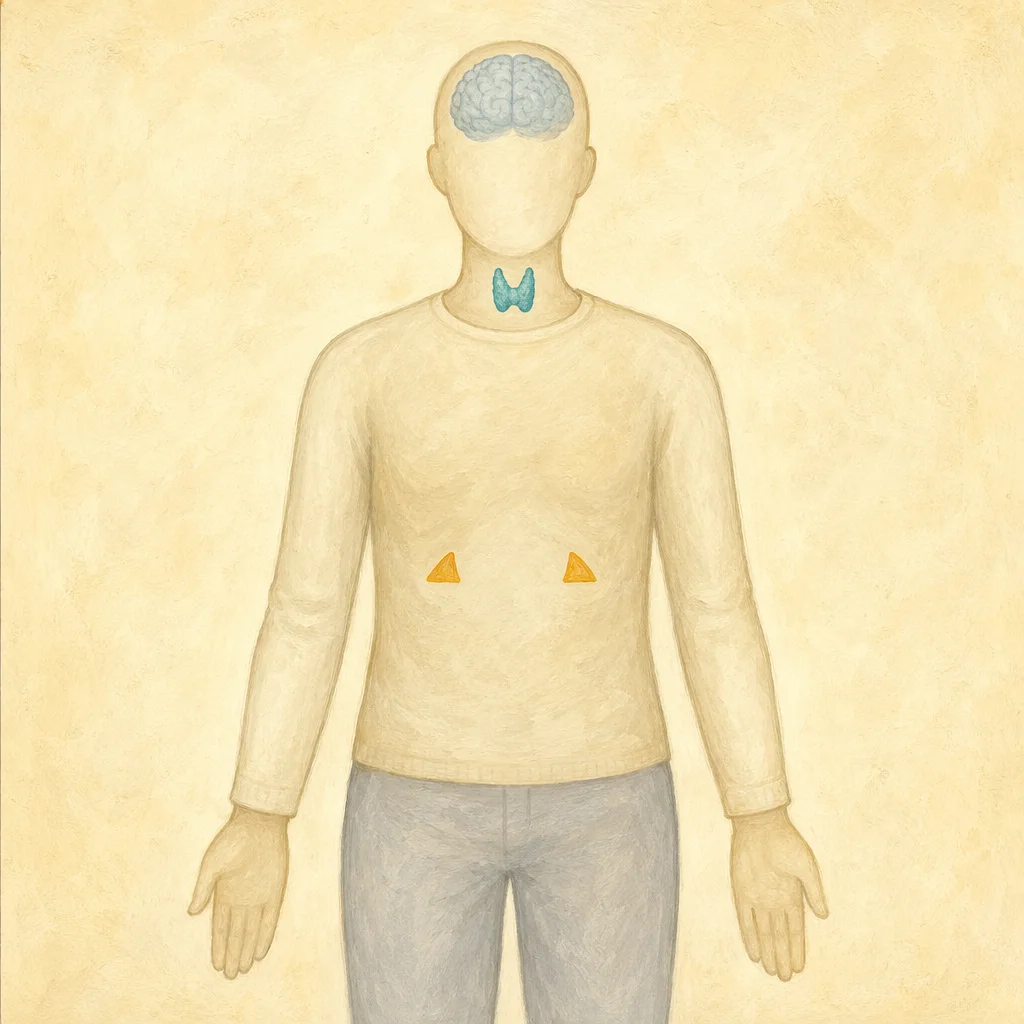
- 1Thyroid gland —
- 2Thyroxine negative feedback —
- 3Adrenal glands —
- 4Fight-or-flight response —
- 5Hormones vs nervous system —
Key endocrine glands — tap a dot to explore function and mechanism
This topic focuses on two specific hormones that illustrate how the endocrine system can operate on very different timescales:
Earn the mark scheme marks
Memory Aids
Adrenaline = "Action hormone": Every effect of adrenaline prepares you for action. Heart rate up (more blood to muscles), breathing up (more oxygen), glucose released (more energy), digestion slowed (non-essential during an emergency). If you remember "action," you can reason through each effect.
The adrenaline effects mnemonic — "HBGD":
- Heart rate increases
- Breathing rate increases
- Glucose released into blood (from glycogen in liver)
- Digestion slows (blood diverted to muscles)
Thyroxine negative feedback — "TSH is the thermostat": When thyroxine is low, the pituitary releases TSH to turn the thyroid on. When thyroxine is high, TSH is suppressed to turn the thyroid off. TSH is the controller; thyroxine is what it controls.
Quick Check: A student is about to give a presentation in front of the class. Describe the physiological changes caused by adrenaline and explain why each change is useful for this situation.
Adrenaline is released by the adrenal glands. Heart rate increases — this delivers more oxygenated blood to muscles, preparing the body for physical activity. Breathing rate increases — this increases oxygen intake and CO2 removal, supporting higher respiration rates. Blood glucose rises — the liver breaks down glycogen to release glucose, providing fuel for cellular respiration in muscles and the brain. Blood is diverted from the digestive system to skeletal muscles — this prioritises immediate physical readiness over digestion. Pupils dilate — improving vision and alertness. In a presentation context, these changes improve alertness and cognitive performance, though in extreme cases they can cause the sensation of "nerves."
Quick Check: Explain why a person with an underactive thyroid gland (hypothyroidism) might feel constantly cold, tired, and gain weight despite not eating more.
The thyroid gland produces thyroxine, which sets the body's basal metabolic rate. An underactive thyroid produces insufficient thyroxine, so the metabolic rate is abnormally low. A low metabolic rate means cells carry out chemical reactions more slowly — less heat is generated (feeling cold), less energy is released from food (fatigue), and food is metabolised slowly so excess is stored as fat (weight gain despite no increase in food intake). This illustrates how a single hormone deficiency can cause widespread physiological effects.
Quick Check: Using the concept of negative feedback, explain how thyroxine levels are maintained within a normal range.
When blood thyroxine concentration falls below the normal range, the pituitary gland detects this and releases TSH (thyroid-stimulating hormone) into the blood. TSH travels to the thyroid gland and stimulates it to produce and release more thyroxine. As thyroxine levels rise and return to normal, the pituitary gland reduces its TSH output, which decreases thyroxine production. This is negative feedback: the response (increased thyroxine) opposes the original change (low thyroxine), restoring the level to its set point. The reverse occurs if thyroxine rises above normal — less TSH is released, reducing thyroxine output.
Now try it yourself
Quiz · Question 1 of 9
Which response does adrenaline prepare the body for?
Tap an answer to check it
This topic in real past papers
Every real exam question we've found on hormones & behaviour, with a full worked answer.