The Body's Food Processing Factory
The Body's Food Processing Factory
Imagine a sophisticated factory that can take raw materials (food) and break them down into useful components that can be distributed throughout an entire organization. Your digestive system is exactly this - a complex organ system that transforms food into nutrients your cells can use.
From the moment food enters your mouth to when waste leaves your body, it travels through about 9 meters of specialized tubing, each section perfectly adapted for its specific job. This journey involves both mechanical and chemical breakdown, with enzymes playing crucial roles at every stage.
The human digestive system. Tap any label to explore that organ in detail.
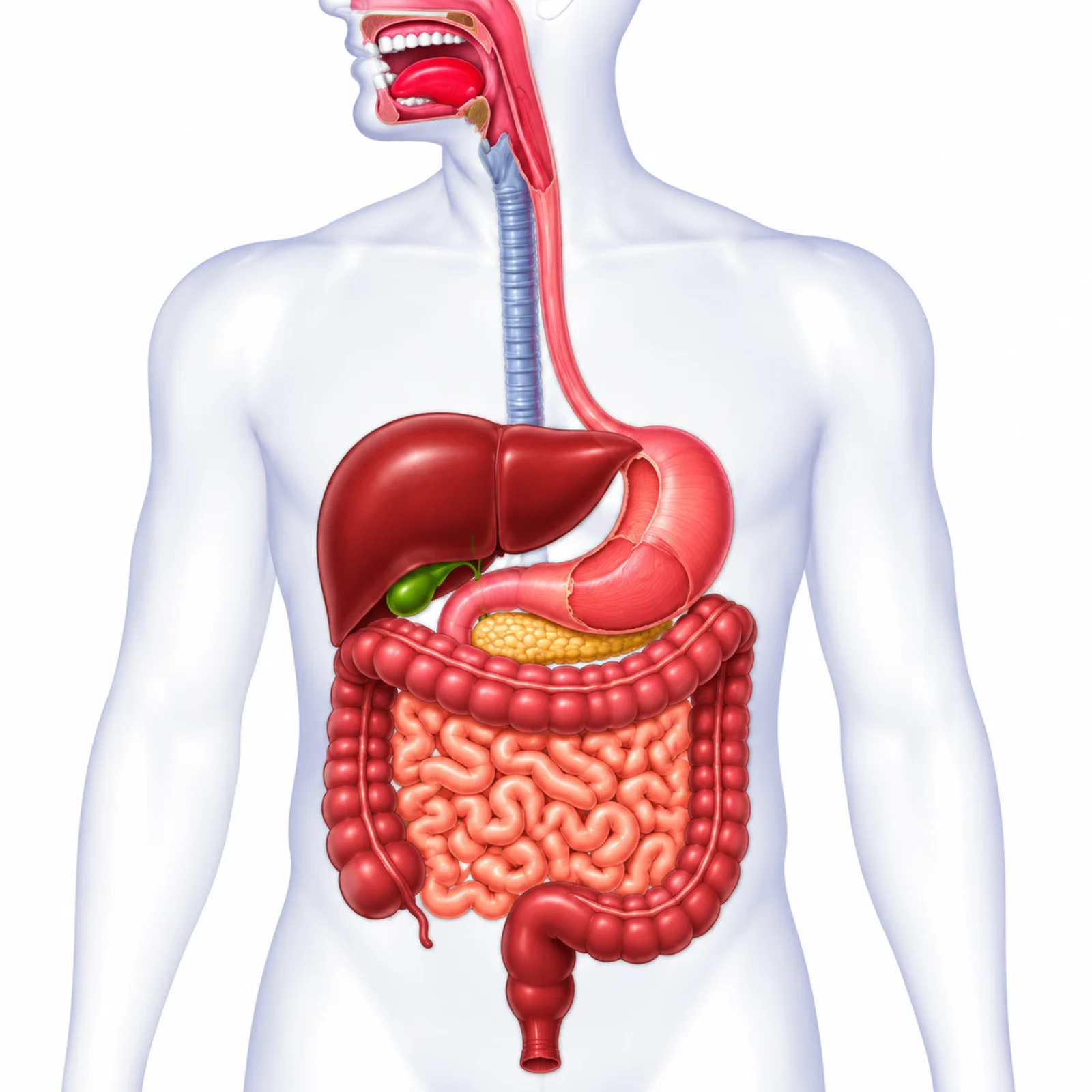
- 1Mouth — Where mechanical and chemical digestion begins — teeth chew, salivary amylase digests starch.
- 2Oesophagus — Muscular tube connecting mouth to stomach — food is pushed down by peristalsis.
- 3Liver — Produces bile — an alkaline fluid that emulsifies fats, breaking them into tiny droplets for enzymes.
- 4Gall bladder — Stores bile made by the liver — releases it into the small intestine when fats are present.
- 5Stomach — J-shaped muscular sac — churns food and secretes pepsin (protease) and hydrochloric acid.
- 6Pancreas — Produces all three digestive enzyme types — amylase, lipase, and protease — delivered to the small intestine.
- 7Small intestine — Where most digestion is completed and ALL nutrients are absorbed — villi give huge surface area.
- 8Large intestine — Absorbs water from undigested material — remaining matter forms faeces, stored in the rectum.
- 9Salivary glands — Three pairs of glands secrete saliva — salivary amylase begins starch digestion before food even reaches the stomach.
- 10Duodenum — First section of small intestine — where bile from the liver and enzymes from the pancreas mix with food.
- 11Rectum — Final section of large intestine — stores faeces until elimination through the anus.
Figure 1: The human digestive system. Tap any label to explore that organ in detail.
Biology glossary
- What are villi?
- Villi are tiny finger-like projections on the wall of the small intestine that greatly increase the surface area for absorption of nutrients.
Digestion begins in the mouth with both mechanical and chemical processes:
Earn the mark scheme marks
Memory Aids
The Journey Mnemonic — "My Stomach Stops Doing Little Runs":
- My = Mouth (chewing, salivary amylase)
- Stomach = Stomach (acid, pepsin, churning)
- Stops = Small intestine (most digestion and all absorption)
- Doing = Duodenum (first section, receives bile and pancreatic enzymes)
- Little = Large intestine (water absorption only)
- Runs = Rectum (waste storage and elimination)
Bile vs Enzyme — the key distinction: Remember "Bile Breaks Blobs" — bile physically breaks fat blobs into smaller droplets (emulsification), but it does not change the fat molecules chemically. Enzymes (like lipase) change molecules chemically. If a question asks whether bile is an enzyme, the answer is always no.
Villi surface area: Picture a tennis court (200 m²) folded into a 6-metre tube — that is what villi and microvilli achieve. This image helps you recall the approximate surface area figure and explain why villi are so important.
Quick Check: Coeliac disease is an autoimmune condition in which the immune system attacks and flattens the villi of the small intestine. Using your understanding of villus structure and function, explain why a person with untreated coeliac disease might lose weight even if they eat a normal diet.
Villi increase the surface area of the small intestine, maximising the rate of nutrient absorption. They also contain blood capillaries close to the epithelial surface, maintaining a steep concentration gradient that drives diffusion of glucose and amino acids into the blood. When villi are flattened by coeliac disease, the surface area is dramatically reduced. Even if digestion occurs normally, the rate of absorption falls sharply — glucose, amino acids, and fatty acids pass through the small intestine and are excreted rather than absorbed. The person receives fewer calories and nutrients from each meal, causing weight loss despite normal food intake.
Quick Check: A patient has had their gall bladder surgically removed. The liver still produces bile, but it now drips continuously into the small intestine rather than being released in response to a fatty meal. Predict and explain the likely effects on fat digestion.
The gall bladder stores and concentrates bile, releasing it in a large surge when fats are detected in the small intestine. Without the gall bladder, bile is not concentrated and is not released in a controlled surge — instead it drips continuously at a low level. When a fatty meal arrives in the small intestine, there is less bile available to emulsify the fat globules. Emulsification increases the surface area of fat available for lipase to act on. With reduced emulsification, lipase has less surface area to work on, so fat digestion is slower and less complete. The patient may experience difficulty digesting fatty foods, particularly in larger quantities.
Quick Check: The pancreas produces both digestive enzymes and hormones such as insulin. Explain why damage to the pancreas from pancreatitis (inflammation) could simultaneously disrupt both digestion and blood glucose regulation.
The pancreas has two distinct functions: it secretes digestive enzymes (amylase, lipase, and proteases) into the small intestine via the pancreatic duct, and it produces hormones (insulin and glucagon) from the islets of Langerhans that regulate blood glucose levels. Pancreatitis causes inflammation that damages pancreatic tissue indiscriminately. Damage to enzyme-producing cells reduces the secretion of digestive enzymes into the small intestine, leading to incomplete digestion of starch, fats and proteins, and therefore reduced nutrient absorption. Simultaneous damage to insulin-producing cells reduces insulin secretion, impairing the body's ability to lower blood glucose after eating. This illustrates how a single organ can participate in more than one organ system.
Now try it yourself
Quiz · Question 1 of 22
Which organ produces hydrochloric acid to kill bacteria in food?
Tap an answer to check it
This topic in real past papers
Every real exam question we've found on the human digestive system, with a full worked answer.