Your Body's Security System
Your Body's Security System
Imagine your body as a fortress under constant attack from invisible invaders. Every second of every day, countless pathogens — bacteria, viruses, fungi, and other microorganisms — try to breach your defences and establish infections. But your body isn't defenceless. You have a security system that works 24/7 to keep you healthy.
This security system has two main layers. The first layer consists of physical and chemical barriers designed to keep pathogens out entirely. If they break through, a second layer of white blood cells springs into action. This is your non-specific (innate) immune system — it responds the same way to any pathogen, without needing to recognise what type it is.
Tap any structure to see how the skin defends against pathogens — the epidermis blocks entry, sebaceous glands produce antimicrobial oils, capillaries deliver white blood cells when the barrier breaks.
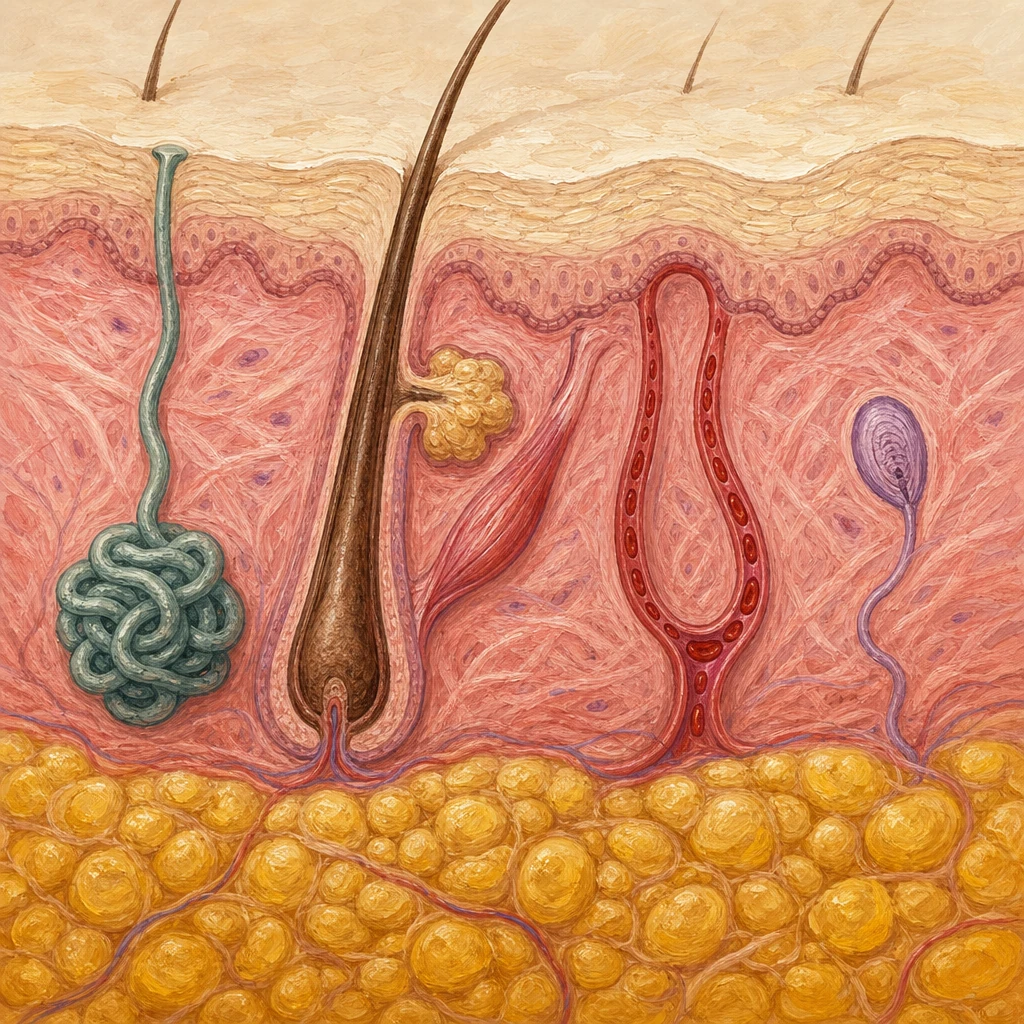
- 1Epidermis — Your body's outer wall — continuous, waterproof, protective
- 2Sweat gland — Your built-in cooling system — sweat evaporates, heat leaves
- 3Capillary loop — The radiator near the surface — wider to lose heat, narrower to keep it
- 4Hair follicle — The hair and its puller muscle — your fur coat response to cold
- 5Temperature receptor — The skin's thermometer — tells the brain how hot it is outside
- 6Subcutaneous fat — The body's insulating blanket — sits below the dermis, retains heat
Tap any structure to see how the skin defends against pathogens — the epidermis blocks entry, sebaceous glands produce antimicrobial oils, capillaries deliver white blood cells when the barrier breaks.
Biology glossary
- What is sebum?
- An oily substance produced by sebaceous glands in the skin that creates an acidic environment on the skin surface, inhibiting bacterial and fungal growth.
- What is phagocytosis?
- The process by which white blood cells (phagocytes) engulf and digest pathogens or foreign particles.
Earn the mark scheme marks
Memory Aids
SMA — Three categories of non-specific defence:
- S — Skin (physical barrier; skin oils help maintain the barrier)
- M — Mucus and cilia (trap and sweep pathogens out of airways)
- A — Acid (stomach acid kills ingested pathogens)
Phagocytosis steps — DED:
- D — Detect chemicals from the pathogen
- E — Engulf it (cell membrane surrounds and takes it in)
- D — Digest with enzymes inside the cell
Mucus and cilia work as a pair: Mucus traps the pathogens; cilia move the mucus. Never describe one without the other. If cilia are damaged (e.g., by smoking), mucus cannot be swept away — pathogens stay in the airways and infection is more likely. This is a favourite exam application.
Quick Check: A person with cystic fibrosis has thick, sticky mucus that their cilia cannot sweep effectively. Explain why these patients are significantly more susceptible to respiratory infections than healthy individuals.
In healthy airways, mucus traps pathogens (bacteria, viruses, particles) and cilia beat rhythmically to sweep this mucus upward towards the throat, removing trapped pathogens before they can cause infection. In cystic fibrosis, the mucus is abnormally thick and viscous, so cilia cannot move it effectively. Pathogens become trapped in the airways and remain in contact with the respiratory surface for much longer. This gives bacteria time to multiply and establish infection. The first line of non-specific defence (the ciliary escalator) is therefore impaired, making respiratory infections far more likely and harder to clear.
Quick Check: State three ways in which the body prevents pathogens from entering internal tissues.
Any three from: (1) Skin acts as a physical barrier, preventing pathogens from penetrating into underlying tissues. (2) Mucus in the nose and airways traps pathogens before they can reach the lungs. (3) Cilia sweep mucus (with trapped pathogens) upward to the throat where they are swallowed. (4) Stomach acid (pH ~2) kills most pathogens that are swallowed. (5) Lysozyme in tears and saliva destroys the cell walls of bacteria. (6) Blood clots seal wounds to stop pathogens entering through damaged skin.
Now try it yourself
Quiz · Question 1 of 21
Which part of the body acts as the main physical barrier to prevent pathogens entering?
Tap an answer to check it