Edward Jenner and the Birth of Vaccination
Edward Jenner and the Birth of Vaccination
In 1796, English doctor Edward Jenner made a groundbreaking observation. He noticed that milkmaids who had contracted cowpox (a mild disease) never seemed to catch smallpox (a deadly disease). Acting on this insight, Jenner deliberately infected an 8-year-old boy with cowpox, then later exposed him to smallpox. The boy remained healthy - the first successful vaccination had been performed.
This revolutionary discovery laid the foundation for one of medicine's greatest achievements: the complete eradication of smallpox in 1980, and the near-elimination of diseases like polio. Today, vaccination programs protect millions of lives worldwide through the power of adaptive immunity.
How vaccination works. Click each labelled part — vaccine trigger, memory cells, primary vs secondary response, herd immunity, and types of vaccine.
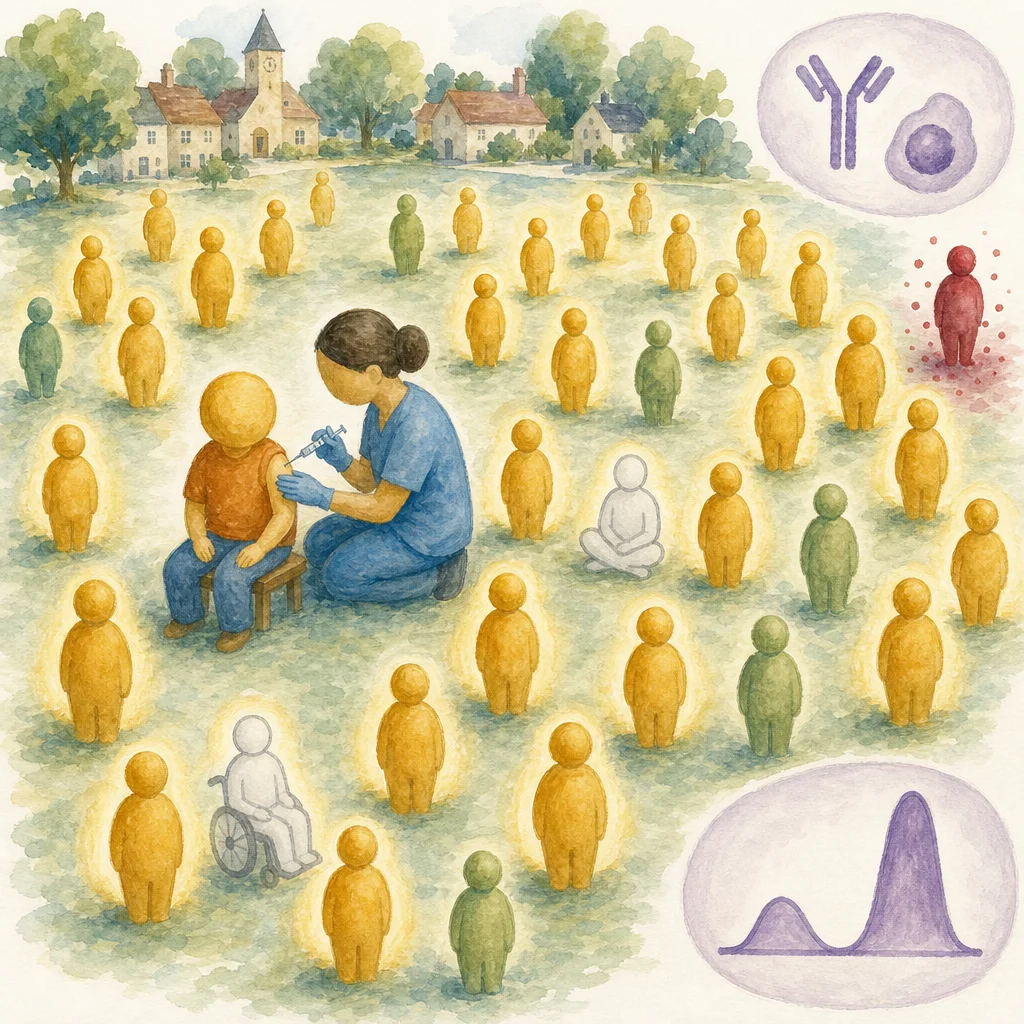
- 1Vaccine triggers response — The vaccine is a safe antigen — your immune system can't tell the difference.
- 2Memory cells — Memory B cells: the whole point of vaccination.
- 3Primary vs secondary — Primary response: slow. Secondary response: fast and large.
- 4Herd immunity — When enough people are immune, the vulnerable are protected too.
- 5Types of vaccine — Three ways to deliver an antigen safely.
Figure 1: How vaccination works. Click each labelled part — vaccine trigger, memory cells, primary vs secondary response, herd immunity, and types of vaccine.
Biology glossary
- What is a vaccine and how does it work?
- A vaccine contains a dead or weakened form of a pathogen (or its antigens). It triggers the immune system to produce antibodies and memory cells without causing disease. If the real pathogen enters later, memory cells respond rapidly.
Earn the mark scheme marks
Exam Tips: Vaccination and Herd Immunity
Memory Formation Questions
Link vaccination to adaptive immunity topics:
- Antigen presentation → B cell activation → antibody production
- Memory B cells formed during primary response
- Secondary response faster and stronger upon pathogen exposure
- Memory cells provide long-term immunity
Herd Immunity Calculations
Practice threshold calculations:
- Formula: Threshold = 1 - (1/R₀)
- Higher R₀ = more contagious = higher threshold needed
- Measles (R₀=15) needs 93% coverage
- Influenza (R₀=2) needs 50% coverage
Vaccine Types Comparison
Remember key differences:
- Live attenuated: Strong immunity but risk for immunocompromised
- Inactivated: Safer but may need boosters
- Subunit: Very safe, specific targeting
- Consider advantages/disadvantages for each type
Ethical and Social Issues
Be prepared to discuss:
- Individual choice vs. community benefit
- Protecting vulnerable populations
- Risk-benefit analysis of vaccination
- Role of scientific evidence in public health policy
Data Analysis Skills
Practice interpreting graphs showing:
- Disease incidence before/after vaccination programs
- Vaccination coverage rates over time
- Correlation between coverage and disease outbreaks
- Age-specific vaccination schedules
Now try it yourself
Quiz · Question 1 of 21
What do vaccines contain?
Tap an answer to check it