The Body's Elite Forces
The Body's Elite Forces
Imagine your body's immune system as a military operation. While the innate immune system acts like border guards providing immediate but general protection, the adaptive immune system is like an elite special forces unit. These highly trained specialists can identify specific enemies (antigens), mount targeted attacks, and most importantly — they never forget a face. Once they have encountered an invader, they create a detailed wanted poster that lasts for years, sometimes a lifetime!
This is why you typically only get chickenpox once, and why vaccines work so effectively. Let's explore how this remarkable biological memory system protects us.
The adaptive immune response. Click each labelled part to see how B cells, plasma cells, memory cells, and antibodies work together.
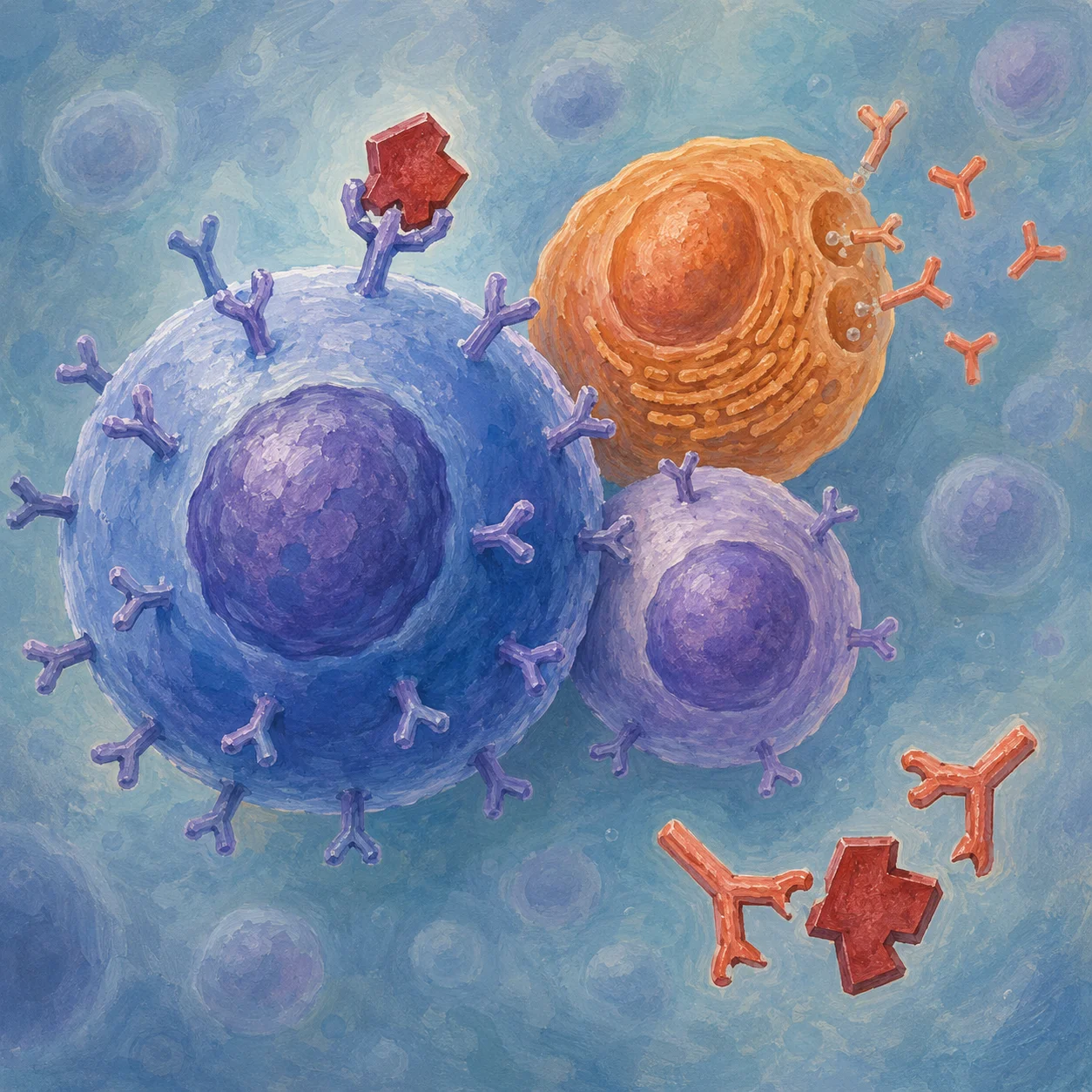
- 1Antigen locked to receptor — Antigens have unique shapes — only the right receptor fits.
- 2B lymphocyte — B lymphocytes — the antibody factories of your immune system.
- 3Plasma cell — Plasma cells mass-produce antibodies to fight the pathogen now.
- 4Memory B cell — Memory B cells — long-term protection that makes vaccines work.
- 5Antibody binding — Antibodies bind to antigens by a complementary shape match.
Figure 1: The adaptive immune response. Click each labelled part to see how B cells, plasma cells, memory cells, and antibodies work together.
Biology glossary
- What is an antigen?
- A protein on the surface of a pathogen (or cell) that the immune system recognises as foreign. Antigens trigger the body to produce antibodies.
- What is an antibody?
- A protein produced by lymphocytes (white blood cells) that binds to a specific antigen. Each antibody has a unique shape that fits one antigen only — like a lock and key.
Antigens are foreign substances that can trigger an immune response. The term comes from "antibody generator" — literally, substances that generate antibodies.
Earn the mark scheme marks
Memory Aids
Antigen = ANTIbody GENerator: The word antigen literally contains "anti" and "gen" — it is the molecule that generates an antibody response. Any time you see "antigen" in an exam question, think: this is the specific molecule on the pathogen that the immune system recognises and responds to.
The lock-and-key for immunity: The antigen is the key; the B cell receptor (and subsequent antibody) is the lock. Only the key with the right shape fits. This is why each antibody is specific to one antigen — the shapes must be complementary.
Primary vs Secondary response — SSFL:
- Primary: Slow, Small antibody production, takes 5–10 days, Forms memory cells
- Secondary: Speedy, Stronger/larger antibody production, takes 1–3 days, memory cells already present (Lasting immunity)
B cells vs T cells: B cells = Bodies (B cells make antibodies). T cells = Target infected cells (killer T cells) or Tell other cells what to do (helper T cells).
B cell fate after activation: Most B cells become plasma cells (antibody factories). Some become memory B cells (long-lived sentinels). Think: "most go to work now, some keep watch for later."
Quick Check: A person is infected with influenza for the first time. Explain why they develop symptoms for 7–10 days before recovering, whereas on a second exposure to the same flu strain they may not develop symptoms at all.
During the primary response to the first infection, the immune system must first recognise the viral antigens, select the appropriate B cells, and produce antibodies. This takes 5–10 days before sufficient antibodies are produced to clear the infection. During this time the virus multiplies and causes tissue damage — producing symptoms. Memory B cells are also produced during this primary response. On second exposure to the same flu strain, memory B cells respond immediately (within 1–3 days) and rapidly produce large amounts of antibodies. The virus is eliminated before it can multiply sufficiently to cause tissue damage, so no symptoms develop. This is the principle that underlies vaccination.
Quick Check: Explain why a person who has recovered from measles is protected for life, but someone who recovers from influenza may get flu again in a different year.
After recovering from measles, the immune system produces memory B and T cells specific to the measles virus antigens. The measles virus has very stable surface antigens that do not change significantly over time. The same memory cells remain effective for the person's lifetime. Influenza virus, however, undergoes rapid mutations in its surface proteins. Each year, new influenza strains circulate with slightly different surface antigens. Memory cells produced against last year's strain do not recognise the new antigens, so the person is not protected. New vaccines are formulated each year targeting the antigens on the most common circulating strains.
Quick Check: A scientist injects a mouse with antigen X. Three weeks later, she measures the antibody levels in the mouse's blood, which are high. She then gives the same mouse a second injection of antigen X. Predict and explain what happens to the antibody level over the next two weeks.
After the second injection, the antibody level would rise much faster (within 1–3 days) and to a much higher level than after the first injection. This is because the first injection triggered a primary immune response that produced memory B cells specific to antigen X. These memory cells persist in the body. When antigen X is introduced again, the memory B cells rapidly divide and differentiate into plasma cells, which secrete large quantities of antibodies very quickly. The response is faster, larger, and longer-lasting than the primary response. This demonstrates immunological memory — the basis of vaccination.
Now try it yourself
Quiz · Question 1 of 23
What are antigens?
Tap an answer to check it