The Silent Battle in Your Garden
The Silent Battle in Your Garden
Every day, an invisible war rages in gardens, fields, and forests around the world. Plants, rooted in place and unable to run from danger, face constant attack from microscopic invaders. Yet they've evolved remarkable defense systems that have kept them alive for millions of years.
When you see black spots on a rose bush or strange mottled patterns on a tomato leaf, you're witnessing the aftermath of this biological warfare. Understanding how plants defend themselves — and how diseases spread — is crucial for food security and agricultural success.
Tap any label to explore each defence — physical, chemical, and mechanical protection.
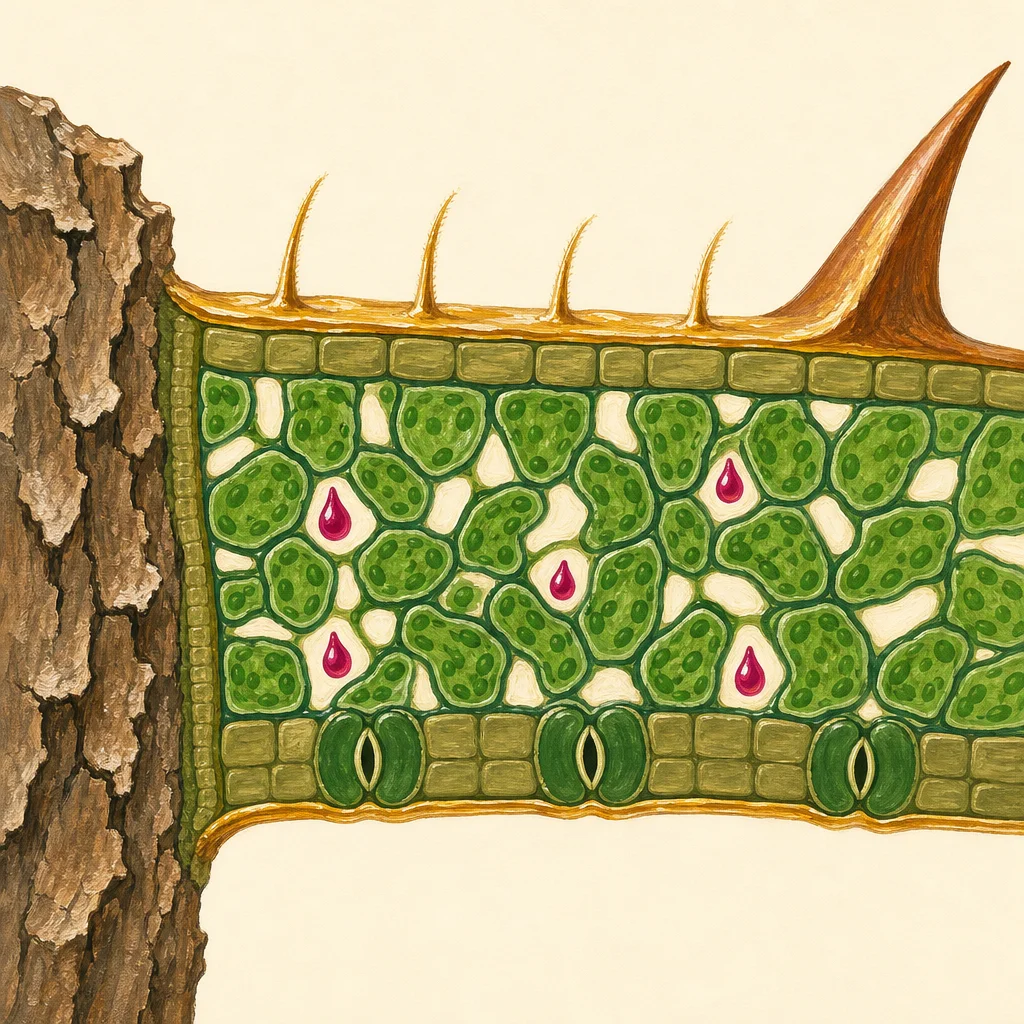
- 1Waxy cuticle —
- 2Cellulose cell wall —
- 3Antibacterial chemicals —
- 4Bark (dead cells) —
- 5Thorns and hairs —
Tap any label to explore each defence — physical, chemical, and mechanical protection.
Biology glossary
- What is a plant pathogen?
- A microorganism that causes disease in plants, such as fungi, bacteria, or viruses.
Earn the mark scheme marks
Exam Tips: Plant Diseases and Defenses
Key Command Words
- "Name": Give specific examples (rose black spot, TMV)
- "Describe": Give symptoms or characteristics
- "Explain": Give reasons why defenses work or diseases affect growth
- "Compare": Show similarities AND differences between plant and human defenses
Common Mistakes to Avoid
- Confusing physical and chemical defenses
- Forgetting to explain HOW TMV affects photosynthesis
- Not linking environmental conditions to disease spread
- Giving vague symptoms instead of specific examples
- Saying yellow leaves always mean disease — mineral deficiency (nitrate or magnesium) also causes chlorosis
- Confusing nitrate and magnesium deficiency — nitrate = proteins/stunted growth/older leaves first; magnesium = chlorophyll/all leaves yellow
Required Practical Links
- Know how to design investigations to test disease treatments
- Understand control variables in field studies
- Be able to identify symptoms and suggest causes
- Link field observations to economic and social impacts
Quick Memory Aids
- Defense types: "Physical-Chemical" — two layers, work together
- Physical defenses: "Waxy-Walls-Bark-Thorns"
- TMV effects: "Mosaic then Less chlorophyll then Poor photosynthesis then Stunted growth"
- Rose black spot: "Spots then Yellow then Drop then Dead"
Exam Technique
- Name both diseases and their pathogen type. If asked to give an example, always give the full name (rose black spot) AND state it is caused by a fungus. One-word answers often score zero.
- Explain the full consequence chain for TMV. Virus disrupts chloroplasts → mosaic pattern → less chlorophyll → less light absorbed → less photosynthesis → less glucose → stunted growth. Each arrow represents a mark point.
- Distinguish physical from chemical. Physical defenses prevent entry (cuticle, cell walls, bark, thorns). Chemical defenses kill pathogens that have entered (antimicrobial compounds, toxins). For full marks, give one of each type.
- When comparing plant and animal defenses, be specific. Write: "plants lack mobile immune cells and specific antibodies; instead they rely on physical barriers such as the waxy cuticle and chemical compounds such as antimicrobial proteins".
- Spread of rose black spot — include conditions. Mark schemes award marks for stating that spores spread in moist/wet conditions or via water splash/wind.
Now try it yourself
Quiz · Question 1 of 22
What type of pathogen causes rose black spot disease?
Tap an answer to check it
This topic in real past papers
Every real exam question we've found on plant diseases and defenses, with a full worked answer.