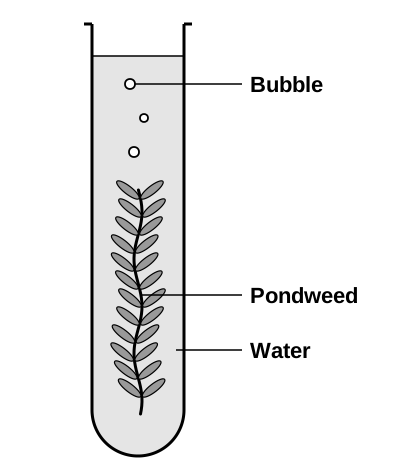
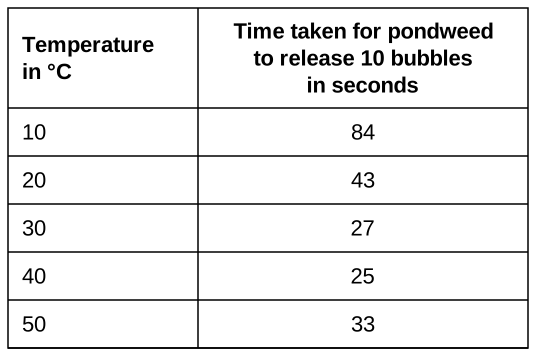
Pondweed gives off bubbles when it photosynthesises. A student tested how temperature changes its rate. Figure 4 shows a single tube. Five of these tubes were left for two minutes in water baths at five different temperatures, then each was timed until 10 bubbles had come off. Table 4 lists the times.
Name the independent variable in the pondweed investigation.
Our own questions on this topic, marked straight away, so you see what to revise. Free now.
Show model answer for 04.1Hide model answer for 04.1
Temperature. It is the variable the student chooses and changes, and the time for 10 bubbles is what is measured.
How the marks are earned
- Temperature, meaning the temperature of the water bath.
From Table 4, work out how fast the pondweed photosynthesised at 20 °C. Round to 3 significant figures and state the unit.
See how you would score on PhotosynthesisShow model answer for 04.2Hide model answer for 04.2
time at 20 °C = 43 s
rate = 10 ÷ 43
rate = 0.23255...
rate = 0.233 bubbles/s (3 s.f.)
How the marks are earned
- One mark: rate as bubbles ÷ time, with the time for 20 °C read from Table 4, set out as 10 ÷ time, or as 1 ÷ time × 10.
- One mark: the unrounded value, 0.23255 and so on.
- One mark: the value to 3 significant figures, 0.233. A wrongly worked value of the student's own, correctly rounded to 3 significant figures, is allowed, and so is a calculation using a different time from Table 4.
- One mark: the unit, bubbles per second. A correct calculation in another unit is allowed, such as bubbles per minute (14.0) or bubbles per hour (837). The unit must match the student's own value. The same unit written bubbles/s is accepted.
- A correct answer on its own, 0.233 bubbles per second, or the same rate correctly worked in another unit, earns all 4 marks with no working shown. A rate worked correctly in another unit can earn every mark, not only the unit mark. A correct final answer reached from wrong working does not earn full marks.
Why it scores
This is not a mark by itself, but it is the value the first mark needs.
The first mark is for setting out the bubbles divided by the time, using the right time for 20 °C.
The second mark is for the unrounded value from the calculator.
The third mark is for rounding to 3 significant figures, and the fourth is for the unit. A rate is the amount per unit of time, so the unit is bubbles per second.
Revise PhotosynthesisUsing Table 4, give reasons why photosynthesis runs faster or slower at 40 °C than at 10 °C.
See how you would score on PhotosynthesisShow model answer for 04.3Hide model answer for 04.3
The rate is higher at 40 °C. Pondweed took only 25 s to release 10 bubbles at 40 °C, but 84 s at 10 °C.
At 40 °C the reactant molecules and the enzymes have more kinetic energy, so they move faster.
So they collide more often, and more collisions are successful. Photosynthesis therefore goes faster.
How the marks are earned
- One mark: the rate is higher at 40 °C. Saying the rate rises as the temperature rises is also credited, and so is the opposite for 10 °C if it is clearly stated.
- One mark: at the higher temperature the particles, reactants, molecules or enzymes have more energy (the word kinetic is not needed). Saying they move faster is also credited.
- One mark: so they collide more frequently. Also credited: more collisions in the same period of time, or more successful collisions.
Why it scores
The first mark is for saying the rate is higher at 40 °C. Quoting the times from Table 4 supports the answer.
The second mark is for the cause, which is more kinetic energy and faster movement.
The third mark is for the effect on collisions. It needs frequent collisions in the same time, not just a fast reaction.
Revise PhotosynthesisApart from temperature, name two things that can speed up or slow down photosynthesis.
See how you would score on PhotosynthesisShow model answer for 04.4Hide model answer for 04.4
1. Light intensity. 2. Carbon dioxide concentration.
How the marks are earned
- Any two, one mark each: light intensity or level; the colour or wavelength of the light; carbon dioxide (the word concentration is optional); chlorophyll (the amount or mass is optional). The number of chloroplasts is also credited.
- An extra wrong answer cancels a correct one, so a list that includes an error can lose marks.
- If neither light intensity nor the colour or wavelength of light is credited, light with no more detail earns one mark, and it can pair with another listed factor.
- Water and humidity are ignored, and wind is not accepted.
Why it scores
Each correct factor earns one mark, so two factors score both. Light intensity and carbon dioxide are two of the factors that limit photosynthesis; the amount of chlorophyll would also earn a mark.
Revise PhotosynthesisDescribe one change to the method that would give more accurate photosynthesis rates.
See how you would score on PhotosynthesisShow model answer for 04.5Hide model answer for 04.5
Collect the oxygen in a gas syringe and measure its volume for a set time.
How the marks are earned
- Trap the gas (oxygen) given off, in a gas syringe or in an upturned measuring cylinder.
- Saying bubbles in place of gas or oxygen is allowed, but naming the wrong gas is not accepted.
- Measuring the volume of gas in a syringe or in an inverted cylinder is allowed. Saying only use a gas syringe, collect the gas in a measuring cylinder, or use an inverted cylinder earns nothing.
- Any other correct method is allowed.
Why it scores
Bubbles vary in size, so counting them is not accurate. A measured volume of gas is a more accurate measure of the rate.
Revise PhotosynthesisSome of a gardener's plants are growing poorly. Give two methods the gardener could use to find out which disease it is.
See how you would score on Plant Diseases and DefensesShow model answer for 04.6Hide model answer for 04.6
1. Compare the symptoms with the pictures in a gardening manual or a gardening website. 2. Take a diseased plant to a laboratory or an expert to be tested.
How the marks are earned
- Any two, one mark each: check the symptoms in a gardening manual, a website or an app; send diseased plants to a lab, or to a scientist or expert; use a kit built on monoclonal antibodies to test for the pathogen.
- Saying only use or search the internet earns nothing.
- An extra wrong answer cancels a correct one, so a list that includes an error can lose marks.
Why it scores
Each way of finding out which disease the plant has earns one mark: comparing the symptoms with a reference, and having a sample tested by an expert or in a laboratory.
Revise Plant Diseases and DefensesA plant's leaves showed purple spots, then dropped from the plant. Name the disease that fits best.
See how you would score on Plant Diseases and DefensesShow model answer for 04.7Hide model answer for 04.7
Black spot of roses, a fungal disease. It causes purple or black spots on the leaves, which can turn yellow and fall early. Less photosynthesis happens, so growth is poorer.
How the marks are earned
- Black spot (of roses), a fungal disease. The word rose is optional.
- Another correct disease, such as rust, is allowed.
- A nitrate or magnesium deficiency is not accepted, and neither is tobacco mosaic virus (TMV).
Leaves of another plant had turned yellow and showed no spotting. Explain what could cause leaves to turn yellow.
See how you would score on Plant Diseases and DefensesShow model answer for 04.8Hide model answer for 04.8
The plant may lack magnesium ions in the soil. Without them it cannot make enough chlorophyll, so the leaves lose their green colour and turn yellow. This yellowing is called chlorosis.
How the marks are earned
- One mark: a shortage of magnesium ions. A shortage of nitrate ions or iron ions is also credited.
- One mark: this leads to chlorosis, or to chlorophyll being made in smaller amounts, since magnesium is a part of chlorophyll production. Likewise credited: nitrate or iron being needed for chlorophyll production.
- Or, one mark for a lack of light, and one mark for it causing chlorosis or the breakdown of chlorophyll.
- Chlorosis on its own earns no mark, and neither does fewer chloroplasts.
Why it scores
The first mark is for the mineral shortage and the second is for the effect on chlorophyll. Chlorophyll is the green pigment, so less of it leaves the leaves yellow. Lack of light, which breaks down chlorophyll, would also earn both marks.
Revise Plant Diseases and Defenses