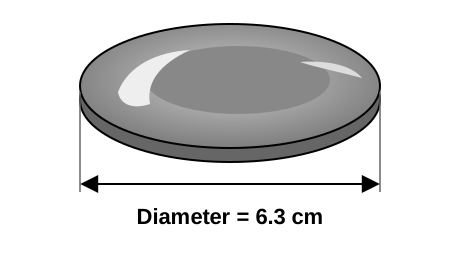
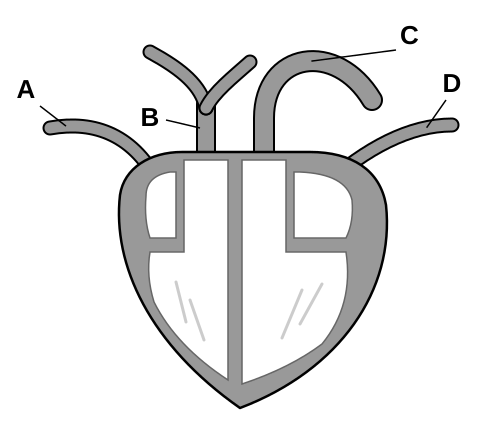
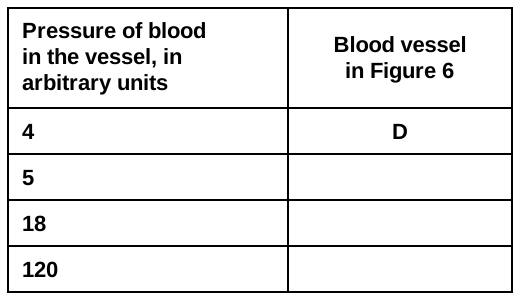
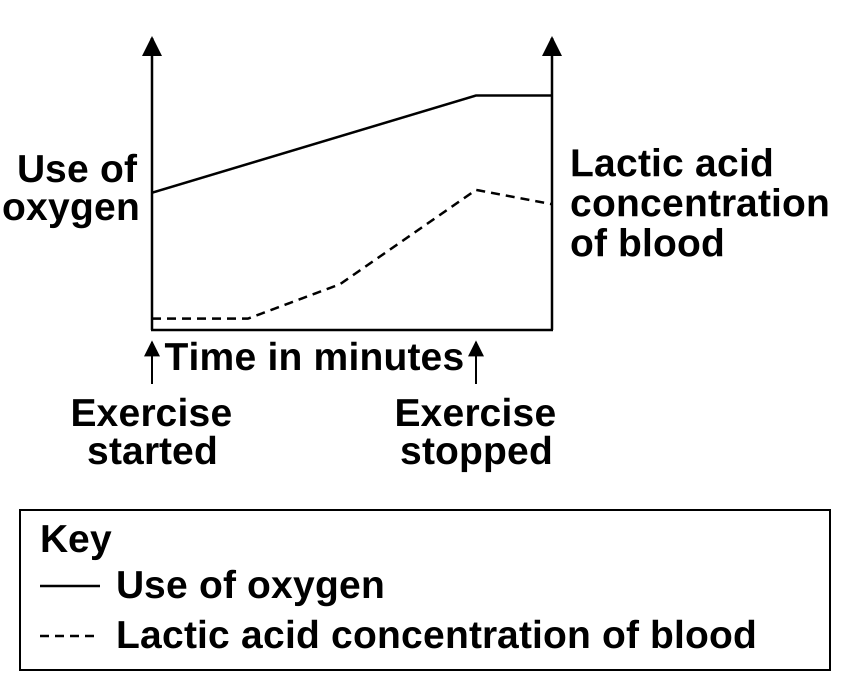
This question covers blood, the heart and its vessels. Figure 5 is an enlarged red blood cell. Figure 6 shows a heart with four vessels lettered, and Table 5 lists their pressures. An athlete ran on a treadmill until reaching maximum effort, then stopped; Figure 7 follows oxygen use and blood lactic acid.
Give one job of blood plasma, other than carrying blood cells or oxygen.
Our own questions on this topic, marked straight away, so you see what to revise. Free now.
Show model answer for 05.1Hide model answer for 05.1
Plasma carries carbon dioxide from the body cells to the lungs. It also carries other dissolved substances such as glucose, urea and hormones.
How the marks are earned
- Plasma moves a named substance round the body, for example glucose, urea, carbon dioxide, hormones, enzymes, antibodies, proteins or ions. Any other correctly named substance is accepted, and so is moving platelets. Naming only nutrients, waste or oxygen is ignored.
Figure 5 is a red blood cell image magnified 7200 times. Work out the real diameter of the cell in micrometres.
See how you would score on MicroscopyShow model answer for 05.2Hide model answer for 05.2
magnification = (image size) ÷ (real size)
real size = (image size) ÷ magnification
real diameter = (6.3 cm) ÷ 7200
real diameter in cm = 0.000875
0.000875 cm × 10 000 = 8.75 µm
How the marks are earned
- One mark: write the magnification equation, magnification = image size over real size. Using diameter in place of size is accepted. An equation triangle on its own is ignored.
- One mark: rearrange so real size = image size over magnification. The diameter form is accepted.
- One mark: substitute 6.3 over 7200 into the rearranged equation (the 6.3 cm is printed on Figure 5). Substituting 63 000 over 7200 after converting first is also accepted, and a wrongly converted value still earns this mark.
- One mark: carry out the division to get 0.000875 cm. An answer that follows from a wrongly converted value still earns this mark, and so does dividing 63 000 by 7200 if the conversion came first.
- One mark: convert to micrometres (µm) to reach 8.75. The conversion can come at any stage. 8.8 is also accepted, and any further rounding is ignored.
- A correct answer on its own, 8.75 micrometres (8.8 also accepted), earns all 5 marks with no working shown. A correct final answer reached from wrong working does not earn full marks. A step left out may still earn its mark if a later step is correct.
Why it scores
First mark: the equation that links the three quantities. Writing diameter instead of size is fine.
Second mark: rearrange so the quantity you want is on its own.
Third mark: put in the image diameter read from Figure 5, in cm, and the magnification 7200. A wrongly converted value here still earns the mark.
Fourth mark: divide 6.3 by 7200 to get 0.000875 cm. An answer that follows from a wrongly converted value still earns this mark.
Fifth mark: 1 cm is 10 000 micrometres, so multiply by 10 000. Changing the units at an earlier step also works, and 8.8 micrometres is accepted.
Revise MicroscopyComplete Table 5 by writing the correct Figure 6 letter beside each pressure. One row is already done.
See how you would score on The Heart and CirculationShow model answer for 05.3Hide model answer for 05.3
Pressure 5 goes with vessel A.
Pressure 18 goes with vessel B.
Pressure 120 goes with vessel C.
How the marks are earned
- Two marks for all three letters right: pressure 5 goes with A, pressure 18 with B, pressure 120 with C.
- One mark for one or two of those letters right. Names of the vessels written in the cells are ignored.
Why it scores
A is the vena cava, a vein carrying blood back to the heart, so its pressure is very low. The other vein, D, is also low.
B is the pulmonary artery. The blood only has to reach the nearby lungs, so it needs much less pressure than blood sent round the body.
C is the aorta. The left ventricle pumps blood through it to the whole body, so it has the highest pressure of the four.
Revise The Heart and CirculationGive the name of the vessel labelled D on the heart in Figure 6.
See how you would score on The Heart and CirculationShow model answer for 05.4Hide model answer for 05.4
D is the pulmonary vein, which brings oxygenated blood from the lungs to the left side of the heart.
Describe the structure of an artery's walls.
See how you would score on Blood Components and VesselsShow model answer for 05.5Hide model answer for 05.5
An artery wall has a thick layer of muscle and elastic fibres, which lets it cope with blood at high pressure.
How the marks are earned
- The wall is thick elastic tissue or fibres, or thick muscle (the word layer is optional, but thick is needed). A thick wall with no detail is ignored, and so is saying there are no valves. Cell walls are not accepted.
During the run the athlete used both types of respiration. Explain why anaerobic respiration is the less efficient one.
See how you would score on RespirationShow model answer for 05.6Hide model answer for 05.6
Anaerobic respiration releases less energy from each glucose molecule, so more glucose is needed to release the same amount of energy.
This is because the glucose is only partly broken down, into lactic acid. Aerobic respiration, with oxygen, breaks it right down to carbon dioxide and water.
How the marks are earned
- One mark: less energy is released or transferred; adding that this is per glucose molecule is optional. Also accepted: to get an equal amount of energy, more glucose must be used up. Not accepted: energy produced, made or created; no energy being released at all; less energy released for respiration.
- One mark: the glucose is incompletely broken down, or incompletely oxidised, so only part of its energy is released. Also accepted: glucose is broken down only as far as lactic acid.
Why it scores
First mark. Say energy is released or transferred, never made or created, and compare per glucose molecule.
Second mark: the cause is the incomplete breakdown of glucose, which keeps most of its energy locked in the lactic acid.
Revise RespirationFigure 7 shows oxygen use and blood lactic acid during and after exercise. Explain why oxygen use stays high once exercise has stopped.
See how you would score on RespirationShow model answer for 05.7Hide model answer for 05.7
Hard exercise used oxygen faster than the blood could deliver it, so the muscles respired anaerobically and lactic acid built up. The athlete is left in oxygen debt.
After exercise, extra oxygen is needed to break down (oxidise) the lactic acid, so oxygen use stays high until the lactic acid has gone.
How the marks are earned
- One mark: an oxygen debt has built up. Also accepted: the lactic acid concentration is still high.
- One mark: extra oxygen is needed to oxidise the lactic acid. Also accepted: extra oxygen is needed to remove it or to break it down. Oxygen turning lactic acid back into glucose in the liver is ignored, and so is naming the liver as the place where lactic acid is oxidised.
Why it scores
First mark: the oxygen debt, or a lactic acid concentration that is still high.
Second mark: link the extra oxygen to getting rid of the lactic acid.
Revise RespirationSome athletes train in conditions that raise their red blood cell count. Explain how more red blood cells help an athlete.
See how you would score on Blood Components and VesselsShow model answer for 05.8Hide model answer for 05.8
Red blood cells contain haemoglobin, which binds oxygen. More red blood cells give more haemoglobin, so more oxygen is carried to the muscles.
The muscles can then respire aerobically for longer, releasing more energy for contraction and delaying the muscle fatigue that lactic acid causes.
How the marks are earned
- One mark: more red blood cells mean more haemoglobin, so more oxygen is carried or bound. More oxyhaemoglobin forming is also accepted.
- One mark, by either route: the athlete respires aerobically more, so more energy is released; or aerobic respiration goes up so the muscles tire or cramp less. Also accepted: anaerobic respiration falls, and it would have released less energy; or anaerobic respiration falls, and it would otherwise have brought on tiredness or cramp. Not accepted: the athlete doing more anaerobic respiration; energy produced, made or created; energy released for respiration.
Why it scores
First mark: more haemoglobin means more oxygen carried (or more oxyhaemoglobin formed).
Second mark: link the extra oxygen to more aerobic respiration, with either more energy released or less fatigue and cramp.
Revise Blood Components and Vessels