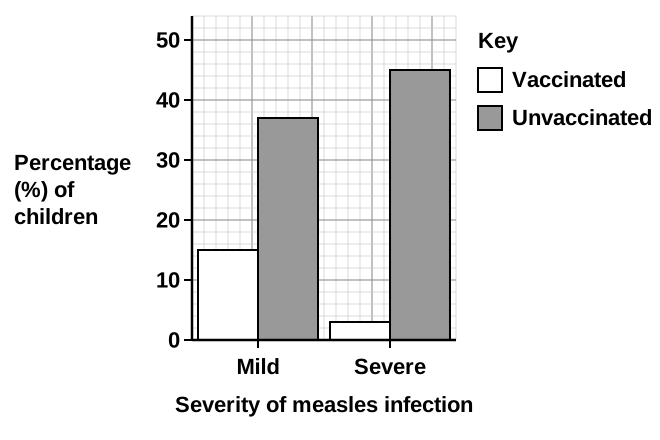
Measles is a disease that spreads between people. A survey recorded how serious the illness was in children who had been vaccinated and in children who had not (Figure 1).
Name the type of pathogen that causes measles.
See how you would score on Pathogens and Disease TransmissionShow model answer for 01.1Hide model answer for 01.1
A virus. Measles is caused by a virus, not by a bacterium, a fungus or a protist.
State one way that measles passes between people.
See how you would score on Pathogens and Disease TransmissionShow model answer for 01.2Hide model answer for 01.2
Droplets from a cough or a sneeze. An infected person breathes out droplets that carry the virus, and another person breathes them in.
How the marks are earned
- Any one of: droplets, saliva or mucus; sneezes; coughs.
- Other ways of passing on a pathogen, given with no more detail (touch or direct contact are examples), earn nothing, but they do not cancel a correct route given with them.
- Transfer through sexual intercourse is not accepted.
Aspirin treats pain in adults. Name the plant that aspirin first came from.
See how you would score on Antibiotics and Drug ResistanceShow model answer for 01.3Hide model answer for 01.3
Willow. The pain-relieving chemical was first found in willow bark, and aspirin was developed from it.
How the marks are earned
- Willow.
- Naming a part of the willow, such as the bark or the leaves, neither adds to the answer nor takes away from it.
Name one symptom of measles that is not pain.
See how you would score on Pathogens and Disease TransmissionShow model answer for 01.4Hide model answer for 01.4
A fever, meaning a high body temperature. A red skin rash is another symptom.
How the marks are earned
- Fever (a high temperature) or a rash.
- Also credited: sweating, spots, lumps or boils (red or not), red or itchy skin, a cough or sneeze, a runny or blocked nose, a sore throat, red, watery or sore eyes, a headache.
- Flu-like symptoms with no detail, and pain with no detail, earn nothing.
- Nausea and diarrhoea are not accepted.
Explain why vaccinating many children reduces how far the measles pathogen spreads through the population.
See how you would score on Vaccination and Herd ImmunityShow model answer for 01.5Hide model answer for 01.5
Vaccinated children make antibodies quickly if the virus enters, so they are much less likely to become ill. Far fewer people in the population carry the virus.
So an unvaccinated person is much less likely to meet someone who is infectious, and the virus is less likely to be passed on to them.
How the marks are earned
- One mark: after vaccination a smaller number of people in the population carry the pathogen, the measles virus, or have the disease. Saying vaccination gives herd immunity is also credited here, and a named type of pathogen, such as a virus, counts as the pathogen.
- One mark: so the pathogen, measles or the disease is less likely to be passed on, spread or caught. Saying a person is less likely to meet someone who is infected also earns this.
- Both marks go to a single answer saying fewer people have measles and so spread is less likely. Being less likely to meet an infected person is also accepted for the second mark.
- Saying only that the spread of the disease is reduced repeats the question and earns nothing.
Why it scores
The first mark is for the smaller number of infected people. This is the idea behind herd immunity.
The second mark is for the effect on spread. It must say that passing on or catching the pathogen is less likely, and not only that spread is reduced.
Revise Vaccination and Herd ImmunityThe survey covered 240 children. From Figure 1, find the number of children without the vaccine whose measles was severe.
See how you would score on Vaccination and Herd ImmunityShow model answer for 01.6Hide model answer for 01.6
Read the grey bar for severe infection: 45% of the children.
number of children = 45 ÷ 100 × 240
number of children = 108
How the marks are earned
- One mark: read the percentage for unvaccinated children with severe measles from Figure 1, which is 45.
- One mark: that percentage of 240, set out as 45 ÷ 100 × 240, or as 0.45 × 240.
- One mark: the final number of children, 108.
- Full marks for a correct answer of 108 on its own, with no working shown.
- If the wrong bar was read, one mark is allowed for 7 or 7.2 where the working shows 3 per cent was used, or for 88, 88.8 or 89 where the working shows 37 per cent was used.
Why it scores
Reading the right bar from Figure 1 earns the first mark. The unvaccinated children are the grey bars, and the severe group is the right-hand pair.
Taking this percentage of the whole survey earns the second mark. 0.45 × 240 is also accepted.
The final value earns the third mark. A correct 108 with no working earns all three.
Revise Vaccination and Herd ImmunityBack the advice to vaccinate every child against measles, using numbers from Figure 1.
See how you would score on Vaccination and Herd ImmunityShow model answer for 01.7Hide model answer for 01.7
Severe measles was rarer in the vaccinated children. Of all the children surveyed, 3% were vaccinated and had severe measles, but 45% were unvaccinated and had severe measles.
The unvaccinated share is 42 percentage points higher, or 15 times as large. So vaccination makes measles less severe.
How the marks are earned
- One mark: a statement that vaccinated children were less often severely ill (a smaller percentage), or that unvaccinated children were more often severely ill, or that the vaccine lessens how serious measles is.
- The converse is accepted, and so is an answer given as a number of children or as the chance of getting the disease.
- One mark: figures from Figure 1 used in a comparison, for example 42 per cent higher in the unvaccinated or 15 times higher.
- Correct raw values used in a comparison also earn this mark.
Why it scores
The first mark is for saying that vaccination goes with less severe measles. The four bars in Figure 1 together make up all the children surveyed, so each bar is a share of everyone. The statement alone is not enough for the data mark.
The second mark is for data used as a comparison. A difference or a multiple works, and so do the two raw values placed side by side.
Revise Vaccination and Herd Immunity