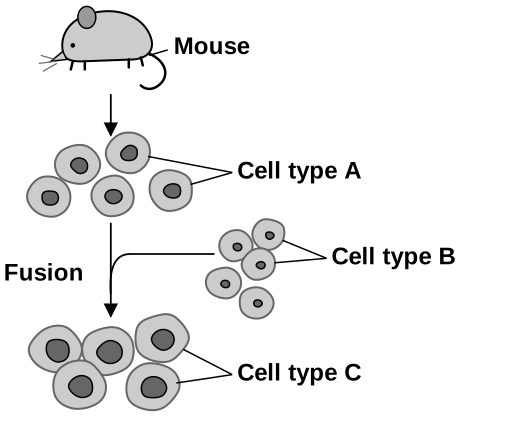
A patient with a badly failed liver might be given embryonic stem cells by injection. A drug that helps stop a donor liver being rejected is made of monoclonal antibodies aimed at an antigen on liver cells. Figure 9 shows some steps in making them. The liver also makes bile.
Name the property of embryonic stem cells that makes them useful for treating liver disease.
Our own questions on this topic, marked straight away, so you see what to revise. Free now.
Show model answer for 07.1Hide model answer for 07.1
Embryonic stem cells can differentiate, so any kind of cell, liver cells included, can form from them.
How the marks are earned
- The property is that they differentiate: they can form any type of cell. Differentiating into liver cells is also accepted. Saying they specialise is ignored.
Suggest one ethical objection a patient might have to receiving embryonic stem cells.
See how you would score on Stem Cells and Cell DifferentiationShow model answer for 07.2Hide model answer for 07.2
Embryonic stem cells come from embryos, and taking them destroys the embryo, which is a potential human life.
How the marks are earned
- Any one of: taking the cells destroys an embryo, a life or a potential life; the embryo cannot give consent (the embryo has no choice is accepted); the treatment goes against religious, cultural or personal beliefs (against someone's faith is accepted). Against God's will is ignored, and religion with no detail is ignored.
Figure 9 shows three cell types, A, B and C, used in making monoclonal antibodies. Name each one.
See how you would score on Monoclonal AntibodiesShow model answer for 07.3Hide model answer for 07.3
A is a lymphocyte, the cell that makes the antibody for the antigen.
B is a tumour cell.
C is a hybridoma cell.
How the marks are earned
- One mark: A is a lymphocyte, the white blood cell that makes antibody to the antigen. White blood cell on its own is ignored.
- One mark: B is a tumour cell. Myeloma cell, or another named type of tumour cell, is also accepted. Cancer cell on its own is ignored.
- One mark: C is a hybridoma cell, formed by fusing A and B.
Why it scores
Use lymphocyte, as white blood cell alone is too general.
Tumour cells divide again and again, which the fused cell needs.
It is made by fusing the lymphocyte with the tumour cell.
Revise Monoclonal AntibodiesWhat is done to the mouse so that it makes cell type A?
See how you would score on Monoclonal AntibodiesShow model answer for 07.4Hide model answer for 07.4
The mouse is injected with the liver antigen, or with liver cells, so its lymphocytes make antibodies against it.
How the marks are earned
- The mouse receives an injection of antigens (liver antigens also fine). Giving the mouse liver cells by injection is also accepted, and there the word liver is needed. Injecting a pathogen is not accepted.
The patient takes this antibody drug after the transplant. Explain how it protects the donor liver cells from the patient's own white blood cells.
See how you would score on Monoclonal AntibodiesShow model answer for 07.5Hide model answer for 07.5
The drug's antibodies attach to antigens sitting on the donor liver cells.
They can do this because their shape is complementary to the shape of the liver antigen, like a lock and key.
So the antibodies made by the patient's lymphocytes cannot bind to the liver cells, and phagocytes cannot detect the cells to engulf them.
How the marks are earned
- One mark: the monoclonal antibodies bind to antigens or cells (the word liver is optional). The drug sticking to them is also accepted.
- One mark: the antibody and the antigen have shapes that fit together, so they are complementary. Describing the fit is also accepted. Saying only that the antibodies are specific is ignored. Saying the antibody has the same shape as the antigen is not accepted.
- One mark: the patient's own antibodies from white blood cells are then unable to attach to antigens or cells (the word liver is optional). Antibodies from lymphocytes is also accepted, and so is phagocytes being unable to identify or detect the cells they would engulf. Antibodies from phagocytes is not accepted.
Why it scores
First mark: the drug attaches to the liver antigens.
Second mark: complementary shape, not the same shape.
Third mark: the antigens are covered, so the patient's own immune response cannot attach to the liver cells.
Revise Monoclonal AntibodiesState a use of monoclonal antibodies other than in pregnancy tests.
See how you would score on Monoclonal AntibodiesShow model answer for 07.6Hide model answer for 07.6
Monoclonal antibodies can carry a cancer drug to tumour cells, so the drug acts on the cancer cells.
How the marks are earned
- Any one of: delivering a drug or chemical to cells, toxic or not (chemotherapy or immunotherapy is accepted); locating or detecting cancer, or cancer cells; locating or identifying particular molecules inside a cell or tissue; tests for hormones, chemicals or drugs; tests for pathogens (a COVID test, a lateral flow test or an LFT is accepted). Treating a named disease is accepted. Saying only that it diagnoses or treats disease is ignored.
Which organ stores bile? Tick one box.
See how you would score on The Human Digestive SystemShow model answer for 07.7Hide model answer for 07.7
Bile is made in the liver and stored in the gall bladder.
Explain why severe liver disease makes it hard to digest fats.
See how you would score on Enzymes in DigestionShow model answer for 07.8Hide model answer for 07.8
The liver makes bile. In severe liver disease it makes little or no bile.
Bile emulsifies fat, breaking large fat globules into tiny droplets. With little bile the fat stays in large globules, so its surface area is small.
Lipase can only work on the surface of the fat, so with a small surface area it digests the fat into fatty acids and glycerol more slowly.
Bile is also alkaline. It neutralises the acid that comes from the stomach, so without bile the small intestine stays too acidic.
An acidic small intestine is not the optimum pH for lipase, so lipase works poorly or is denatured. Less fat is digested.
How the marks are earned
- This is level marked. For 5 to 6 marks, give reasons in enough detail, linked into a clear account, and cover lipase activity, emulsification and the effect of pH. For 3 to 4 marks, give reasons with some attempt at linking, but the account is not fully clear. For 1 to 2 marks, give simple statements that are not linked.
- Emulsification: the damaged liver makes little or no bile, so fat is not broken into small droplets, the surface area of the fat does not increase, and lipase digests the fat more slowly, or digests less of it.
- pH: bile is alkaline and normally neutralises the acid from the stomach, so without it the small intestine is not at the best pH for lipase, lipase denatures or works poorly, and less fat is digested.
Why it scores
Start with the cause: the liver is where bile is made.
Emulsification is the first route. Link the missing bile to a smaller surface area.
Linking the small surface area to slower lipase action is one part of the top band (5 to 6 marks). The top band also needs the effect of pH.
pH is the second route and has to be covered for the top level.
Finish by linking the wrong pH to the lipase and the fat. A top answer covers both routes.
Revise Enzymes in Digestion