Free taster
5 of 6 sections open
The Hidden Power of Water Loss
The Hidden Power of Water Loss
Every day, a large oak tree can lose over 400 liters of water through its leaves - enough to fill two bathtubs. This might seem wasteful, but transpiration is the driving force that powers water transport from roots to the tallest branches, delivers minerals throughout the plant, and keeps leaves cool in summer heat. Understanding transpiration reveals how plants balance their need for carbon dioxide with water conservation, creating some of nature's most ingenious adaptations.
What is a potometer?: An apparatus that measures the rate of water uptake by a plant shoot. Used to estimate transpiration rate (though actually measures uptake, not loss).
Tap any label to see how this tissue contributes to the transpiration stream — or why some tissues do NOT.
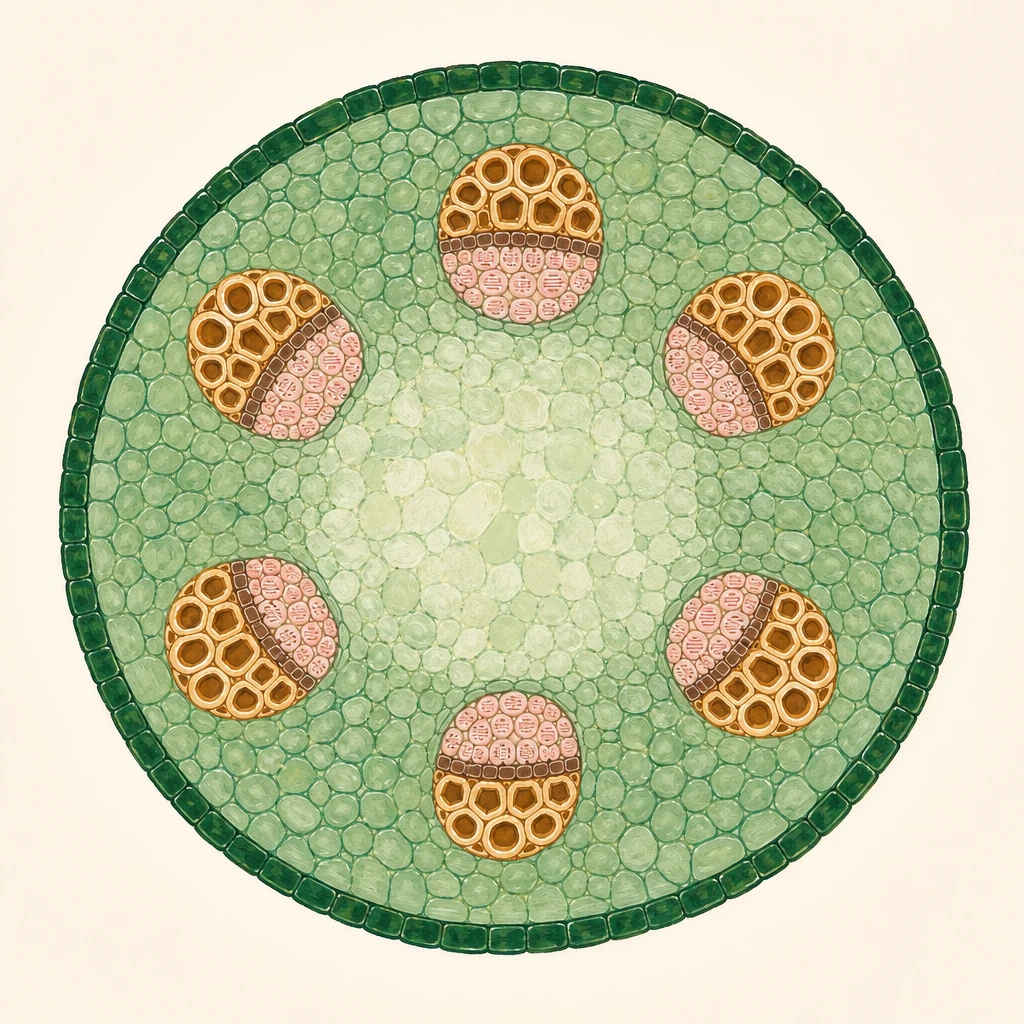
- 1Xylem — water rises — Water is pulled up through xylem vessels from roots to leaves.
- 2Phloem — NOT transpiration — Phloem carries sucrose. Don't confuse with xylem!
- 3Cortex — water flows here — Water crosses the cortex from roots to xylem.
- 4Stomata regulation (in leaves) — Stomata in leaves control the rate of transpiration.
Tap any label to see how this tissue contributes to the transpiration stream — or why some tissues do NOT.
Biology glossary
- What is a potometer?
- An apparatus that measures the rate of water uptake by a plant shoot. Used to estimate transpiration rate (though actually measures uptake, not loss).
- What is a xerophyte?
- A plant adapted to survive in dry/arid conditions with limited water availability (e.g., cacti, marram grass).
Earn the mark scheme marks
Exam Success Tips
- Remember THAW: Temperature, Humidity, Air movement, Water/light - factors affecting transpiration
- Potometer limitation: Always state it measures uptake, not transpiration directly
- Guard cell mechanism: K⁺ ions → osmosis → turgor → shape change
- Adaptations: Link structure to function (e.g., sunken stomata trap humid air)
- Graphs: Be ready to interpret transpiration rate vs time or environmental factors
- Calculations: Rate = distance/time, remember units (mm/min or ml/hour)
- Practical skills: Explain why cutting underwater prevents air bubbles
- Integration: Link to xylem structure (Topic 14) and gas exchange (Topic 13)
Now try it yourself
Quiz · Question 1 of 21
What is transpiration?
Tap an answer to check it