The Discovery of Cells
🔬 The Discovery of Cells
In 1665, Robert Hooke looked through his microscope at a thin slice of cork and saw something that reminded him of the small rooms that monks lived in - he called these structures "cells". Little did he know that he had just discovered the basic building blocks of all life on Earth!
Today we know that every living thing - from the tiniest bacterium to the largest blue whale - is made up of cells. Understanding cell structure is like understanding the architecture of life itself.
A typical animal cell. Tap any label to see what it does.
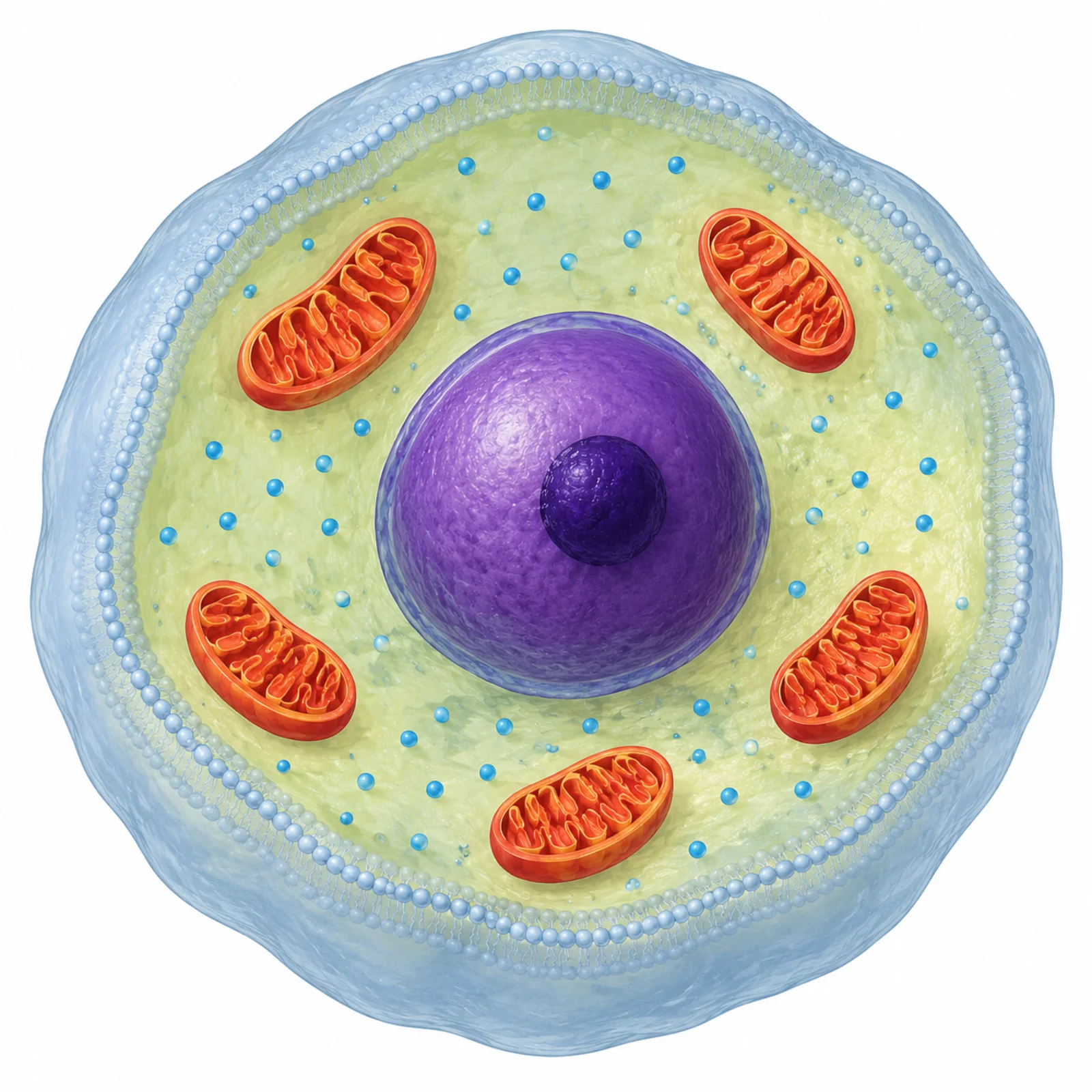
- 1Nucleus — Contains DNA. Controls all cell activities — the cell's control centre.
- 2Mitochondrion — Site of aerobic respiration. Releases energy from glucose.
- 3Ribosomes — Tiny structures where proteins are made.
- 4Cell membrane — Controls what enters and leaves the cell.
- 5Cytoplasm — Jelly-like substance where most chemical reactions happen.
Figure 1: A typical animal cell. Tap any label to see what it does.
Biology glossary
- What is the function of ribosomes?
- Ribosomes are the sites of protein synthesis. They translate mRNA into proteins by linking amino acids together.
- What is the function of the nucleus?
- The nucleus is the control center of the cell. It contains DNA which controls all cellular activities and heredity.
Quick Check: A muscle cell needs lots of energy. Which organelle would you expect it to contain many of, and why?
Earn the mark scheme marks
🧠 Memory Aids
The Cell-as-Factory Analogy
Think of a cell as a busy factory. Each part of the factory matches an organelle:
- Nucleus = Manager's office — contains all the instructions (DNA) and controls what the factory does
- Mitochondria = Power station — generates the energy (ATP) that keeps the whole factory running
- Ribosomes = Assembly line — where the actual products (proteins) are made, following the instructions
- Cell membrane = Security gate — controls what comes in and what goes out; only lets authorised substances through
- Endoplasmic reticulum = Corridors and conveyor belts — transports products around the factory
- Golgi apparatus = Post office / packaging department — packages finished proteins and sends them to the right destination
- Cell wall (plants only) = Outer walls of the factory — rigid structure that gives shape and protection
- Chloroplasts (plants only) = Solar panels — capture energy from the sun to power the factory
Remembering Pro vs Eu
The prefix tells you everything you need to know:
- PRO-karyote = PRImitive — no true nucleus, no membrane-bound organelles, came first in evolution
- EU-karyote = EUvolved / has a trUE nucleus — has a true nucleus enclosed by a membrane; more complex
Memory trick: "Pro came before, Eu has it all in store" — prokaryotes are the primitive ancestors, eukaryotes evolved with a proper nucleus and compartments.
Now try it yourself
Quiz · Question 1 of 31
Which part of the cell contains DNA and controls the cell's activities?
Tap an answer to check it
This topic in real past papers
Every real exam question we've found on cell structure, with a full worked answer.